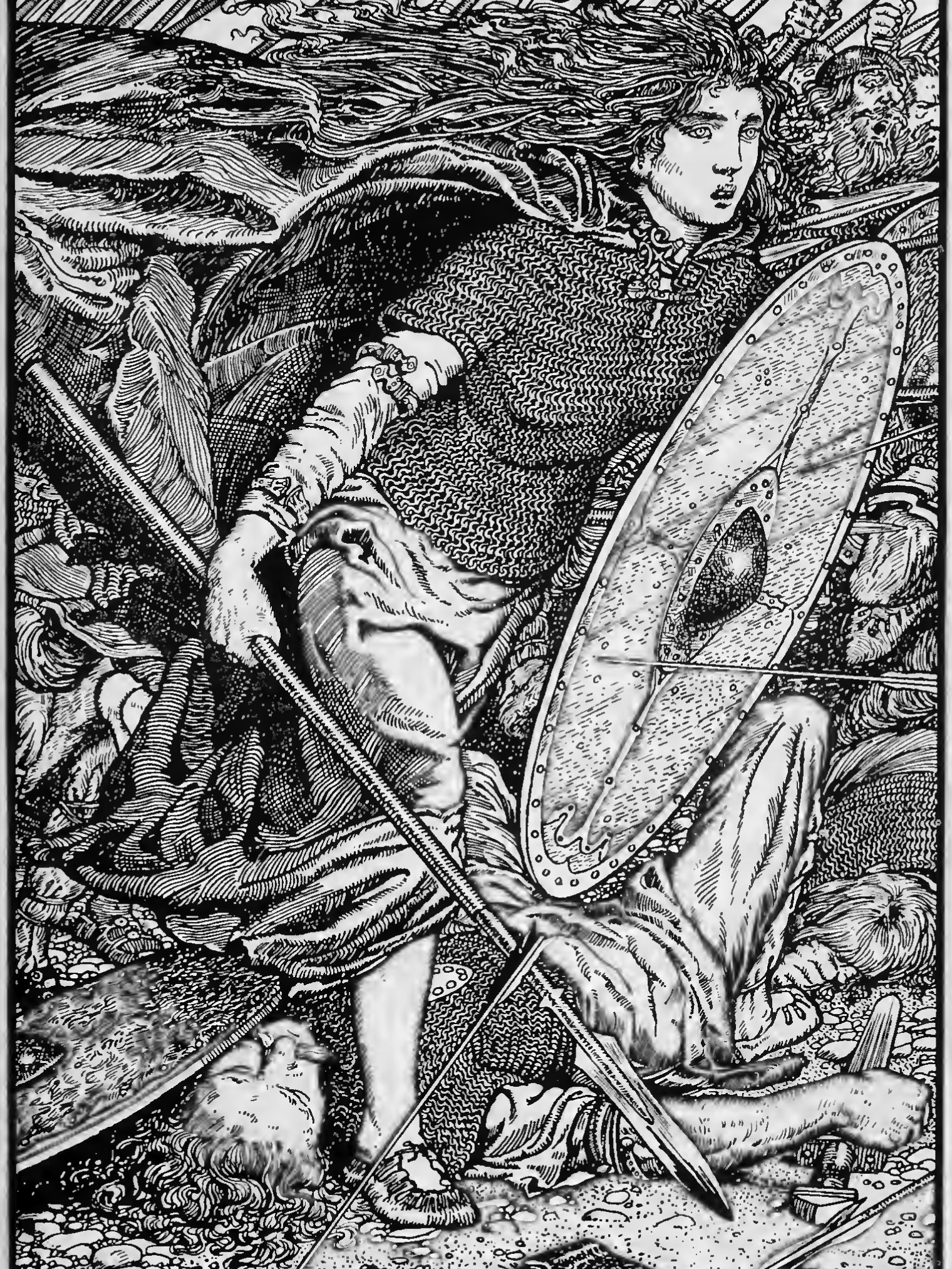
 She is the face of the fighting Viking woman today: Lagertha, Ragnar's first wife, warrior, ruler. But the closer you look, the clearer it becomes that almost everything we think we know comes from a single medieval source – and from a television series that made something entirely its own out of it.
Anyone searching for the historical Lagertha ends up at one book: the Gesta Danorum, the „Deeds of the Danes," written around 1200 by the Christian scholar Saxo Grammaticus for the Danish royal house. In its ninth book Saxo tells of a woman named Ladgerda who rides into battle beside a young warrior called Regner – Ragnar. He is the only medieval source who knows this figure. No Icelandic saga, no chronicle, no runestone names her otherwise. That is the first and most important sentence of any honest Lagertha story: we have exactly one witness – and he wrote in Latin, roughly 350 years after the Viking age in which the tale is set, with the clear aim of giving the Danes a glorious prehistory.
Saxo describes her first appearance so vividly that the image still echoes today:
Ladgerda, a skilled amazon, who, though a maiden, had the courage of a man, and fought in front among the bravest with her hair loose over her shoulders. All marvelled at her matchless deeds, for her locks flying down her back betrayed that she was a woman.Saxo Grammaticus, Gesta Danorum, Book 9 (trans. O. Elton, 1894)
You should not read past that tone. Saxo marvels – but he marvels from the viewpoint of a high-medieval cleric, for whom a fighting woman is an oddity that must be explained. The loose hair that „betrays" her is, for him, not a detail but a signal: here a woman steps out of her role.
How does a maiden reach the front line in Saxo's tale at all? The occasion is grim. Frø, a king of the Swedes, invades Norway and kills King Siward there. To shame them, he locks the women of the defeated house in a brothel. When Ragnar marches to avenge Siward's death, many of these women escape, dress in men's clothing and join his side. At their head: Ladgerda. Saxo leaves no doubt that her effort decides the battle – Ragnar wins, we are told, above all thanks to this one fighter.
That framing matters. In Saxo, Lagertha's feat of arms is not a matter of course but an exceptional situation: dishonoured women who take up weapons because otherwise only disgrace remains. It is a recurring pattern across the whole work. Saxo populates his early history with „shield-bearing maidens" who, as he writes elsewhere, dress and fight like men – and whom he both admires and eyes with suspicion. Lagertha is therefore not the one real shield-maiden but the most famous in a whole line of literary warrior women whom Saxo marshals for his great battle scenes.
Impressed by her courage, Ragnar woos Ladgerda – from afar, for after the victory she has withdrawn to her farmstead in Norway. To test the suitor (or keep him off), she keeps a bear and a great hound as guards. Ragnar slays the bear with his spear and chokes the hound to death, and so wins her hand. From the union, Saxo reports, come a son named Fridleif and two daughters whose names the source does not preserve.
The motif – the suitor who must overcome deadly beasts to win the unapproachable warrior – is classic fairy-tale and saga material found in many cultures. It tells us more about narrative tradition than about a real biography. But it shows how Saxo builds his heroine: dangerous, contested, to be won only by one who himself rises above his limits. Already here Lagertha is less a person with a life story than a figure with a dramatic function.
The marriage does not last. Ragnar, Saxo says, harbours a grudge against Ladgerda – over the very beasts she once set against him. He casts her off and woos Thora Borgarhjört, a king's daughter from Gautland. With that, Lagertha vanishes from the story for a time. Many modern retellings inflate this break into a great wound, the root of a lifelong rivalry. In Saxo it stays sober and brief: a ruler swaps one wife for a more suitable one, and the narrative turns to other deeds of Ragnar. That we now expect more drama says much about our stories – and little about the thin medieval original.
The most striking scene comes only later. Ragnar is caught in a civil war in Denmark and finds himself in dire straits. He sends to Norway for help – and Ladgerda comes. With a fleet of 120 ships, even though he once cast her off. Saxo tells how she and her men intervene in the wavering battle, turn the tide for her old husband and secure the victory. The woman he had sent away saves his rule.
It is one of the rare places in medieval literature where a woman appears not as a prize, plunder or victim but as an independent military power – a leader with her own fleet, her own following and her own will, who decides of her own accord over a king's victory and defeat. That it is the Christian Saxo who tells this scene is remarkable. He could have cut it; he preserved it.
And then the story turns dark. After the battle Ladgerda returns home. In the night she kills her (new) husband with a spearhead she had hidden in her gown, and seizes his title and rule for herself. Saxo's verdict is as sharp as it is telling:
For this most presumptuous dame thought it pleasanter to rule without her husband than to share the throne with him.Saxo Grammaticus, Gesta Danorum, Book 9 (trans. O. Elton, 1894)
Here Saxo's ambivalence appears in its purest form. He admires the warrior and condemns her in the same breath. The heroine who saved a king becomes a husband-killer acting out of lust for power. This is not a neutral report of facts but a moral tale told by a Christian scholar about a woman who breaks every role – and is punished for exactly that, yet also made immortal by it. Anyone who celebrates Lagertha only as a strong heroine reads past half the text.
That leaves the big question: did fighting women like Lagertha really exist? The honest answer is a double yes-and-no. No: a widespread army of shield-maidens is a modern image; Saxo's warrior women are a literary motif, not a demographic finding. Yes: there are isolated archaeological hints that carry a serious debate. The best-known case is chamber grave Bj 581 in Birka – richly furnished with a sword, an axe, spears, arrows, two horses and a gaming board, long taken as a matter of course to be a man's „warrior grave." In 2017 a genetic study (Hedenstierna-Jonson et al.) showed that the buried person was biologically female. That was a small sensation – and immediately disputed: weapons in a grave do not necessarily prove a fighter, just as a gaming board does not automatically make a general. What is certain: a woman was buried with full warrior equipment. What that says about her life remains interpretation. Lagertha lives on in exactly this tension – between a single medieval text and a single archaeological grave, both fascinating, both refusing a quick answer.
What is documented is above all one thing: that Saxo Grammaticus wrote down this tale around 1200. The material of the first nine books of the Gesta Danorum is widely regarded in scholarship as largely legendary – a blend of sagas, oral tradition and Saxo's own shaping. That there may have been individual armed women in the Viking age is a serious debate (grave Bj 581 in Birka, identified as female by genetics in 2017). But a historical „Lagertha" as a real, tangible person cannot be proven with this: Saxo remains the only witness, and he wrote centuries after the events and with a discernible agenda.
The shield-maiden as a widespread army of warrior women is a modern image. Saxo's „shield-bearing maidens" are a recurring literary motif, not a demographic finding – he himself frames Ladgerda's feat as an exception of dishonoured women. Grave Bj 581 shows that a woman buried with weapons existed; whether she was a fighting warrior remains interpretation. And the Lagertha of „Vikings" (Katheryn Winnick) – farmer, jarl, queen of Kattegat – is for the most part modern invention: Saxo knows neither Kattegat nor her on-screen biography nor her on-screen death.
Why does almost everyone know Lagertha today? Because of the series „Vikings," in which Katheryn Winnick plays her across six seasons as Ragnar's first wife – as farmer, shield-maiden, jarl and finally queen of Kattegat. This figure is charismatic, tragic, grand – and she is a screenplay. The name and the spark come from Saxo; almost everything else, from Kattegat to the political intrigue to her death, is invented for television. Even Kattegat is in truth a strait between Denmark and Sweden, not a place.
That is exactly what makes Lagertha such a good example of our approach: we love the saga – and we honestly say where the source ends and the legend begins. The real Ladgerda is a single, fascinating strand in a medieval scholar's work. That does not make her smaller. It only makes her more honest – and, read closely, even more enigmatic than any series could show.
Ragnar Lodbrok · Ragnar's sons · Berserkers.
All History & Finds articles →
Without their ships the Vikings would never have become Vikings. The longship was the high technology of its time …
Read more →It is not two centimetres tall and weighs nine grams – and yet it set off one of the most exciting debates in Norse …
Read more →