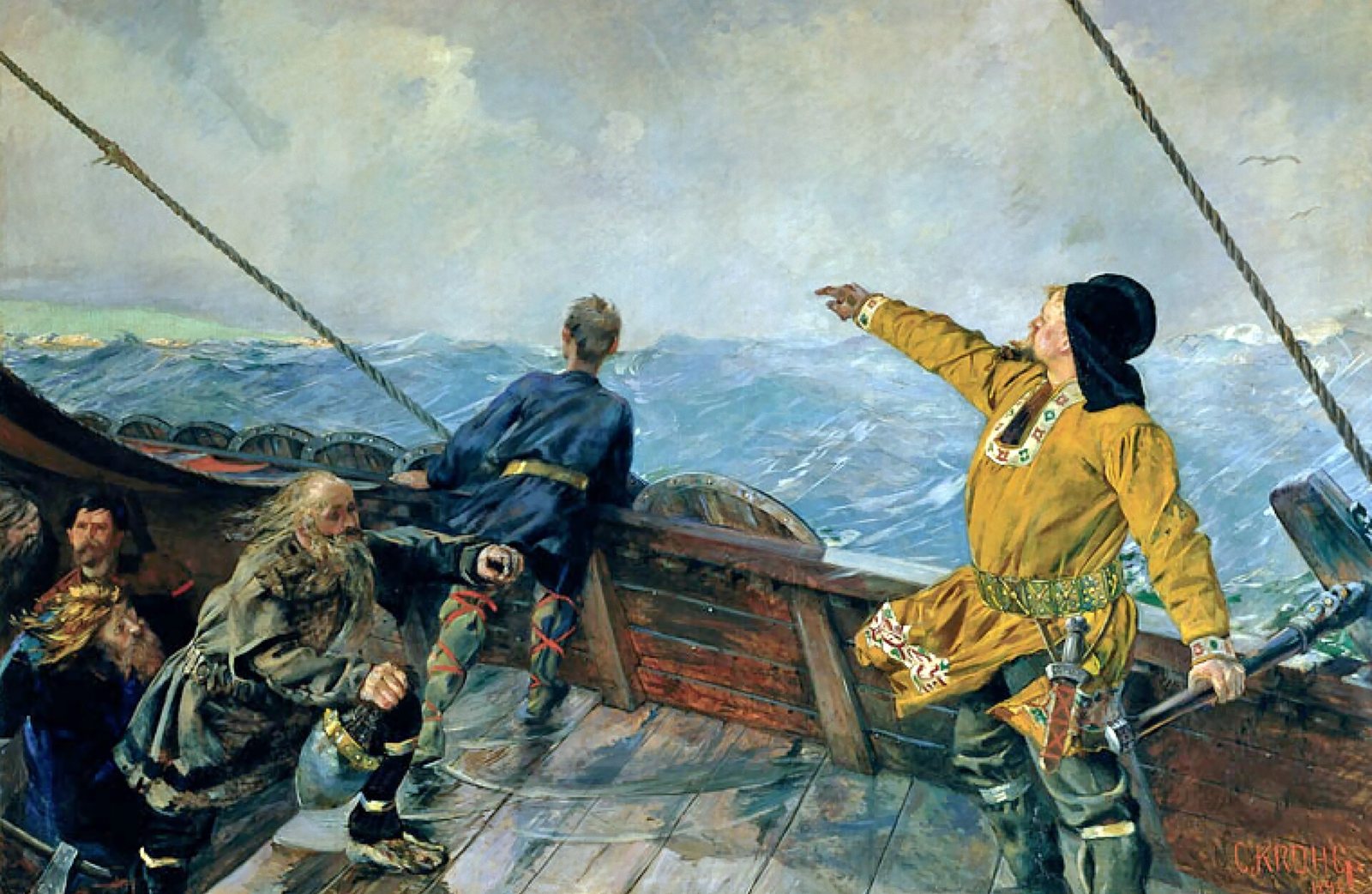
Leif Erikson (Old Norse Leifr Eiríksson) was a Norse seafarer from the Greenland colony who, around the year 1000, became one of the first Europeans to set foot on the American mainland – almost five centuries before Columbus. Son of Erik the Red, he earned the nickname “Leif the Lucky” and gave Vinland its name. Here is what the two Vinland sagas actually say about him, where they flatly contradict each other, how much truth there is in his missionary voyage, and what archaeology has proven.
Picture a late summer day off the coast of Greenland. A ship is heading home from a strange land in the west, loaded with timber, its towed boat full of grapes, thirty-five men aboard. Suddenly the young skipper steers closer to the wind than he needs to. His crew asks why. He has seen something they missed: people on a rock out at sea. Fifteen castaways whose ship has been wrecked.
He takes every one of them aboard, along with as much of their cargo as his ship can carry. From that day on, says the saga, he was called Leifr inn heppni – Leif the Lucky. Not because he had found America, but because he had been fortunate, won honour, and come home rich.
That tells you a lot. To the people who told these stories, Leif was not “the discoverer of America”. That label was stuck on him in the nineteenth century. To them he was a skilled seaman with good instincts and better luck. In this article we keep the two apart: the man of the sagas and the monument that was later made of him.
Leif's father was Erik the Red, born in Jæren in south-western Norway. After killings in Norway his family moved to Iceland, where Erik was outlawed in turn, and around 985/986 he led a group of settlers to the land he had named Greenland. His wife Þjóðhildr came from a respected Icelandic family.
Going by the sagas' own chronology, Leif was most likely born in Iceland, in the west around Breiðafjörður, probably in the 970s. No source gives an exact year. The Icelandic historian Sverrir Jakobsson has pointed out that the question “Icelander, Greenlander or Norwegian?” is a modern one; the sagas barely care about nationality. Leif grew up a Greenlander, on the farm of Brattahlíð (“steep slope”) in Eiriksfjord, today's Qassiarsuk in South Greenland.
The name Leifr belongs to the Old Norse word leif, “inheritance, what is left behind” – a fitting name for an eldest son. The sagas give him brothers named Þorvaldr and Þorsteinn and a half-sister, Freydís, who later sailed to Vinland herself. For the colony as a whole, see our piece on the Greenlanders.
Let's be honest up front: there is not a single contemporary source that names Leif Erikson. Everything we know about him was written down generations later.
The first thing to appear in writing is not Leif but his land. Around 1075 the Bremen cleric Adam of Bremen reports that the Danish king Sven Estridsson told him of an island in the ocean called Winland, because vines grow there by themselves and yield excellent wine – not a fable, Adam insists, but reliable information from the Danes. Around 1120–1130 the Icelander Ari Þorgilsson mentions Vínland in passing in his Íslendingabók (Book of the Icelanders), as the home of the people the Greenlanders call Skrælingar. Neither writer mentions Leif.
The detailed stories come from two sagas, today known together as the Vinland sagas. Sagas are Icelandic prose narratives of the thirteenth and fourteenth centuries, rooted in oral tradition but shaped by literary craft; our overview of the Sagas of Icelanders explains the genre.
For a long time Erik's saga was considered the more reliable. Since an influential 1956 study by the Icelandic historian Jón Jóhannesson, many specialists regard the Saga of the Greenlanders as the older one. Others, such as Ólafur Halldórsson, see the two as independent written versions of an oral tradition. For Leif it matters a great deal, because the two sagas tell his story in completely different ways.
The Saga of the Greenlanders does not begin its American story with Leif at all, but with a merchant named Bjarni Herjólfsson. Arriving in Iceland from Norway, Bjarni learns that his father has gone to Greenland with Erik – by the saga's chronology around 985/986. He sails after him, though nobody aboard knows the way. Fog and north winds drive the ship aimlessly for days, the state the Norse called hafvilla, being utterly lost at sea.
When the sky clears, Bjarni sees land: wooded, with low hills, no glaciers. That cannot be Greenland. He does not go ashore. He sails on, sees a second flat, wooded land and a third, mountainous and glaciated, and finally reaches his father's farm. Later, in Norway, people criticised him for his lack of curiosity.
Leif is more curious. He buys Bjarni's ship and gathers a crew; in Reeves' 1890 translation, “a company of thirty-five men”. He asks Erik to lead the voyage. Erik protests that he is too old but lets himself be persuaded. On the way to the ship his horse stumbles, Erik is thrown and hurts his foot. He takes it as a sign that he is not meant to discover any more lands. Leif sails without him.
Leif runs Bjarni's route in reverse. The first land he reaches is the last one Bjarni saw. Leif goes ashore and finds no grass, only glaciers and, between sea and ice, what looks like one great flat slab of rock. He names it Helluland, “Flat-stone Land” – and has thereby, the saga notes drily, already done more than Bjarni, who never landed at all.
The second land is flat and wooded, with white sandy beaches. Leif calls it Markland, “Forest Land”. After two more days at sea they reach an island, notice dew on the grass, touch it and taste it, and think they have never tasted anything so sweet. Then they work their ship up a river and into a lake.
Where these places were can only be guessed. Helluland is usually identified with Baffin Island and Markland with the coast of Labrador. Vinland is where agreement ends: proposals range from Newfoundland to the Gulf of St. Lawrence to the New England coast. We have gathered that whole debate in our article on Vinland. One spoiler, though: in the other saga, these names are given by someone else entirely.
By the lake Leif and his men decide to winter. They build large houses, which the saga later calls Leifsbúðir, “Leif's booths”. River and lake teem with salmon bigger than any they have ever seen. The land seems so good that livestock would need no fodder through the winter; there is no frost, and the grass hardly withers.
Then comes one of the most argued-over passages in all saga literature. Day and night, it says, were more nearly equal in length than in Greenland or Iceland, and on the shortest day the sun stood in the sky at eykt and at dagmál – Norse time markers roughly corresponding to mid-afternoon (about half past three) and nine in the morning. Scholars have tried to calculate Vinland's latitude from this. Depending on how the terms are defined, the answers range from northern Labrador to Florida. What the passage really shows is that the storytellers knew the west lay much further south than home.
Leif runs his winter camp like a careful householder. He splits the crew into two groups: one stays by the houses, the other explores, but never so far that it cannot be back by evening, and nobody is to leave his group. The saga describes him as tall and strong, striking to look at, wise and moderate in all things – a leader, not a daredevil. How such voyages across the open Atlantic were possible at all is the subject of our article on Viking navigation.
One evening a man is missing: Tyrkir, an older man whom Leif calls his foster-father. Leif sets out with twelve men to search and soon finds him in high spirits, rolling his eyes, pulling faces and talking for a long while in German – á þýzku – so that nobody understands a word. The saga calls him a suðrmaðr, a “southerner”, a word that often meant Germans or Saxons. For us, working near Aachen, it is a pleasing thought: if the saga is right, one of the first Europeans in America spoke German.
“I did not go much further [than you], and yet I have something of novelty to relate. I have found vines and grapes.”Saga of the Greenlanders, transl. Arthur Middleton Reeves, The Finding of Wineland the Good (1890)
When Leif doubts him, Tyrkir insists that he was born where there was no lack of vines and grapes. Leif reorganises the work: one day gathering grapes, the next cutting vines and felling trees. The towed boat is filled with grapes, the ship with timber. And, in Reeves' words, “from its products Leif gave the land a name, and called it Wineland” – Vínland.
Were they really grapes? Wild riverbank grapes (Vitis riparia) grow as far north as New Brunswick and along the St. Lawrence, but not on Newfoundland, and Old Norse vínber could also mean other berries. A find from L'Anse aux Meadows, though, points to voyages into grape country: butternuts, which grow only where wild grapes grow too. Tyrkir's tipsy scene may well be embroidered. Whether he was German or, as some suggest, Hungarian or Slavic, remains open.
In spring Leif sails home with a full cargo. On this return voyage comes the scene we started with: Leif spots castaways on a reef, among them a Norwegian named Þórir and his wife Guðríðr. He rescues fifteen people and takes their cargo, as custom allowed, and so gains wealth and honour. From then on he is Leif the Lucky.
The luck has a dark side. The following winter sickness breaks out among Þórir's crew; Þórir and many of his people die. That same winter, according to the Saga of the Greenlanders, Erik the Red dies too. Leif takes over Brattahlíð and becomes the leading man in Greenland. Guðríðr, the woman he saved, marries first Leif's brother Þorsteinn and, after his death, the Icelander Þorfinnr Karlsefni, with whom she sails to Vinland herself.
Leif never goes west again. He lends his houses but never gives them away: first to his brother Þorvaldr, who is killed there fighting the locals, then to Karlsefni, and finally to Freydís, whose voyage ends in a bloodbath.
Erik's saga tells it all differently. There is no Bjarni. Leif sails from Greenland to Norway, is driven off course to the Hebrides and there falls for a high-born woman called Þórgunna, who becomes pregnant by him. He refuses to take her along but gives her a gold ring, a Greenland cloak and a belt of walrus ivory. Their son Þorgils later comes to Greenland.
In Norway Leif becomes a retainer of King Olaf Tryggvason, the ruler who forced Christianity on Norway. Olaf has him baptised and sends him back to Greenland as his envoy to preach the new faith, with a priest aboard. On the return voyage – in the year 1000, according to Heimskringla – Leif loses his way. He comes upon a land nobody expected: fields of self-sown wheat, vines, and trees the saga calls mösurr, perhaps maple. On the way home he rescues men from a wreck.
The difference is fundamental. Here Leif is the first to see the western land, but he does not explore it. The names Helluland and Markland are given in this saga by Þorfinnr Karlsefni, who sets out years later with a fleet of settlers – the ancestor of Icelandic bishops, and the real hero of this saga. Leif is an accidental discoverer and a missionary, and he owes his nickname both to the rescue and to bringing Christianity to the land.
Snorri Sturluson also adopts the missionary story in his history of the Norwegian kings, Heimskringla, which has a chapter on Leif's baptism. But did it happen?
Many historians are sceptical. The probably older Saga of the Greenlanders knows nothing of a mission, and Ari, who describes Iceland's conversion with great care, mentions no mission to Greenland by Leif. The story most likely goes back to a lost Latin saga of Olaf by the monk Gunnlaugr Leifsson (around 1200), which aimed to show the missionary king in the brightest possible light.
There is an archaeological objection too. Radiocarbon dates on skeletons from early Greenlandic churchyards, studied by the National Museum of Denmark, suggest that some settlers were already Christian during the first phase of settlement. The faith probably arrived gradually with the settlers themselves, not on one ship by royal command. For the bigger picture, see our article on the Christianisation of the Germanic peoples.
That Leif was baptised at the Norwegian court around 1000 remains possible. But Leif the missionary is a thirteenth-century tradition, not an established fact.
Erik's saga has one more vivid scene. Erik wants nothing to do with the new faith. His wife Þjóðhildr, however, converts and has a church built, not too close to the houses – Þjóðhildarkirkja, Þjóðhildr's church. And she refuses to live with Erik as long as he remains a heathen, which, the saga notes, annoyed him greatly.
For centuries that was just a good story. Then, in 1961, workers building a school in Qassiarsuk dug up a human skull. The National Museum of Denmark excavated and found the remains of a tiny church: horseshoe-shaped, with wooden walls wrapped in turf, the interior only about two by three and a half metres. Around it lay a churchyard with the remains of 144 people, buried without grave goods.
For the millennium of Leif's voyage, a replica was built in 2000 a short distance from the original site. Since 2017 the area has been part of the UNESCO World Heritage site “Kujataa”, the Norse and Inuit farming landscape of South Greenland.
Until 1960 Leif was a saga figure without archaeological proof. Then a local fisherman, George Decker, led the Norwegian explorer and writer Helge Ingstad to some grass-covered mounds at L'Anse aux Meadows on the northern tip of Newfoundland. Ingstad's wife, the archaeologist Anne Stine Ingstad, directed the excavations from 1961 to 1968; Parks Canada continued the work later.
They found eight timber-and-turf buildings: three dwelling halls, a smithy and four workshops, built and laid out in unmistakably Icelandic-Greenlandic style. There was iron slag, a bronze pin, a soapstone spindle whorl and some 800 artefacts in all. The houses could hold roughly 70 to 90 people. The refuse layers are thin: the site was probably used for only about a decade, likely as a base camp and ship-repair station. The butternuts in the bog show that its inhabitants sailed further south, at least into the Gulf of St. Lawrence.
Then, in 2021, came the breakthrough. A team led by Margot Kuitems and Michael Dee of the University of Groningen, together with archaeologist Birgitta Wallace, examined three pieces of wood bearing cut marks from metal tools. They used a clever marker: in 993 a burst of cosmic radiation hit the Earth and left a sudden spike of radiocarbon in every tree ring growing at the time, worldwide. Find that ring, count outwards to the bark, and you know the felling year. The answer: all three trees were cut down in 1021.
Does that prove Leif's voyage? Not directly. 1021 falls after Leif's journey around 1000 and fits the later voyages better. Whether L'Anse aux Meadows is Leifsbúðir, Karlsefni's camp Straumfjörður from Erik's saga, or a place no saga mentions is still open; Birgitta Wallace considers Straumfjörður the most likely. What is certain: the sagas describe real voyages within Leif's lifetime.
We know little about Leif's later years, and that little comes from late sources. He lived as master of Brattahlíð. The sagas name two sons: Þorgils from the Hebrides, said to have been none too popular in Greenland, and Þorkell, who later took over the farm. No source records when Leif died; because later sagas name Þorkell as chieftain by about 1025, his death is usually estimated at around 1020 to 1025.
Leif was not a restless adventurer but a farmer and chieftain at the far edge of the European world, who once did something no European had done before and then went back to running the farm. If you think of Vikings only as raiders, here is the other, far more common side: settlers, traders, family men. Our article on the Vikings in the North Atlantic sets the wider scene.
In the nineteenth century Leif was rediscovered in the United States – as a counterweight to Columbus and a hero for Scandinavian immigrants. The chemist Eben Horsford, convinced the Norse had reached Massachusetts, paid for a bronze statue by the sculptor Anne Whitney, set up in 1887 on Commonwealth Avenue in Boston. Horsford's theories about Vikings on the Charles River are now regarded as baseless; the statue still stands.
The best-known Leif statue stands in Reykjavík in front of Hallgrímskirkja. It was a gift from the United States for the thousandth anniversary of Iceland's Althing in 1930, made by Alexander Stirling Calder and unveiled in 1932 – older than the church itself, which was only begun in 1945. The pedestal reads: “Leifr Eiriksson, Son of Iceland, Discoverer of Vinland”.
Since 1964 the United States has marked Leif Erikson Day on 9 October: under Public Law 88-566 the President proclaims it every year. The date has nothing to do with Leif. On 9 October 1825 the sloop Restauration reached New York with the first organised group of Norwegian emigrants, so the day honours both Leif and Norwegian-American immigration. Wisconsin had already adopted the date in 1929.
And Vinland – “Wine Land” or “Meadow Land”? Scholars today clearly favour “wine”; the arguments are in our article on Vinland. Whether these encounters left genetic traces is discussed under Indigenous DNA in Iceland.
Leif remains half saga, half history. The sagas contradict each other, his mission is doubtful, his birth and death years unknown. But the wood from 1021 does not lie: Greenlanders ventured into the unknown, and the memory of it has outlasted a thousand years.
Who was Leif Erikson? Leif Erikson was a Norse seafarer and chieftain from Greenland, the son of Erik the Red. According to the sagas he reached North America around 1000 AD as one of the first Europeans and named the land Vinland.
When did Leif Erikson come to America? According to the sagas around the year 1000. Archaeology securely places Norse people at L'Anse aux Meadows in Newfoundland in 1021, within Leif's lifetime.
Why was Leif Erikson called “the Lucky”? Because on his way back from Vinland he rescued castaways from a reef and gained wealth and honour by it. Erik's saga also links the nickname to his role in bringing Christianity to Greenland.
Was Leif Erikson Norwegian or Icelandic? His father was born in Norway, Leif was most likely born in Iceland in the 970s and lived in Greenland. He died at Brattahlíð, probably around 1020 to 1025.
When is Leif Erikson Day? On 9 October. The United States has proclaimed it every year since 1964; the date recalls the arrival of the first Norwegian emigrants in New York in 1825.
For courage. For remembrance. For legends that live on.
Erik the Red · Harald Hardrada · Cnut the Great · Rollo of Normandy · Hedeby.
All History & Finds articles →
It is not two centimetres tall and weighs nine grams – and yet it set off one of the most exciting debates in Norse …
Read more →To a farmer from Uppland, „the great city" was as unimaginable as another planet. Constantinople had walls that fire …
Read more →Whoever won did not always keep the spoils. In the Roman Iron Age, Germanic victors sank the entire equipment of …
Read more →