
Few figures of the Viking Age come down to us as contradictory as Freydís Eiríksdóttir. In one saga she is a cold-blooded murderer who demands an axe to cut down defenceless women. In the other she is the pregnant heroine who faces the Skrælingar alone and drives them off with a naked sword. Both portraits stand side by side – and that is exactly what makes Freydís one of the most honest lessons in how history is made.
Freydís Eiríksdóttir was the daughter of Erik the Red (Eiríkr rauði), founder of the first Norse settlement in Greenland, and thus a half-sister of Leif Eriksson – the man who around the year 1000 became the first European known to have set foot on American soil. That places her within one of the most famous families of the Viking Age: a line of emigrants, explorers and border-crossers who moved from Norway to Iceland, from Iceland to Greenland, and finally further west, to the shores of what the sagas called Vinland.
Her name is telling. Freydís combines the name of the goddess Freyja with the element dís, denoting a female guardian spirit or ancestral woman. It is a powerful, heathen name – fitting for a woman who lived on in the memory of the North as anything but meek. Yet the trouble begins right here: almost everything we think we know about Freydís comes from two texts that openly contradict each other at the decisive point.
Two medieval Icelandic sagas report the voyages to Vinland, known together as the Vinland Sagas: the Grœnlendinga saga (the Saga of the Greenlanders) and the Eiríks saga rauða (the Saga of Erik the Red). Both were written down only in the 13th century – roughly two hundred years after the events they describe. Both rest on oral tradition, both pursue different interests, and both portray Freydís in opposite ways.
This is no small matter. Where two texts contradict one another in dating, sequence and even in the character of the people involved, you cannot simply take both at face value. Historians therefore read the Vinland Sagas not as travel diaries but as literature – as remembered narrative, shaped by the storytellers who passed it down over generations and by the scribes who finally set it on parchment.
In the Grœnlendinga saga, Freydís is a sinister figure. There she joins two Icelandic brothers, Helgi and Finnbogi, in a shared expedition to Vinland. They agree that each ship should carry the same number of men. Freydís, however, secretly breaks the pact and smuggles extra men aboard – a first betrayal of trust that sets the tone for all that follows.
Once in Vinland, the quarrel between the two camps deepens. One morning Freydís visits the brothers, returns to her husband Þorvarðr with wet feet and cold fury, and claims – falsely, according to the saga – that the brothers had beaten and mistreated her. She goads her husband to restore their honour and threatens him with divorce if he refuses. Þorvarðr's men then fall upon the sleeping Icelanders and kill the men.
But five women remain, and none of the men will strike them down. Here comes the sentence that branded Freydís forever in memory: she calls for an axe herself and kills the women with her own hands. Afterwards she swears her companions to silence. The truth, the saga says, comes out later – and even her half-brother Leif, who will not let the deed go unpunished, can in the end only bring himself to say that her descendants would come to no good.
Freydís said: "Hand me an axe." And when she received one, she killed the five women herself, and did not stop until they were all dead.Rendered from the Grœnlendinga saga (Saga of the Greenlanders), ch. 8; translation: Glanz & Gravur
Open the Eiríks saga rauða, and you meet an entirely different woman. Here Freydís is no instigator of a massacre but one of the bravest figures in the whole narrative. When the Norse settlers – led by Þorfinnr Karlsefni – are attacked by the Skrælingar, the native people, the men panic and flee before the superior numbers.
Freydís, heavily pregnant and barely able to run, calls after them that they are cowards: if only she had a weapon, she would fight better than any of them. She snatches up the sword of a fallen man and turns to face the attackers. Then she bares her breast and strikes it hard with the flat of the blade. The Skrælingar, the saga says, are terrified by this fearsome sight, break off their attack and flee to their boats. Karlsefni and his men afterwards praise her for her courage.
It is one of the most striking scenes in the Vinland Sagas – and it shows a Freydís who is the exact opposite of the murderer of the Greenlanders' Saga: not treacherous but defiant; not cruel to the defenceless but brave against the odds.
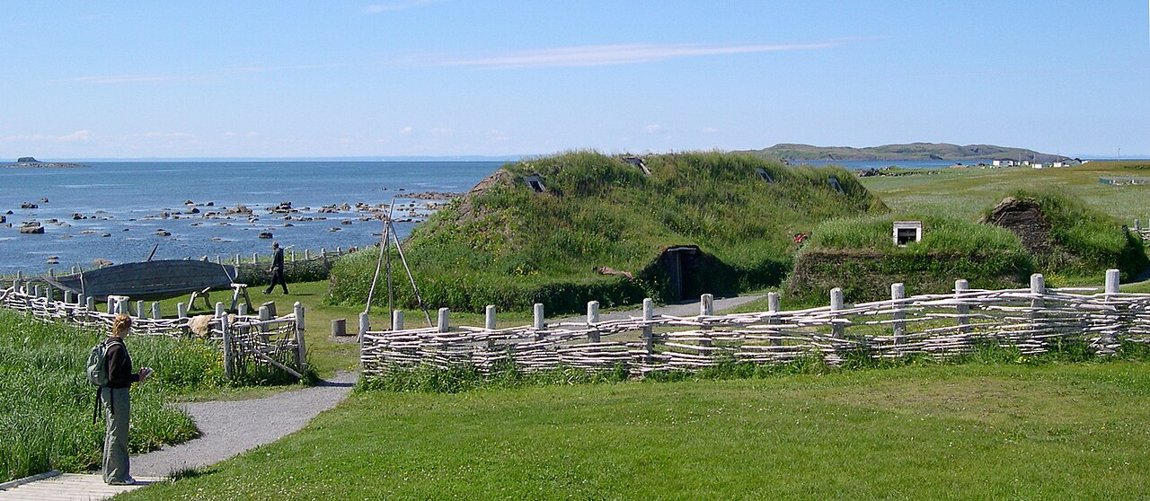
Both portraits play out at the same distant edge of the known world: in Vinland, the land the sagas place on the coast of North America. For a long time Vinland was thought a legend. That changed when Helge and Anne Stine Ingstad excavated the site of L'Anse aux Meadows at the northern tip of Newfoundland in the 1960s: remains of turf houses of Norse construction, a smithy, iron rivets – unmistakably a Viking-Age settlement. This proved that Norsemen really did reach America, some five hundred years before Columbus. A later dendrochronological and radiocarbon study dated the timber to the year 1021 – the first precisely datable evidence of Europeans in the Americas.
The distinction matters: L'Anse aux Meadows proves the voyages. It does not prove the individual people the sagas name. No find carries a name. Whether Leif, Karlsefni or Freydís truly stood there cannot be said archaeologically – the settlement is silent. You can read more of the background in our articles on Vinland and the discovery of America, on Leif Eriksson and on Erik the Red.
Now the two images of Freydís stand side by side, and they cannot be reconciled. In one saga she is a calculating liar and murderer; in the other a fearless fighter praised by the men. These are not merely different facets of the same person – they are opposing moral verdicts.
This contradiction is the real heart of the whole story. It shows that the sagas are no neutral records. Each generation of storytellers had its own purposes: one saga may have wished to show the descendants of Karlsefni and his wife Guðríðr in the best light – that Guðríðr who was remembered as the pious, virtuous ancestress of important bishops. Against such a background, a counterpoint may have been needed, a dark figure against whom evil could be measured. Freydís, called the illegitimate daughter of Erik in the Eiríks saga, lent herself to the role. In the other saga, by contrast, the same Freydís was free to act out her wild courage.
However opposite the portrayals, on one point both sagas agree: Freydís was there. She was no minor figure who stayed at home, but a woman who put out onto the open sea, into an unknown land, among people she had never seen before. This fits what we otherwise know of Viking-Age women: they ran farms, managed wealth, made decisions and emigrated too. The settlement of Iceland and Greenland would have been unthinkable without women – Freydís's own kinswoman Aud the Deep-Minded led an emigration herself.
But caution is due: to turn Freydís's courage in the Eiríks saga into that of a "shield-maiden" goes too far. In her hour of need she seizes a fallen man's sword – she is no trained warrior riding into battle as such. The scene lives precisely on the fact that a pregnant woman does what the men shy away from. What the fighting women of the North really amount to is examined in our article on the shield-maiden.
In recent years Freydís has become known to a wide audience above all through the series Vikings: Valhalla. There she appears as a young warrior and passionate defender of the old faith – a figure who fights, travels and makes history. This is gripping television, but it shares little more than the name with the sagas. The series invents freely: it moves Freydís to a different era, gives her an invented backstory, and turns the contradictory saga figure into a straightforward heroine.
That is legitimate for fictional entertainment – as long as one knows it is fiction. It only becomes a problem when the series image is sold as "the real Freydís". For a secure, historically graspable Freydís with a fixed character simply does not exist.
One might think the contradiction makes Freydís uninteresting. The opposite is true. Precisely because we cannot pin her to a single image, she becomes a mirror of what we read into a woman of the Viking Age. Whoever seeks a dark anti-heroine finds her in the Greenlanders' Saga. Whoever seeks a fearless border-crosser finds her in Erik the Red. Both Freydís are real – as narratives. Neither is real as secure biography.
For us at Glanz & Gravur, that is the true lesson: the Viking Age is rarely as clear-cut as films and series suggest. Anyone who tells the old stories honestly must tell the fractures along with them. Freydís Eiríksdóttir is the finest example that a figure can wear two faces – and that both may have been invented at the same time. Therein lies her lasting appeal: not in an answer, but in an open question.
Freydís Eiríksdóttir belonged to a family that pushed back the edges of the known world. She sailed to Vinland, a land that only a thousand years later became tangible again through the spades of archaeologists. The sagas made her both murderer and heroine. We need not choose which version "is true" – we should only not pretend to know. Freydís remains one of the most striking and at the same time most enigmatic women of the North: a figure from two sagas, with two faces, and a name that carries the goddess Freyja within it.
Vinland · Leif Erikson · Erik the Red · Aud the Deep-Minded.
All History & Finds articles →
Some 1,700 years ago a man from the Near East settled in a Germanic village in present-day Thuringia – and rose into …
Read more →