 Some peoples fill whole libraries. And then there are the Frisiavones. A single ancient author mentions them at all, and only in lists; everything else rests on building stones, bronze tablets and an altar in North Africa. That is exactly what makes them interesting. They show how much history can be won from almost nothing – and where the guesswork begins. We try to keep the two apart.
Anyone who studies Germanic peoples gets used to a particular kind of disappointment: most of them are known to us not through what they did, but through what a Roman official had to write down about them. With the Frisiavones this disappointment is total. They fought no battle that has come down to us. They have no leader whose name survived. They have no town one could mark on a map. What they have is a name – and it turns up in Roman lists, again and again, across some three hundred years.
So this article is not an epic but a workshop report. It is about what can honestly be extracted from five lines of Pliny, a few dozen inscriptions and a handful of military diplomas. One note in advance, since we work in a Norse-minded workshop: the Frisiavones belong to the Roman imperial period, the first to fourth centuries. Centuries pass between their last mention and the first longship off Lindisfarne. Anyone looking for Vikings here is about seven hundred years early.
In all surviving ancient literature exactly one author names the Frisiavones: Pliny the Elder, in his Naturalis historia, published around AD 77. Not Caesar, not Tacitus, not Cassius Dio, not Ptolemy. One author, two passages. That is the entire literary record of a people who at the same time supplied their own unit to the Roman army.
One passage stands in the list of the inland peoples of Gallia Belgica. It reads as unromantically as it is – and that is precisely why it belongs here in full:
introrsus Catoslugi, Atrebates, Nervi liberi, Veromandui, Suaeuconi, Suessiones liberi, Ulmanectes liberi, Tungri, Sunuci, Frisiavones, Baetasi, Leuci liberi …
“Inland: the Catoslugi, the Atrebates, the free Nervii, the Veromandui, the Suaeuconi, the free Suessiones, the free Ulmanectes, the Tungri, the Sunuci, the Frisiavones, the Baetasi, the free Leuci …”Pliny, Naturalis historia IV,106; translation: Glanz & Gravur
That is all. No verb, no characterisation, no custom, no place. Here the Frisiavones are a comma between two other names. Anyone who wants to know how Roman administration perceived peoples who were not currently causing trouble has the model case in front of them.
The real knot is that Pliny uses the same name a second time – somewhere else entirely. Describing the islands of the Rhine delta he writes of the island of the Batavi and the Cananefates “and others of the Frisii, Chauci, Frisiavones, Sturii and Marsacii, which stretch between Helinium and Flevum”. That single line is valuable for two reasons. First, it places Frisiavones in the delta, far north of the Belgica list. Second, and more weightily, Frisii and Frisiavones stand side by side there as two different groups.
Scholars have worn themselves out on this contradiction. Theodor Mommsen simply declared the second mention an error by Pliny. Ludwig Schmidt held the island passage to be a later interpolation. Others assumed two separate settlement areas, a larger one inland and a group on the coast. The question cannot be decided. Only one thing should be avoided: picking whichever passage suits one's favourite map.
Linguistically the case is clearer than historically. Günter Neumann pointed to the initial f-, which speaks for a Germanic formation, and read the name as Frisi- plus the suffix -avo-, roughly “those belonging to the Frisii” or “those descended from the Frisii”. It sounds like a tidy solution, and many popular accounts treat it as one.
But an etymology proves no kinship. A name tells us how others spoke about a group – not where that group came from, and certainly not what it thought it was. There is no self-designation of the Frisiavones, no text from their own hand, no gravestone on which someone explains who his ancestors were. Dieter Timpe put it plainly: apart from the resemblance of the names, no connection between Frisii and Frisiavones can be demonstrated, neither geographical nor historical.
The equation survives anyway, and it has a convenient variant. In the Germania Tacitus distinguishes greater and lesser Frisii, Frisii maiores and minores, and for a long time it seemed natural to identify the “lesser Frisii” with the Frisiavones. That identification is now generally rejected in the specialist literature – not least because Roman writers of the second century clearly kept the two groups apart.
Marjan Galestin, who in 2008 worked through all the literary and epigraphic evidence again, reaches a sober conclusion: to the Romans, Frisii and Frisiavones were two separate groups. Both served in the army, but not in the same unit. No cultural relationship is attested. Their only link, she writes, was the similarity of their names. An archaeological point often overlooked fits this: so-called Frisian pottery does not occur in the very regions attributed to the Frisiavones. The material culture contradicts the elegant derivation.
Since it is regularly claimed online that the Frisiavones took part in the Batavian revolt of 69/70, the relevant chapters are worth opening. In the Histories Tacitus describes how Claudius Labeo tried to hold the Meuse crossing against Iulius Civilis with a hastily assembled force of Baetasii, Tungri and Nervii – and how the Tungri surrendered under their leading men Campanus and Iuvenalis. No Frisiavones appear. Where Labeo is sent into exile earlier, the text does not say “among the Frisiavones” but among the Frisii.
One cautious inference is possible: if the neighbours are named and the Frisiavones are not, they were in the historian's view no independent political factor – or they took the field under someone else's name. Nico Roymans has suggested understanding them and the Cananefates as client groups of the Batavi, whose contingents were absorbed into Batavian units, and that only after the revolt did they get the chance to express an identity of their own. That is a plausible thesis. It is not evidence.
Localisation is the point at which every account has to become honest, because there is not a single hard anchor. There is no site, no inscription found in their own soil, no boundary marker. What there are, are proposals, and they differ considerably. A. W. Byvanck placed them on both banks of the Waal, on his map roughly between Nijmegen and Cuijk. Julianus Bogaers shifted them west, into southern South Holland, Zeeland and the northern part of North Brabant south of the Meuse. Willem van Es thought of western North Brabant and invoked the vacuum left by the destruction of the Eburones. Roymans in turn located them in southern South Holland and the north-west of North Brabant.
Georges Raepsaet and Marie-Thérèse Raepsaet-Charlier reopened the whole question from the Zeeland side in 2013. The result of all this work is a broad perhaps between Meuse, Scheldt and Rhine. Anyone who sees a sharply drawn border on a map is looking at the opinion of the cartographer, not at the evidence.
The single most informative source on the Frisiavones was found in 1958 in Tunisia, a good two thousand kilometres from any conceivable Frisiavonian field. The town council of Bulla Regia in the province of Africa proconsularis set up an equestrian statue for the imperial procurator Quintus Domitius Marsianus and listed his career on the base. It records that he was procurator for the census “of the provinces of Belgica in the districts of the Tungri and the Frisiavones and of Lower Germany and the Batavi”. The inscription dates to the reign of Marcus Aurelius.
This is dry and sensational at once. Here the Frisiavones appear not as a legend but as an administrative unit: a regio with its own designation, in which people were registered and assessed for tax. In the second century they were part of the empire, not a frontier people. The inscription also triggered a long debate about exactly where the border between Gallia Belgica and Germania inferior ran, because the list jumps back and forth between the two provinces.
Where literature falls silent, the army speaks. The cohors I Frisiavonum was a pure infantry unit, a cohors peditata quingenaria with a nominal strength of around 480 men in six centuries. It was probably raised in the first century, possibly after the Batavian revolt, at the latest around AD 80 – counting back from the first secure record.
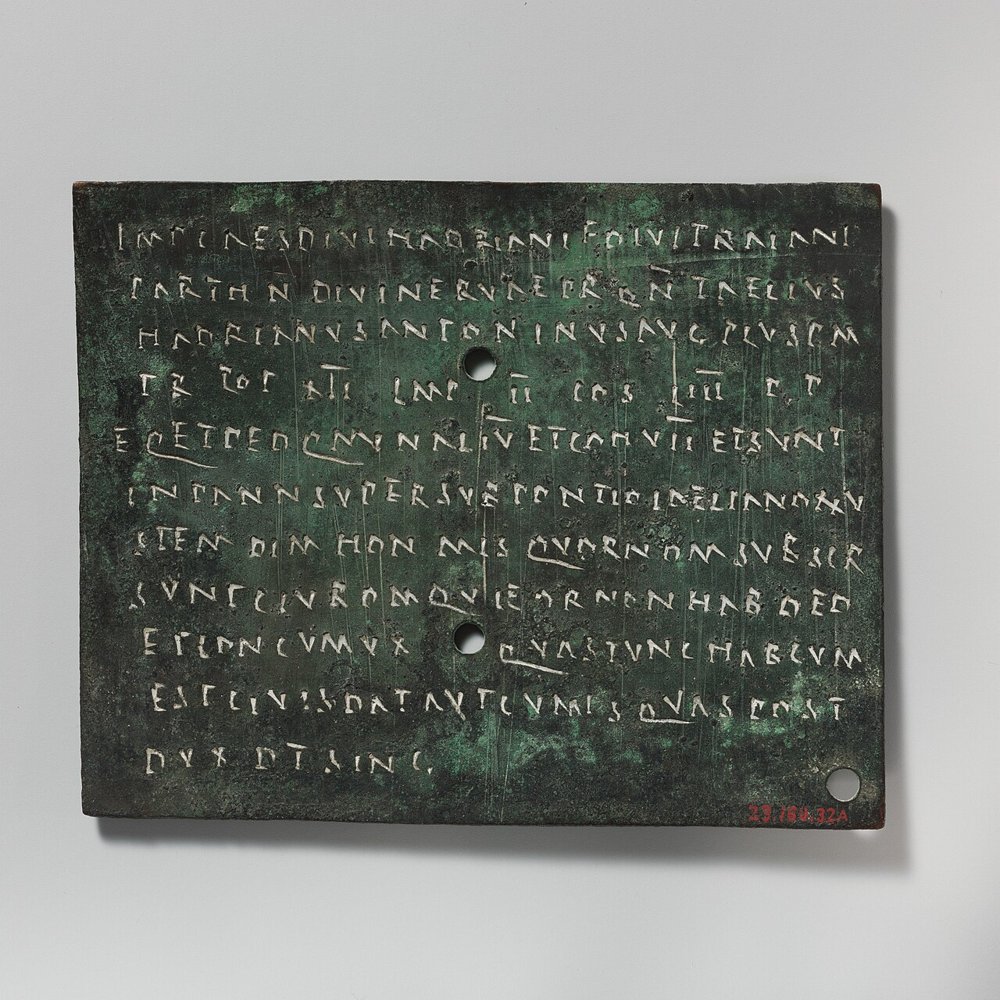
That record is a military diploma of AD 105, found at Sydenham. After it the chain does not break: a diploma from Delwijnen in Gelderland of Trajanic date, the great British diploma of 17 July 122, another of 124 from Stannington near Sheffield, a piece of 127, three fragments of 158 from Ravenglass and finally a diploma of 178. Seven documents across seventy-three years, all issued for Britain. A people whose town we do not know sent young men to an island at the edge of the world for more than two generations.
The building stones bring us closer still. At Mamucium, Roman Manchester, three stones survive on which centuries of the cohort account for their work: the century of Masavo twenty-three feet, that of Quintianus twenty-four, plus a stone of the century of Cudrenus. At Ardotalia, today Melandra Castle in Derbyshire, a fourth stone names the century of Valerius Vitalis.
These are unspectacular texts, and that is exactly their charm. This is building accountancy in stone: so many feet of wall, by this unit, under that officer. Anyone who engraves today and has to judge how much text fits a surface understands these stones at once. Note the names, too. Masavo and Cudrenus do not sound Latin; here men from the Lower Rhine and Meuse region put their origins into stone in a foreign province without meaning to.
The most personal testimony comes from Brocolitia, the fort of Carrawburgh on Hadrian's Wall. In 1876 a small sandstone altar barely 38 centimetres high was recovered there from the well of the goddess Coventina. The text is short: to the goddess Coventina, Mausaeus, optio of the first cohort of the Frixiavones, paid his vow. A junior officer, a promise, an altar thrown into a spring. The spelling with x instead of s is taken as a variant of the same name.
The unit's late history is documented as well. Two altars from Vindobala, today Rudchester, name third-century prefects assigned to the cohort: Publius Aelius Titullus dedicated to the unconquered Mithras, Tiberius Claudius Decimus Cornelius Antonius restored a temple of the Sun god. And the late Roman Notitia dignitatum lists for that same Vindobala a tribune of the cohors I Frixagorum – presumably the same unit, its name worn smooth by centuries of chancery use.
In Rome, in the cemetery of the imperial horse guards, lie eight tombstones of men whose stated origin hovers somewhere between Frisii and Frisiavones: Frisaoni, Frisiavo, Frisaevone, in one case natione Friseo. Michael Speidel wanted to assign almost all of them to the Frisiavones; Galestin is more cautious and counts at least one of the men among the Frisii. Something else is striking: three of the dead are called Titus Flavius. Citizenship came into their families under the Flavians – quite possibly as a reward after the Batavian revolt.
And then there are the mothers. Near Xanten a votive stone was found reading matribus Frisavis Paternis, “to the paternal Frisavian mothers”. That belongs to the great Rhineland cult of the Matronae, also attested among the Cugerni and their neighbours. Whether this Frisavae means the Frisiavones or the Frisii, the text leaves open. A people who cannot be pinned down even in their goddesses – it could hardly be more consistent.
Here lies the commonest error in popular accounts, and it is systematic. On Hadrian's Wall and in its hinterland there were several third-century cunei Frisiorum, Frisian formations named after their stations: Aballava (Burgh-by-Sands), Vinovia (Binchester) and Vercovicium (Housesteads). They are attested by five votive inscriptions, among them two altars of 241 and 242 that probably came from Papcastle, a stone from Binchester whose dedicant is the only soldier of all these units known by name, and the famous Housesteads altars on which Germani cives Tuihanti dedicate to Mars and the Alaisiagae.
These stones belong to the Frisii. They are nonetheless routinely filed under “Frisiavones”, including on well-visited English-language reference websites. Anyone collecting the evidence must therefore keep them apart: the cohors I Frisiavonum is a regular second-century auxiliary cohort, the cunei Frisiorum are irregular third-century formations. Two names, two kinds of unit, two centuries, two peoples.
For us in Alsdorf this story has a very concrete connection. Pliny's sequence runs: Tungri, Sunuci, Frisiavones, Baetasi, Leuci. We have written about the Tungri, about the Sunuci, who sat between Meuse and Rur in the area of Aachen, Eschweiler and Jülich, and about the Baetasii as well. With the Frisiavones the chain of neighbours in that one line of Pliny is now almost complete for us – and that is more than collector's zeal. It shows that Roman administration saw this whole region as a series of small units, none of them large, none of them famous, all of them liable to tax. This is the administrative landscape in which our region took shape, long before a Norse army reached Charlemagne's palace here.
The Frisiavones stand in that line like their neighbours the Menapii, the Toxandri or the Chamavi: a group real enough to be taxed and to supply soldiers, and too minor to be narrated. What remains of them are building accounts from Manchester, a vow in an English spring, a tax district on an African statue base and a comma in Pliny. No epic. But an honest inventory – and an honest inventory is worth more to us than a well-invented story.
In literature only Pliny names the Frisiavones, in two passages (Naturalis historia IV,101 in the Rhine delta beside Frisii, Chauci, Sturii and Marsacii; IV,106 in the list of inland peoples between the Sunuci and the Baetasi). Epigraphically they are far better attested. The statue base of Q. Domitius Marsianus from Bulla Regia (AE 1960, 167 = AE 1962, 183, reign of Marcus Aurelius) records a census “per regiones Tungrorum et Frisiavonum”. The cohors I Frisiavonum appears in seven military diplomas from 105 to 178 (among them CIL XVI 51 for 105, CIL XVI 69 for 122, RIB II.1 2401.6 for 124, AE 1997, 1001 for 158) and on building stones: RIB 577, 578 and 579 from Manchester and RIB 279 from Melandra Castle. Altar RIB 1523 from Coventina's well at Carrawburgh names Mausaeus as optio of the cohors prima Frixiavonum; RIB 1395 and 1396 from Rudchester name two third-century prefects. The Notitia dignitatum lists a cohors I Frixagorum for Vindobala. In Rome eight tombstones of the equites singulares give origins such as Frisaoni, Frisiavo and Frisaevone; three of the men bear the name Titus Flavius. Near Xanten a votive stone reads matribus Frisavis Paternis (CIL XIII 8633).
“The Frisiavones are a splinter group of the Frisii” is a reading of a name, not a proof. Linguistically the name can be derived from Frisii, but no historical or geographical connection is attested, and so-called Frisian pottery is absent precisely from the regions assigned to the Frisiavones. The identification with Tacitus's Frisii minores is also now rejected. Tacitus does not mention the Frisiavones at all: in the Meuse-crossing episode of the Batavian revolt the peoples named are Baetasii, Tungri and Nervii, and Claudius Labeo is exiled among the Frisii, not the Frisiavones. No capital is known; Cuijk is a suggestion by Bogaers, not a find, and even a separate civitas is more inferred than proven. No cohors II Frisiavonum is attested anywhere – anyone citing one has confused it with another unit. And the altars from Papcastle, Binchester and Housesteads belong to the cunei Frisiorum, the third-century Frisii; they are nonetheless regularly credited to the Frisiavones. Finally, “Germanic” is a judgement about the name, not about how these people saw themselves: not a single text of their own survives.
The Sunuci · The Baetasii · The Tungri · The Canninefates · The Batavi.
All History & Finds articles →
Two horns of heavy gold, covered all over with puzzling figures, and on one of them a line of runes in which, for the …
Read more →