 Anyone driving today from Alsdorf to Kornelimünster crosses, in barely half an hour, the entire core territory of a people almost nobody has heard of. The Sunuci lived between the Meuse and the Rur, in the triangle of Aachen, Jülich and Eschweiler, and they are among the most poorly attested peoples of the Roman Rhineland. Not one sentence survives in their own words. What we have is two brief notices by Roman authors, a handful of votive stones, a military diploma found in England and a temple precinct on the edge of the Eifel. That is precisely what makes them interesting: the Sunuci show how much, and how little, history can be won from such splinters.
Not a single word survives that the Sunuci themselves formulated. No story, no law, no song. Everything we know was written down by others: Roman authors who looked at them from outside and mostly in passing, and Roman stonecutters who, on private commission, struck names into sandstone. That is not a footnote. It is the precondition of every statement made about this people.
The record is thin. One entry in a list by Pliny the Elder, half a line in Tacitus, roughly ten votive inscriptions to a goddess whose name contains the tribal name, a bronze diploma from northern England, and the remains of a sanctuary near Aachen-Kornelimünster. Everything else has to be inferred, and where it cannot be inferred, a gap remains that is better endured than filled.
Still, the effort is worth it, especially from here. The settlement area of the Sunuci coincides almost exactly with the landscape in which our workshop stands. Aachen, Jülich, Eschweiler, Kornelimünster, Alsdorf, Düren: this is not some remote corner of antiquity, it is the doorstep.
Scholarship places the Sunuci in the first and second centuries between the Meuse and the Rur, that is, in the western Rhineland and the adjoining parts of the present-day Netherlands and eastern Belgium. To the south lies the northern Eifel, to the north the fertile plain, to the east the territory of the Ubii around Cologne. It is a transitional land between loess and uplands, between river and forest.
The loess is no minor detail. The fertile soils of the Jülich and Zülpich plains carried, in Roman times, a dense network of agricultural estates, the villae rusticae. Whoever lived here did not live at the edge of the world but in a granary that helped supply the Rhine army.
At the same time the area lay close enough to the Rhine to matter militarily and far enough from it not to be frontier country in the narrow sense. This in-between position shapes almost everything recorded about the Sunuci: they surface where greater powers collide, and vanish again as soon as the front moves on.
The oldest secure attestation stands in Pliny's Natural History. In his catalogue of the peoples of Gaul he lists, among the communities of the interior, Tungri, Sunuci, Frisiavones, Baetasi, then Leuci, Treveri, Lingones. Nothing more. No character sketch, no numbers, no story, merely a position in a list.
Yet this dry finding is usable. The order of such lists usually follows geography, and the proximity to the Tungri, whose chief town was Atuatuca Tungrorum, modern Tongeren, fits the location between Meuse and Rur exactly. Pliny thus confirms that in the second half of the first century the Sunuci counted as a community in their own right.
No further ancient narrator names them beyond doubt. Attempts to identify them in other geographical works of antiquity are not regarded as secure. Anyone who wants to say more about the Sunuci has to fall back on Tacitus and on the stones.
Their one narrative appearance falls into the chaotic year after Nero's death. Julius Civilis, leader of the Batavi, had opened the revolt against Rome and, after his alliance with Cologne, was busy collecting the neighbourhood. In a few lines Tacitus describes how the Sunuci fared.
Civilis societate Agrippinensium auctus proximas civitates adfectare aut adversantibus bellum inferre statuit. occupatisque Sunucis et iuventute eorum per cohortis composita, quo minus ultra pergeret, Claudius Labeo Baetasiorum Tungrorumque et Nerviorum tumultuaria manu restitit, fretus loco, quia pontem Mosae fluminis anteceperat. – Strengthened by his alliance with the people of Cologne, Civilis resolved to win over the neighbouring communities or to make war on those who refused. Having occupied the Sunuci and organised their young men into cohorts, he was met by Claudius Labeo with a hastily assembled force of Baetasii, Tungri and Nervii, who sought to stop his advance; Labeo trusted in the ground, because he had seized the bridge over the river Meuse beforehand.Tacitus, Histories IV.66. Latin text according to the standard transmission, translation by Glanz und Gravur.
Two things stand out. First, the Sunuci are occupied, not won over. They are the object, not the actor. Second, their young men are immediately organised into cohorts, that is, along Roman lines. That presupposes people who knew how such a thing was done, because they had seen it before.
The revolt ended in 70 with the defeat of Civilis, and the region was thoroughly reorganised afterwards. In the literature the Sunuci are often given the label civitas Sunucorum, an administrative unit of the province of Lower Germany in its own right. That is not certain.
Part of the scholarship regards the Sunuci rather as a sub-unit, a pagus, within the territory of the Cologne colony. Both readings are compatible with the thin evidence, and no inscription settles the question. Anyone using the term civitas should know that they are using a working hypothesis, not a document.
Only the outcome is certain: by the second century at the latest the Sunuci were part of the Roman system. They paid dues, supplied soldiers, dedicated stones in Latin and bore Roman name forms. The road from occupied community to integrated provincial population was short.
A people without a chief town is hard to imagine in Roman thinking, and the search has been correspondingly eager. Three candidates are debated. Iuliacum, modern Jülich, lay as a road station and Rur crossing on the great route from Tongeren to Cologne and was fortified in the fourth century with a mighty fourteen-sided wall.
Coriovallum, modern Heerlen, was likewise a road station, possessed large baths and an important pottery industry with more than forty kilns identified. Aquae Granni, Roman Aachen, was a spa and cult site with hot springs, bath buildings, a large sacred precinct and two Gallo-Roman temples.
None of these places bears a name that mentions the Sunuci, and no inscription identifies any of them as their capital. The honest answer is that we do not know. It is quite possible that this community had no urban centre in the classical sense at all, but lived dispersed in farmsteads and small settlements along the road.
The Sunuci become most tangible where they were furthest from home. An auxiliary unit was levied from the people, the cohors I Sunucorum, nominally five hundred men. Its history can be followed across centuries and half the North Sea.
In April 1761 a man named Edward Nichols ploughed two thin bronze plates out of the ground at Stannington in what is now Sheffield. It was a Roman military diploma, issued in the year 124 under the emperor Hadrian, granting the recipient citizenship and a valid marriage after twenty-five years of service. The man was an infantryman of the cohors I Sunucorum, son of one Albanus, and his origin is given simply as: of the Sunuci.
Some eighty years later the unit reappears, this time in Wales. A building inscription from Segontium, the fort at modern Caernarfon, records that the emperors Septimius Severus, Caracalla and Geta had the aqueduct channels, fallen in through age, restored for the First Cohort of Sunuci. The stone dates to the years 198 to 209. A people from the edge of the Eifel was at that moment guarding an outpost on the edge of Britain.
The strongest evidence for the Sunuci is not a story but a divine name. On roughly ten inscriptions from Lower Germany a deity appears called Sunuxsal or Sunucsal. The closeness to the name of the people is obvious, and scholarship has good reason to see in her the tribal goddess of the Sunuci.
The best-known stone was found in 1856 in the northern Propsteier Wald near Eschweiler, measures twenty-eight by thirty-six centimetres and is completely legible: Deae Sunuxsali Ulpius Hunicius votum solvit libens merito, that is, to the goddess Sunuxsal, Ulpius Hunicius has fulfilled his vow gladly and deservedly. At the break where the upper part is missing, the garment of a seated woman and the forelegs of a reclining animal can still be made out.
The other stones are spread from Varnenum near Kornelimünster via Inden-Frenz, Nideggen-Embken, Zülpich-Hoven and Nettersheim as far as Neuss, Cologne, Bonn and Remagen. The core area lies unambiguously between Aachen and the Rur; the outliers to the east are probably Sunuci who travelled. The Zülpich stone of a woman named Probia Iustina carries the year 239 and belongs to the late testimonies.
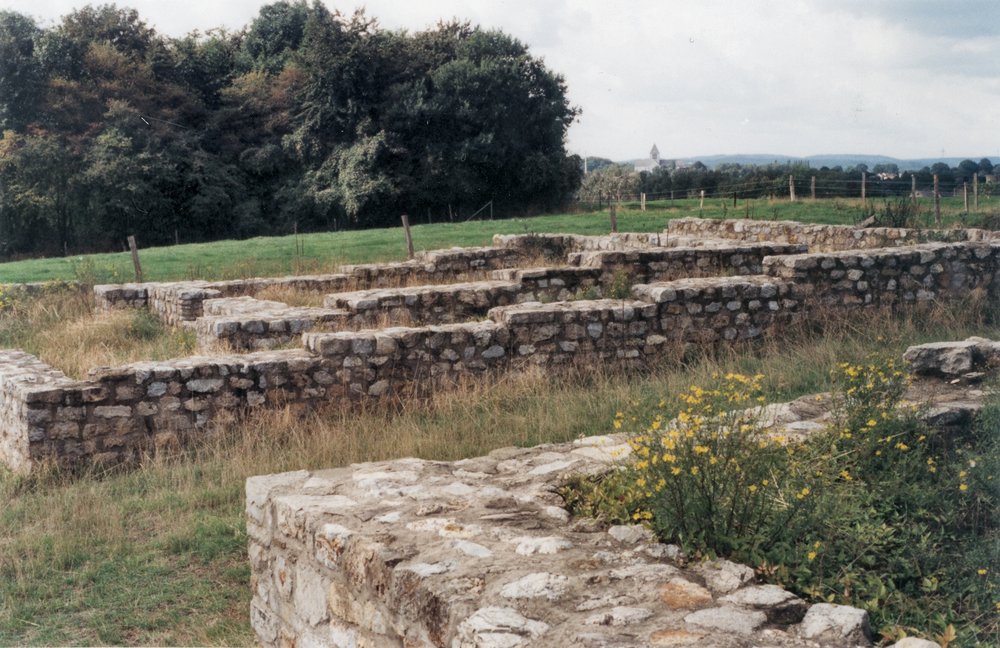
About seven hundred metres east of the church of St Stephen in Aachen-Kornelimünster, on a plateau called the Schildchen, lies the temple precinct known today as Varnenum. Excavation began in 1907, resumed later, and in 1989 the foundations were rebuilt to a height of roughly one metre. You can walk there.
The name of the site is a modern coinage. It derives from bronze tablets found on the ground that name a god Varneno or Varnenus alongside the goddess Sunuxal. One of the dedications comes from a Marcus Fucissius Secundus, who held a municipal honorary office in the Cologne colony. The rural precinct was therefore connected with the provincial capital.
Magnetometer surveys and phosphate analyses of the soil have made a temple district of at least one hundred and fifty thousand square metres, together with an associated settlement, probable. The precinct was destroyed by fire before 70 and rebuilt on a larger scale afterwards. Wolfgang Spickermann has interpreted Varnenum as the sanctuary of the Sunuci, which is well argued but not proven by any inscription.
The lifeline of the region was the great road from Bavay via Tongeren, Heerlen and Jülich to Cologne. It followed a pre-Roman route and was measured in Gallic leugae, not in Roman miles. Along it lay inns, baths, tile works and the large estates.
One of them is the Propsteier villa in the Propsteier Wald near Eschweiler, discovered by chance in 1876 and excavated in 1880 and 1881. Documented features include cellars, a working yard, a milling room with a grindstone of Eifel lava, a kitchen, a bath suite with underfloor heating and drainage channels with a lead pipe. This is not a farmstead, it is an enterprise.
Then there was mining. South-east of Aachen, around Breinig, Stolberg and Gressenich, calamine was already being extracted in Roman times, a zinc ore from which brass could be made. Remains of smelting installations and a Gallo-Roman settlement in the Breinig area attest to the activity. A track demonstrably ran from Varnenum in the direction of Breinig.
The classification of the Sunuci is an old quarrel. Caesar reports that beyond the Meuse several peoples lived who were collectively called Germani, among them the Eburones, the Condrusi, Caerosi and Paemani. Tacitus in turn writes that the first to cross the Rhine were called Tungri in his own day but Germani back then. These Germani cisrhenani west of the Rhine remain a research problem to this day.
The name Sunuci itself is usually explained as Germanic. Günter Neumann connected it with a word for son, which might point to a young warrior band that split off; a second reading starts from an Indo-European root for pig. Since the word for son is absent from Celtic, the first explanation rather favours a Germanic origin.
Little is gained by that. A Germanic tribal name proves no Germanic speech in daily life, and the personal names of the region cheerfully mix Celtic, Germanic and Latin elements. The Sunuci were probably exactly what their position suggests: a mixed population in a border zone whose leading families presented themselves first as Celts and then as Romans.
After the diploma of 124 and the late votive stones of the third century the trail goes cold. The name no longer appears as a soldier's origin, and nobody dedicates stones with the old tribal reference any more. The third century brought incursions by groups from east of the Rhine, abandoned estates and a dramatic fall in population across both Germanic provinces.
The population did not vanish because of that. In Jülich a strong fortification stood in the fourth century which, according to Ammianus Marcellinus, was still in use in 357 when Frankish cavalry plundered the area. In Aachen the bath at the Kaiserquelle was destroyed between 350 and 360, while an apse was built into the baths beneath the present-day minster, turning the building into a church.
What remained was absorbed into the Franks. The people between Meuse and Rur became part of those confederations from which the Frankish kingdom later emerged, and the old settlement area became the medieval Jülichgau. Anyone looking for Charlemagne's palace in Aachen is standing over Roman baths that the Sunuci are likely to have known.
There is no Sunuci museum, no monument, no feast day. What there is: a small, heavy stone from the Propsteier Wald with four lines of text, a handful of foundations on the Schildchen near Kornelimünster, a sheet of bronze in the British Museum and one line in Tacitus. For an entire people that is shatteringly little.
Which is exactly why they are a good example of what history in this region really looks like. Not as a grand narrative but as a series of accidents: a plough that struck the wrong thing in England in 1761, a patch of woodland near Eschweiler with a stone lying in it in 1856, an excavation team that started digging on a plateau in 1907.
When we set names and signs into slate and wood in Alsdorf, we work in a landscape where people did the same thing nearly two thousand years ago. They had their name and the name of their goddess struck into stone so that something would remain. In the case of Ulpius Hunicius it worked. His vow is still standing.
The Ubii · The Eburones · The Batavi · The Cugerni · The Matronae.
All History & Finds articles →
A whole royal ship, buried beneath a mound, full of gold and weapons – and a helmet that became the face of an entire …
Read more →Some Vikings raided, others had Danegeld paid to them – Sweyn Forkbeard did both and then reached for the crown itself …
Read more →