 On the Lower Rhine, around today's Xanten, settled a Germanic tribe that Rome deliberately placed there: the Cugerni. Out of their land grew one of the largest Roman cities north of the Alps.
The Cugerni (Latin, also Cuberni) were a Germanic tribe on the Lower Rhine, in the area of today's Xanten. They belong to the Rhine peoples that Rome wove into its frontier order – and their territory became the site of one of the most important Roman cities of Germania. For our region their history is a strong local connection: it plays out on the Lower Rhine, scarcely a day's ride from our home.
The Cugerni are closely connected in scholarship with the Sugambri, a powerful Germanic tribe of the Lower Rhine. After Rome partly resettled the Sugambri onto the left, Roman side of the Rhine around 8 BC in the course of securing the frontier, the Cugerni later appear there. Much suggests that they arose from resettled Sugambri and related groups – a model of Rome's policy of transplanting whole peoples to pacify the frontier.
Resettling whole tribes was a tried Roman means. Generals like Agrippa and Tiberius settled Germanic groups on the left bank of the Rhine, where they stood under Roman supervision, settled borderland and supplied soldiers. So the Ubii came to Cologne – and in a similar way the Cugerni to the Xanten area. Free Germani from beyond the Rhine thus became Roman frontier-dwellers whose territory was organised as a civitas.
The territory of the Cugerni was administered as the civitas Cugernorum, with a centre in the Xanten area. Here, at a strategically important Rhine crossing, lay first the great legionary camp of Vetera, destroyed in the Batavian revolt of 69/70. The Cugerni themselves were involved in these events – the revolt of Iulius Civilis engulfed the whole Lower Rhine. After the suppression of the revolt, Rome reorganised the region.
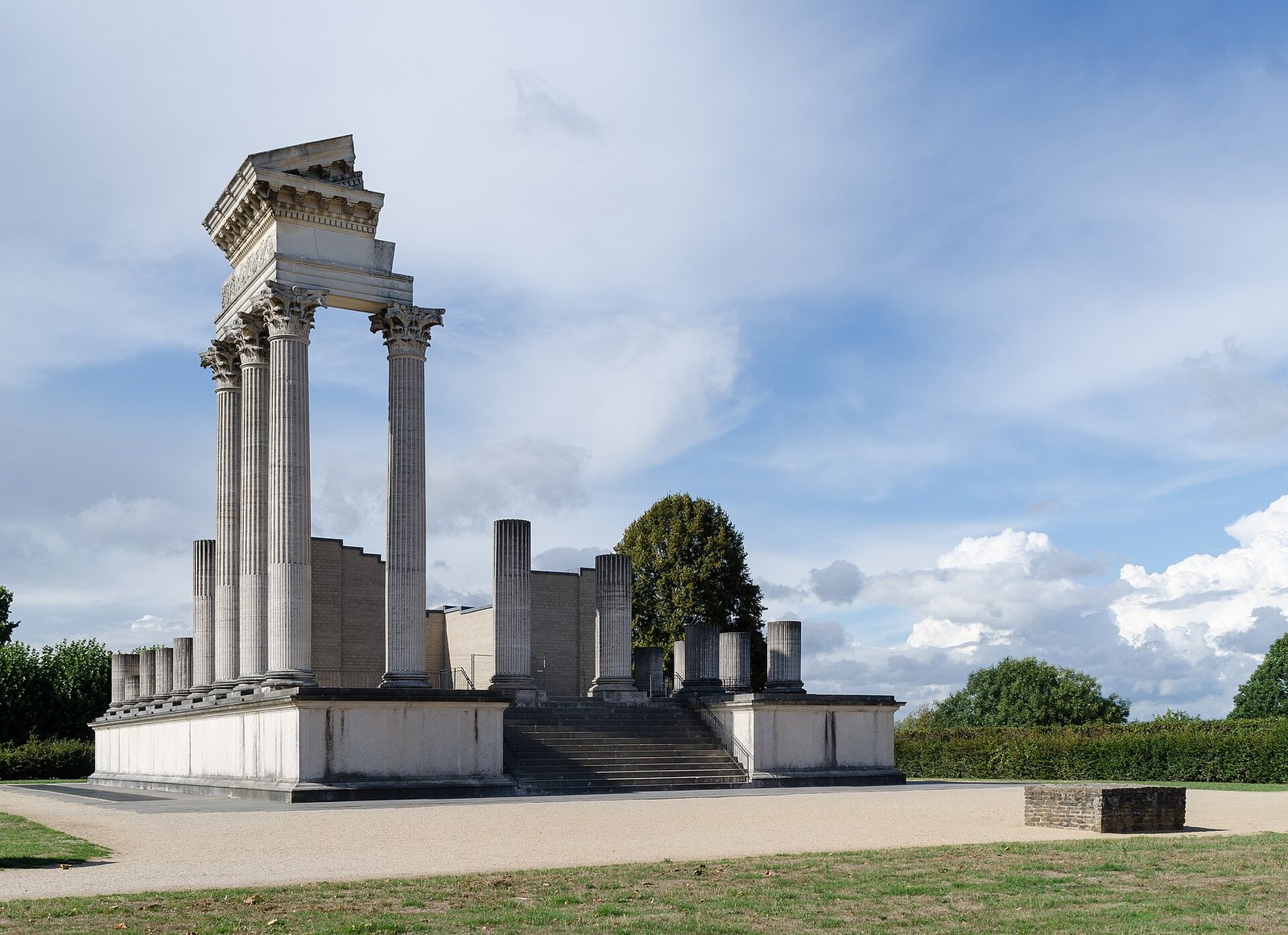
The high point of the history of the Cugerni land was the founding of the Colonia Ulpia Traiana (CUT) around 100 AD under Emperor Trajan – on the soil of the civitas Cugernorum near Xanten. It became one of the largest and most splendid Roman cities north of the Alps, with amphitheatre, harbour, temples and town wall, laid out for tens of thousands of inhabitants. The CUT is today partly reconstructed in the Archaeological Park Xanten – one of the most impressive Roman sites in Germany. Out of the land of a Germanic tribe had grown a Roman metropolis.
The Cugerni show exemplarily how Germani became Romans. Their upper class received Roman citizenship, young men served in auxiliaries, and their land was administered and built up in Roman fashion. Votive stones and inscriptions from the region name Germanic and Roman names side by side. On the Lower Rhine, Germanic, Celtic and Roman elements thus merged into the Gallo-Germanic-Roman mixed culture that shaped the Rhineland for centuries.
The religion of the region mirrors this fusion. On the Lower Rhine numerous native deities were worshipped – Matronae (mother goddesses), Hercules Magusanus and others – often in Roman building form and with Latin votive inscriptions. In the Cugerni area too such testimonies were found. They prove that the Germanic and Celtic world of gods did not vanish under Rome but lived on in new forms – a central theme of Rhenish religious history.
The name Xanten itself leads far: it derives from ad Sanctos ("at the saints"), the early-medieval cemetery of Christian martyrs near the old colonia. The Roman city decayed after the end of Rome, but the place remained important. The Cugerni land is thus a continuous stage from the Germanic early period through the Roman metropolis to the medieval city – a piece of the densest history on the Lower Rhine.
The Cugerni are a model case of the interweaving of Germani and Rome on the Lower Rhine – in our own region. Their history shows Rome's resettlement policy, the emergence of a great Roman city on Germanic soil and the cultural fusion from which the Rhineland arose. For an honest picture of the Germani they are important: not all Germani faced Rome as enemies; many became part of the Roman world without wholly losing their origin.
The Cugerni are reported by Roman authors (Tacitus, Pliny) and above all by inscriptions from the region. Their real wealth is the archaeology of Xanten – the Colonia Ulpia Traiana, the legionary camp of Vetera and the Archaeological Park. Where the texts are brief, stones and finds speak. We keep evidence and interpretation apart: the civitas, the CUT and the involvement in the Batavian revolt are well attested; the exact origin of the Cugerni (from resettled Sugambri?) remains a well-founded but not definitively secured thesis.
Long before the colonia arose, one of the most important military camps of the Roman Rhine lay in the Cugerni land: Vetera on the Fürstenberg near Xanten. Here two legions stood at times – the spearhead of the Roman Rhine army. From Vetera the campaigns of Germanicus set out into free Germania, and here raged the battles of the Batavian revolt of 69/70, in which the camp was besieged and destroyed. The Lower Rhine was thus no quiet province but a highly militarised frontier zone – and the land of the Cugerni lay right in the middle.
The Colonia Ulpia Traiana was no small frontier settlement but a real Roman city. It had a street grid, an amphitheatre for thousands of spectators, great temples, public baths, a Rhine harbour and a mighty town wall with gates. Estimates run to ten thousand and more inhabitants. Today the Archaeological Park Xanten, with its reconstructed harbour temple, amphitheatre and town wall, makes this world tangible again – on the soil once inhabited by the Germanic tribe of the Cugerni. Hardly anywhere can the road from Germanus to Roman be walked so vividly.
For our region the Cugerni are a valuable building block. They remind us that the Lower Rhine, before the Franks and long before today's cities, was a melting pot: Germani, Celts and Romans lived here side by side, exchanging gods, goods and names. From Xanten through Cologne to Bonn the testimonies of this age line up. Whoever wants to understand the history of the Rhineland cannot pass by tribes like the Cugerni, Ubii and Batavians – they are the Germanic base layer beneath Roman and later German history.
"The Ubii, the Cugerni, the Batavians – all dwelt on the Rhine, partly allies, partly subjects of Rome."freely after Tacitus, Histories IV/V (public domain, own summary)

The Sugambri · The Ubii · The Batavi.
All History & Finds articles →
Sometimes a war is won not with the sword but with the purse. In 991 the English ealdorman Byrhtnoth faced a Viking …
Read more →In 723 an Anglo-Saxon missionary stood axe in hand before the holiest tree of the Hessians – the oak sacred to the …
Read more →Vikings were not only raiders. In the Rhine-Meuse delta they sat in the very middle of the greatest trading centre of …
Read more →