 Some peoples of the Roman period left cities behind, others tombstones. The Baetasii left little more than their name in other people's texts. Pliny the Elder writes them into a list. Tacitus brings them on stage twice, both times as armed men in a war that others had started. Then they vanish from the narrative and reappear where you would least look for them: on altars along the Antonine Wall in Scotland and on roof tiles at the English Channel coast. Their territory lay somewhere between the Meuse, the Niers and the Rhine, which is the wider neighbourhood of our own workshop. Exactly where, nobody knows.
The Baetasii, in Latin also Betasii, belong to those peoples of the province of Germania inferior about whom we know almost everything at second hand. No ancient author describes their customs, no inscription from their own land names them beyond doubt, no settlement securely carries their name. What remains are three kinds of evidence: a geographical list, two scenes from a year of revolt, and a surprisingly well documented auxiliary unit that carried their name across the empire for centuries. A picture can be built from these fragments, but it stays a picture with large blanks. Anyone who fills the blanks with guesses and then sells them as knowledge turns an interesting case into a legend. With the Baetasii that has happened often.
The oldest reference stands in Pliny's Naturalis Historia, book IV, chapter 106. There he lists the peoples of the interior of Gallia Belgica, and the sequence runs: Tungri, Sunuci, Frisiavones, Baetasi, Leuci liberi. Pliny's form of the name is Baetasi, not Baetasii. It is tempting to read the order as a map, which would place the Baetasii between the Sunuci and the Leuci. That does not work: the Leuci sat far to the south around Toul, the Tungri west of the Meuse. Pliny is not ordering by neighbourhood but by a logic we can no longer reconstruct. What the list does prove is this: by about AD 77 the Baetasii counted, for Roman administrative purposes, as a distinct and nameable group.
They appear a second time during the Batavian revolt. The Batavian officer Claudius Labeo, a personal rival of the rebel leader Julius Civilis, had been removed by him into exile among the Frisii. Labeo escaped, was given a small detachment by the Roman commander Vocula, and began a war of raids. Tacitus reports in Histories IV,56 that he induced a few Nervii and Baetasii to take up arms and conducted less a campaign than a series of stealthy attacks against the Cananefates and Marsaci. It is a passing remark, but it says something important: the Baetasii were evidently not a solid rebel bloc but a body of fighting men that could be recruited by either side. Small peoples on a frontier rarely chose between war and peace, only between masters.
The second scene is the better known one. Civilis had come to terms with the colony on the Rhine and turned to the neighbouring communities. In Histories IV,66 Tacitus writes that he occupied the Sunuci and organised their young men into cohorts. Anyone who wanted to go further had to get past Labeo.
Occupatisque Sunucis et iuventute eorum per cohortis composita, quo minus ultra pergeret, Claudius Labeo Baetasiorum Tungrorumque et Nerviorum tumultuaria manu restitit, fretus loco, quia pontem Mosae fluminis anteceperat.
Having occupied the Sunuci and formed their fighting youth into cohorts, he was stopped from advancing further by Claudius Labeo, who resisted with a hastily gathered force of Baetasii, Tungri and Nervii, trusting to his position, because he had seized the bridge over the river Meuse in advance.Tacitus, Histories IV,66; translation by Glanz und Gravur
The fighting in the narrow ground stayed indecisive until Germanic warriors swam the river and took Labeo in the rear. Civilis rode up to the Tungrian line and called out that they had not taken up arms so that Batavians and Treveri might rule the tribes. Two Tungrian nobles, Campanus and Juvenalis, thereupon surrendered the whole people. Labeo got away before he could be surrounded.
What happened to the Baetasii stands in the same sentence: Civilis received them and the Nervii into his allegiance and added them to his forces. The Latin phrase in fidem acceptos means submission and protection at once. What sounds like a political act was in practice conscription: a defeated people became formations. Civilis had demonstrated exactly this pattern with the Sunuci a few lines earlier. For the Baetasii the passage means that they ended the revolt on the losing side without having started it. After that the historians fall silent about them. The rising ended in 70 with the surrender of the Batavians, and Roman administration reorganised the landscape of the lower Rhine.
Here begins the honest part. There is no secure localisation. The view most often held in current scholarship places the Baetasii south of the river Niers, that is in the land between Meuse and Rhine to the south-west of the later Colonia Ulpia Traiana at Xanten. The area around Gennep, Goch and Geldern has been proposed specifically. A second suggestion moves them considerably further west and links them to the Belgian place name Geetbets, which would put them inside the territory of the Tungri. Both are hypotheses, not findings. The eastern placement at least has two arguments in its favour: Tacitus names them in the same breath as Sunuci, Tungri and Nervii, and the inscriptions later tie them to Xanten. Neither argument proves anything.
The Romans counted the Baetasii among the Germani on the left bank of the Rhine, in the tradition of those groups Caesar called Germani cisrhenani. The name itself speaks a different language. Bernard Sergent connected it in 1991 to a Proto-Celtic root usually rendered as boar; Gunter Neumann pointed out that the suffix -asio- is common in Gaulish and barely attested in Germanic. Linguistically, then, the name looks Gaulish. That is not a contradiction but the normal state of affairs on this frontier: names of peoples could outlive the people who later bore them, and Roman categories such as Germanic or Gaulish were instruments of political order, not language statistics. How the Baetasii called themselves, and in what language, we do not know.
Around AD 100 to 105 the emperor Trajan founded the Colonia Ulpia Traiana at Xanten. Shortly afterwards the way Baetasii introduce themselves in inscriptions changes. Imperial horse guards in Rome describe themselves in the second and third centuries as Trajanensian Baetasii, tying their people's name to the new colony. For scholarship this is the strongest indication of their administrative position: the Baetasii evidently belonged to the hinterland of the Colonia Ulpia Traiana, much like the neighbouring Cugerni. One can watch an identity shift here. The member of a people becomes the member of a district. The statement of origin survives, but it now hangs on a Roman city rather than on a tribal boundary.
A self-governing community of the Baetasii is not attested. For the first century it is entirely open whether one existed; for the period after the founding of the colony the formula used by the guardsmen rather argues against it. The same problem arises with the Cugerni and the Sunuci: older scholarship readily assigned each of these peoples its own civitas, while more recent work regards that as uncertain at best. This uncertainty has to be endured. Roman administration in northern Lower Germany was thinner and more flexible than maps with clean boundary lines suggest, and for long stretches between Meuse and Rhine we simply do not know who gave judgement and who collected the taxes.
The best documented thing about this people is the part of it that left: its cohort. The cohors I Baetasiorum was an infantry unit of nominally five hundred men. It appears in British military diplomas dated 19 January 103 (found at Malpas), 17 July 122 (Brompton-by-Sawdon), 124 (Stannington) and 14 April 135 (Wroxeter). These documents are discharge certificates for veterans and the hardest kind of evidence available: official bronze tablets with a date on them. They show that the unit was in Britain by 103 at the latest, only a few years after the colony at Xanten was founded. Recruitment was probably genuinely from the people at first; later the unit will have been filled up locally, as was normal.
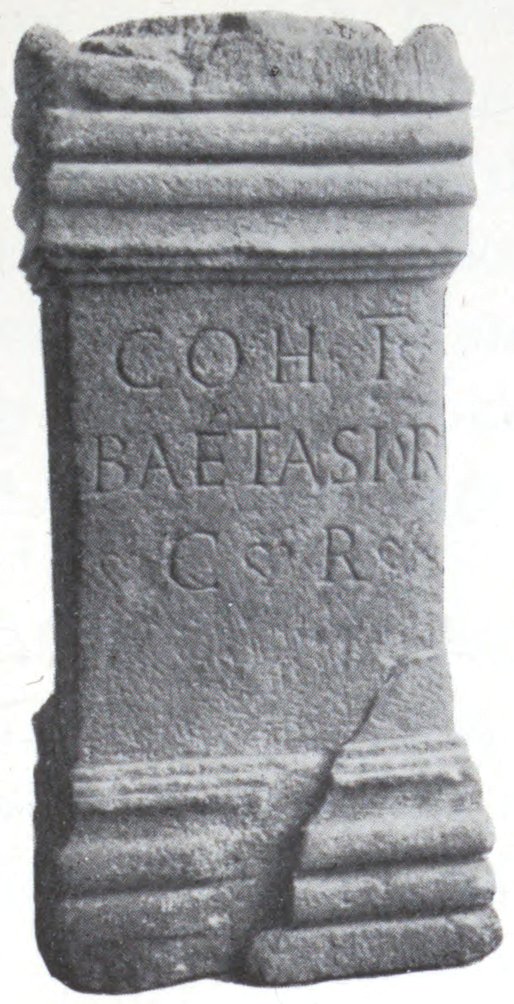
Under Antoninus Pius the cohort stood in Scotland. Two stones came out of the well of the headquarters building at Bar Hill in 1903: an altar with the plain text coh I Baetasior c R, and a building inscription for the emperor on which the unit is styled Roman citizens, honoured for valour and loyalty. The phrase ob virtutem et fidem is, however, largely restored; the slab was found in three fragments. At Old Kilpatrick at the western end of the wall an altar to Jupiter Optimus Maximus was found in 1969, dedicated by the same cohort under the prefect Publicius Maternus, with the centurion Julius Candidus as acting commander. Traces of red paint were still visible on the stone, which suggests it was buried soon after dedication.
Later the unit lay at Maryport on the Cumbrian coast. Several altars from there are dedicated to Jupiter, Mars and Victoria by the cohort under commanders such as Titus Attius Tutor and Ulpius Titianus, mostly dated to the years around 165 to 185. Its last appearance is on the Channel coast: at Reculver in Kent tiles carry the stamp C I B, a heavily restored building inscription of the early third century names the cohort, and the late Roman Notitia dignitatum lists a tribune of the first cohort of Baetasii at Regulbium. The trail thus ends after some three hundred years on the English coast, while the home region on the lower Rhine was largely depopulated in late antiquity and settled by new groups from whom the Franks emerged.
Pliny names the Baetasi in his list of the peoples of Gallia Belgica (Naturalis Historia IV,106). Tacitus mentions them twice during the Batavian revolt: as part of Labeo's raiding force (Histories IV,56) and in the fight at the Meuse bridge, after which Civilis incorporates them into his troops (Histories IV,66). The cohors I Baetasiorum civium Romanorum is documented by British military diplomas of 103, 122, 124 and 135 and by altars and building inscriptions from Bar Hill, Old Kilpatrick, Maryport and Reculver; tile stamps and the Notitia dignitatum place it last at Reculver. That members of the people described themselves in the second and third centuries as Trajanensian Baetasii links them administratively to the Colonia Ulpia Traiana at Xanten.
Popular accounts name Novaesium, modern Neuss, as the capital of the Baetasii. There is no evidence for this; Neuss was a legionary fortress. The identification of the Meuse bridge with Maastricht is likewise a modern interpretation, since Tacitus names only the river. The honorific phrase for valour and loyalty on the Bar Hill building inscription is largely restored and must not be quoted as a fully preserved text. Derivations of the people's name from modern place names such as Beeck or Baesweiler are not linguistically secure, and even the connection with Belgian Geetbets discussed in the literature remains a conjecture. Finally, the Roman classification as a Germanic people is a political category: the name itself looks linguistically Gaulish.
For us in Alsdorf the interesting thing about this story is the section of the map it covers. The Sunuci, whose occupation Tacitus describes immediately before the Baetasian engagement, sat in the Aachen area between Meuse and Rur. West of the Meuse lay the Tungri, to the south-east the Ubii around Cologne, to the north the Cugerni around Xanten, and before Roman times the Eburones had held wide stretches of this loess landscape. Every place that was set in motion in the year 70 lies within a radius you can drive in a day. Anyone travelling from Alsdorf via Julich to the lower Rhine still follows Roman alignments in places. We do not engrave Baetasian symbols, because there are none. But the landscape our workshop stands in was their borderland.
The Baetasii are a good example of what history looks like when you refuse to smooth it out. A name in a list. Two sentences in a historian who was interested in quite different people. A district that absorbed the name. And a cohort that carried it for three hundred years until it turned up on roof tiles on the English coast, long after the people itself had ceased to be traceable. That is precisely where the appeal lies: not everything that had a name also left a history. Sometimes all that survives is the mark other people made of you.
The Sunuci · The Ubii · The Batavi · The Cugerni · The Eburones.
All History & Finds articles →
Between the world of humans and the world of the gods a bridge of light is stretched: Bifröst, the rainbow. It is the …
Read more →