A farmer kills a neighbour because the neighbour's servant rode his horse. Thirty pages later four families are at odds, two men are outlawed and one is dead. No narrator comments, no hero is praised, nobody tells you what to think. That is how the sagas of Icelanders work: some forty anonymous prose texts of the thirteenth and fourteenth centuries about people said to have lived two hundred years earlier. They are the greatest literature of the medieval North – and the most difficult source you could pick for the Viking Age.
Saga simply means "what is said", a telling. The Íslendingasögur, the sagas of Icelanders, form one group within that: prose narratives about farmers, chieftains and seafarers in Iceland, set between the founding of the Althing around 930 and the conversion and its aftermath around 1030. That span is called the saga age.
You know them by their make. They narrate from the outside: you are not told what anyone thinks, you are told what he does and says. They are terse to the point of harshness and fond of understatement – "that was a hard blow," says a man who has just lost an arm. They almost always open with descent, often across several generations, because in this society kinship decides who stands up for whom. And they are built like a lawsuit: cause, escalation, attempted settlement, breakdown, revenge, settlement. Between the prose stand stanzas in skaldic metre, which the saga puts into its characters' mouths.
All of them are anonymous. Not one author of a saga of Icelanders is known.
This is where it is decided how these texts should be read. The saga age ends around 1030. The sagas were written mostly between 1200 and 1350, the majority in the thirteenth century.
That is six to ten generations. In the meantime Iceland had accepted Christianity, acquired monasteries and schools, learned the Latin alphabet and developed a historical literature of its own. By the time Njáls saga was written, the Commonwealth had just passed under the Norwegian crown. Anyone writing then about the tenth century was writing about a period he knew only from stories, genealogies and older books – and he was writing for readers who wanted to know where they came from.
In everyday use the word covers anything Old Norse. That misleads, because medieval Icelandic prose falls into clearly distinguishable genres.
Kings' sagas (konungasögur) deal with Norwegian and Danish rulers – Snorri Sturluson's Heimskringla, Morkinskinna, Fagrskinna. They lean on skaldic stanzas, some of which go back to the lifetimes of the kings they praise, which makes them in part a better source.
Legendary sagas (fornaldarsögur) are set before the settlement of Iceland, on the mainland, in a world of dragons, magic swords and kings without dates. Völsunga saga and Hrólfs saga kraka belong here. They are heroic literature, not history, and do not pretend otherwise.
Bishops' sagas (biskupasögur) tell of Icelandic bishops of the eleventh to fourteenth centuries, often with miracle accounts, and were written close to their subjects' own time.
Contemporary sagas (samtíðarsögur) cover the twelfth and thirteenth centuries, the present of their authors. The great collection is Sturlunga saga. For the conditions in which the sagas of Icelanders were written it is the single most important source – and in places it reads like one of them, only more brutal.
Chivalric sagas (riddarasögur) are translations and adaptations of courtly matter from France and England.
A short guide to the texts worth reading first.
Njáls saga is the longest and the most widely preserved: a feud that ends with a farmstead burned, and for long stretches a book about procedural law. Egils saga tells the life of the warrior and poet Egill Skallagrímsson, who takes on the Norwegian royal house and buys his life in York with a poem. Laxdæla saga has the strongest women: Guðrún Ósvífrsdóttir, four marriages, and at the end the line that she was worst to the man she loved most. It opens with Auðr the Deep-Minded, who brought her own ship to Iceland.
Grettis saga follows an outlaw who survives nineteen years in the wilderness and is probably the latest of the great sagas. Gísla saga is its bleak counterpart. Hrafnkels saga is short, sharp and a classic of scholarship. Eyrbyggja saga is the richest in detail on cult and daily life. Gunnlaugs saga ormstungu tells of two poets and one woman. And the two Vinland sagas, Grænlendinga saga and Eiríks saga rauða, report the voyages to Greenland and North America – more on that with Erik the Red.
Alongside them stand the þættir, short single episodes of a few pages, usually preserved as insertions in kings' sagas.
Where these texts come from was argued over for a century. The argument acquired two names.
Freeprose holds that the sagas were told orally, across generations, in a form already close to the written text, and that the thirteenth-century scribe essentially took them down. Its best-known advocate was the Swiss Germanist Andreas Heusler, and in Norway the folklorist Knut Liestøl.
Bookprose holds that the sagas are literature. An author made a work out of oral stories, genealogies, legal knowledge and older books, with structure, motifs and intent. This position was developed in Iceland – Björn M. Ólsen, Sigurður Nordal, Einar Ólafur Sveinsson – and is therefore often called the "Icelandic school".
The decisive blow was struck by Sigurður Nordal in 1940 with a slim study of Hrafnkels saga. He showed that its geography does not work: the valleys described could never have carried so many farms, and the cliff over which the horse Freyfaxi is driven does not exist. A man who writes like that is not transmitting, he is inventing. After 1940 pure freeprose was finished.
Today scholarship sits between the two. Hardly anyone denies that oral tradition supplied the matter, or that the surviving texts are written works of art. The argument is about how much substance orality could carry – and that cannot be measured, because nobody has the oral version.
For hard facts of the Viking Age the sagas of Icelanders are poor witnesses. They give numbers nobody checked, they put speeches into people's mouths, they arrange events according to dramatic need. A date or an event found in a saga alone is not evidence, it is a story.
As a source for other things they are excellent. They show how law worked and how it was got around. They show farm economy, clothing, ships, travel routes, food, illness, division of labour. They show what counted as honour and what as shame, down to the choice of words. And they show how thirteenth-century Icelanders thought about their ancestors – which is itself a hard historical fact.
Much of it can be cross-checked. Saga genealogies partly reappear in Landnámabók and in Ari Þorgilsson's Íslendingabók, the oldest Icelandic historical work. Archaeology confirms farm sites, building methods and trade goods. Where saga, Landnámabók and the ground agree, a statement will carry weight. Where a saga stands alone, it stays a text. We have described the society all this plays out in under the Icelanders.
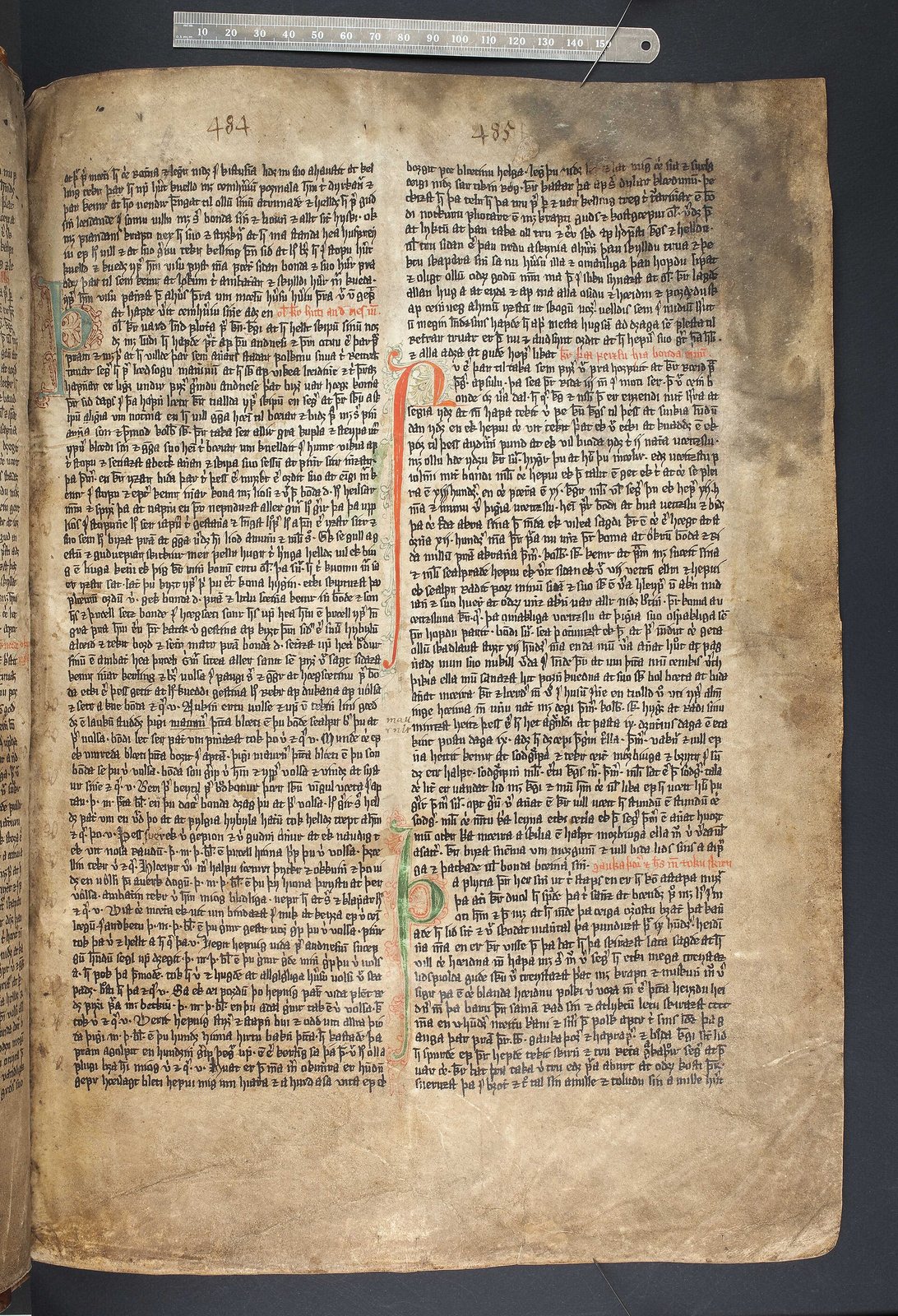
Not a single original survives. What we read are copies of copies, written on calfskin, mostly in the fourteenth and fifteenth centuries, often decades or centuries after the text was composed.
The most important collective manuscript is Möðruvallabók (AM 132 fol), made in the fourteenth century and named after the farm of Möðruvellir in Eyjafjörður. It contains Njáls saga, Egils saga and Laxdæla saga among others, which makes it the largest medieval collection of sagas of Icelanders in existence. Several texts are known chiefly or only through it.
The rest is a story of losses. From the late seventeenth century the Icelandic scholar Árni Magnússon gathered everything he could lay hands on and took it to Copenhagen. In 1728 the city burned, and part of the collection burned with it. The manuscript Vatnshyrna was lost then; some sagas survive only because copies had been made beforehand. Twelve leaves of Heiðarvíga saga went up together with the only transcript – Jón Ólafsson of Grunnavík wrote the missing part out from memory. In that form it still stands in the editions.
Between 1971 and 1997 Denmark returned the bulk of the manuscripts to Iceland. They are now in the Árni Magnússon Institute in Reykjavík, and many can be examined page by page online.
The standard scholarly edition is the series Íslenzk fornrit, published in Reykjavík since 1933, with the Icelandic text and a full introduction. In German the first broad edition was the Thule collection, twenty-four volumes edited by Felix Niedner and published by Eugen Diederichs between 1911 and 1930 – archaic in its language, but for a long time the only one. In 2011 a complete new German translation appeared in five volumes, edited by Klaus Böldl, Andreas Vollmer and Julia Zernack. In English there is The Complete Sagas of Icelanders, published in Reykjavík in 1997.
One piece of advice from experience: do not start with Njáls saga. The names will bury you. Begin with Hrafnkels saga or Gunnlaugs saga, both short, and then take up Laxdæla.
Contemporary with the saga age the sagas are not. What may be contemporary are individual skaldic stanzas quoted in them, some of which are likely older than the prose – provable only case by case, through metre and language.
Archaeologically attested are the framing conditions: settlement from the late ninth century, farm layouts, longhouses, graves, trade goods, the assembly site at Þingvellir, and L'Anse aux Meadows in Newfoundland as proof of a Norse presence in North America.
Later tradition is the sagas themselves, written two to four hundred years after the events they describe, together with Landnámabók and Íslendingabók, which are closer but still not contemporary.
Modern interpretation covers the dating of individual sagas, every statement about authorship, the whole edifice of freeprose and bookprose theory, and the question how much memory oral tradition can carry across ten generations.
What we like about these texts is that they do not explain their characters. You see what someone does, and you have to decide for yourself what to make of it. For courage. For memory. For legends that live on.
Njáls saga · Egill Skallagrímsson · Snorri Sturluson · The Icelanders · Aud the Deep-Minded · Erik the Red.