Eric Bloodaxe (Old Norse Eiríkr blóðøx) was a son of Harald Fairhair who ruled Norway for only a few years around 930, was driven out by his half-brother Hákon the Good and then – on the view most historians still hold – reigned as king in York in 947/48 and again in 952–954. He died at Stainmore in 954. His nickname, the murders of his brothers, Queen Gunnhild and Egill's "Head-Ransom", however, come from sources written two to three centuries later. Here we separate coin, chronicle and saga.
Some nicknames hit like a blade. Say "Bloodaxe" and you picture a man hacking his way to the throne. That is exactly the story the Icelandic sagas tell: a king's son who kills his brothers, a wife skilled in sorcery, a poet who saves his head with a song, and finally a funeral poem in which Odin himself orders the benches of Valhalla made ready.
What makes Eric fascinating is that we can test the tale against harder evidence: silver coins with his name, entries in the Anglo-Saxon Chronicle – and a serious scholarly debate about whether the king of York and the brother-slayer from Norway were even the same man.
The contemporary evidence comes almost entirely from England: the Anglo-Saxon Chronicle, annals surviving in several manuscripts that name a "Yric" as king of the Northumbrians; coins from York inscribed ERIC REX; and the Life of the Scottish saint Cathróe, written around 1000 at the latest, which mentions a king "Erichius" in York. Close to events but terse – no nickname, no fratricide.
The Norwegian and Icelandic histories only begin in the late twelfth century: Theodoricus Monachus, the Latin Historia Norwegie, the Old Norse Ágrip, then in the early thirteenth century Fagrskinna and finally Snorri Sturluson's Heimskringla (c. 1230). This is where Eric acquires colour, character and his bloody byname.
The third group is poetry: the anonymous memorial poem Eiríksmál and Egill Skallagrímsson's verses in Egils saga (c. 1220–1240). Skaldic poems – the intricate praise poetry of Norse court poets – are often treated as older than the prose around them because their strict form resists change. None of them is securely dated, though.
According to the sagas, Eric was a son of Harald Fairhair (Haraldr hárfagri), the king tradition credits with first uniting Norway. Snorri names his mother as Ragnhild, daughter of a King Eric of Jutland. Harald, in Snorri's account, fathered a bewildering number of sons by several women, and many of them were set up as sub-kings. That is the raw material of every brothers' war.
When Eric became king can only be estimated. The sources already disagree about joint rule with his ageing father: one year in the Historia Norwegie, two in Ágrip, three in Fagrskinna and Heimskringla. Several texts arrive at about five years in all; scholars usually place them in the early 930s – based on a chronology Icelandic scholars worked out three centuries later.
The name blóðøx first appears in texts of the late twelfth century. The Historia Norwegie renders it in Latin as sanguinea securis, "bloody axe". Theodoricus gives him a much less flattering tag: fratrum interfector, "killer of his brothers".
And Eric had brothers to spare. In Heimskringla he kills Rögnvald Straight-Leg (Rǫgnvaldr réttilbeini) of Hadeland, a reputed sorcerer – on the orders of his father, who loathed seiðr – and Björn the Seafarer (Bjǫrn farmaðr) of Vestfold. After Harald's death Olaf and Sigröd fall fighting him near Tønsberg, and when Halfdan the Black dies suddenly, the saga whispers of poison from Gunnhild's hand.
Sounds clear-cut. It isn't. Fagrskinna, for instance, links the name rather to Eric's reputation as a violent raider. And a name like "Bloodaxe" is first of all a warrior's name of the kind skalds liked to hand out: it says someone shed blood in battle, not whose. The fratricide explanation may be genuine memory – or a later reading that filled a dark name with a fitting story.
A small but important clue comes from poetry. One of Egill's occasional verses (lausavísur) refers to a son of "Bloodaxe". If that stanza really dates from the tenth century, the byname was in circulation during Eric's lifetime or soon after. That "if" is a big one, because the verse survives only in the thirteenth-century saga.
At Eric's side the sagas place one of the most striking women in Old Norse literature: Gunnhild, later called konungamóðir, "mother of kings" – because several of her sons ruled Norway after Hákon's death, above all Harald Greycloak (Haraldr gráfeldr).
Even her origins are disputed. The Historia Norwegie makes her a daughter of Gorm the Old and thus a sister of Harald Bluetooth. Egils saga, Fagrskinna and Heimskringla instead name a certain Özur from Hålogaland in northern Norway as her father. Snorri says Eric found her in a hut with two Finnish – that is, Sámi – sorcerers who had taught her magic.
In Egils saga Gunnhild is Egill's implacable enemy: clever, vengeful, versed in magic, the real power behind the throne. That is a literary portrait drawn from her opponents' side by Icelanders whose ancestors had feuded with Eric's family. How much of it was the historical woman, we cannot know.
Scholars point to a telling detail. The Life of St Cathróe, written much closer to the events, says the wife of King Erichius of York was a kinswoman of the saint – which suggests British or Scottish rather than Norse descent. It gives no name. That fits awkwardly with a Gunnhild from Hålogaland or Denmark, and it is one of the building blocks of the debate we will come to shortly.
Eric's Norwegian reign was ended by a brother he had not removed. Hákon, Harald Fairhair's youngest son, had according to the sagas been raised at the court of the English king Æthelstan – hence his byname Aðalsteinsfóstri, "Æthelstan's foster-son". There he received a Christian upbringing.
Snorri says Hákon won the farmers over after his father's death by restoring their odal, the inherited family land; a key role falls to Sigurd, Earl of Lade. Theodoricus instead says discontented magnates invited Hákon back. The outcome is agreed: Eric's following melted away and he left without a decisive battle, usually dated around 934/935.
Where did Eric go? The sagas mention Orkney, raids along the coasts of Scotland and Ireland, and finally England. The Orkneyinga saga also records the Orkney link: Torf-Einar's sons Arnkel and Erlend are said to have joined him and fallen with him.
Eric's sons did not give up: around 961 Hákon fell fighting them at the battle of Fitjar, and Gunnhild and her sons came to power after all, for about a decade.
According to Heimskringla, King Æthelstan offered Eric the kingdom of Northumbria as a sub-king who would defend it against Danes and other Vikings. The condition: Eric and his men were to be baptised. The Historia Norwegie has a similar account.
The snag: Æthelstan died in 939, and Eric appears in English sources only from 947/948. In between, York was ruled by kings of the Dublin dynasty, above all Olaf Guthfrithsson and Olaf Sihtricsson (Amlaíb Cuarán; more on the Norsemen of Jórvík). The saga compresses years into a moment and puts the most famous English king where his brother Eadred stood.
Now we reach solid ground. According to version D of the Anglo-Saxon Chronicle, the Northumbrians swore loyalty to King Eadred in 947 and soon broke their oath. In 948 Eadred ravaged Northumbria in revenge and burned the minster at Ripon; the York army fell on his rearguard at Castleford. When Eadred threatened to lay waste the whole land, the Northumbrians dropped Eric and paid compensation. Note: they had explicitly "taken Eric as their king" themselves.
A gap follows, during which Olaf Sihtricsson ruled York again. Version E, the so-called Peterborough Chronicle, contains the crucial line under 952: the Northumbrians drove out King Olaf and received Eric, "Haroldes sunu" – Harald's son. And under 954: the Northumbrians drove out Eric, and Eadred succeeded to the kingdom of the Northumbrians.
From these sober lines a picture emerges. Eric was no English governor but a king chosen by a Northumbrian faction against Eadred and dropped again when the pressure grew too great. A key figure was probably Wulfstan, Archbishop of York. He had backed kings of Scandinavian origin before, and in 952 Eadred had him arrested. Whether Wulfstan led the party that brought Eric in remains open.
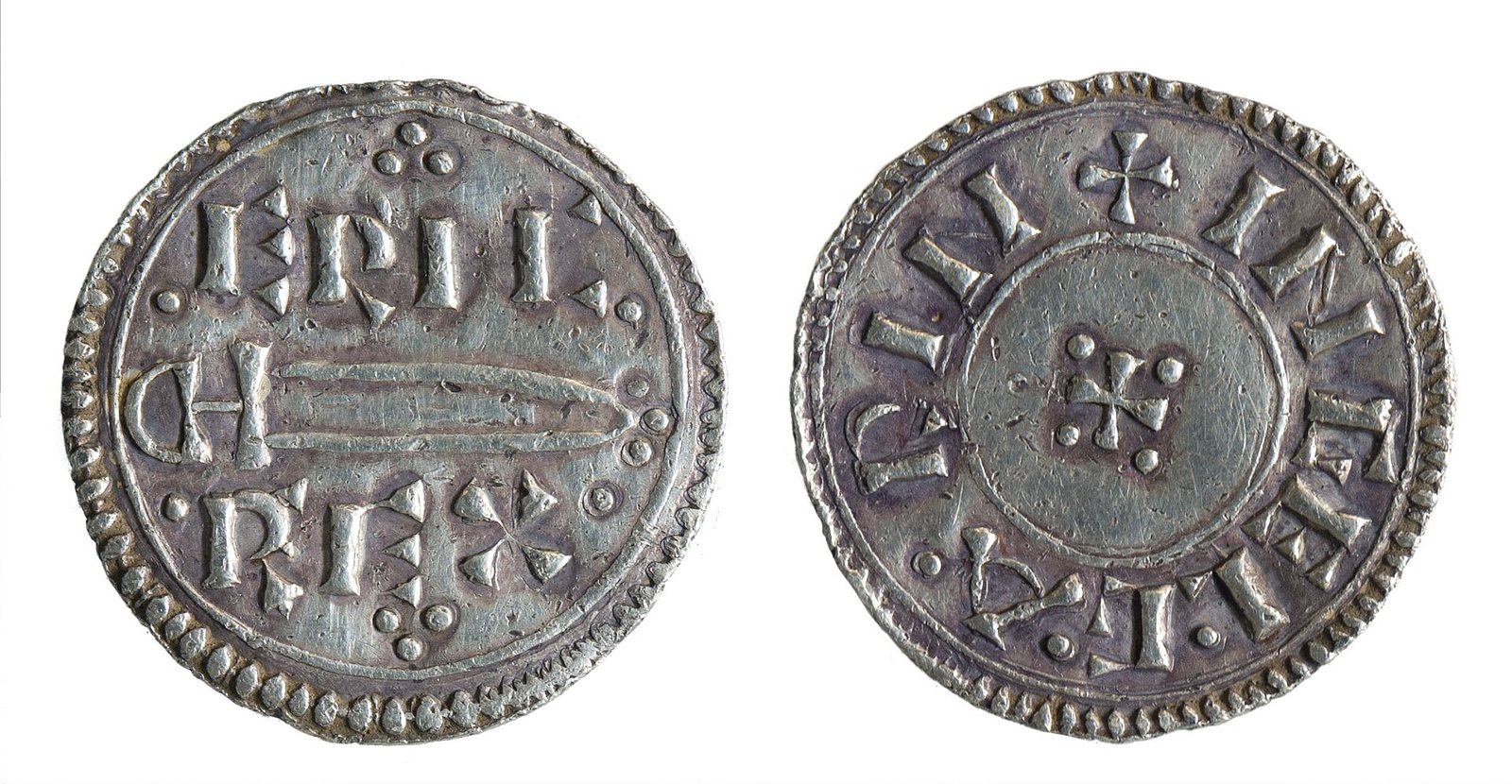
The coins speak even more directly than the Chronicle. Silver pennies from York bearing the name ERIC and the title REX are known – about thirty according to a 2009 count. There are two types. One shows Eric's name in two lines on the obverse with a horizontal sword between them. The other has a cross and the legend around the edge. The British Museum holds a sword-type penny by the moneyer Ingelgar, dated 952–954; another moneyer appearing on both types is Radulf. Whether the two types correspond to the two reigns is uncertain – both could belong to a single phase.
The sword is no warrior's portrait. It draws on earlier York coins that set a sword beside the name of St Peter, patron of the cathedral. And the fact that moneyers like Ingelgar kept striking through several changes of ruler shows how pragmatic the city was about its kings.
For us as engravers that is a lovely twist: a king about whom so much has been written leaves as his most tangible trace a few grams of silver with struck letters.
No episode has shaped Eric's image like his encounter with Egill Skallagrímsson, Icelandic fighter and perhaps the greatest skald of his age. In the saga he is Eric's mortal enemy: in Norway he has killed Gunnhild's men and a king's son and raised a scorn-pole (níðstǫng) – a stake topped with a horse's head meant to turn the land-spirits against the royal couple.
Years later Egill is shipwrecked on the coast of Northumbria – of all places, in Eric's kingdom. He goes to York, to his friend Arinbjörn, a Norwegian lord in Eric's service. Gunnhild wants him dead, but Arinbjörn wins a delay until morning – a killing at night counts as murder – and advises Egill to compose a praise poem overnight. In the morning Egill performs the Höfuðlausn, the "Head-Ransom": some twenty stanzas praising Eric's prowess and generosity. Eric grants him his life.
Formally the poem is unusual. It is composed in runhent, an end-rhymed metre rare in skaldic verse. Many scholars see English or Latin influence here – which would suit a performance in York nicely. If the poem is genuine, it is among the earliest end-rhymed poems in the North.
That "if" is the heart of the dating debate. Some scholars regard the Höfuðlausn as a genuine tenth-century work passed down orally; others see it as wholly or partly a later creation from the saga's own milieu. John Hines put the question squarely in his 1995 article "Egill's Höfuðlausn in Time and Place". Then there is chronology: on the Chronicle's evidence Eric was king in York only in 947/48 and 952–954, so the meeting must fall in one of those windows; it is often placed around 948. And anyone who shares Clare Downham's doubts must even ask whether Egill's enemy from Norway and the king of York were the same person.
In 954 the Northumbrians drove Eric out, says the Chronicle. What happened next is told only by Roger of Wendover, a monk at St Albans, in his early thirteenth-century Flores historiarum. According to Roger, Eric was killed "in a certain lonely place called Stainmore" by a man named Maccus, through the treachery of Earl Osulf. With Eric fell his son Haericus and his brother Reginaldus. After that, King Eadred ruled the land.
Stainmore is a pass over the Pennines on the old Roman road from York to Carlisle – an obvious escape route west. Osulf, lord of Bamburgh, afterwards became Eadred's governor over all Northumbria. A man with a motive, then.
But Roger wrote some 280 years later. He used older northern English material that is now lost, yet we cannot check how faithfully he reproduced it. The Norse sources know nothing of Stainmore. Fagrskinna and Heimskringla have Eric fall in a great battle in England alongside five other kings. The date 954 is secure, the place Stainmore is likely, the details are late.
And then poetry turns a flight across a mountain pass into an entry into the hall of the gods. Eiríksmál, an anonymous memorial poem, is preserved in Fagrskinna, which says Gunnhild had it composed after Eric's death. Probably only its opening survives.
It begins with Odin recounting a dream: before dawn, he had Valhalla made ready for fallen warriors.
What dream is this? I thought I rose a little before day to make Valhalla ready for slain men. I woke the einherjar, bade them rise, strew the benches, rinse the beer-cups, and the valkyries bear wine, as though a prince were coming.Eiríksmál, st. 1, our own translation from the Old Norse text in Fagrskinna
Then Bragi, god of poetry, hears a din as if a thousand men were moving. Odin sends the heroes Sigmund and Sinfjötli to meet the newcomer: it is Eric. Sigmund asks why Odin robbed the king of victory if he thought him so brave. Odin's answer is one of the most famous lines in skaldic poetry, roughly: it cannot be known for sure – the grey wolf gazes at the seat of the gods. Odin needs good warriors for Ragnarök, the last battle against the Fenris wolf, so he takes the best while they are strong. Eric enters and names himself the sixth of six kings arriving with him.
This is the earliest extended scene in which Valhalla appears as the reception hall for a specific, historical dead man. For more on the idea, see our articles on Valhalla and the Einherjar.
The poem's date is disputed: usually soon after 954, by another view only after Hákon's death around 961. For Eyvindr skáldaspillir composed Hákonarmál for Hákon on exactly the same pattern. Most think Eyvindr imitated Eiríksmál. Two feuding brothers, two funeral poems – and both times Odin opens the door.
An awkward yet beautiful finding: Eric, according to Snorri, had been baptised, ruled a Christian city with an archbishop, struck coins with St Peter's sword – and his widow had a poem made in which Odin welcomes him. The old imagery lived on as a language of honour and fame.
So far we have assumed that the brother-slayer from Norway and the king of York were obviously the same man. That is exactly what historian Clare Downham challenged in 2004, in an article with the memorable title "Eric Bloodaxe – axed? The mystery of the last Viking king of York", published in Mediaeval Scandinavia.
Her starting point: the English sources say only that Eric of York was a son of a man called Harald. In the nineteenth century some took him for a son of Harald Bluetooth – citing Adam of Bremen's note that Harald sent a son "Hiring" to England with an army – others for Harald Fairhair's son. The second view prevailed in the early twentieth century, largely through W. G. Collingwood.
Downham argues that the identification rests mainly on the late Norse texts, whose authors may have merged two men called Eric into one figure, perhaps using English information. The queen problem fits her case: the Life of Cathróe knows a kinswoman of the saint, not a Gunnhild.
For the traditional view: the name is Scandinavian, "son of Harald" fits, the timing fits an expulsion from Norway around 935, and the poetry links Harald Fairhair's son with a death in England. Against the Bluetooth option stand the dates – and "Hiring" is not "Eric".
Downham's thesis is regarded as a serious objection but has not produced a consensus. Most accounts still speak of Eric Bloodaxe as king of York, many now with a cautious caveat. That is our position too: the identification is probable, not proven.
Eric grew larger in memory than he was in life. In England he is the final chapter of the Scandinavian kingdom of York that began with the Great Army in 866 – more in our overviews of the Vikings in England and the Danelaw.
A little over a century later another Norwegian of Harald Fairhair's line died on English soil: Harald Hardrada, at Stamford Bridge in 1066. Between the two lies the whole Viking Age in England. And in the Yorkshire Museum a small silver penny with a sword and the name ERIC is the most genuine thing Eric left behind.
For us at Glanz & Gravur, Eric is a lesson: with motifs from saga and Edda we ask whether an image rests on a find, a text or a later fantasy. The man with the bloody axe is a saga figure. The king with the sword on the silver penny is history.
Why was Eric called Bloodaxe? Nobody knows for sure. The sagas of the twelfth and thirteenth centuries link the name to the killing of his half-brothers, Theodoricus calls him "brother-slayer", while Fagrskinna connects it rather with his raiding.
When was Eric Bloodaxe king of York? According to the Anglo-Saxon Chronicle in 947/948 and again in 952–954. In 954 the Northumbrians expelled him and King Eadred took over.
How did Eric Bloodaxe die? According to Roger of Wendover (early thirteenth century) he was killed at Stainmore in the Pennines in 954 by a certain Maccus, betrayed by Earl Osulf. The Norse sagas speak of a battle in England.
What is the Höfuðlausn? A praise poem by Egill Skallagrímsson for Eric, with which, according to Egils saga, he saved his life in York. Whether it really dates from the tenth century is debated.
For courage. For remembrance. For legends that live on.
Egill Skallagrímsson · Ragnar's sons · Stamford Bridge 1066 · The Great Heathen Army · Hedeby.
All History & Finds articles →
Some 1,700 years ago a man from the Near East settled in a Germanic village in present-day Thuringia – and rose into …
Read more →Two horns of heavy gold, covered all over with puzzling figures, and on one of them a line of runes in which, for the …
Read more →The Roman Tacitus praised Germanic women as chaste, honoured and even brave at the edge of battle. But above all he was …
Read more →Somewhere a story must begin. For the kingdom of Denmark this beginning is a man named Gorm – Gorm the Old, the first …
Read more →