
The Norse world knows strong women: Freyja, who rules love and battlefield alike, the Norns who lay down fate, Idun with her apples, Frigg who knows everything and says nothing. If you want to give something to a woman who loves the North, you do not need clichés, you need a motif that suits her and whose pedigree is right. This guide combines the two: it shows what the sources really say about gifts to women, about jewellery and about goddesses, and then sorts the motifs by occasion and personality, with the option of having everything engraved individually.
A gift with a Norse motif has it easy and hard at once. Easy, because the images are familiar and look good. Hard, because a large share of what is sold as "Viking gifts" has little to do with the Viking Age: horned helmets, fantasy runes, women in fur bikinis. Anyone giving a gift to a woman who is seriously interested in the North notices the difference at once.
So we take a detour through the sources. First the question of what women in the Germanic and Viking-Age North were actually given and what they wore, as far as texts and graves show. Then the goddesses and figures that offer themselves as motifs: Freyja, the Norns, Frigg, Idun, the shield-maiden. For each we say what is attested and what later poetry or modern interpretation adds. Finally come occasions, materials and the question of how to make a piece personal without hanging meanings on it that it cannot carry.
The oldest description of Germanic marriage gifts stands in the Germania of Tacitus, written around AD 98. In chapter 18 he explains that among the Germani it is not the wife who brings a dowry to her husband, as in Rome, but the husband to the wife. Parents and relatives attend and inspect the gifts.
"The dowry is brought not by the wife to the husband but by the husband to the wife. Parents and kinsfolk are present and approve the gifts; gifts not chosen for women's trifles, nor to adorn the young bride, but oxen, a bridled horse, a shield with spear and sword."Tacitus, Germania 18 (c. AD 98; our own translation from the Latin)
Tacitus has an agenda: he holds up the supposedly austere customs of the Germani as a mirror to the Romans. He speaks of a bond of shared toil and danger in which the wife receives arms so that she understands herself as a partner in war and peace. What is observation and what is Roman moral rhetoric cannot be separated. But as a starting point the passage works: the first known "gift to a Germanic woman" was neither jewellery nor flowers but an economic asset and a weapon, and it was a matter for the families.
About a thousand years later conditions are easier to grasp in Nordic legal texts, though only in records of the twelfth and thirteenth centuries, such as the Icelandic Grágás and the Norwegian Gulathing and Frostathing laws. Families arranged the marriage. The groom paid the mundr, the bride-price, which later belonged to the bride. The bride brought the heimanfylgja, the trousseau, which the husband administered. Early medieval Germanic law also knows the morning gift (German Morgengabe), a present from the husband on the morning after the wedding, meant to support the wife in widowhood. It is attested, for instance, in Lombard law; the detailed rules differ from region to region.
What matters for the question of gifts: the gift was part of the legal transaction and belonged to the woman; it was meant to provide for her. A woman could divorce, inherit and, if widowed or unmarried, manage her own affairs. This is read from laws and sagas, not from the Viking Age itself, since written sources by Scandinavians from that time are almost only runes, and those are short. More on legal life is in our articles on Viking law and on Norse wedding and christening gifts.
We mention this because it suggests a thought about giving: in the tradition a gift to a woman is not an ornament but something of her own that stays with her. A piece of slate or a pendant with her name, given to her and belonging to her, is in that sense closer to the matter than the mass-produced item.
The best picture comes from graves. In Scandinavia, Viking-Age women, roughly from the ninth into the tenth century, wear a strap dress fastened at the shoulders with a pair of oval brooches of bronze, nicknamed "tortoise brooches". Strings of beads hang between the brooches. Another piece of jewellery is the trefoil brooch, which closed the cloak and has its origin in Carolingian models. Among the beads are glass, amber, carnelian and rock crystal. That thousands of glass beads were found in places like Åhus and Ribe alone speaks to strong demand. Earrings, by contrast, Scandinavian women evidently did not wear; they were seen as a Slavic fashion.
A key often belonged to the outfit. Many women's graves contain keys and pouches, and the sagas speak of the lady of the house carrying the keys to stores and chests. A key is a sign of authority, not decoration. Details on the finds are in our articles on Viking jewellery, on bead-making and on Viking clothing.
Craft also belongs here. Women's graves often hold spindle whorls, loom weights, shears and needles. Cloth was a central economic good: wool, linen and sailcloth came from household workshops where women did most of the work. That belongs in any consideration if one thinks of "gifts for women" historically, because cloth and yarn were among the most valuable things in a household. More on textile craft: Weaving in the Viking Age.
Rank speaks from graves too. In the Oseberg grave, dated by tree rings to autumn 834, two women were buried, the higher-ranking one with sleighs, a wagon, textiles and household gear. Who she was, nobody knows. Proposals range from a queen to a seeress; only the splendour of the grave goods is attested. The find shows that women held property in the form of textiles, jewellery and equipment, and that this property went with them into the grave.
If one goddess stands for self-assured women, it is Freyja. Her name means "Lady". The sources are Eddic poems and Snorri, so the thirteenth century, but with older roots. According to the Grímnismál (stanza 14) she chooses half of the fallen each day for her hall Fólkvangr; the other half goes to Odin. Snorri says in the Gylfaginning that she drives a team of cats, and in the Ynglinga saga that she taught the Aesir the magic art of seiðr. At the same time she is goddess of love and fertility. The poetry does not present her as a saint: in the Lokasenna Loki accuses her of having slept with all the gods. That belongs to the picture and to any fair account.
Famous is her necklace Brísingamen. In the Þrymskviða it bursts from her neck when she hears that the giant Thrymr demands her as his bride, and Thor wears it when he disguises himself as the bride. The skalds call Loki "thief of the Brísingamen", and Heimdall wins it back. It also appears in the Old English Beowulf as "Brosinga mene", which suggests the name is older than the Norse tradition. What the necklace is and what it looked like nobody knows; scholarly commentary is sober: little is known about it. A silver pendant from a grave of about the year 1000 at Hagebyhöga in Sweden shows a woman with a broad necklace; whether that is Freyja remains open. More on this piece in our article on Brísingamen, and on her under Freyja.
As a slate motif Freyja suits women who combine warmth and will. That is our description of the motif, not the source's.
The Norns Urd, Verdandi and Skuld stand in the Völuspá, stanza 20, and in Snorri. Both texts are Icelandic; the Völuspá probably arose in the tenth century and was written down in the thirteenth.
"From there come maidens, much-knowing, three, from the lake beneath the tree. Urd is one called, the second Verdandi – they cut staves –, Skuld the third. They laid down lots, they determined life for the children of men, the fate of men."Völuspá 20 (Elder Edda; our own translation from Old Norse)
Striking is what is not there: this stanza says nothing of weaving or spinning. The Norns "cut staves" and lay lots. Weaving fate appears elsewhere in the Edda, in the Darraðarljóð, where valkyries weave on a loom of spears and entrails, and it is an image that later poetry and the present day transferred to the Norns. That is no forgery, it is how myths grow, but we say so. For a gift the motif stays strong: three women, past, present and future, one shared well. It suits a mother, a grandmother, three friends or three sisters. More on the figures: The Norns.
Frigg is Odin's wife, in the sources more background figure than actor. The Lokasenna says of her that she knows all fates but does not speak of them. In the Völuspá she weeps in her hall Fensalir for Baldr. Snorri tells that she had all beings swear not to harm her son Baldr and still could not turn fate. Her continental counterpart Friia stands in the Merseburg charm, and Friday is named after her, by the usual reading. Whether Frigg and Freyja were once one figure has long been disputed; see our articles on Frigg and on Friday.
As a gift Frigg is a calm, dignified motif for the women who hold everything together in the background, and because she is a mother figure she suits Mother's Day.
Idun keeps the apples the gods eat when they grow old, and become young again. Snorri reports this in the Gylfaginning. The older source is skaldic poetry: in the Haustlöng of Þjóðólfr ór Hvini, around 900, the giant Thjazi abducts Idun with Loki's help, and the gods age until she is brought back. The image is plain: without Idun the gods grow old. More on the figure: Idun.
As a motif Idun stands for freshness, confidence and the good we easily overlook. It fits a new beginning, a birthday or a thank-you. That apples "give youth" is myth, not a promise: neither the motif nor an apple promises anything for the body.
Few motifs are debated as fiercely as the shield-maiden. The sources are literary: in the sagas and in Saxo Grammaticus, around 1200, fighting women appear, such as Lathgertha at Ragnar's side or Hervör in the Hervarar saga. The Byzantine historian John Skylitzes reports of the battle of Dorostolon in 971 that among the fallen Rus armed women were found. Whether that is true nobody knows; scholars like to quote the passage and like to doubt it.
Then there is the archaeological case that has shaped the debate since 2017: chamber grave Bj 581 in Birka. Hjalmar Stolpe dug it in the nineteenth century, and for a long time it counted as a model warrior burial: sword, axe, spears, 25 arrowheads, shield bosses, two horses, a gaming set. A genetic study led by Charlotte Hedenstierna-Jonson found in 2017 that the person buried was a woman. The authors read her as a high-ranking warrior and officer. Critique came at once: Judith Jesch faulted the use of textual sources, Anne-Sofie Gräslund held that the many weapons could signal rank rather than combat, and Fedir Androshchuk pointed to the disturbed state of the graves. The authors replied in 2019 in the journal Antiquity. The honest summary: it is certain that a woman with a full weapons set was buried in Birka. What she did in life is interpretation. The dispute is laid out in our article on Bj 581, and more on the motif under shield-maiden.
A simple rule of thumb helps when the choice is hard: ask yourself what moves the recipient most about the Norse world. If she loves stories and myths, Freyja, Frigg or the Norns fit. If she is more drawn to archaeology and everyday life, a piece modelled on beads, brooches or a historical find is more honest. If she has a strong bond to family and generations, the Norns or Frigg are obvious. Whoever likes fighting spirit takes the shield-maiden but should know the debate behind it. And if you know none of this: a name, a date and a plain sign are safer than a motif that does not belong to her.
Not every woman wants a goddess's image on the wall. Some prefer to carry their link to the North on the body. Our natural jewellery works with real wood and real stones: pendants with runes, Mjölnir or the world tree, plus bracelets with rock crystal, rose quartz or onyx. It is more discreet than a large plate and still recognisably Norse.
For historical context: Viking-Age women's graves yield beads of glass, amber, carnelian and rock crystal. Rose quartz and onyx are not among the typical finds. Anyone who values historical closeness chooses rock crystal, amber or carnelian; anyone who simply likes certain stones makes no mistake, only a different choice. Gemstones are jewellery. Healing or energy effects are not scientifically established, we promise none and ascribe none to any stone. More on the beads and stones of the era: Gemstones in the Viking Age, amber, carnelian beads and rock crystal.
Birthday: A slate plate with her favourite figure or a pendant, perhaps with her name in runes. Such pieces do not stand about arbitrarily on a shelf because they are cut to her.
Mother's Day: Frigg or the Norns strike the note especially well: the one as mother and keeper of the house, the others as an image of generations. A tealight holder of Stölzle crystal glass from Lusatia, laser-engraved by us, brings warm light into the room in the evening.
Valentine's Day and anniversary: Freyja fits here as the Norse image of love. It gets more personal with an old love word or a shared date; ideas are in the article Norse words of love, and anyone seeking a rune for love will find notes under Runes for love. A rune is a written character with a name and a meaning in the transmitted rune rows, not a magic switch; as a gesture it is lovely, as a guarantee it is no use.
Birth, naming, christening: Norse girls' names often have an original meaning. A plate with name and birth date is a gift that grows with the child. Ideas for names: Norse girls' names.
Just because: Sometimes the finest gift is the one without an occasion. A small pendant or tealight holder with a short line says more than an occasion could.
The difference between a nice gift and an unmistakable one often lies in personalisation. We engrave names, a meaningful date or a short line in runes onto slate, wood, pendants or tealight holders. The easiest way is the page Custom Engraving. If you would rather design it yourself, arrange motif, text and runes in the engraving configurator and see the effect at once.
An honest note on runic writing. The Vikings wrote with the Younger Futhark, a row of 16 characters; the Elder Futhark of 24 characters belongs to the time before, before the eighth century. For a modern name there is no single "correct" transliteration, but several, depending on sound value and period. We gladly discuss that with you before engraving. Background: Futhark compared and Runes in scholarship.
A tip from the workshop: if you are not sure about the motif, go for personalisation instead. A plain pendant or a slate plate with her name in runes and a date almost always works, because it is unmistakably hers. If you are unsure which sign means what, drop us a line and we will advise you personally before engraving.
Natural slate is a rock that brings structure, colour and surface with it when split. Every plate is therefore a little different: grain, edges and shades from anthracite to blue-grey vary, and that is a property of the material, not a flaw. Laser engraving removes the surface and creates lighter contours; how strongly the motif contrasts depends on the stone. We describe this soberly because a gift that looks different on unpacking than in the mind spoils the pleasure. On technique: Laser engraving on natural slate; on care: Caring for a slate plate. In short: wipe dry or only slightly damp, no harsh cleaners, and do not leave the plate permanently in the sun or in a place with a lot of moisture.
The line can be drawn in three tiers. Tier one is contemporary finds and texts: Tacitus on bridal gifts (c. 98), the graves of Oseberg, Birka and other sites, the beads and brooches, the runes. Tier two is the Icelandic and Norwegian legal texts and sagas of the twelfth and thirteenth centuries: they describe how women lived, how people married and inherited. Tier three is the mythological poetry: Edda, Snorri, skaldic verse, which show us the goddesses but were written down in the thirteenth century by Christians. A gift motif with a goddess sits on tier three; a pendant with rock-crystal beads on tier one. Both are fine as long as one knows which tier one stands on.
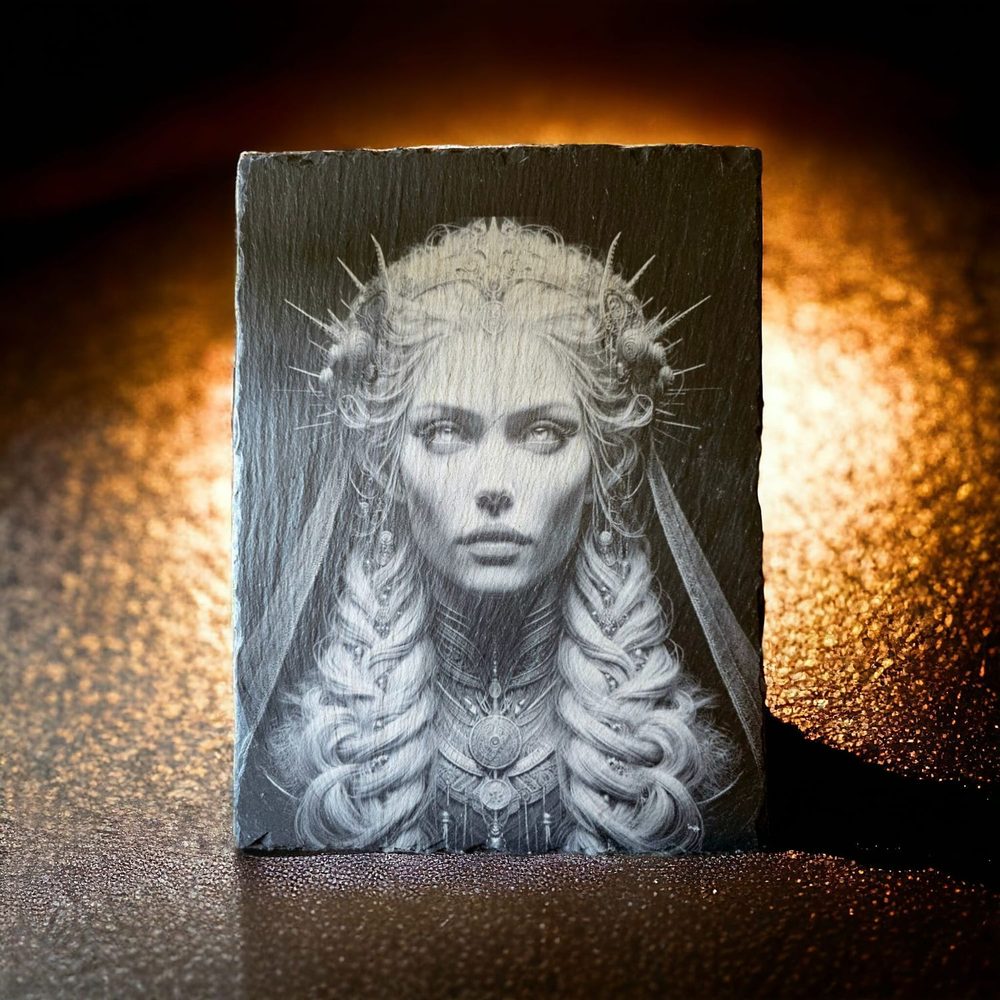
What do you give a woman who likes Vikings? Ideally something meaningful rather than a cliché. Popular are slate plates with Freyja, the Norns or a warrior woman, pendants with runes and laser-engraved tealight holders. If you do not know her taste exactly, choose a personalised piece with a name or date.
Which Norse symbol stands for love? Most of all Freyja herself, goddess of love, and her necklace Brísingamen. A historically attested Viking heart does not exist. It gets most personal with an engraved love word or name.
Can I have it personalised? Yes. We engrave names, dates and rune lines onto slate, wood, pendants and tealight holders. Design your motif via the Custom Engraving page or in the engraving configurator; every draft is checked before engraving.
Did Viking women really fight? Literarily, shield-maidens appear in sagas and in Saxo. Archaeologically, grave Bj 581 in Birka is a woman's grave with weapons; whether the woman buried there fought is disputed.
What did Germanic people and Vikings give their wives? According to Tacitus the groom gave cattle, a horse and weapons. In the Nordic legal texts the bride-price (mundr) belongs to the woman. Jewellery is attested through graves.
Are gemstones in jewellery effective? Gemstones are jewellery. An effect on health or fate is not established, and we promise none.
For courage. For remembrance. For legends that live on.
Viking gifts for men · Norse wedding & christening gifts · Viking jewellery · Norse words of love · Slate, Wood or Glass?.
A tie, another shower-gel set, one more mug with a slogan — for birthdays and Christmas, men often get exactly what …
Read more →The little blue symbol on your phone is over a thousand years old: two interlocking runes – the initials of the Viking …
Read more →Few questions reach us in the workshop as often as this one: „Which material actually suits my motif best?" Whether …
Read more →A dark slate plate, a brief beam of light, and where there was deep anthracite a moment ago, a bright, silvery-white …
Read more →