
Ragnar, Astrid, Björn, Sigrid – Norse names ring of fjord, fire and distant saga. But what really lies behind them? Here you will find how Old Norse names are built, what the best-known men's and women's names mean, and why some things that feel „truly Viking" today were in fact smoothed over in modern times. Honestly explained, evidence kept apart from interpretation – and with a thought on how to hold a name fast in runes.
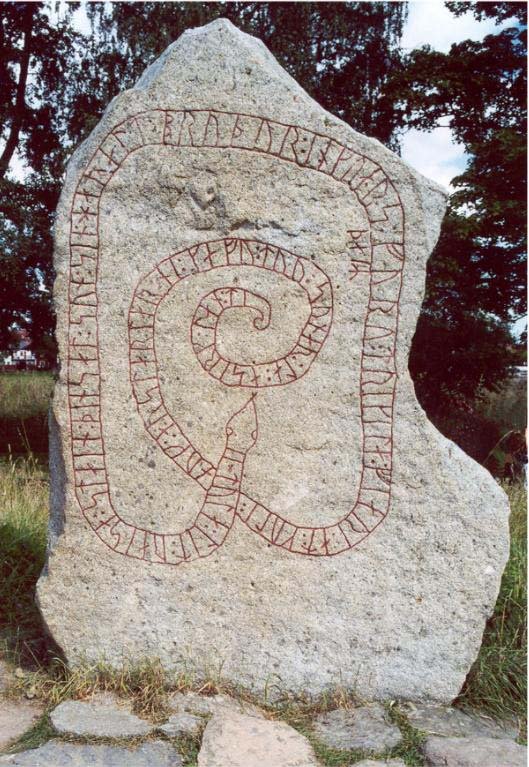
In the North of the Viking Age a person rarely bore a merely pretty name by chance. A name tied its bearer to the family, to a departed ancestor, to a god, or to a quality the parents wished upon the child. Whoever was called „Þórsteinn" carried Thor's name and the hardness of stone within; whoever was called „Sigríðr" was meant to take victory and fair fortune into life. Names were a promise, not an accident.
And they were meant to endure. In a world without registries or gravestone bureaucracy, a person's afterlife hung on what was told and passed on about them – and a strong name was the first thread of that renown. This is exactly what the most famous proverb of the Hávamál speaks of:
Cattle die, kinsmen die, the self must also die; but the fame of a good name never dies for the one who wins it. … I saw the sons of the Fitjung folk; now they are gone with the wind.Hávamál, stanzas 76–77, after Henry Adams Bellows (1923), public domain
The name is the handle by which that fame stays within reach. Small wonder that parents chose it with care.
Most old Norse names are dithematic: they are put together from two meaningful words, a first element and a second element. „Sig-" (victory) plus „-fríðr" (fair, beloved) gives Sigfríðr / Sigrid. „Þór-" (the god Thor) plus „-björn" (bear) gives Þorbjörn. The elements could be combined freely, and they often echoed within a family: father Hallgrímr, son Hallfreðr, daughter Hallgerðr – the same first element held a kin group audibly together.
The building blocks come from a few large fields of meaning, and once you know them you can decode almost any name:
Not every name is dithematic. There were also simple, very old short names and pet names: Björn (simply „bear"), Ari („eagle"), Bjǫrk („birch"), Ulfr („wolf"). They seem plain, and for that very reason are often extremely ancient.
The following selection shows well-known male names, with their Old Norse base form and meaning. Etymologies are linguistic reconstructions; where the reading is only inferred, an *asterisk marks it.
One thing stands out: pure Odin names are rare. While Thor and Freyr appear very often in the name stock, Óðinn hardly occurs as a name element. People seem to have hesitated to bind the unpredictable lord of ecstasy and death into a child's name.
The female second elements tell a world of their own: -dís calls upon the protective female spirit-beings (the dísir), -gerðr means the guarding, enclosing one, -unnr the wave or loving. Battle (-hildr, -gunnr) sits just as naturally in women's names as in men's.
No other field of meaning shapes the Norse names as strongly as that of the animals – and each animal carried its own message. The bear (björn) stood for raw strength and endurance; the wolf (ulfr) for the fighter who battles in the pack yet also for the untamed thing that can turn dangerous to society. The eagle (ǫrn, ari) meant far sight and the lord of the skies; the raven (hrafn) tied its bearer to Odin's birds Huginn and Muninn, to thought and memory. The serpent or dragon (ormr) rang of ferocity and the guarding of treasure. So a whole menagerie of names arises:
These names are not a disguise but a wish: may the child carry the bear's strength, the wolf's courage, the eagle's gaze. It is exactly this imagery that still makes them beloved engraving motifs today.
Many names we still carry because a figure made them unforgettable. From the sagas, kings' histories and heroic lays we know their bearers, and with the name their story resonates:
Whoever chooses Sigurd, Ragnar, Astrid or Gudrun today brings a piece of that storytelling world home – consciously, not as a costume, but as a link to an old thread.
A name was rarely invented freely. Very common was naming after the ancestors: a child received the name of a departed grandfather or grandmother, often in the expectation that with the name luck (hamingja) and a part of the character would be passed on too. Someone who had died shortly before the birth might in dreams „ask" to live on in the child. So the same names travelled down the generations, binding the living to the dead and holding the kin together across time. This custom also explains why names recur within a family and why the first element so often stays the same. For us today there is a fine thought in this: to bear or to engrave a name is to continue a line – from the ancestor, through us, and onward.
There was no family name in today's sense. People were placed through the patronymic: son or daughter of the father. Leifr Eiríksson was „Leif, Erik's son"; Auðr Ketilsdóttir was „Aud, Ketil's daughter". This principle lives on in Iceland to this day (-son / -dóttir). To it was often added a personal byname recording appearance, origin, character or a deed: Haraldr hárfagri („Fair-hair"), Eiríkr inn rauði („the Red"), Ívarr inn beinlausi („the Boneless"), Auðr djúpúðga („the Deep-minded"). First the given name, then the origin, then the mark – and so a human became an unmistakable person. How this worked in daily life, and which bynames existed, we go deeper into in the article Viking names and their meaning.
The same Old Norse name looks different today from land to land – because the Scandinavian languages have grown apart. Þórsteinn became Danish/Norwegian Torsten and Swedish Torsten/Thorsten; Sigríðr became Sigrid; Guðrún became Gudrun, Icelandic still Guðrún. Iceland keeps the old forms most faithfully (with þ, ð and the full endings), while Danish, Norwegian and Swedish have smoothed them out. That is why you meet the same name in several shapes:
None of these forms is „more wrong" than another – they are siblings from one shared root. For an engraving a conscious look pays off: should it be the old, Icelandic-faithful form or the familiar modern one? Both have their appeal; one should simply know what one is choosing.
Scandinavian first names are long past being a niche subject. In Norway, Sweden, Denmark and Iceland, names such as Astrid, Ingrid, Freya, Sigrid, Erik, Björn and Leif have stood high in the lists for generations – partly in unbroken tradition, partly rediscovered in the waves of 19th-century national romanticism and today's delight in Nordic culture. In the German-speaking world too, Astrid, Ingrid, Sven, Björn and Freya have been at home for decades. The names carry their old imagery with them: sun, victory, bear, stone, nearness to the gods – and that still speaks to people today.
Precisely because a name carries origin and wish within it, it makes a fine motif for a lasting engraving – whether your own, your partner's or a child's. What matters to us is honesty: runes are a script, not a magical alphabet. One transfers sounds into rune signs (transliteration) – that is a convention, not a secret. If you like, you can transfer your name into the Elder Futhark with our rune name generator and see how it looks in runes. And should it become a real piece – on slate, wood or stainless steel, cleanly and permanently laser-engraved – we plan it together via the custom engraving page. So a name with meaning becomes an object that endures: the first thread of that renown of which the Hávamál already speaks.
Viking names & their meaning · Old Norse Terms · Runes & their meaning · Kin & Family.
Natural slate is a rewarding material: sturdy, millions of years old and genuinely low-maintenance. Still, there are a …
Read more →Are you the thinker or the protector? The trickster or the watcher? The Norse pantheon isn't a distant gallery of idols …
Read more →The Norse world is full of strong women: Freyja, who rules over love and battle alike, the Norns who weave fate, Idun …
Read more →A tie, another shower-gel set, one more mug with a slogan — for birthdays and Christmas, men often get exactly what …
Read more →