The troll cross, Swedish trollkors, is not a Viking symbol on current evidence but a modern piece of jewellery: an iron ring with crossed, curled ends that appeared in Sweden only in the late twentieth century. The belief behind it, however, is genuinely old. For centuries Scandinavians protected themselves against trolls with steel in the cradle, crosses over the door and crosses cut into the bread dough. We show you what is documented, where the amulet probably comes from, and why we still like engraving it – with an honest label.
Search for “troll cross” and you will quickly find yourself surrounded by blackened iron, leather cords and confident promises. “Ancient Scandinavian protection amulet,” the listings say. “Worn by the Vikings against trolls and evil spirits.” Sometimes the story gets a little extra colour: a farm deep in the Swedish forest, a grandmother, a sign that hung above the barn door for generations.
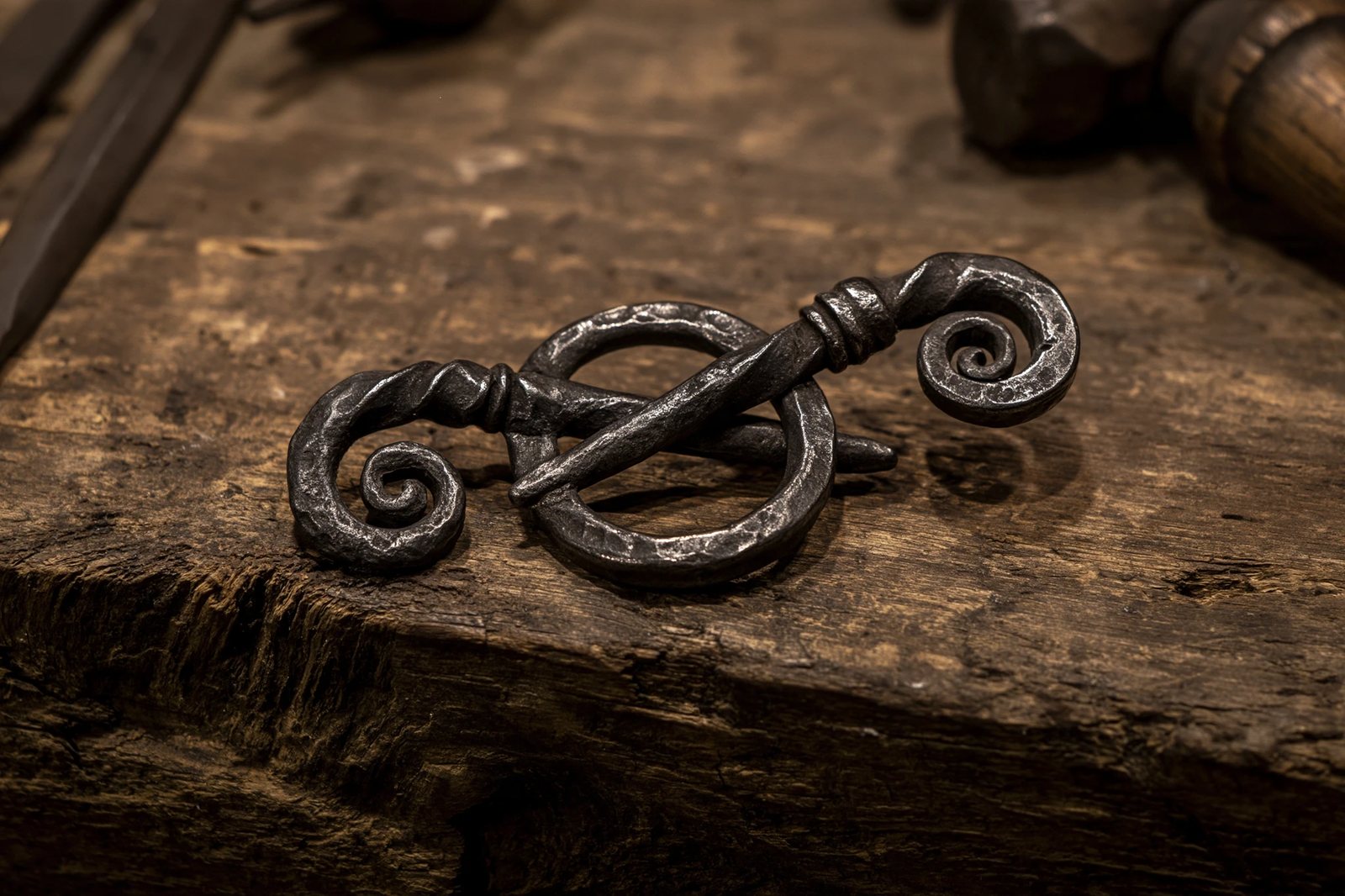
The object itself is easy to describe. A rod of iron is bent into a circle, the two ends cross at the bottom and curl outwards into small spirals. It is worn as a pendant, sometimes as a bracelet. It looks simple and slightly archaic, which explains why it has become one of the best-selling “Norse” amulets on the market.
There is just one problem. For the claim “Viking Age” there is not a single piece of evidence. No grave find, no hoard, no runic inscription and no saga passage shows this sign. Browse the collections of the big Scandinavian museums – the Swedish History Museum in Stockholm, the National Museum of Denmark in Copenhagen, the Museum of Cultural History in Oslo – and you will find Thor’s hammers, cross pendants, rings, brooches and amulets of every kind. A troll cross in its modern shape is not among them.
That does not mean the amulet is built on nothing. Quite the opposite: it draws on a folk belief that was genuinely deep-rooted in Scandinavia and is well documented. The trick is to keep two things apart – the modern piece of jewellery, and the old world of belief it claims as its ancestry. That is exactly what we do here. And because we are an engraving workshop that puts motifs onto slate, wood and glass ourselves, we will also tell you at the end how we handle the troll cross.
Before we get to the amulet, look at the word. Trollkors is older than the iron ring, and it originally meant something different: plain cross signs that people in Scandinavia carved or scratched into objects and buildings to keep “trolls” away.
In this context “troll” did not primarily mean the bulbous-nosed giant of children’s books. In Swedish and Norwegian folk belief the word also stood for harmful magic and for malevolent forces in general. The verb trolla means “to work magic, to bewitch”, and trolldom is sorcery – which is how the great dictionary of the Swedish Academy (SAOB) records them. A troll cross therefore protected not just against creatures from the mountain, but against harmful magic of every kind: envy, witchcraft, the evil eye cast on your cows.
This older practice is particularly well studied for Uppland, the province north of Stockholm. In the 1940s the ethnologist Nils Ålenius of the Upplandsmuseet described in the yearbook Uppland where such crosses were found: cut into the lintel above the farm gate, into the gateposts, into the overhanging upper storeys of storehouses. Sometimes a pair of carved horns flanked the cross. One post from Oxsälra carried two crosses. The gateposts Ålenius studied in 1940 are mostly eighteenth-century structures from the plain around Uppsala, concentrated in the parishes of Bälinge and Björklinge.
Even more striking is a second article by Ålenius from 1943, “Skyddet för födan” – “Protecting the food”. It shows how densely protective signs ran through everyday life, above all wherever food was involved. That is no accident. Bread, milk and grain were life itself. Lose them and you went hungry.
When baking, the housewife cut a cross into the dough. When the loaf was broken, people said “Gu signe” – “God bless”. The sowing loaf, kept from Christmas until the first day of sowing in spring, was decorated with crosses and plaited patterns; it was eaten out in the field, given to the draught animals or crumbled into the seed corn. On hand querns, a carved cross surrounded the hole through which the grain ran down.
Milk was thought to be especially vulnerable, because in folk belief it was a favourite target of harmful magic. Ålenius reports from Odensala that a burning stick was dipped into milk before it was sold, so that nobody could use the milk to bewitch the seller’s cows. If you are curious about the darker side of milk magic, Iceland offers a particularly lurid figure: the tilberi, a magical creature that steals milk from other people’s cows.
The most remarkable object in Ålenius’ article is a trestle table from Vendel, which he dates to the sixteenth or seventeenth century. Each trestle has about nine, possibly ten, crosses cut into it, on the outer and inner faces. Alongside it he describes an old cast-metal cooking pot, also from Vendel, whose legs end in pairs of horns, with a cross between each pair – the very same ornament found on the farm gates.
What makes this fascinating is that these crosses are plainly Christian in form, and yet they work like a charm. Church and folk belief merged over centuries. The cross was the strongest sign anyone knew, so you cut it wherever evil might get in: at the threshold, on the pot, into the bread. How stubbornly older ideas survived beneath a Christian surface is something we explore at length in our article on the Christianisation of the Germanic peoples.
The second pillar of the modern troll cross is its material. The amulet is made of iron, and that is deliberate. The belief that iron and steel keep away trolls, elves and the “hidden folk” is among the best-attested elements of Scandinavian folk tradition.
It shows most clearly in a fear that haunted parents for centuries: the changeling. According to folk belief, the underground people could steal an unbaptised child from its cradle and leave one of their own sickly offspring in its place. The remedies were recorded in many collections. The Swedish folklorist Herman Hofberg, whose legends appeared in English in 1890 as Swedish Fairy Tales, advises keeping the fire burning near an unbaptised child and fastening a needle or some other steel object to its swaddling. Amund Helland’s Norwegian survey Norges Land og Folk (1908) recommends putting steel or a hymn book in the cradle, especially before the christening.
Around these sit many other customs that turn up in variants all over the North: scissors or a knife under the pillow of a woman in childbed, a horseshoe above the stable door, a piece of steel thrown into the water before bathing so that the näck, the water spirit, has no power over you. The tradition varies a great deal from region to region. But the idea that iron and steel protect is documented in countless records from the nineteenth and early twentieth centuries – in Sweden, for instance, in the archives of today’s Institute for Language and Folklore (Isof) in Uppsala.
Why iron, of all things? The tradition itself never really says, and scholars stay cautious. A common suggestion is that the metal stood for the human world of smiths and settled culture – the opposite of the wild, pre-human world of mountain and forest the trolls came from. That is a plausible reading, but it is a reading. For the Viking Age itself we have no source that explicitly describes iron as protection against trolls. What we do know is that iron was valuable and the smith was a respected and sometimes uncanny figure. More on that in our piece on Viking blacksmithing.
If iron kept trolls at bay, church bells did so even more. In Scandinavian legends recorded in the nineteenth century this is a recurring motif: trolls cannot bear the ringing and move away.
A Danish legend published in English by Charles John Tibbitts in 1890 tells of a troll who lived in a hill by the village of Kund, where the church now stands. As the people grew more devout and the bells rang more and more often, he could stand it no longer and moved to Funen. He still wanted revenge, though. He gave a man from Kund a sealed letter to be thrown over the churchyard wall. The man opened it too early – and out of the seal poured an entire lake, which fills the meadow to this day.
Even more famous is the troll as master builder. In Lund the giant Finn is said to have built the cathedral, demanding the sun and the moon as his fee unless the patron could guess his name. The patron overhears Finn’s wife singing a lullaby, calls out the name – and Finn and his wife are turned to stone just as they try to pull the church down. The same story is told of Kalundborg in Denmark (where Esbern Snare calls out the name), of Trondheim, and of Reynir in Iceland. Folklorists call tales like these, which wander across northern Europe with changing names and places, migratory legends; Reidar Th. Christiansen catalogued the Norwegian ones in 1958.
The pattern is always the same: the heathen and the wild are pushed aside by the Christian; the cross and the bell are stronger than the mountain. And the motif is closely related to myth. In the thirteenth century Snorri Sturluson already tells of a giant who offers to build the gods a fortress in return for Freyja, the sun and the moon – and who ends up killed by Thor. The troll builder of Lund is a late descendant of that giant. How the giants of the Edda turned into the trolls of folk legend is the subject of our article on trolls.
Which brings us to the question underneath it all: who or what were trolls to the people of the Viking Age? The honest answer is that they were something vaguer than we tend to imagine.
The Old Norse word troll appears in skaldic poetry and in the sagas, often as a catch-all for threatening supernatural beings – giantesses, revenants, people skilled in sorcery. The boundaries are fluid. In Grettis saga, written down in the fourteenth century, the hero Grettir fights a troll-woman in Bárðardalur who breaks into a farmhouse at night. He cuts off her arm and she plunges into the gorge. But the saga adds, dryly, that the people of the farm told it differently: she was caught by the dawn and turned to stone. Here we already meet the familiar folk motif that trolls cannot endure daylight.
The same saga gives us Glámr, the revenant Grettir defeats in a wrestling match – a figure we would rather class as a draugr, but whom the saga also places close to the trolls. And in medieval texts trolldómr simply means “sorcery”. A troll could even be a human being who practised harmful magic.
The important point for us: in none of these sources does anyone protect himself with a bent iron ring. Grettir has a sword and a short sword, and those do the job. The protective amulets the Viking Age really knew look different: small Thor’s hammers of silver or iron, cross pendants, amulet rings hung with miniature hammers, runic inscriptions with formula words such as alu. What the finds actually show is gathered in our articles on Mjölnir, Thor’s hammer and on runes for protection.
Now to the amulet itself – and here we have to be open about where solid knowledge ends.
In English-language writing, and above all online, the iron troll cross is usually attributed to a smith named Kari Erlands from western Dalarna in Sweden. She is said to have designed it as jewellery in the late 1990s, modelling it on a protective sign she claimed to have seen on her grandparents’ farm. This account appears, among other places, in the English Wikipedia – but explicitly flagged as lacking a source. We could not find a dated primary source during our research: no newspaper article from the time, no interview, no workshop catalogue. Divergent versions of the person, the place and the decade also circulate. Until someone produces solid evidence, we treat the name as “attributed”, not as established fact.
What is fairly certain is that the amulet in its present form does not appear before the late twentieth century. The Swedish Academy’s dictionary has no entry for trollkors, and older ethnological work such as Ålenius’ uses the word for carved crosses, not for an iron ring. The jewellery spread through craft fairs, medieval markets, modern paganism and finally online retail.
An intriguing question is which “protective sign” on the grandparents’ farm might have been meant. The shape clearly recalls the rune othala (ᛟ), a circle or lozenge with two crossed legs. The English Wikipedia suggests – again without a source – that a farm mark was mistaken for a protective symbol. That is plausible speculation, nothing more. But it opens a rewarding side path.
Until the nineteenth century almost every farm in Sweden, Norway and Denmark had a sign of its own, the bomärke or house mark. It was a kind of signature in a world where many people could not write. It was scratched into tools and household goods and put on boundary stones, and it stood for the farm and the family who worked it. When a farm was divided among heirs, a slightly altered mark often appeared, perhaps with one extra stroke. As early as the fourteenth century a village code associated with the Hälsinge Law regulated the use of such marks in Medelpad.
Because house marks are built from straight strokes and arcs that are easy to cut with a knife, they often look strikingly like runes. A circle with crossed feet on an old barn door might well have been a mark of ownership that a child remembered as a mysterious protective sign. And the othala rune itself? Its name is linked to a Germanic word for inherited property, *ōþila, related to Old Norse óðal, “ancestral farm”. That meaning rests on the traditional rune names, above all the Old English rune poem, where the rune is called ēþel, “homeland, inherited land”. No source gives it any role as a protective sign against trolls. For more on the rune row and its names, see our honest introduction to the runes.
The troll cross is not an isolated case. Many signs sold today as “Viking symbols” share a similar biography. Once you know it, you spot the pattern quickly.
The best-known example is the Vegvísir, the eight-armed “wayfinder” said to stop you losing your way in a storm. It is genuinely old, but not Viking Age: it comes from early modern Icelandic magical manuscripts, above all a compilation from the middle of the nineteenth century. Roughly 800 years separate it from the Vikings. Its career as a “Viking compass” only began when it migrated into tattoo studios, fantasy art and online shops in the twentieth and twenty-first centuries.
The same goes for the Web of Wyrd, a modern design, and for the name valknut, which does not occur in the old sources – even though the sign itself appears on picture stones. The pattern runs in four steps:
With the troll cross you can follow this path almost like a textbook case. The core is real: crosses and iron as protection against trolls. The new creation is a smith’s piece from around the turn of the millennium. The origin story is the sign on the grandparents’ farm. And multiplication has turned the whole thing into a “Viking amulet”, although the original story never even claimed that.
If you want to test such signs yourself in future, ask three questions. Is there a dated find? Is there a written source, and if so, from which century? And who tells the story first? A fuller overview of the best-known signs is in our article Which Norse symbols are real – and which were invented?.
Trolls were not the only beings people guarded against. Scandinavian folk belief knew a whole neighbourhood of creatures living alongside humans: the underground people, the huldra with her cow’s tail in the forest, the näck in the water, the elves who could bring sickness. Some of their forerunners already appear among the elves of the Edda.
What all these ideas share is that the human world was imagined as an ordered space – house, farm, baptised child, blessed bread – surrounded by an unpredictable world beyond. The protective measures marked the boundary: steel at the cradle, a cross on the gate, a bell above the village. The modern troll cross picks up exactly this boundary thinking and makes it wearable. That part is real.
So how do we handle it at Glanz & Gravur? Simply: we are happy to engrave the troll cross if you want it. It is a beautiful, clear shape that looks superb on slate and wood. But we will not label it “ancient Viking symbol”, because it is not.
We describe it as what it is: a modern jewellery motif from Sweden, probably created in the late 1990s, inspired by the genuine Scandinavian folk belief that iron and crosses protect against trolls and harmful magic. That is not a weaker story. Honestly, we think it is a better one. A symbol does not have to be a thousand years old to mean something. Nobody wears a wedding ring because it is archaeologically attested.
If you would rather have something with a demonstrably old pedigree, there are alternatives: the plain carved protective cross after the Uppland model, perhaps flanked by a pair of horns, as it stood on farm gates. A farm mark of your own for your family, designed like a bomärke – a lovely idea for a door sign. Or a Thor’s hammer based on a specific find. For all three we can tell you exactly where the model comes from.
All that matters to us is that you know what you are hanging on your wall or wearing around your neck. The knowledge is part of the piece.
Is the troll cross a real Viking symbol? No. There are no finds and no written sources from the Viking Age for the bent iron amulet. On current knowledge it is a modern piece of Swedish jewellery.
Who invented the troll cross? It is usually credited to a smith named Kari Erlands from western Dalarna, said to have designed it in the late 1990s. We found no reliable dated source for this, so the attribution remains uncertain.
What does the troll cross mean? It is meant to protect against trolls, evil spirits and harmful magic. That meaning draws on genuine Scandinavian folk belief that iron, steel and cross signs keep trolls away.
What was a “trollkors” originally? In older Swedish folk custom the word meant simple crosses cut into farm gates, storehouses, furniture or bread to ward off harm – particularly well documented in Uppland.
Why does iron protect against trolls? The tradition does not explain it. A common interpretation is that iron stood for human culture and was therefore the opposite of the trolls’ wild world.
Can I still wear a troll cross? Of course. It is a handsome sign with a real background in folk belief. Just do not pass it off as a Viking-Age artefact.
For courage. For remembrance. For legends that live on.
Norse symbols: real or invented? · Vegvísir & Ægishjálmr · The Triquetra · The Web of Wyrd · The Valknut.
Slender animals and serpents winding around one another in endless, elegant loops, as fine as if drawn with a pen: this …
Read more →Three interlocking triangles, an eight-armed magical stave, a “wayfinder” – few areas are as full of beautiful …
Read more →