In Norse mythology a troll was originally not one particular creature but a label: Old Norse troll covered giants, sorcerers, fiends and anything uncanny that stood outside the human order. Only the later folklore of Norway and Sweden shaped the familiar mountain troll with the bulbous nose, who turns to stone at sunrise and flees the sound of church bells. We follow the trail from the troll-woman who challenged the poet Bragi, through Grettir's fight at the waterfall, to Kittelsen, Ibsen and Tolkien.
Evening, a forest, a poet travelling alone. Out of the dusk a woman's voice asks who goes there. Then she tells him what she is: the swallower of the sky's bright wheel, the companion of the seeress, the warden of the corpse-fjord. And she ends with a question that could stand over this whole article: what is a troll, if not that?
That scene is more than a thousand years old, and it reveals something the souvenir shops of Bergen prefer not to mention. The medieval troll had no potato nose and no cow's tail. It was a category, not a costume. To understand where trolls come from, you have to dig through three layers: the language, the medieval literature of Iceland, and the folklore of Scandinavia, which was only written down and drawn in the nineteenth century.
The Old Norse noun troll (also spelled tröll) is grammatically neuter, and that alone tells us something. It describes less a creature of fixed shape than a quality: the alien, the threatening, the supernatural. In the sources troll can mean a giant, a giantess, a ghost, a human being with uncanny powers, or simply an enemy you want to insult. The origin of the word is unresolved. Etymological dictionaries trace it to a Germanic *trulla- whose basic meaning is uncertain, and Middle High German knows trolle in the sense of fiend or lout. The Norwegian national encyclopedia, the Store norske leksikon, puts it honestly: scholars are unsure of the word's original meaning.
The derived words are revealing. The verb trylla means to enchant, or to turn someone into a troll. Trolldómr and trollskapr mean sorcery, usually the harmful, forbidden kind. A saga character called trollaukinn is "troll-enhanced", gifted with uncanny abilities. This is where trolls meet seiðr, the Norse magic that the sagas so often view with suspicion: people skilled in sorcery could themselves be called troll.
The law knew the troll too. According to the Store norske leksikon, Norwegian laws of the eleventh and twelfth centuries prohibited "sitting out to wake trolls", referring to útiseta, the practice of sitting outside at night to consult the dead or the spirits. The ban carried on in King Magnus the Lawmender's national law of 1274. In Christian Norway the troll was not just a figure of tales but a matter for legislation.
And what about the giants? The Edda has several words for them: jötunn, þurs, risi and troll. Whether these named distinct classes of beings is disputed. The philologist Lotte Motz proposed such a division; the Icelandic scholar Ármann Jakobsson considers it unsupported and reads the words as overlapping labels for the Other. A troll was whoever stood beyond the boundary: out in Jötunheim and the mountains, or outside law and community.
The opening scene comes from Skáldskaparmál, the handbook of poetic diction in the Prose Edda of Snorri Sturluson (c. 1220). Snorri says the skald Bragi Boddason was driving through a forest late one evening when a troll-woman addressed him in verse. Bragi is counted among the oldest named skalds and is dated to the ninth century. Whether the stanzas really go back to him, or were attributed to him later, cannot be proven; Snorri, at any rate, preserves them under his name.
The troll-woman does not introduce herself by name but with kennings, the riddling circumlocutions for which skaldic poetry is famous. In Old Norse her stanza opens with Troll kalla mik, "they call me troll", and closes with hvat er troll nema þat?, "what is a troll but that?" In between she calls herself, in loose paraphrase, a giant's moon, a giant's wealth-sucker, the bane of the storm-sun, the seeress's companion, the warden of the corpse-fjord and the swallower of the wheel of heaven.
Look at what is packed into that list. She is bound to the giants, but also to the völva, the seeress, and so to magic. She threatens the sun, like the wolves of the Edda, and the corpse-fjord points to death and the underworld. Bragi answers in the same form: skalds, people call him, and he describes himself as a craftsman of Odin and a bearer of the poet's gift. A duel of words between the man of language and the creature of the night. The troll-woman defines herself not by her looks but by her effect: she devours light, stands close to death and belongs with giants and witches. Not a wart in sight.
The motif every child knows today has its oldest clear attestation in a heroic poem of the Poetic Edda, Helgakviða Hjörvarðssonar. Helgi's fleet lies at anchor in a bay, and at night a giantess called Hrímgerðr appears, daughter of the giant Hati whom Helgi has killed. She wants revenge. Helgi's man Atli is on watch and engages her in a senna, a contest of insults in which each side tries to outdo the other.
The flyting is a trap. Atli keeps Hrímgerðr talking until daybreak. Stanza 30 begins in Old Norse Dagr er nú, Hrímgerðr, "it is day now, Hrímgerðr". Atli has held her until her end, and now she will stand as a laughable hafnarmark, a harbour mark, in the shape of stone.
"As a harbor mark men shall mock at thee, / Where in stone thou shalt ever stand."Helgakviða Hjörvarðssonar 30, trans. Henry Adams Bellows (1923)
If any saga hero stands for fighting trolls, it is Grettir Ásmundarson, the outlaw. Grettis saga is one of the Sagas of Icelanders and was probably written down in the early fourteenth century, some three hundred years after the events it describes. In chapters 64 to 66 Grettir arrives under a false name, calling himself Gestr, "Guest", at the farm of Sandhaugar in Bárðardalur in north Iceland.
At this farm people have vanished at Yule two years running: first the farmer, then a farmhand. On Yule eve Grettir stays alone in the house while the mistress crosses the river to attend Mass. At midnight a huge troll-woman comes in, carrying a trough in one hand and a great chopper in the other. A wrestling match follows that wrecks half the hall. She drags Grettir out to the gorge of the river. There he gets his right hand free, draws his short sword and strikes off her arm.
"she fell into the gulf and was carried down the force."The Story of Grettir the Strong, ch. 65, trans. Eiríkr Magnússon and William Morris (1869)
The saga then offers two explanations, which is typical of its style. Grettir himself says she threw herself into the gorge. The people of Bárðardalur, however, said that daylight overtook her while they wrestled, that she burst when he cut off her arm, and that she still stands on the cliff in the likeness of a woman of stone. That is the sunlight motif right in the middle of a saga, and a local legend explaining a feature of the landscape, exactly the kind of storytelling that would later shape Scandinavian folklore.
The story is not over. After Yule, Grettir has himself lowered on a rope, dives beneath the waterfall and finds a cave behind it. A giant, called jötunn in the saga, sits by a fire. The giant attacks with a long-shafted blade the saga calls a heptisax; Grettir cuts through the wooden shaft and kills him. Steinn the priest, who was supposed to mind the rope, sees blood and entrails drifting downstream, assumes Grettir is dead and goes home. In the cave Grettir finds the bones of two men, climbs back up the rope alone and, that night, leaves the bones at the church door together with a rune-stick on which he has carved verses about the fight.
Anyone who knows the Old English epic Beowulf will sit up here. There too a hero first fights a night-stalking monster in a hall, Grendel, and tears off its arm. Then he follows the trail to an eerie mere, dives down and kills Grendel's mother in an underwater hall. And, as in the saga, men waiting above see blood in the water and give the hero up for dead.
The resemblance has been debated since the nineteenth century and is one of the most discussed questions in Old Germanic studies. One detail catches philologists' attention: the rare weapon name heptisax in the saga has an exact Old English counterpart, hæftmece, which occurs in the whole Old English corpus only in Beowulf. A direct dependence of the saga on the poem is nonetheless considered unlikely; centuries and the sea lie between them. Scholars discuss a shared older narrative tradition or a widespread folktale pattern, such as the "Bear's Son" type proposed by Friedrich Panzer in 1910. In 1998 the Icelandic scholar Magnús Fjalldal argued that many of the claimed correspondences are weaker than they look.
For our purposes what matters is this: Grendel's mother and the troll-woman of Sandhaugar belong to the same type, female monsters who live by the water and take people from the hall. The North called that type troll. For more on Beowulf's people, see our article on the Geats.
The same saga contains a figure often wrongly filed under trolls: Glámr. He is a sinister shepherd from Sweden who is killed on Yule eve by some unknown evil being, and who then comes back. Grettir wrestles him down on a famous moonlit night and beheads him. But before he dies Glámr curses him: from now on Grettir will be afraid of the dark.
Glámr is not a troll but a draugr, a revenant, a dead man who returns in the body. The difference matters. The draugr was once human and comes back from the grave; the troll is the Other from the start. In the sagas the boundary is porous, though: because troll is such a wide term, the undead or malicious sorcerers can also be abused as "trollish". Ármann Jakobsson's book The Troll Inside You (2017) explores exactly these fluid categories of the paranormal in the medieval North.
After Christianisation the trolls lived on in a new role. In the legends of Norway and Sweden, handed down orally for centuries and systematically collected from the nineteenth century, they inhabit the mountains, the forests and the boulder fields. They are old, strong, often gigantic, sometimes many-headed, and they have a problem with Christianity.
One story type is found all over Scandinavia: a troll is annoyed by a new church and hurls boulders at it. He always misses, because trolls are poor throwers and God protects the building. The boulder still lies in some field today as proof. Another type tells how the trolls left a district because they could not stand the endless ringing of church bells. In some traditions thunder also frightens trolls, which scholars such as John Lindow read as a distant memory of Thor, the giant-slayer.
Trolls remained dangerous all the same. They stole children and left changelings in the cradle, and they took people into the mountain. Being "taken into the mountain" (Norwegian bergtatt, Swedish bergtagen) is one of the strongest motifs in the tradition: whoever was taken came back confused, or not at all. Protection came from steel, fire, the sign of the cross and the name of God.
And the sunlight? In the folk belief of many regions trolls had to get back inside their mountain before dawn, or they would freeze into stone or burst. Striking rock formations were explained this way: here stands a troll the sun caught out. These landscape legends have a long pedigree, from Hrímgerðr the harbour mark, through the rock in Bárðardalur, to the stone noses hiking guides still point out on Norwegian trails.
Folklore does not always sort its creatures neatly, and that is what keeps it alive. Beside the great mountain trolls stand the huldrefolk, the "hidden people", who live under the ground, keep cattle and look much like humans. The best known of them is the huldra: a beautiful woman in the forest who gives herself away from behind, with a cow's tail or a back hollow like a rotten tree. In Sweden her counterpart is the skogsrå, the lady of the woods.
The line between troll and household spirit is fluid too. The nisse or tomte lives on the farm rather than in the mountain, but belongs to the same world of beings you feed and do not provoke. According to the Store norske leksikon, Swedish trolls are on the whole more human-like and less frightening than Norwegian ones. In Iceland the Christmas fiends are Grýla and the Yule Lads, and the sources call them tröll as well.
That we have a fairly fixed image of the Norwegian troll today is thanks to two men: the naturalist Peter Christen Asbjørnsen and the theologian Jørgen Moe. Inspired by the Brothers Grimm, they collected folk narratives and began publishing their Norske Folkeeventyr in instalments from December 1841. The Norske Huldre-Eventyr og Folkesagn followed between 1845 and 1848.
In these tales the troll is huge, cruel, ugly, about as sociable as a boulder, and stupider than humans. He is beaten by the cleverest, not the strongest: the Askeladden, the Ash Lad, the youngest brother who sits by the hearth. In the tale of the Ash Lad who had an eating match with the troll, he secretly stuffs a knapsack under his shirt, slits it open and talks the greedy troll into doing the same. The troll dies of his own stupidity. And the Three Billy Goats Gruff outwit the troll under the bridge by always fobbing him off with the next, bigger goat. According to the Store norske leksikon, both tales were published in 1843.
This is where the troll loses its terror: the power of the wilderness becomes an opponent you can laugh at. In the Norway of national romanticism, which after the separation from Denmark in 1814 was searching for its own culture, the troll became a national figure.
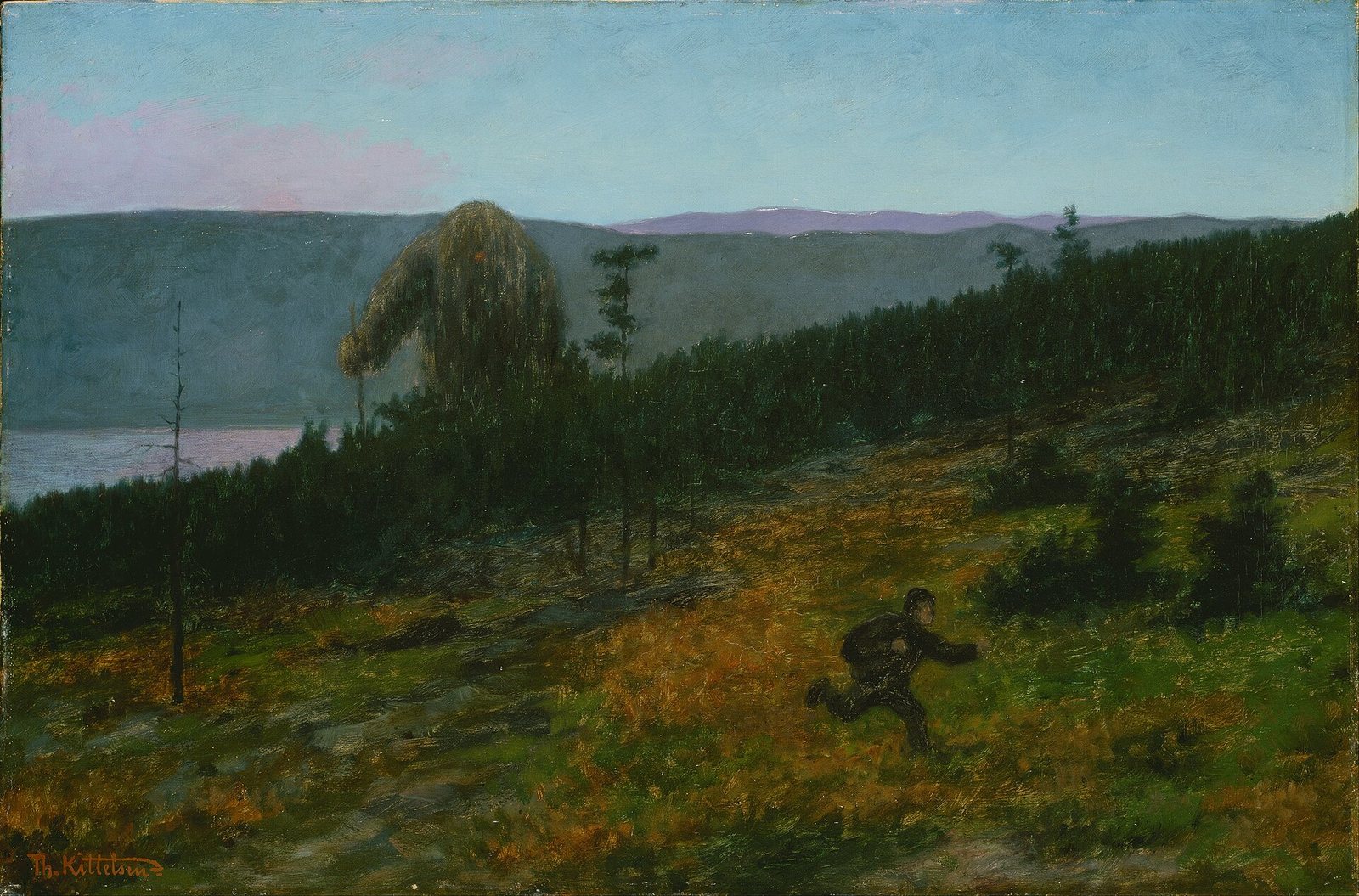
Illustrated editions followed from 1879; for the Eventyrbog for Børn (1883–1887) the drawings came from Erik Werenskiold and Theodor Kittelsen (1857–1914). Kittelsen gave the Norwegian troll its face. His trolls are not clawed monsters but landscape with eyes: mossy giants whose backs are forests, brooding over fjords, so vast that a human beside them looks like a beetle. In 1892 he published his own book, Troldskab ("Troll Magic"), with images such as the water spirit Nøkken. His picture of the Ash Lad in the eating contest still adorns countless fairy-tale books.
In Sweden, John Bauer (1882–1918) created a very different troll. From 1907 he illustrated the annual Christmas book Bland tomtar och troll ("Among Gnomes and Trolls") almost every year until 1915. Bauer's trolls are heavy, good-naturedly dim and often melancholy, standing in dark spruce forests beside delicate princesses. Bauer himself died on the night of 20 November 1918, together with his wife and son, when the steamer Per Brahe sank in Lake Vättern. He was only 36.
The most significant literary troll was written by Henrik Ibsen. In his dramatic poem Peer Gynt, published in 1867, the title character stumbles into the hall of the Dovregubben, the Old Man of the Dovre mountains, king of the trolls. The king wants Peer to marry his daughter and explains the difference between humans and trolls. Among men the saying is: man, be yourself. Among trolls: troll, to yourself be enough.
That one word turns the troll into a question of character. For Ibsen the troll is no longer a mountain monster but the person who is sufficient unto himself, smug and blind to everything else. To stay, Peer is supposed to accept a tail and have his eye scratched so he will see the world as a troll does. That is where Peer draws the line. At the premiere in Christiania on 24 February 1876 Edvard Grieg's incidental music was heard, including "In the Hall of the Mountain King", which no troll documentary has done without since.
The troll's road into pop culture runs through Oxford. J. R. R. Tolkien, professor of Old English and a close reader of the Edda, put three trolls named Bert, Tom and William into The Hobbit (1937). Gandalf keeps them squabbling with imitated voices until the sun comes up, and they turn to stone. That is Atli against Hrímgerðr and Thor against Alvíss, with Cockney accents. Tom Shippey has pointed out that Tolkien's readers in 1937 knew trolls from Grimm and from Asbjørnsen and Moe.
Then there are the harmless trolls: the Moomins of the Finland-Swedish author Tove Jansson (in the original mumintroll), the Danish good-luck trolls, or the Norwegian films Trollhunter (2010) and Troll (2022). And the landscape carries the old names onward: Trollstigen, Trolltunga, Trollveggen, Trollheimen.
The internet troll is only a distant cousin. The Store norske leksikon suggests the modern sense probably comes from the English verb to troll, fishing by trailing a lure. That the word fits the creature under the bridge who heckles passers-by so well is a happy accident of language.
What we at Glanz & Gravur love about the troll is that it is landscape. Natural slate suits it like few other materials: dark, layered, with broken edges that look like rock themselves. A troll silhouette in the style of the rock trolls, its back flowing into a mountain ridge, looks on slate as if it had always been there. If you prefer something literary, take the troll-woman's question as an inscription: Hvat er troll nema þat? "What is a troll but that?" Over a front door it makes a wry greeting to every visitor.
If you would rather protect than tease, choose the troll cross, knowing that it is a modern sign. We are happy to help you find the right motif for your slate, wood or glass.
Where do trolls come from originally? The word troll is Old Norse and referred to giants, sorcerous beings and fiends in general. The modern shape of the mountain troll grew out of Scandinavian folklore and was fixed in the nineteenth century by folktale collections and illustrators.
Are trolls and giants the same thing? In the medieval sources the terms overlap heavily; troll can mean a giant, but also a sorcerer or a ghost. Whether there were separate classes of beings is disputed among scholars.
Why do trolls turn to stone in sunlight? The motif goes back at least to the Edda: the giantess Hrímgerðr turns to stone at daybreak in Helgakviða Hjörvarðssonar. In folklore it explained striking rock formations in the landscape.
Why are trolls associated with Norway? Asbjørnsen and Moe's collections from 1841 and Theodor Kittelsen's pictures made the troll a Norwegian national figure in the age of national romanticism. Place names such as Trollstigen and Trolltunga keep that alive.
Do trolls appear in the Icelandic sagas? Yes, most famously in Grettis saga, where Grettir fights a troll-woman at Sandhaugar and kills a giant behind a waterfall. The episode closely resembles Beowulf's fights with Grendel and his mother.
For courage. For remembrance. For legends that live on.
The Huldra · Nisse & Tomte · The Draugr – the walking dead · The Troll Cross · Seiðr – the magic.
All Beings & Creatures articles →
Almost everything that makes the gods mighty comes from a single set of hands: those of the dwarves. Thor’s hammer …
Read more →Between gods and humans dwells a third, half-hidden race: the elves (Old Norse álfar). They are bright and beautiful …
Read more →At the feet of the father of the gods lie two wolves: Geri and Freki – both names mean „the greedy one". In the hall of …
Read more →The end of the world does not begin with thunder but with a rooster's crow — and it sounds three times over. Three …
Read more →