The fylgja and the hamingja are two Old Norse ideas about what belongs to a person: the fylgja is a personal attendant spirit, or “fetch”, that appears as an animal or a woman, while the hamingja is the luck of a person and their kin, which can be lent and inherited. We follow both through the sagas – from the bloody goat in Njáls saga to the giantess in Víga-Glúmr’s dream and the nine black riders – sort out how they relate to the dísir, and keep saga, later folklore and modern esotericism clearly apart.
Wish an Icelander a happy birthday and you will hear Til hamingju! – roughly “to luck”, the everyday Icelandic for “congratulations”. In the modern language hamingja simply means happiness or good fortune. Nothing in the word betrays that some eight hundred years ago it could name a figure who walks beside a man, abandons him at his death and crosses the sea to find his grandson. That gap is where our investigation starts.
The two terms in this article belong together, but they are not the same thing. The fylgja (plural fylgjur) is literally “the follower, the companion”: the noun comes from the verb fylgja, “to follow, to accompany”. English translators of the nineteenth century usually rendered it as “fetch”, borrowing an old word from Irish and northern English folklore. The hamingja is the luck of a person or a family – not luck as a roll of the dice, but something that clings to you, that you can lose, lend and bequeath, and that occasionally becomes visible.
Two linguistic details already say a lot. In Icelandic, fylgja also means “afterbirth”. Hallvard Magerøy’s entry in the Norwegian encyclopaedia Store norske leksikon mentions the belief that the afterbirth stood for the newborn’s fylgja, and that a child whose afterbirth was destroyed was fylgjulaus, “without a fylgja”. Hamingja, for its part, is usually traced back to an older *ham-gengja, “one who walks in a shape (hamr)” – a being that appears in borrowed form. The etymology is widely accepted but not beyond doubt; we will come back to the hamr later.
Before the stories, an honest inventory. For fylgja and hamingja there is not a single secure piece of evidence from the Viking Age itself: no runic inscription naming a fylgja, no grave find that can be read that way with confidence. Almost everything we know comes from Icelandic prose of the thirteenth and fourteenth centuries – the sagas of Icelanders, the kings’ sagas and shorter tales known as þættir. They were written by Christians, two or three centuries after Iceland’s conversion around the year 1000.
That does not mean the ideas were invented. The authors use the terms as if their readers knew them well. It does mean we see the fylgja through a Christian, medieval lens, and many scenes are carefully built as foreshadowing or as a quiet verdict on a character. The Norwegian scholar Else Mundal showed in her study Fylgjemotiva i norrøn litteratur (1974) how differently the motifs work from text to text, and argued that the animal fylgja and the female fylgja probably have different roots.
One witness has an older ring to it: the Eddic poem Vafþrúðnismál. In stanza 49 three throngs of maidens come over the settlements, and the poem calls them the only hamingjur in the world, “though they were raised among giants” (our own rendering). Henry Adams Bellows translated the line freely in 1923: “They all shall protect the dwellers on earth.” The poem survives in the Codex Regius of around 1270; how much older it is cannot be said precisely. Still, it shows that hamingja could name female protective beings within myth.
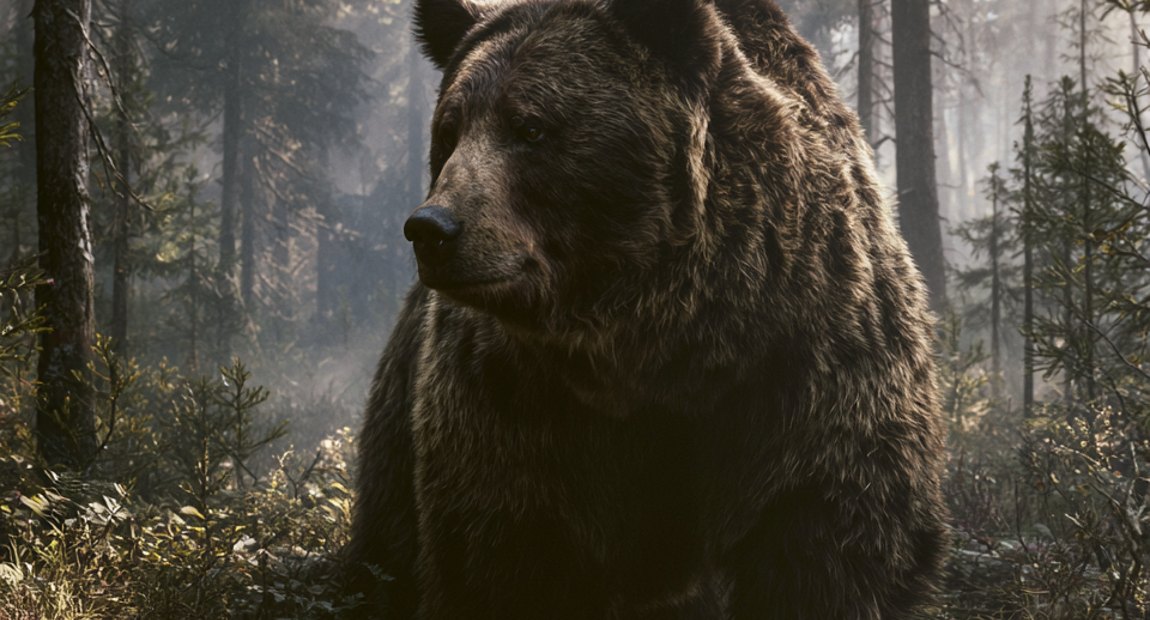
The best-known form is the fylgja in animal shape. It belongs to one individual and shows what is inside them. The sagas keep returning to the same animals: bear and bull for powerful chieftains, the wolf for warriors and enemies, the fox for the sly or the sorcerous, along with eagles, boars, goats and horses.
Take an example from Hávarðar saga Ísfirðings: a man dreams of a vixen leading eighteen wolves. Soon afterwards a band of attackers arrives, led by a man skilled in magic. The animals are the attackers’ fylgjur, running ahead of them. Strange as it sounds, the “follower” in the sagas often goes in front. It announces who is coming.
The choice of animal is never random; it tells you how the saga rates a person. Here the fylgja touches other animal images of the North, such as the wolf- and bear-warriors we discuss in our articles on the berserkers and the úlfheðnar. The difference matters: a berserker becomes bear-like in battle. A fylgja is a separate being that accompanies its person.
The fylgja shows itself most often in dreams – and usually not to its own person but to someone else. Dreams are a favourite device for announcing disaster in the sagas; see our piece on draumar, the dreams of fate.
In Njáls saga, written down around 1280, Gunnar of Hlíðarendi rides out with his brother Kolskeggr and young Hjörtr. On the way Gunnar falls asleep and dreams that at Knafahólar many wolves set upon them and tear open Hjörtr’s breast. Hjörtr refuses to turn back, and shortly afterwards the ambush comes at exactly that spot; Hjörtr is killed. The saga does not spell out what the wolves mean, but the pattern is unmistakable: the beasts stand for the attackers already on their way.
A second example comes from Ljósvetninga saga, a north-Icelandic saga about rivalries in Eyjafjörður. Shortly before the death of the great chieftain Guðmundr inn ríki (“the Powerful”), his brother Einarr Eyjólfsson dreams of a large ox coming up the valley and collapsing at Guðmundr’s farm of Möðruvellir. Einarr reads the animal as a man’s fylgja – and Guðmundr dies. An ox suits a wealthy, weighty lord. (We were not able to check the exact wording against the original text for this article; the episode is regularly cited in scholarship as a fylgja dream.)
Gísla saga Súrssonar takes a different turn. In his last years the outlaw Gísli is visited by two dream-women, a “better” and a “worse” one (betri and verri draumkona). The good one urges him towards gentleness and promises him a kindly dwelling after death; the bad one threatens blood and ruin. The dreams are cast in verse. The word fylgja is never used – yet the figures stand so close to the female fylgja and the dísir that Carolyne Larrington describes them as hard to tell apart.
Now it gets eerie. As a rule you never see your own fylgja. Whoever does see it while awake is feigr, “fey” – an Old Norse word that survives in English as “fey” and in German as feige, but originally meant “doomed to die”.
The classic scene is again in Njáls saga, chapter 41. Þórðr, foster-father to Njáll’s sons, sees a goat lying in a hollow in the home-field, all one gore of blood. Njáll sees nothing there. In George Webbe Dasent’s translation of 1861 he tells Þórðr: “Thou must be a ‘fey’ man, and thou must have seen the fetch that follows thee, and now be ware of thyself.” Þórðr shrugs it off and is killed soon afterwards. A goat, not a wolf: Þórðr, a freed slave, is a loyal and kindly man, and his fylgja fits him.
The logic is simple and chilling. The fylgja is bound to its person’s life; when it shows itself, the bond is coming loose and the thread has run out. It recalls the Norns, though the sources never link the two.
The second main form is female. The texts call her fylgjukona, “fylgja-woman”, and she appears as a tall woman, often in armour. Unlike the animal fylgja she is frequently bound not to one person but to a family; scholars speak of the ættarfylgja or kynfylgja, the fylgja of a lineage.
The most striking scene comes from Hallfreðar saga, the saga of the poet Hallfreðr vandræðaskáld (“the troublesome poet”), who served King Óláfr Tryggvason around the year 1000. Hallfreðr lies mortally ill aboard ship. The crew see a tall woman in a mail-coat walking behind the vessel over the waves as if on dry land. Hallfreðr recognises her as his fylgjukona and renounces her. She asks his brother Þorvaldr whether he will take her; he refuses. Then Hallfreðr’s son of the same name says: “I will take you.” She vanishes, and Hallfreðr dies.
That short scene contains almost the whole theory of the female fylgja. She accompanies a person to death, reveals herself only at the end, and then passes on within the family. She can be accepted or turned away.
Njáls saga shows once more how Christian authors reshaped the motif. When the missionary Þangbrandr presses the respected chieftain Síðu-Hallr to accept baptism, Hallr sets a condition: the archangel Michael is to become his fylgjuengill, his “fylgja-angel” (chapter 100 in the Icelandic numbering). The old word is simply transferred to the Christian guardian angel – a neat example of vocabulary surviving a change of faith.
It is Síðu-Hallr’s own family that provides the most famous text about female family spirits. In Þiðranda þáttr ok Þórhalls, preserved in Flateyjarbók within the great saga of Óláfr Tryggvason, Hallr is holding the Winter Nights feast. The seer Þórhallr warns that nobody must go outside that night. Hallr’s son Þiðrandi does so anyway. From the north ride nine women in black with drawn swords; from the south, nine in bright clothing on white horses. The black riders are faster. In the morning Þiðrandi is found mortally wounded.
Þórhallr explains: the women were the family’s fylgjur – and the text also calls them dísir. The black ones sensed the coming change of faith and took their due while they still could; the bright ones wanted to help but could not yet. Here fylgja and dís are practically interchangeable.
Even so, it pays to keep the terms apart. The dísir are female powers with a cult of their own: there was a dísablót, a sacrifice to them, and according to Snorri a dísir hall at Uppsala. Nothing of the kind is known for the fylgja – nobody sacrifices to their following-spirit. The overlap lies in the female fylgja of a kin-group. Our rule of thumb: every family fylgja has something of a dís about her, but not every dís is a fylgja.
Now to the hamingja. The dictionary of Cleasby and Vigfússon (1874) defines it as luck, but in its personal sense as a guardian spirit; words such as gæfa, gipta, auðna and heill stand close to it, yet the hamingja is the most closely tied to person and family. Someone with great hamingja wins lawsuits and survives voyages; someone without it fails at everything, however brave and able.
In the kings’ sagas this becomes political. A king’s hamingja is a force of state. In his Óláfs saga helga Snorri Sturluson remarks, for instance, that the king’s hamingja once again proved stronger than the sorcery of the Sámi. Retainers ask their lord to send his luck with them. According to Snorri, the Icelander Hjalti Skeggjason asks King Óláfr Haraldsson for his hamingja before setting out on a delicate embassy to Sweden. The Old Norse idiom is leggja sína hamingju með e-m, “to lay one’s luck with someone”. It means more than a pious wish.
The finest scene of inherited hamingja is in Víga-Glúms saga, a saga from Eyjafjörður usually dated to the first half of the thirteenth century. Young Glúmr has sailed to Norway and won the respect of his maternal grandfather, the distinguished Vigfúss. On parting, Vigfúss gives him a cloak, a spear and a sword and advises him to keep these gifts.
Back in Iceland Glúmr dreams (chapter 9) that he is standing outside his farm at Þverá and sees a woman coming up the fjord from the sea. She is so tall that her shoulders touch the mountains on either side. Glúmr goes to meet her and invites her to his home. On waking he interprets the dream himself: his grandfather must be dead, and the woman taller than the mountains must be Vigfúss’s hamingja, now seeking a dwelling with him. News of Vigfúss’s death soon follows.
That is the doctrine of the hamingja in a single scene. A lineage’s luck has a shape, it crosses the sea, and it seeks out the worthiest heir – not necessarily the eldest son. Glúmr becomes the most powerful man in his valley. But the saga also tells the reverse: when Glúmr later gives away his grandfather’s gifts and entangles himself in an ambiguous oath and acts of violence, his luck deserts him, and in the end he loses Þverá. The hamingja is no blank cheque. For how much such ties to farm and ancestors mattered, see our article on kin and family in the North.
The sagas have several words for luck and use them with care. Gæfa and gipta both belong with the verb gefa, “to give” – luck is what you have been given. A gæfumaðr is a person things go right for; an ógæfumaðr is someone for whom everything goes wrong despite every talent. The textbook case is Grettir the Strong: stronger than anyone, brave, witty – and still a man of ill luck whose deeds turn against him. Grettis saga sums it up in the insight that luck and ability are two different things.
Early in the twentieth century the Danish historian of religion Vilhelm Grønbech built a grand theory out of this vocabulary: a kin-group’s “luck” as a collective life-force binding together honour, peace and prosperity. His work (in Danish 1909–1912, in English in 1931 as The Culture of the Teutons) was hugely influential, but is now seen as too smooth, fusing evidence from very different periods into one closed world-view. Peter Hallberg, in a paper of 1973, looked more closely at how gipta, gæfa and hamingja are actually used in the texts – and how much Christian providence they contain.
Two more terms complete the picture. The hamr is the outward shape – literally the “skin” or “hide”. A person who can change shape is hamramr, “shape-strong”, or eigi einhamr, “not of one skin only”. Egils saga says as much of Egill’s grandfather Kveld-Úlfr, “Evening-Wolf”, who grew sullen and sleepy as night fell. In the late Hrólfs saga kraka a huge bear fights in King Hrólfr’s army while the hero Böðvarr bjarki sits motionless in the hall; when he is roused, the bear vanishes. If hamingja really derives from *ham-gengja, it ties luck to this outer shape: the hamingja would be a being that walks about in a form.
The hugr is the mind, mood, disposition and will. It lives on in the name of Odin’s raven Huginn. Hávamál says (stanza 95 in Bellows’s 1923 translation): “The mind knows alone what is nearest the heart.” In some sagas other people’s hugr can be felt – hostile thoughts weigh on a person, making them drowsy or restless before the enemies themselves appear. Here hugr and fylgja blur together.
In books and online you often meet a neat chart of the “Germanic soul”: body, hamr, hugr, minni, önd, fylgja, hamingja – each part with a fixed function, sometimes with a colour and a matching rune. Such models are modern. They come from rune and heathen literature since the 1980s, for instance from Edred Thorsson and Kveldulf Gundarsson; in 1995 Diana Paxson proposed a six-part scheme of her own and explicitly called it “speculative”. For heathens today it may be useful (see Ásatrú today), but it is not a teaching of the sagas.
A word of caution before we finish: much of what you read about fylgjur today does not come from the Middle Ages but from early modern and modern folk belief. That tradition lies six or seven centuries after the sagas and must not simply be projected back onto the Viking Age.
Iceland, nineteenth century. The collector Jón Árnason published his Íslenzkar þjóðsögur og æfintýri in 1862–1864. There fylgjur appear mainly as hauntings attached to particular people or families – as forerunners that enter the house shortly before a visitor, or as family ghosts such as the male móri (named for his brown clothing) and the female skotta (named for her backward-curling headdress). Jón filed these stories among the ghosts of the dead. They have little in common with Hallfreðr’s dignified fylgjukona: the word has slid from guardian spirit to household spook, much as the draugr slid from saga revenant to horror material.
Norway, modern times to the present. The vardøger is a “forerunner”: you hear someone’s footsteps, the creak of the door, their cough – and a while later the person actually arrives. Store norske leksikon traces the word to an Old Norse term for “guardian” and calls the vardøger essentially related to the fylgja; Finland knows a similar being as the etiäinen. Georg Hygen devoted a whole book to it in 1987. The vardøger is no witness to the Viking Age – but it shows how stubbornly the idea of a companion who runs ahead has survived.
Our timeline in brief: Viking Age – no direct evidence. Thirteenth and fourteenth centuries – sagas, kings’ sagas, Eddic manuscripts. Nineteenth century – Icelandic folk legends, Norwegian vardøger stories. Since the 1980s – esoteric soul models and power-animal readings.
In our workshop in Alsdorf we often hear stories like these when families plan an engraving for a house sign, a memorial plaque or a gift for the next generation. You cannot engrave a hamingja. But you can record whom you owe something to – in slate, wood or glass.
What is a fylgja in Norse mythology? A fylgja is a personal attendant spirit in Old Norse belief that accompanies someone throughout life. In the sagas it appears as an animal that mirrors the person’s character, or as a woman often attached to a whole family.
What does hamingja mean? Hamingja is the luck of a person or kin-group, imagined as a force or even as a figure. It can be lent, inherited and lost; in modern Icelandic hamingja simply means happiness.
What happens if you see your own fylgja? In the sagas it is an omen of death. In Njáls saga Þórðr sees a bloody goat that nobody else can see and is killed soon afterwards.
Is a fylgja a spirit animal or power animal? No, that is a modern borrowing from neo-shamanism. The saga fylgja is not chosen or summoned; it mostly appears to other people in dreams.
What is the difference between a fylgja and a dís? The dísir are female protective powers with their own sacrificial cult, concerned with families or places. The fylgja is a personal or family companion without a cult; the two overlap in the female fylgja of a kin-group.
Is there Viking-Age evidence for the fylgja? There is no direct evidence such as runic inscriptions. The sources are Icelandic texts of the thirteenth and fourteenth centuries, plus the Eddic poem Vafþrúðnismál, which names hamingjur as female beings.
For courage. For remembrance. For legends that live on.
Draumar – dreams as omens · The Dísir – guardian spirits of the kin · The Norns · Seiðr – the magic · How the Germanic peoples honoured their dead.
All Festivals & Belief articles →
A word that tastes of cold air and carved staffs: Gandreið. The “magic ride” carries us to the dark frontier of Norse …
Read more →For our ancestors death was no taboo but a passage accompanied with care. They closed the dead one's eyes, made him …
Read more →The Germanic year knew no spring – only summer and winter. And its feasts followed the rhythm of field and war. Snorri …
Read more →January, February, March – these names are Roman, and late arrivals at that. Only between the 16th and 18th centuries …
Read more →