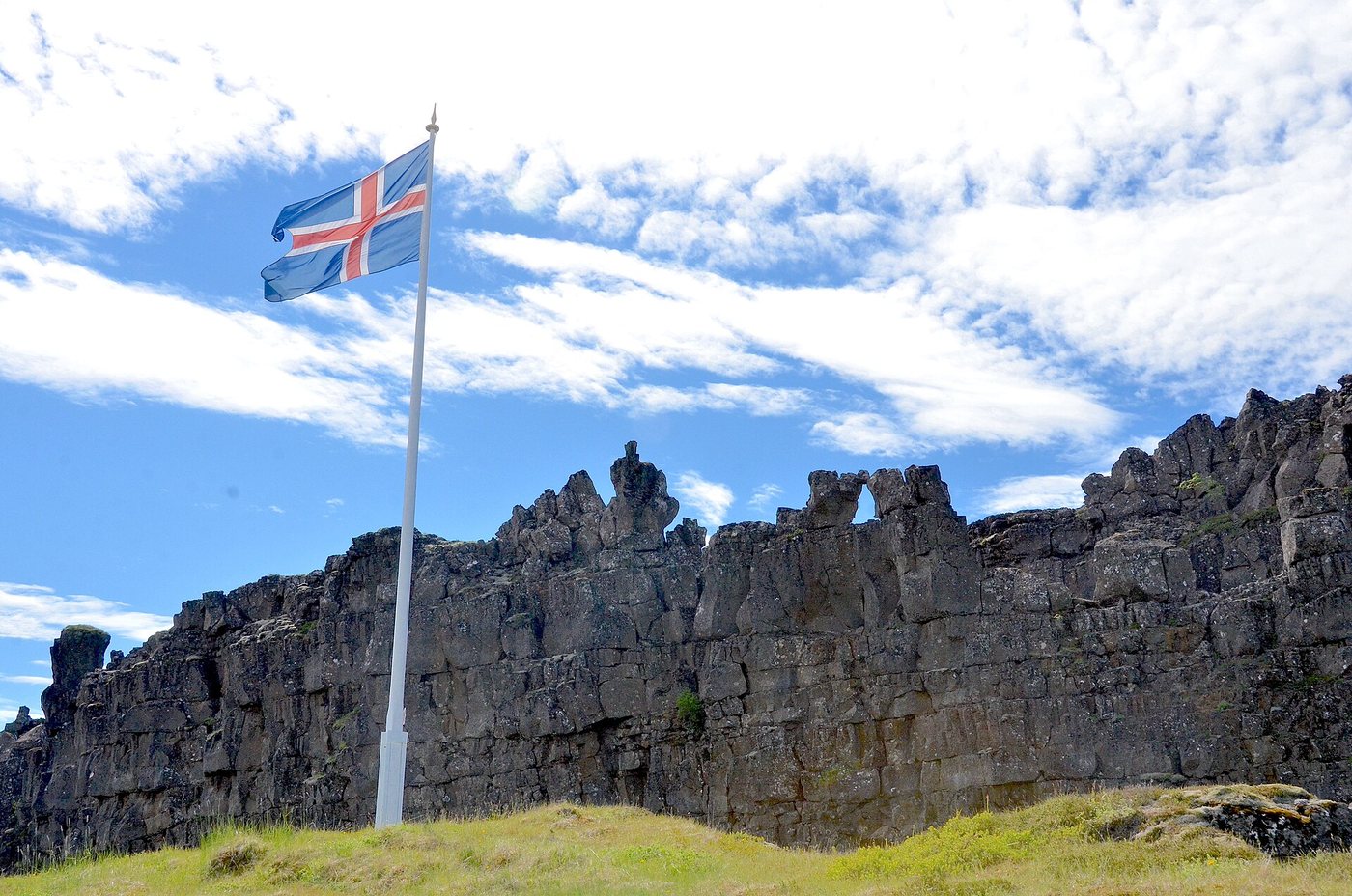
Ingólfr Arnarson has been regarded since the 12th century as the first permanent settler of Iceland. Almost nothing about him is secure: the texts are some 250 years younger and his name appears in no find. This article sorts Íslendingabók, Landnámabók, Dicuil, the Landnám ash layer and the Reykjavík excavations by age and weight, tells the high-seat-pillar story with Hjörleifr and the slaves, corrects common errors in the dating, and says plainly that no documented link to the Rhineland exists.
Say Iceland and sooner or later you say Ingólfr Arnarson. Icelandic tradition makes him the first permanent settler of the country, the man who threw his high-seat pillars into the sea and built his farm where the current brought them ashore. A mountain and a headland carry his name, and in Reykjavík he stands in bronze on a hill.
The curious part is how little of him we can touch. There is no inscription, no coin, no grave that can be assigned to him, and no text from his own lifetime. What counts as secure is both small and surprisingly large. Small, because his name appears in no excavated find. Large, because volcanic ash layers and digs now show fairly well that people from the north were building houses in south-western Iceland in exactly the period the sources name. That a man called Ingólfr was among them is a question for written sources, and those are late.
This article therefore sorts five layers: what archaeology and natural science establish; what writings of the 12th and 13th centuries report; what was added later still; what modern scholarship makes of it; and what is simply legend. The wider setting is in the pieces on the Icelanders and the sagas of Icelanders.
Between the events and the first texts lie roughly 250 years. Everything else rests on that fact.
Íslendingabók, the "Book of the Icelanders". Its author is the priest Ari Þorgilsson, called Ari fróði, "the learned". Scholars usually date it to 1122 to 1133, based on the bishops named in the preface. It originally existed in two versions; only the younger survives, and that only in two 17th-century paper copies made by Jón Erlendsson for Bishop Brynjólfur Sveinsson (AM 113 a and b fol.). The exemplar, probably from around 1200, was later lost. Ari writes tersely, avoids most marvels and names informants; for the settlement Teitr, Þorkell and Þuríðr. Íslendingabók counts as the most reliable source for early Icelandic history: careful, not an eyewitness account.
Landnámabók, the "Book of Settlements". By the figures usually given it lists about 1,500 farm and place names and more than 3,500 people and walks the country settler by settler. The core goes back to the late 11th or early 12th century, but the oldest version is lost. What survives is the Sturlubók, which Sturla Þórðarson wrote probably between 1275 and 1280 (preserved in a 17th-century copy), the Hauksbók of the early 14th century, which cites the Sturlubók and the lost Styrmisbók, and the Melabók of about 1300, of which only two leaves remain. The Ingólfr story as usually told comes mainly from the Sturlubók. Whether the Landnámabók is historical or partly folklore remains debated; Gunnar Karlsson, for one, points to parallels between the Flóki episode and the story of Noah.
Later narrative. The 14th-century Flóamanna saga extends the biography, for instance with the remark that he was twenty when he went raiding; that is another layer of storytelling, not another witness. The Norwegian national encyclopedia warns against using the detailed accounts of the Landnámabók and Flóamanna saga uncritically, since some episodes may have grown out of place names.
What is contemporary. Nothing here comes from Ingólfr or his generation. The oldest hint of Iceland at all comes from Ireland. In 825 the Irish scholar Dicuil finished De mensura orbis terrae, which reports clerics who had been on an island called Thule, where there was no darkness at midsummer. According to a summary they had spent about six months there around 795, some thirty years before he wrote. Whether Thule means Iceland cannot be settled from the text; the work is a compilation. Ari knows his own predecessors: Irish Christians, the Papar, who left because they did not want to live with heathens, leaving behind books, bells and croziers.
A word on the numbers. The texts count not in calendar years but in relations. Ari ties the settlement to the death of King Edmund of East Anglia, which he dates to 870 after Christ's birth; the Landnámabók gives 874, tied to Harald's twelfth year as king. Both are calculations of the 12th and 13th centuries, not diary entries.
The timeline divides by strength of proof,.
Reachable by science and archaeology. Sometime before the middle of the 870s there are people in south-western Iceland, at least in Reykjavík, and they build. Around 877 (the newer dating, discussed below) a volcanic eruption lays a conspicuous ash layer over much of the island, the so-called Landnám tephra layer. After it, settlement traces multiply across the island. A longhouse on Aðalstræti in Reykjavík dates from the 10th century.
From later writings. Before Ingólfr the tradition knows visitors: the Norwegian Naddoddr, said to have called the land Snæland, "Snow Land"; the Swede Garðarr Svavarsson, who around 860 became the first to overwinter, built a house at Húsavík, sailed round the island and named it Garðarshólmur, leaving his man Náttfari behind; and Hrafna-Flóki, who took three ravens, wintered at Vatnsfjörður, saw ice in a fjord and gave the land its name, Ísland. One Wikipedia article dates Flóki's voyage to 868; I could not check that against a primary source.
Then Ingólfr. Ari writes that a Norwegian named Ingólfr was the first to sail from Norway to Iceland, when Harald was sixteen, and again a few years later; he settled in the south, at Reykjavík. The Landnámabók describes three winters, the murder of Hjörleifr, the revenge and the land-taking in detail. His son Þorsteinn is said to have set up the first assembly at Kjalarnes, before the Alþing, which arose around 930. More on that legal form in The Thing and the assembly places. Ingólfr's own death is not reported in the part of the Sturlubók I read.
Two sets of figures collide here, and the literature often blurs them. Ari and the Landnámabók supply 870 and 874. Natural science now supplies 877 ± 1 for the ash layer. These are different things: a written number about a human life and a measured number about an eruption.
Of rule in the strict sense there is little to say. Iceland had no king to inherit from, and the sources give Ingólfr no title. What they give him is land, followers and standing. The Landnámabók calls him frægastur allra landnámsmanna, the most famous of all settlers, and gives the reason: he was the first to settle an empty land, and others followed.
Origins. According to the Sturlubók (chapter 3) Ingólfr was a son of Örn, who was a son of Björnólfr; his sister was Helga. The family comes from western Norway. The Store norske leksikon links it with Dalsfjord in Fjaler, but also notes that the Melabók classifies him differently and that sources vary on his father's name. He is sometimes called Björnólfsson rather than Arnarson.
Feud and flight. Ingólfr and his foster-brother Leifr, later called Hjörleifr, fall out, in the Landnámabók, with the sons of a jarl named Atli. Ingólfr's sister Helga plays a part; two of the sons are killed, and the matter ends in a settlement and the loss of property. The two sail to Iceland once, winter at Álftafjörður in the east and go back to Norway. That can be linked with Ari's statement that Ingólfr went twice. Leifr then raids Ireland, enters an earth-house, kills a man there who carries a bright sword and from then on bears the name Hjörleifr, "sword-Leifr". He brings home ten Irish captives who will later play their part. Each fits out a ship.
The crossing and the pillars. The ships keep together until land is sighted. Then happens what Iceland still carries in its picture of itself:
“… skaut hann fyrir borð öndugissúlum sínum til heilla … hann skyldi þar byggja, er súlurnar kæmi á land.”
“… he shot his high-seat pillars overboard for good luck … he would settle where the pillars came ashore.”Landnámabók (Sturlubók), chapter 6 in the numbering of the edition on snerpa.is (normalised Icelandic spelling, Sturla Þórðarson, c. 1275 to 1280); the two half-sentences read myself, omission between them; English rendering my own translation
Ingólfr comes ashore at Ingólfshöfði. Hjörleifr is driven west, runs short of water and survives because his Irish slaves mix flour and butter into a paste until rain falls. He lands at the headland that bears his name, Hjörleifshöfði, and builds houses there.
Hjörleifr's end. In spring he has the slaves pull an ox in a plough. One of them, Dufþakr, is to kill the ox and blame a bear. Under that pretext the slaves kill Hjörleifr and his men, take women, goods and a boat, and flee to islands. Ingólfr's two slaves, Vífill and Karli, find the dead man. Ingólfr says, so the text goes, lítið lagðist hér fyrir góðan dreng, roughly: a poor end for a good man, a sentence of bitter understatement. He has a grave prepared, hunts the slaves down and kills them. The islands are called Vestmannaeyjar because the slaves were Vestmenn, "West-men", the Norse word for the Irish. A notch in the rock called Dufþaksskor is said to recall their leader. The viewpoint is the masters', as with all we know about slavery among the Vikings.
Three winters, one find. Ingólfr winters a second time at Hjörleifshöfði. In summer he moves west and spends the third winter under Ingólfsfell, west of the Ölfusá. Where he spent the first winter the text I read does not say outright; it is often placed at Ingólfshöfði, but that is inference, not statement. Vífill and Karli, whom he had sent out, find the pillars at Arnarhváll "below the heath". In spring Ingólfr crosses over and settles at Reykjavík. The Sturlubók adds that the pillars still stand in the kitchen there. Whether that means a very old house or a narrative proof-piece cannot be decided.
The land. According to the Landnámabók his land-taking lay between the Ölfusá and Hvalfjörður, excluding the Brynjudalsá, with all the peninsulas and territory up to the Öxará. It is a vast area; by one summary he passed much of it on to later arrivals. Karli, in the summary I read, finds the land poor and leaves, complaining that they had passed good districts to settle on this remote peninsula; Vífill is freed and settles at Vífilstóftir by Vífilsfell. His wife was Hallveig Fróðadóttir; their son Þorsteinn founded the Kjalarnesþing, and the text names among descendants the lawspeaker Þorkell máni and the chieftain Þormóðr.
The one hard clock of the Icelandic settlement is not a chronicle but a layer in the ground. In an eruption in which, by the descriptions, the Veiðivötn and Torfajökull volcanic systems took part, ash fell over large parts of the island. It has been matched chemically with deposits in Greenland ice cores, and that is how its age was found. For a long time the figure was 871 ± 2 years. After a revision of the Greenland ice chronology that moves the Eldgjá eruption to 939, the Landnám layer shifts back by about six years: Schmid, Dugmore, Vésteinsson and Newton arrive in a 2017 study (Quaternary Geochronology 40) at 877 ± 1. Anyone reading "871" today reads an outdated measurement, even if a museum carries it in its name.
More important than the year is the logic of the layer: what lies beneath the ash is older, what lies above is younger. The 2017 study reaches two results. First, human traces below the ash exist at only two places, both in the south-west, and Reykjavík is one of them. Second, settlement across the whole island begins only afterwards; the authors count 81 sites above the layer.
Aðalstræti. During construction at Aðalstræti 16, wall remains came to light in 2001, which the Icelandic Institute of Archaeology examined under the supervision of the city museum. They are open to visitors where they were found, as the Settlement Exhibition (opened 2006). The find has several parts. A longhouse, the hall (skáli), was inhabited, by the figures I found, roughly between 930 and 1000, generations after Ingólfr. North of it lies a stretch of turf wall sealed beneath the Landnám ash, so older than the eruption. The exhibition's name "Reykjavík 871±2" refers to that wall and the ash, not to the longhouse. One travel site wrongly calls the number the radiocarbon age of the hall.
The wall is evidence that someone built in Reykjavík before the ash fell. It says nothing about the builder, nothing about his name and nothing about whether Ingólfr or someone else raised it. Íslendingabók and Landnámabók do not say where exactly his farm stood either; Icelandic accounts give two possibilities, the Arnarhóll or the southern end of Aðalstræti on the shore of the Tjörn pond. The name is just as uncertain: it is traced to the steam of hot springs, "smoky bay", but the Icelandic place-name institute is reported to say there was never a bay of that name.
And before? Whether Norse people were on Iceland before 870 is under discussion. At Stöð in Stöðvarfjörður in the east, a hall of the settlement period sits over an older and larger one; the excavator Bjarni F. Einarsson proposes the first half of the ninth century, though it may have been a seasonal base. At Hafnir on Reykjanes a hut was abandoned between 770 and 880. At Kverkarhellir, deposits point to use around 800, with Hiberno-Scottish crosses carved nearby. That Papar lived on Iceland is archaeologically unproven, however; excavations on Papey showed ninth-century Norse settlement but no trace of the monks. This changes the picture: Ingólfr may not have been the first person on the island, but the first whose name stuck in the tradition.
The öndvegissúlur were pairs of posts standing on either side of the high seat in the longhouse, where the master of the household sat. What they looked like is poorly documented. The Landnámabók and several sagas say some settlers brought them from Norway, threw them overboard on sighting land and settled where they drifted ashore. According to Eyrbyggja saga the temple of Þórólfr Mostrarskegg had high-seat pillars with "god-nails", reginnaglar, and in one saga a pillar is carved with an image of Thor. Ingólfr is only the most famous of several men with the motif.
Whether a real custom stands behind it or a narrative form that gives land-takings the gods' approval cannot be decided from my sources; I found no evidence that anyone actually did this, and no surviving pillar appears in the archaeological literature I read. The houses that held such pillars are covered in the article on the Viking longhouse.
Iceland is often told as a refuge from Harald Fairhair, who supposedly subdued Norway. Ari does not say that. He uses Harald's reign as a time frame and reports that Harald later made emigration harder with a levy of five aurar (ounces of silver) a head, so that the country would not be emptied; from this the land-toll arose. The flight story sits rather in the later sagas. Sverrir Jakobsson sees in it, by a Wikipedia summary, a reaction to Norwegian claims in the early 13th century. Harald himself is also disputed: since Peter Sawyer's doubts in 1976, one camp reads the Harald tradition as an origin myth, another sees a historical core. For Ingólfr this means that the "flight from the king" motif also lies in a layer later than what it describes. In the Landnámabók his own story is one of a feud. More on Harald in the article on Harald Fairhair and on rulers of the age in the Nordic kings.
The places in the story are real and carry his name. Ingólfshöfði, a small headland on the south coast about 76 metres high, is now a private nature reserve; the Sturlubók has him land there. Hjörleifshöfði east of Vík bears the name of his foster-brother. Ingólfsfjall, a 551-metre flat-topped mountain near Hveragerði, is taken to be the Sturlubók's Ingólfsfell where he spent the third winter. Modern descriptions say that according to the Landnámabók he lies in a small mound on the summit. In the Sturlubók text, as far as I read it, that is not there, and I know of no secure find of a grave of Ingólfr. This remains to be checked.
The monument came late. The sculptor Einar Jónsson (1874 to 1954) made a first small design in Rome in 1902/03 and showed a reworked version in Copenhagen in 1906. Money was raised in Iceland after a delegation of the Althing visited Denmark in autumn 1906; the figure was ready by the end of 1907, but funding stalled and sculptor and donors quarrelled. The bronze cast was not unveiled on the Arnarhóll until 24 February 1924. It shows an armoured man with a raised halberd (atgeir) beside a dragon-headed high-seat pillar. According to the plaque, the other side of the pillar carries scenes with Odin and his ravens, Yggdrasil and Sleipnir. A copy erected in 1961 in Sunnfjord recalls him in Norway. What Ingólfr looked like nobody knows; the figure is an early 20th-century image of a founding father.
The honest answer is short: I have not met any documented link between Ingólfr and the Rhineland, Aachen or the Frankish realm. The settlement of Iceland unfolds in the North Atlantic, and the only foreign region tied to the settlers is Ireland, home of Hjörleifr's slaves and the Papar. Readers who want Vikings in the Rhineland will find them in the article on the Vikings at Aachen; nothing there connects to Ingólfr.
Open, first, is the person. Whether a man called Ingólfr sailed from western Norway to south-western Iceland in the late ninth century can be neither proved nor refuted from the sources; that Icelanders of the 12th century knew him as their founder is secure, because Ari writes it down. Open is the date: between the written 870 and 874 and the ash figure 877 ± 1 lie only a few years, but they shift who was contemporary with whom. Open is where his farm stood. Open is whether the Sturlubók episode of Hjörleifr, the slaves and the West-men has a historical core or grew out of place names such as Vestmannaeyjar and Dufþaksskor. Open, too, is the prehistory: the finds at Stöð and Hafnir may alter the early picture.
Genetics fits the slaves' story without proving it: by one summary about 62 percent of maternal lines of present-day Icelanders trace to Scotland and Ireland, 75 percent of paternal lines to Scandinavia.
Until another text or a find with a name turns up, Ingólfr remains a figure between memory and narrative. That makes him a case in which one can watch closely how a people tells itself its beginning.
Who was Ingólfr Arnarson? According to Íslendingabók and Landnámabók, the first permanent settler of Iceland, a Norwegian from the west of the country who settled at Reykjavík. Both texts were written in the 12th and 13th centuries, a good two hundred years later.
When did he settle on Iceland? Ari ties the settlement to the year 870, the Landnámabók gives 874. The Landnám ash lying above the oldest buildings is now dated to 877 ± 1. The exact arrival cannot be determined.
Why did he throw his high-seat pillars overboard? According to the Sturlubók he wanted to settle where they drifted ashore. His slaves Vífill and Karli found them at Arnarhváll. Whether such a custom existed is not documented.
Is the settlement at Reykjavík confirmed by archaeology? A stretch of wall under the Landnám ash shows that building took place in Reykjavík before the ash. The longhouse on Aðalstræti is younger, from the 10th century. A link to Ingólfr cannot be shown.
Where is his statue? On the Arnarhóll in Reykjavík. Einar Jónsson designed it in 1906/07 and it was unveiled on 24 February 1924. A copy has stood in Sunnfjord, Norway, since 1961.
Related articles: The Icelanders, Sagas of Icelanders, Harald Fairhair, The great kings of the Viking Age, Erik the Red, Leif Eriksson, Vinland, The Thing, The Viking longhouse, Slavery among the Vikings and The Greenlanders.

The Icelanders · The Icelandic Sagas · Harald Fairhair – the first king of all Norway · Erik the Red · The Thing.
All History & Finds articles →
The Insubres were the mightiest Celtic people of the Po plain in today's northern Italy – part of those Celts whom Rome …
Read more →No other people in Europe knows its beginnings so precisely – or believes it does. The Icelanders have a book that …
Read more →The Isle of Man is a small island. Even so, it has more Viking Age runestones than some whole regions of Scandinavia …
Read more →