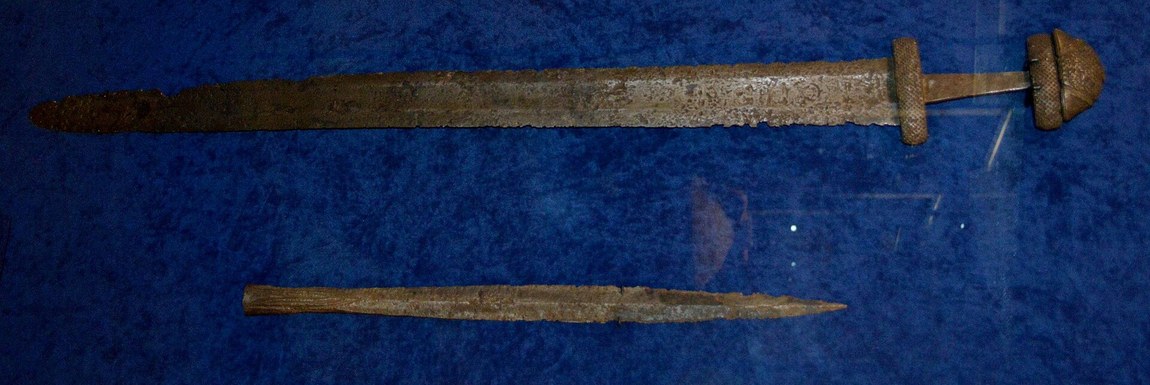
If the axe was the weapon of the common man, the sword was its opposite: costly, rare, inherited and often given its own name. Few objects of the Viking Age carried so much meaning. Let us take an honest look at what blade, sagas and finds really tell us.
A Viking sword was no mass product. It held weeks of forge work, rarer good steel and often imported blade blanks. It was correspondingly rare. Whoever owned a sword belonged to the upper ranks - or had earned his in battle, trade or inheritance. A good sword could be worth as much as several milk cows, and it was not given away carelessly but handed down over generations.
This value explains why the sword is so over-present in the record even though it lies in the ground far more rarely than axe or spear. Skalds sing of swords, sagas name them, kings give them away. The sword was less a plain tool than a sign: of rank, of family, of a promise. To draw it was to make a statement.
That is also why the sword was a social affair. A king bound followers to himself by giving them swords; a father passed to his son not just any blade but the grandfather's sword. In the skalds' poems the generous lord is therefore often simply the "sword-giver". Whoever could give swords away showed power - and bound loyalty to steel.
The typical Viking sword is a double-edged cutting weapon of about 90 centimetres overall. The blade is broad and relatively flat, often with a lengthwise groove - the so-called blood channel, a misleading name, for it has nothing to do with blood. The groove (fuller) saves weight without meaningfully weakening the blade; it makes the sword faster and better balanced. Such a sword usually weighed about one to one and a half kilograms - considerably lighter than many assume.
The hilt consisted of a guard, a tang faced with wood, horn or leather, and a pommel. It is the pommel and guard that let archaeologists date a sword best, because their shapes changed with fashion. Some pommels were three-lobed, others flat, still others adorned with silver and copper. The balance point lay close to the hand: a Viking sword was built for the swift cut and for wielding from the wrist, not for ponderous bludgeoning.
The sword was carried in a wood-lined, leather-covered scabbard, usually on a belt over the shoulder or at the hip. The scabbard was often lined inside with fleece or greased wool - the retained grease guarded the blade against rust. A sword was thus costly not only to make but to keep: it wanted oiling, care and protection from damp, or rust would eat the precious steel.
The finest blades of the early Viking Age were made by pattern welding. Several bars of iron and steel were twisted, folded and forge-welded together. After grinding and etching, a wave-, snake- or herringbone-like pattern emerged on the blade, depending on the twist. This pattern was at first a matter of technique: it was the smiths' answer to uneven raw material. By combining soft and hard layers you got a blade that was at once tough and edge-holding.
Over time pattern welding also became ornament: the patterns were deliberately arranged to gleam. Yet the better the available steel became, the less the effort was needed. From the 10th and 11th centuries onward, more homogeneous blades of uniform steel increasingly took over, and pattern welding receded. A single draw of good steel was now better than the most artful weave of poor steel.
The effort behind it was enormous. For a single pattern-welded blade the smith had to heat, fold and re-weld dozens of times without letting slag or cold shuts leave the blade to break in battle. A mistake in the middle of this days-long process could undo the whole work. No wonder good blades were traded and imported over long distances rather than made in every village forge.
Some blades carry an inlaid inscription that, between two crosses, spells the name +VLFBERH+T. Around 170 such swords are known. They rank as the top products of their day, and their workshops are thought to lie in the Frankish Rhineland - practically on our own doorstep. An Ulfberht sword was a kind of quality mark, forgeries included: there are blades with wrongly placed crosses, evidently cheaper copies hoping to trade on the good name. We have devoted a separate article to the Ulfberht swords and leave it here at this pointer.
With the sword, too, there is no getting past Jan Petersen. In his 1919 work he sorted the Norwegian Viking swords by the shape of pommel and guard into a system that he ran through with more than twenty letters - from type A to the special characters of the Norwegian alphabet. Later scholars refined the system, but the basic idea held: know the hilt shape and you can roughly place and date a sword. Thus a single find becomes a building block in the history of a whole class of weapon.
Incidentally, Petersen's system shows how international the Viking weapon was. Many of the finest blades came as blanks from the Frankish realm and were only fitted with local hilts in the north. A single sword could thus unite a Rhineland blade, a Scandinavian pommel and an inscription in Latin letters - trade good and status symbol at once.
Hardly anything shows the rank of the sword so clearly as the fact that it was given a name. In the sagas, blades are called "Leg-biter", "Snake-tongue" or "Heirloom". A named sword had a biography: it was inherited, given away, seized in battle, sometimes laid in the grave with a dead man or lifted back out of a burial mound. Historically graspable - if through the saga's lens - is Skofnung, the sword of a legendary Danish king, which lives on in several tales. Other names belong wholly to heroic poetry: Gramr, with which the dragon-slayer Sigurd kills the worm Fafnir, is pure legend.
This distinction matters. That swords were named and inherited is well attested. That a particular sword held magic powers, was indestructible or struck of its own accord belongs to literature - however fine the stories are.
Some swords followed their owner into the grave; others were deliberately bent or broken before being laid down - "killed", as scholars say, so that the weapon would follow the dead into the next world and no one would dig it up. Still others stayed above ground and travelled on through the generations. A sword was not replaceable like an axe; it had a history, and that history was part of its worth.
A good Viking sword was an excellent weapon: sharp, fast, balanced. But it was no wonder-cure. Against a shield or a helmet even the best blade did little if the blow sat badly; the sagas frankly tell of swords that bent in the fight and that the fighter first had to tread straight again. Poetry, by contrast, loves the flawless blade. In the Old English poem Beowulf the hero carries such an heirloom:
"Hrunting" they named the hilted sword, of old-time heirlooms easily first; iron was its edge, all etched with poison, with battle-blood hardened...Beowulf, trans. Francis B. Gummere, 1910, public domain
The "etched with poison" iron is a poetic image for exactly that patterned, pattern-welded blade we know from the finds. And yet Hrunting fails at the decisive moment - even the poet knew: the blade alone was not to be relied on.
This honesty sits already in the Norse sources themselves. Again and again the sagas tell of blades that bent in the fray and that the fighter had to straighten under his foot in the middle of the fight. The north's costliest status symbol was, in the end, only as good as the iron it was forged from - and the warrior who wielded it.
Viking swords were double-edged cutting weapons about 90 cm long with a fuller, pommel and guard, usually around 1 to 1.5 kg. Pattern welding is metallurgically attested and gave way from the 10th/11th century onward to more homogeneous blades. Around 170 blades carry the inscription +VLFBERH+T; their manufacture is thought to lie in the Frankish Rhineland. Petersen's 1919 typology orders the swords by hilt shape. That swords were named and inherited over generations is broadly attested in sagas and through graves.
Not every Viking carried a sword - quite the opposite. The sword was the costliest and rarest weapon; axe and spear were far more common. The "blood channel" drains no blood but saves weight. And the indestructible wonder-swords of the sagas - Gramr, which kills Fafnir, or blades that never dull - are heroic poetry, not metallurgy. Real blades could bend and needed care. Even the dramatic failure in single combat, where the sword "will not bite", stands already in the sources themselves.
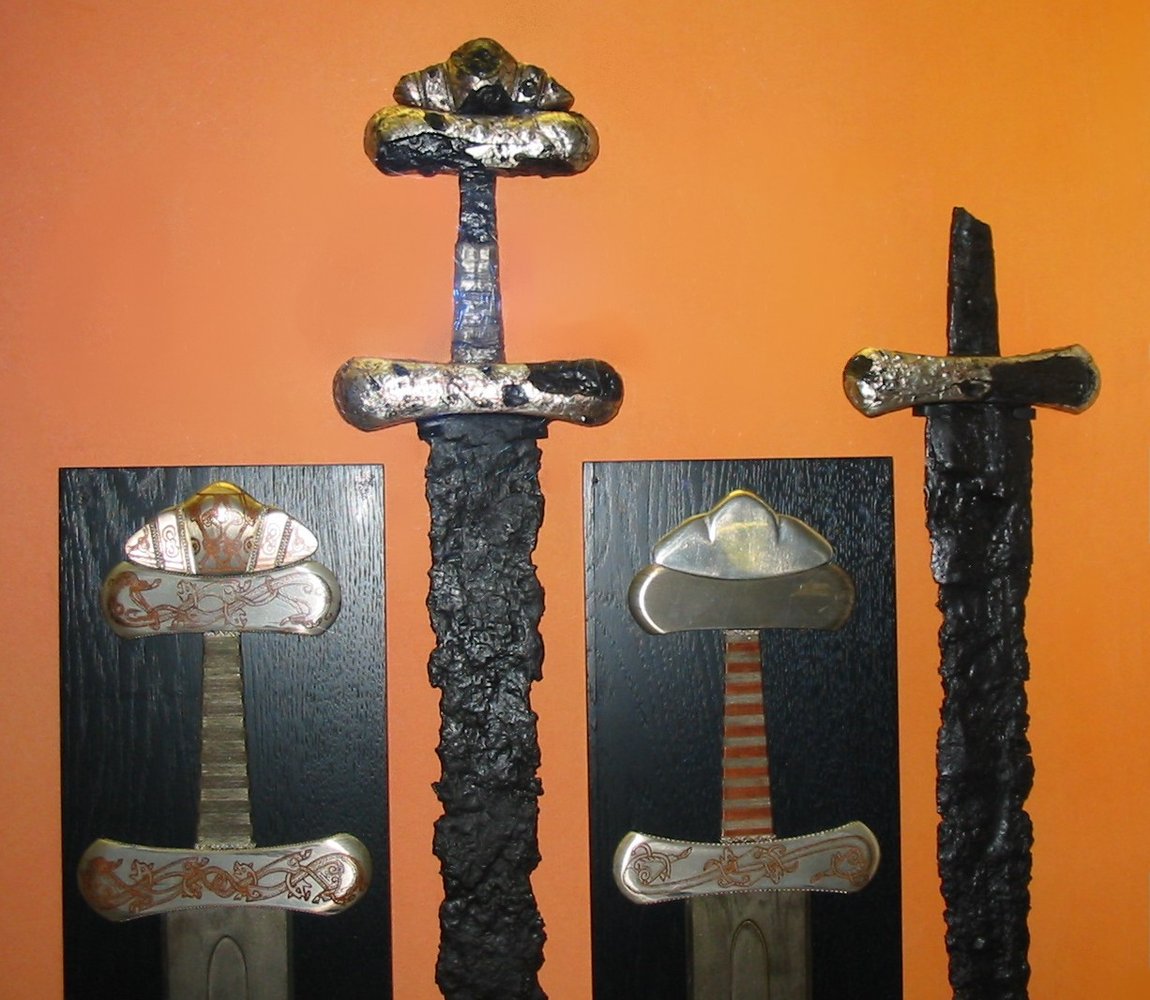
If you want to date a Viking sword, you do not look at the blade first, you look at the hilt. Blades wore down, were reforged and re-mounted; the hilts, by contrast, followed fashion, and so they often reveal date and origin more reliably than anything else. In 1919, in De norske vikingesverd, Jan Petersen laid out the ordering system still in use today: he sorted some two thousand Norwegian finds by the shape of pommel and guard and assigned letters from A to Z. Some types are plain, others carry a two- or three-part (lobed) pommel, still others the distinctive rounded "tea-cosy" form. In 1927, in London and the Vikings, R. E. M. Wheeler condensed this abundance into seven more manageable core types (I to VII), and Ewart Oakeshott later carried the thread on into the High Middle Ages.
The hilt also tells of trade and migration. Very often a Frankish blade sits in a hilt decorated in Norse taste - the blade came across the Rhine, the hilt was made by a local master to his own liking, frequently with silver or copper inlay in interlace. A sword is therefore rarely the product of a single workshop; it is an assembled object from several hands and lands. In honesty it must be said: the typologies overlap, transitional forms are common, and a single hilt can usually be narrowed to a few decades, not to a single year.
| Type | Date (rough) | Hilt feature |
|---|---|---|
| Petersen H / Wheeler II | early, c. 800-950 | most common type, three-part pommel, often inlaid |
| Petersen S | 10th c. | richly decorated, silver inlay, animal ornament |
| Petersen X / Wheeler VI | late, c. 950-1050 | plainer, flat pommel, straight guard |
| Wheeler VII | transition to the High Middle Ages | disc-shaped pommel, longer guard |
How the hilt held together says much about the care of the work. The blade ran out into a narrow tang, led through guard, wooden or leather-wrapped grip and pommel, and riveted over at the upper end. The grip wood could be wound with horn, wire or fish-skin so the hand would not slip even in the wet, bloody press. A well-built sword was no clumsy iron bar: the pommel served as counterweight and drew the balance point close to the hand, so that the weapon lay surprisingly lively in the fist despite its length.
The name +VLFBERH+T is the most famous, but by no means the only lettering worked into the iron of Viking-age blades (we devote a separate article to it). Almost as widespread was +INGELRII, or +INGELRD - probably the name or mark of another Rhineland workshop group of the 10th and 11th centuries. Alongside these appear Latin invocations such as INNOMINEDOMINI ("in the name of the Lord"), as well as purely geometric patterns: crosses, grids, rings and interlaced bands.
These marks were not scratched onto the surface but inlaid. The smith cut fine channels into the still-soft blade, hammered twisted iron or silver wire into them, and forged over the whole until the letters sat flush and permanent within the body of the blade. Only polishing and etching brought them out. What the inscriptions meant is an open question: some are probably workshop marks or marks of quality, others pious protective formulae - a prayer written in steel, meant to accompany the bearer. The two do not exclude each other; a good sword could be trade goods and talisman at once.
Remarkably, many of these letterings are faulty - characters twisted, mangled, drained of sense. This suggests that some smiths imitated a prized model without being able to read it themselves; the name of a famous workshop evidently acted like a mark of quality whose exact wording was secondary. For us that is precisely the telling point: the marks say less about the bearer's Latin than about the reputation of a brand. Whoever inlays a lettering into a blade or a plaque today stands in a very old tradition - the wish to write meaning and origin into the bare metal.
The Viking sword did not fall from the sky - it stands at the end of a long northern lineage. The Celtic warriors of the La Tene period already carried long, double-edged iron swords, and from the Roman cavalry sword, the spatha, Germanic smiths developed the long cutting weapon of the Migration Period. From that spatha the basic form of the Viking sword descends in a straight line: slender, double-edged, made for the cut from the wrist.
In the Merovingian and Vendel periods the sword became a mark of rank. The so-called ring-swords carried a small ring on the pommel - a sign of the oath between retainer and lord, costly and rare. How highly these weapons were prized is shown by the great bog finds: at Nydam and Illerup Adal in present-day Denmark, victorious armies threw the captured gear of defeated foes into the water, among it hundreds of swords with their scabbards. They attest not only the craftsmanship but also that, long before the Viking Age, the sword was an object of value, honour and ritual meaning.
How coveted the good Frankish blades remained is shown by a glance south: the Carolingian rulers tried more than once to forbid by law the export of weapons to the northerners - a ban one would hardly issue had the swords not been flowing across the border in streams. The North took the blades gladly and gave them native hilts and names. So in the end the Viking sword joined three worlds: Celtic smithing tradition, Roman-Frankish blade and Norse craft on the hilt. This long lineage is also why Germanic, Celtic and Norse weapon-worlds can never be cleanly separated - they are branches of the same trunk.

The sword was not a fencing weapon in the later, sporting sense. It was used together with the round shield: shield in the left to cover and shove, sword in the right to strike. The broad, tapering blade was designed above all for the powerful blow, less for fine thrusting - a cleanly delivered cut to head, shoulder or unguarded limb decided a fight faster than any long skirmishing.
For that very reason the sword did not replace axe and spear but complemented them. The spear had the greater reach, the axe the greater force and the smaller price; the sword was the sign of the one who could afford it, and the dependable weapon in the close press. How honestly the sources treated the tool is shown by the sagas: again and again there is talk of blows that glanced away, of blades that bent and that the fighter had to straighten again with his foot. Direct evidence for technique is thin - we have no fencing manuals from the North - yet weapons, wounds and stories together give a credible picture.
In the closed shield-wall, the classic battle order, the sword was moreover seldom the first choice. There the spear counted, thrusting over the shields, while the sword came into play only once the ranks broke and the fight dissolved into a tangle of single combats. The image of the "half-sword" or of acrobatic blade-play does not belong here either: the sagas show sober, hard work - cover, shove, hew, and whoever landed the first clean hit won. A sword was no wand but a tool that demanded practice, strength and a good shield.
A surprising share of the surviving blades comes not from workshops or houses but from the earth and the water. Many were placed with their owners in the grave, a sign of rank and belonging beyond death. Not rarely the weapon was deliberately made useless in the process: bent, kinked or broken. Whether the sword was thus "killed" so it could follow the dead into the other world, or whether this simply meant to deter grave-robbing, is disputed - probably both, depending on place and time.
Greater still is the riddle of the river finds. From the Thames, the Seine and other streams numerous well-preserved blades have come to light - far too many and far too costly for all of them to have been merely lost. Some may be battle and disaster, but much of it looks like deliberate deposition, an offering to the water in a tradition reaching back to the bog finds of the Iron Age. The customs varied by region: where some burned and bent their swords, others gave them to the river.
Whoever received a sword in the grave also tells us something about society. Buried weapons marked rank and free standing; not every fighter was given a blade for the last journey. With Christianisation the custom then vanished quickly: where the cross took hold, the richly furnished graves ended, and the swords stayed with the living, passed down instead of buried. So the circle closes - the same blades that once followed the dead now travelled from hand to hand and carried their names across generations.
That one gave a sword a name and passed it down over generations is well attested - the magic that clings to some of these blades, by contrast, belongs to poetry. Skofnung, the sword of the Danish king Hrolf Kraki, appears in Kormaks saga and Laxdaela saga; it is said its wounds would heal only with its own "Skofnung stone", and that it must not be drawn in the presence of women - splendid storytelling, not a weapon find. Tyrfing from Hervarar saga never strikes without killing, and Gramr from the Volsunga saga splits an anvil for Sigurd as proof - both are pure saga figures in the shape of steel.
Kvernbitr it was called, for it bit through a millstone to the eye when the king brought it down with all his strength.after the Heimskringla (Snorri Sturluson), public-domain translation by Samuel Laing 1844; freely rendered
More historically graspable are the by-names of real royal swords, as the Heimskringla records them: Kvernbitr ("millstone-biter") belonged to Hakon the Good, Legbiter to Magnus Barefoot. Here too the name is well attested, but the marvel is narrative. That is the honest core: passing on, naming and praising swords was lived reality - the cutting wonder-blades live in the manuscripts.
The reason for this naming culture is plain: a sword outlasted its bearer. It travelled from father to son, from the kin to the deserving retainer, and with each owner its story grew. Skofnung, for instance, passes in Laxdaela saga from Hrolf Kraki through a grave into the hand of an Icelandic farmer - an heirloom with a pedigree. In a world without deeds and charters, a named sword was almost a family archive in steel: whoever carried it carried the deeds of all who had carried it before. That is the true magic of the old blades, and it needs no sorcery.
Every sword had a scabbard, and it was a small work of art in itself. Its core consisted of two thin wooden laths that closely enclosed the blade. Inside, the scabbard was lined with fur, fleece or leather whose natural grease protected the steel from rust - a plain, effective solution that kept the costly blade bright. Outside, the wood was covered with leather, often tooled or decorated.
At the lower end there often sat a metal chape that protected the point and served as ornament at the same time. The sword was worn on a baldric across shoulder and chest, usually with two suspension points, so that it hung ready to hand at the hip. The popular image of the sword on the back belongs in the cinema, not in the Viking Age: you simply cannot draw an arm's-length blade from a scabbard on your back. Whoever needed his sword carried it where the hand could find it - at the side, above the hip, within reach of the grasping fist.
Caring for the scabbard was at the same time caring for the weapon. The greasy lining had to be renewed, the leather oiled against damp, and the wise man drew the blade after every rainy march and wiped it dry. A costly blade deserves an equally carefully made scabbard - a principle that runs from the Viking-age chape to every good workshop of today. In the end the sword is only as good as the sheath that keeps it bright and ready to hand.
The Ulfberht sword · The Viking Axe · The shield wall · Berserkers.
Sources: Jan Petersen, De norske vikingesverd (1919); Beowulf in the translation by Francis B. Gummere (1910, public domain); Alan Williams on Ulfberht blades and Frankish blade production; The Archaeologist, "The Viking Age Swords: The Pattern-Welding Technique"; Reliks / vikingsword.com on the Petersen sword typology. Image credits: Viking swords (finds and reconstruction) - photo viciarg, CC BY 2.5; single-edged type-H sword - CC0/public domain; both via Wikimedia Commons.
All History & Finds articles →
Many call the Varus battle the „big bang of Germany". Yet another battle shaped our lands far more deeply – one in …
Read more →