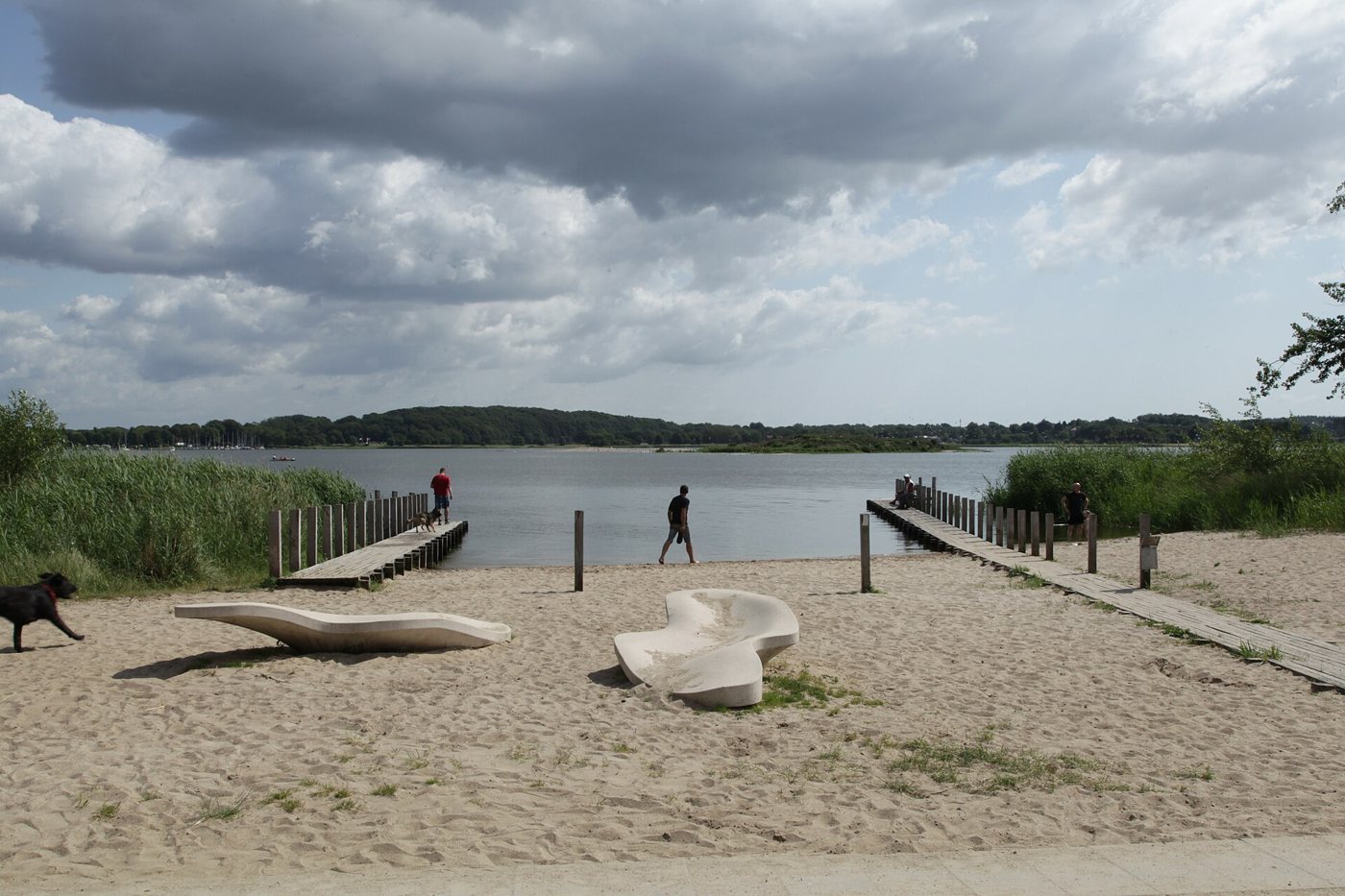
The Schleswig Viking Days (Wikingertage) take place from 6 to 8 August 2027 in the Königswiesen park right on the Schlei in northern Germany. For one weekend a Viking village rises there, with craftspeople, a combat arena, a thing site, an archery tournament, a children's village and ships on the water. The real draw is the view: on the opposite shore lay Hedeby, one of the greatest trading towns of the Viking Age. Here is what to expect, how to get there and the history packed into this stretch of landscape.
Dates: Friday 6 August to Sunday 8 August 2027, as given on the official Wikingertage website in October 2026. Venue: the Königswiesen city park on the shore of the Schlei in Schleswig, at almost twelve hectares the largest park in town. Organiser: Wiking GmbH, whose welcome note is signed by Kaj Uwe Dammann.
Opening hours and ticket prices for 2027 had not been published when we went to press. As a guide, here are the 2026 figures. The site opened at noon on Friday and at 10 am on Saturday and Sunday, staying open until around 10 pm on Friday and Saturday and until 7 pm on Sunday. Adults paid 15 euros, children aged 4 to 14 paid 8 euros, and a family ticket for two adults and up to four children cost 35 euros. Payment was cash only. Dogs were allowed on a lead.
Check wikingertage.de for the 2027 details before you travel. For everything else on the calendar, see our overview of Viking festivals 2027 and our events calendar.
The organisers divide the festival into seven areas: the large Viking village, the thing site, the combat arena, archery with a tournament, the children's Viking village, the Viking ships, and the stage and taverns. The 2026 programme shows what happens in each; 2027 may differ.
The Viking village. According to the organisers, hundreds of craftspeople, warriors and traders pitch their tents here. Recent years brought smiths, mail-makers, woodcarvers, bowyers and a baker with a clay oven. Ask the smith how he hardens his iron. For the background, read our articles on Viking blacksmithing and on the byrnie, the Viking mail shirt.
The thing site. A thing was the assembly of free men where law was spoken and disputes were settled. At the festival, the thing site is mainly a performance space: in 2026 it hosted scenes from Viking life, jugglers, a piece called "Thor Looks for Loki" and skaldic storytelling. How a real thing worked is explained in our article on the thing.
The combat arena. Several fights a day: weapons demonstrations, fighting in lines and formations, and in 2026 a staged story called "The Betrayal of Knut Lavard". Knud Lavard was Duke of Schleswig in the early 12th century and was murdered by his cousin Magnus in 1131. The 2026 arena programme closed with a single-combat tournament on Saturday evening.
Archery. On Saturday there is an archery tournament, with registration in advance. Background: our piece on the bow and arrow.
The children's village. A separate area with a games course, a juggling show and a big Viking games contest. Good companions for the day: our articles on childhood in the Viking Age and on the board game hnefatafl.
The ships. Replica ships are moored on the Schlei and open to visitors. When the wind allows, there are sailing trips. In 2026 the ship area was open daily from noon to 6 pm. How the originals were built is told in our article on the longships.
Stage and taverns. Music, jugglers, in 2026 a round of Tampentrekken (tug of war, northern German style), and torchlight processions at 9 pm on two evenings.
How old are the Viking Days themselves? Surprisingly, this is hard to pin down. A regional online magazine says they have run since 1986; a festival portal says 2009. We found no statement from the organisers. What is documented: in 2012 the German daily taz reported on a Viking village on the Königswiese with around 20,000 visitors over the weekend; in 2014 the festival ran from 8 to 10 August; and it took place in August in 2022, 2023, 2025 and 2026. For a long time it was a biennial event. It now takes place every year.
Hardly any reenactment festival in Europe sits this close to a real Viking-Age site. From the Königswiesen you look south across the Schlei. On the far shore, beyond the Haddebyer Noor, lay Hedeby (German: Haithabu), one of the largest trading places of the Viking Age. And that brings us to the real story.
Look at a map of Schleswig-Holstein. The Schlei is a long, narrow arm of the Baltic reaching about 40 kilometres inland. Schleswig lies at its inner end. From there it is only about 15 kilometres to the rivers Treene and Eider, which flow to the North Sea. If you wanted to move goods between the Baltic and the North Sea without sailing round the dangerous tip of Jutland, this was your shortcut.
The old north-south land route, later the Army Road or Ox Road, crossed here too. Whoever controlled this spot controlled traffic between Scandinavia and the Continent. Hence a great trading town and the mightiest rampart of the North, side by side.
Hedeby, Old Norse Heiðabýr, roughly "heath farm", grew up in the 8th century on the Haddebyer Noor, an inlet of the Schlei. Its founding is often given as "around 770". Archaeologically, what can be said is that there are first traces of settlement in the 8th century. The big, year-exact dates come from the 9th: the Viking Museum dates the cloth merchant's house, whose reconstruction you can walk into today, to 833. The great landing stage in the harbour was built in the winter of 885/886 and used for around 130 years. They come from tree rings in oak timbers preserved in the wet ground (dendrochronology).
The place first appears in writing in the Frankish Royal Annals, the year-by-year record of events at Charlemagne's court. For 804 they report that the Danish king Godfred came with his fleet and army to "Sliesthorp" on the border of his kingdom. Whether that means Hedeby or a settlement on the north shore of the Schlei is debated. A strong candidate is the royal estate at Füsing, which we covered in our article on Sliasthorp and Füsing.
Then comes the famous entry for 808. Godfred destroyed the Obodrite trading place of Reric on the Baltic coast, which had paid him tolls, and moved its merchants to Sliesthorp, putting trade directly under his control. The full story is in our article on Reric. In 811 Danes and Franks made peace and fixed the Eider as the border. Hedeby now sat on the edge of the Danish realm, facing the Frankish empire.
What followed was a rise without parallel. In the 10th century a semicircular rampart enclosed about 26 hectares. Estimates usually put the population at over 1,000, perhaps 1,500: a city by early medieval northern standards. Finds range from Rhineland glass to Arabic silver coins. Payment was often by weight rather than face value, with small folding scales and chopped-up silver, as we explain in our piece on hacksilver. The bigger picture is in our article on Viking trade.
For 808 the Royal Annals say something else as well: Godfred decided to protect his frontier with a rampart running from the Baltic to the North Sea, with a single gate. This was long read as the founding charter of the Danevirke. Archaeology has shifted that picture.
The Danevirke is not one wall but a system of earthworks built over centuries. The oldest year-exact timbers come from a box structure at the so-called Thyraburg and have been dated to 737, some seventy years before Godfred. Whether Godfred strengthened an existing rampart or added a section of his own is not settled. Around 968, under Harald Bluetooth, the Connecting Wall was built, linking Hedeby's semicircular rampart to the Danevirke; a timber foundation has been dendro-dated to that year. Probably shortly after 983 came the dead-straight Kovirke. The last major addition was the Valdemar Wall, a brick wall that King Valdemar I had built around 1170. For Harald's part in all this, see our article on Harald Bluetooth.
Since 30 June 2018, Hedeby and the Danevirke have been inscribed together as a UNESCO World Heritage Site, "The Archaeological Border Complex of Hedeby and the Danevirke".
Hedeby is one of the few Viking-Age places that outsiders wrote about. The first was a missionary. Around 850 the Danish king Horik allowed Archbishop Ansgar to build a church in "Sliaswich". We know this from Rimbert, Ansgar's pupil and successor, in his Life of Ansgar (Vita Anskarii). The church itself has not been found, but a church bell was recovered from the harbour. A bishop of Schleswig is recorded in 948.
The second visitor came from much further away. Around 965 Ibrāhīm ibn Yaʿqūb, a Jewish merchant from Tortosa in Muslim Spain, travelled through central Europe. His description of "Šlešwīq" survives only through a 13th-century scholar, al-Qazwīnī. It speaks of a very large town at the end of the world ocean with freshwater springs, a few Christians with a church, sacrificial animals hung up outside houses, women who could divorce their husbands, eye make-up, and singing that sounded like dogs barking. What holds up and what does not, we checked line by line in our article on Ibrāhīm ibn Yaʿqūb.
Then there is a report from the south. The Saxon chronicler Widukind of Corvey says that King Henry I defeated the Danes in 934 and forced their king Chnuba to pay tribute and accept baptism. This Chnuba is very probably the same Gnupa who is named on two runestones near Hedeby. Which brings us to the stones.
Four runestones from around Hedeby and Schleswig are listed in the Danish corpus as DR 1 to DR 4. They are carved in the Younger Futhark, the runic alphabet of just sixteen characters.
The two Sigtrygg stones (DR 2 and DR 4). A woman named Ásfríðr raised them for her son Sigtrygg. On the smaller stone she calls herself the daughter of Óðinkárr and names Sigtrygg as king and son of Gnupa. A man called Gorm, the stone tells us, carved the runes. The large stone was found at Haddeby in 1797, the small one in 1887 in the ramparts of Gottorf Castle, where it had been used as building material. Both are dated after 934, because that is when Gnupa appears in Widukind. They show that in the early 10th century a royal line ruled at Hedeby that was not the later house of Gorm the Old.
The Eric stone (DR 1). Found in 1796. Thorulf, a retainer of Sveinn, raised it for his partner Eric, who died "when warriors besieged Hedeby". Eric was a ship's captain, a very good drengr (a young warrior of good standing). Sveinn is usually taken to be Sweyn Forkbeard. Which siege is meant is debated; it is often linked to an attack from Sweden while Sweyn was away, around 995. That is not certain.
The Skarthi stone (DR 3). Found in 1857, red granite. King Sveinn raised it for his retainer Skarthi, who had gone west and now met his death at Hedeby. "West" is usually read as England. The original is now in the Viking Museum Haithabu, with a replica at the find spot in Busdorf beside a burial mound. More on the king behind the stones in our article on Sweyn Forkbeard.
The most striking object in the museum is a ship, or what is left of it. Divers found the wreck in the harbour in 1953; in 1979 it was raised from inside a sheet-pile cofferdam. The museum describes it as a royal warship with a crew of more than 60, one of the fastest on the Baltic, which sank at the head of the landing stage around 990 to 1010.
Traces of fire have led researchers to suggest that it may have been sent burning into the harbour, perhaps as a fire ship during an attack on the town. That is an interpretation, not proof. What the ship reveals about construction techniques is covered in our article on Viking shipbuilding. Also on show: the rich boat-chamber grave and gold jewellery from a woman's grave excavated in 2017.
Hedeby lasted about 300 years, and it ended in two blows. Around 1050 the Norwegian king Harald Hardrada attacked the town during his war with the Danish king Sweyn Estridsson. We know this from skaldic poetry and from Snorri's Heimskringla, written around 1230. A verse that Snorri quotes says, in our own paraphrase, that all of Hedeby was burned from end to end in anger. Poetry with a victor's swagger, but it fits the archaeology.
The second blow is described by Adam of Bremen: at the end of 1066 West Slavic warriors raided the area and burned the place. In the same year Harald Hardrada fell at Stamford Bridge. Many historians end the Viking Age there.
The people moved on, but not far. On the north shore of the Schlei, about two kilometres away, the town of Schleswig grew up; its oldest urban layers begin around 1070. Schleswig took over trade, the bishop's seat and the name. On the Königswiesen you stand with the successor and look across at the predecessor.
Viking Museum Haithabu. The essential stop. It lies on the B76 in Busdorf, on the site of the old trading town. It has an exhibition hall with the ship, runestones and a town model, plus an open-air area with seven reconstructed houses and a landing stage, built between 2005 and 2008 on the basis of excavation results. The walk from the exhibition hall to the houses takes about 20 minutes. Allow at least half a day. The path runs along the Haddebyer Noor, and you can climb the semicircular rampart that once enclosed the town. In the 2026 season the museum was open daily from 9 am to 5 pm, and adults paid 14 euros. In some past years a boat shuttle ran between the festival and the museum; whether it will run in 2027 is not yet known.
The Danevirke and the Danevirke Museum. A few kilometres west, in Dannewerk, is the Danevirke Museum, open since 1990 and run by the Danish minority, with an archaeological park right on the rampart. A new building is in preparation, so check what is open before you go.
Schleswig Cathedral (St. Petri). The cathedral in the old town is the successor of the bishop's church first recorded in the 10th century. Its highlight is the carved Bordesholm Altar by Hans Brüggemann from 1521, a huge late Gothic work in oak.
The Holm. The old fishing quarter by the water, with small houses around a cemetery with a chapel at its centre. A quiet evening walk after a loud festival day.
Gottorf Castle. Home of the state museums, which also run the Viking Museum Haithabu. Here you will find the Nydam boat from the 4th century, much older than the Viking Age. For more ideas, see our guide Viking museums and sites and our article on Viking traces in Germany.
By train. Schleswig is on the line from Hamburg via Neumünster to Flensburg and is served by regional trains. The station lies south of the old town. To the Königswiesen on the Schlei it is a fair walk, or you can take a town bus. For Hedeby, the museum refers visitors to the nah.sh regional transport planner; there is a bus stop at the museum.
By car. Take the A7 motorway between Hamburg and Flensburg; the Schleswig exits are signposted. During the festival there are several car parks in town, and the organisers advise following the parking guidance signs. In 2026 a disabled parking area was provided on Königstraße, and in 2023 park-and-ride shuttles were offered.
Where to stay. Schleswig and the villages along the Schlei offer hotels, guesthouses, holiday flats and campsites. Early August is peak season on the Baltic coast, and the festival draws extra crowds. Book early.
Bring cash. In 2026 the entrance was cash only, and many stalls work the same way.
Friday or Sunday for the craftspeople. Saturday is busiest; for a proper chat with the smith or the bowyer, come on Friday afternoon or Sunday morning.
Costume is welcome. The organisers explicitly welcome visitors in historical dress. If you care about authentic colours and fabrics, our article on colours of the Viking Age will help.
Hedeby first, festival second. Afterwards you will recognise the comb on a stall from the one in the display case.
Take home something that lasts. If you would like to keep a rune, a name or a date from your Viking weekend in slate or wood, get in touch with us.
When are the Schleswig Viking Days 2027? From 6 to 8 August 2027, according to the official site wikingertage.de. Times and programme for 2027 had not been published as of October 2026.
Where are the Viking Days in Schleswig held? In the Königswiesen city park right on the Schlei, across the water from the site of old Hedeby.
How much are tickets for the Schleswig Viking festival? 2027 prices are still to come. In 2026 adults paid 15 euros, children aged 4 to 14 paid 8 euros, and a family ticket cost 35 euros, cash only.
Is the Schleswig Viking festival held every year? Yes, nowadays. For a long time it was biennial, but in recent years it has taken place every August.
Can I visit the festival and the Hedeby Viking Museum on the same day? Possible, but a stretch. Better to set aside half a day for the museum, ideally before the festival.
For courage. For remembrance. For legends that live on.

Hedeby · The Danevirke · Ibrāhīm ibn Yaʿqūb in Hedeby · Viking festivals 2027 · Viking museums · Sliasthorp & Füsing.
The Festival of Slavs and Vikings in Wolin, Poland, is held every year over a long weekend in late July or early August …
Read more →Anyone exploring the Viking Age soon trips over strange words: blót, seiðr, ørlög, drengr, kenning. Many are misspelled …
Read more →The little blue symbol on your phone is over a thousand years old: two interlocking runes – the initials of the Viking …
Read more →Few questions reach us in the workshop as often as this one: „Which material actually suits my motif best?" Whether …
Read more →
