Reric was an early trading port on the south-western Baltic coast that the Danish king Godfred (Latin Godofridus, also Gudfred) destroyed in 808; he took its merchants away before sailing back with his fleet to the port of Sliesthorp on the Schlei. That is what the Royal Frankish Annals report. Today the excavated site of Groß Strömkendorf on Wismar Bay is widely regarded as the most likely location of Reric. Here is what the source actually says, what the digs of the 1990s uncovered, and why the popular story of Reric being "moved to Hedeby" is less straightforward than it sounds.
Some places are known to us only because somebody wrote down how they ended. Reric is one of them. Everything the written sources tell us fits on half a page: two entries in the Royal Frankish Annals, for the years 808 and 809. The first reports a destruction, the second a murder. After that, silence.
That we can nonetheless talk about wells, workshops and graves at this site today is thanks to a volunteer heritage warden, several seasons of excavation on Wismar Bay and a great deal of timber that could be dated to the exact year. Reric is a textbook case of how written evidence and the spade work together, and of where they quietly contradict each other.
The Royal Frankish Annals (Latin Annales regni Francorum) are a year-by-year chronicle kept at the court of Charlemagne and his successors. They are close to the events but tell them from the emperor's point of view. Danes and Slavs appear when they touch the frontiers of the empire.
Under the year 808 the annals state that before his return Godfred destroyed a trading place on the coast. The key clause in the original reads:
"destructo emporio, quod in oceani litore constitutum lingua Danorum Reric dicebatur" – "having destroyed the trading place which lay on the sea-shore and was called Reric in the language of the Danes"Annales regni Francorum, year 808 (own translation)
Three things are packed into this short clause, and each of them matters.
First, "Reric" is the Danish name. The annals say explicitly that the place was called this in the Danes' tongue. We do not know what its Slavic inhabitants called it. That alone shows how strongly the site faced north.
Second, the sentence goes on to say that Reric brought great benefit to "his" kingdom through the payment of dues. In context, "his" means Godfred's own realm. P. D. King's English translation renders it as "conferred great benefit on his kingdom through the payment of tolls". Many popular accounts get this wrong, including the older version of this very article, which claimed that Reric earned rich tolls for the Obodrite prince. The source says something else: Reric paid dues to the Danish king. So, taking the annals at their word, Godfred destroyed a place he himself had profited from. Why he did so, the annals do not say, and that is precisely where interpretation begins.
Third, the merchants were "translatis", carried off or relocated. Godfred then had his fleet set sail and returned "with his entire army to the port called Sliesthorp". Where exactly the merchants were taken is not stated. That they were resettled on the Schlei is an obvious and widely held reading, since fleet and army went there. But the text does not say so in so many words.
To see why a Danish king turned up on Wismar Bay, we have to step back a little. The Obodrites (also spelled Abodrites) were a confederation of West Slavic tribes between the Bay of Kiel, the Elbe and the Warnow. You can read more about them in our article on the Obodrites. Their confederation included the Wagrians of eastern Holstein, whose main stronghold was Starigard, today's Oldenburg in Holstein.
In Charlemagne's Saxon Wars the Obodrites fought on the Frankish side. In 798, together with a Frankish envoy, they defeated the Saxons north of the Elbe. In 804, after Charlemagne had deported the Saxons from beyond the Elbe, he handed the trans-Elbe districts to the Obodrites, according to the annals. The emperor's allies now bordered directly on the realm of the Danes. We have described what that frontier zone meant in our piece on Nordalbingia.
In that same year, 804, Godfred appeared with his fleet and cavalry at Sliesthorp, "on the border between his kingdom and Saxony". A planned meeting with Charlemagne never happened; the two sides negotiated through envoys. Godfred is the first Danish king who emerges in Frankish sources as a real power in his own right: a ruler with a fleet, an army and a frontier policy of his own.
In 808 Godfred crossed into Obodrite territory with an army. The annals tell the story in unusual detail. Charlemagne sent his son and namesake, Charles the Younger, to the Elbe with Franks and Saxons to guard the frontier. Godfred camped on the coast for several days and stormed a number of Slavic strongholds.
The outcome was brutal. He drove out the Obodrite leader Thrasco; another leader, Godelaib, he captured by trickery and hanged. Two thirds of the Obodrites were made to pay him tribute. He was supported by the Wilzi (also known as Veleti), a neighbouring Slavic confederation with an old feud against the Obodrites, who joined him of their own accord. The victory was not cheap. According to the annals Godfred lost his best warriors, including his nephew Reginold, who fell with many Danish nobles while besieging a stronghold.
Only "before he returned" did he destroy Reric. And in the very same entry the annals report that he decided to protect the frontier of his kingdom facing Saxony with a rampart that had only one gate for wagons and horsemen. That is the famous notice usually linked with the Danevirke. Archaeologically, the Danevirke is considerably older than 808, so Godfred's rampart was probably an extension rather than a new build. For Reric, this means that the destruction of the trading place, the removal of the merchants, the return to Sliesthorp and the rampart sit side by side in a single annal entry. Whether the court chroniclers saw a real plan here or simply listed events one after another is a matter of interpretation.
Meanwhile Charles the Younger bridged the Elbe and ravaged the lands of the Linones and Smeldingi, who had also gone over to Godfred. There was no pitched battle between Franks and Danes.
This is where the story of Reric becomes truly interesting. Because the place does not simply disappear in 808. In 809 Franks and Danes negotiated at Badenfliot on the Elbe, without result. Thrasco, the exiled Obodrite leader, had by then handed over his son to Godfred as a hostage, as demanded. With Saxon help he attacked the Wilzi and took the chief stronghold of the Smeldingi, winning back the parts of his people that had defected.
Then comes the terse sentence: Thrasco, leader of the Obodrites, was killed by treachery by Godfred's men in the emporium Reric. A year after its "destruction", then, there is still a place called Reric, still described by the annals as a trading place, and an Obodrite leader is staying there.
This has consequences for any interpretation. In 808, "destroyed" evidently did not mean "wiped off the map". Perhaps the settlement was burnt and patched up, perhaps part of its population stayed, perhaps the name was tied to an area rather than to every single house. As we will see, the archaeology fits remarkably well with this picture of a place that lived on for a short time after the blow.
Godfred did not outlive Thrasco by long. In 810 a fleet said to number 200 ships raided Frisia on his behalf; shortly afterwards he was killed by a man of his own retinue. His nephew Hemming made peace with Charlemagne.
For a long time Reric was a name without a place. Historians looked for it in many spots: at Oldenburg in Holstein, around Lübeck, near the Mecklenburg stronghold south of Wismar, or at Alt-Gaarz on the Baltic coast. In 1938 Alt-Gaarz was even renamed "Rerik", the name the seaside resort still bears. It was a naming based on conviction, not evidence. On current research the resort has nothing to do with the early medieval trading place.
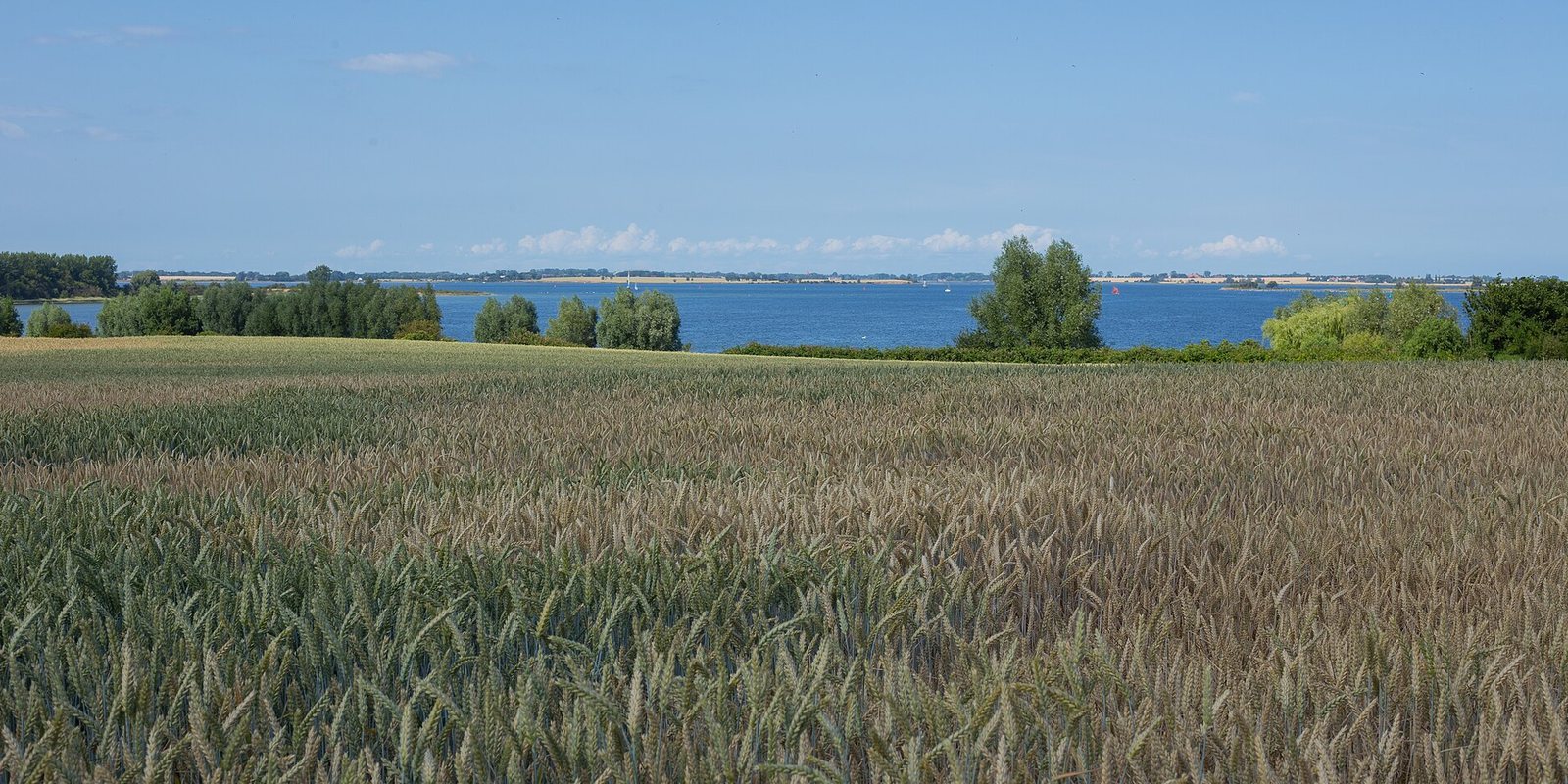
The breakthrough came on Wismar Bay. At Groß Strömkendorf, a village on the eastern shore of the bay opposite the island of Poel, early medieval finds were noticed in the 1980s. In 1986 the volunteer heritage warden H. Kruse from Rostock first connected the site with the emporium Reric. Between 1989 and 1991 F. Wietrzichowski investigated parts of the settlement and argued for the identification, which initially met with criticism in the scholarly literature.
The major excavations followed from 1995 to 1999, in a project funded by the German Research Foundation (DFG) and directed by the archaeologist Hauke Jöns, run jointly by the State Heritage Office of Mecklenburg-Western Pomerania and the Institute of Prehistory and Early History at Kiel University. The cemetery was excavated completely and large parts of the settlement uncovered. The results have since appeared in the series "Forschungen zu Groß Strömkendorf": Torbjörn Brorsson published the pottery in 2010, Astrid Tummuscheit the building remains in 2011, and Marcus Gerds and Michael Wolf the cemetery in 2015.
What makes Groß Strömkendorf so valuable are its wells. More than 70 were found, over 40 of them with surviving timber linings. Numerous samples from these timbers could be dated by dendrochronology, the tree-ring method that matches the sequence of wide and narrow annual rings against a reference curve. Where the last growth ring under the bark survives, the so-called waney edge, the felling year can be fixed to the exact year.
From these dates Astrid Tummuscheit worked out four phases of settlement:
Read that list again with the annals in mind. A place founded around 735, laid out to a plan by mid-century, booming around 780, and with its youngest timber felled in 811. That fits a site that took a heavy blow in 808, was still called an emporium in 809 and then petered out. The dates after 808 are especially telling: somebody was still maintaining wells there long after Godfred had sailed away.
The archaeologist Sunhild Kleingärtner has therefore stressed that the late phase already shows signs of decline before 808, and that the attack accelerated an ongoing process rather than starting it. Not everyone agrees, but either way the finds tell a story of their own that cannot be reduced to a single annal entry.
The settlement consisted mainly of sunken-featured buildings, or pit houses: small structures with a floor dug into the ground and a roof carried on posts. Nearly 100 of them were excavated and recorded. Buildings like these served as workshops, stores or living space. The settlement stretched along the shore at a deep-water location, ideal for ships that needed no quay, only a shelving beach and a sheltered bay.
The house pits held traces of what such a place lived on. There is evidence of textile production, iron and non-ferrous metalworking, and half-finished products and waste from working glass, amber and horn. Hoards of schist whetstones from Norway were also found. Whetstones were a sought-after commodity all over the North, and they show how far the routes from Wismar Bay reached.
The pottery is just as revealing. Most vessels belong to Slavic ware groups, above all the so-called Sukow type, with some Feldberg ware alongside. Using scientific analyses, Torbjörn Brorsson showed that the imported pottery came mainly from Scandinavia and the North Sea coast, with a notable number of sherds from the Rhineland and the Eifel. Among them is Tating ware, a fine pottery often decorated with tin foil, known from great trading places such as Dorestad and Birka. Groß Strömkendorf was plugged into the same network as the major emporia of the North Sea world.
And coins? Caution is needed here. The Baltic of the eighth century was not yet a coin-using landscape. Arab silver, which later shaped Viking trade, reached the Baltic region in quantity only towards the end of the eighth and above all in the ninth century. We could not check against a reliable source how many coins, and of what kind, were found at Groß Strömkendorf, so we give no figures. What is certain is that the earliest Scandinavian coins, the so-called sceattas from Ribe, belong to the same world of early North Sea ports that Reric was connected to.
On the older, northern part of the site the excavators uncovered a complete cemetery. Around 240 human burials are securely identified, along with a good dozen animal graves. The dead were buried in two ways: inhumed, and cremated, sometimes in urns, sometimes in pits or with scattered pyre debris.
The most striking feature is the boat graves. Six people were buried in boats built in the Scandinavian tradition, clinker-built, that is, with overlapping planks fastened by iron rivets. The wood has gone entirely; what the archaeologists found were the rivets lying in their original positions, tracing the outline of the boats. Boat burial is a typically Nordic custom known from Sweden, Norway and Denmark. Its appearance here on the Slavic coast suggests that people from Scandinavia did not merely pass through Reric but lived and died there.
There is also a chamber-grave complex. Michael Wolf's anthropological study adds information on the age, sex and living conditions of those buried. As for dating, the cemetery belongs to the eighth and early ninth centuries. Exactly how its use and the end of the settlement relate in time is debated in the literature; the grave goods suggest that cemetery and settlement were largely contemporary.
The obvious answer: anyone with something to sell. The house forms show Slavic, Scandinavian and Saxon building traditions. The pottery is mostly of Slavic manufacture, with imports from Scandinavia, the North Sea zone and the Rhineland. The graves combine Slavic cremation with Nordic boat burial.
The picture that emerges is of a place where the Obodrites provided the framework (land, food, labour and probably protection) while Scandinavian traders and craftspeople formed an important part of the population. The Danish name in the annals and the dues paid to Godfred's realm fit this. A hub, then, where several claims to power converged. That is exactly what made it vulnerable.
The best-known interpretation runs like this: Godfred destroyed Reric in order to bring its merchants to the Schlei, where they were to boost trade at Hedeby (German Haithabu), sheltered by the frontier rampart and under royal control. Hedeby would thus be Reric's heir. This "relocation" theory is elegant, and it has arguments on its side.
In its favour is the timing: Godfred destroyed Reric, took the merchants, returned to Sliesthorp and had the rampart extended, all in one annal entry. In its favour, too, is the logic: a king who draws dues from a trading place in an insecure, contested borderland might well want to bring that trade closer to his own power base. And Hedeby did indeed grow into one of northern Europe's most important trading towns in the ninth century.
Several points argue against it, or at least for caution. First, the source names no destination for the merchants. Second, there was already settlement activity on the Schlei before 808; Hedeby did not spring from nothing. Third, it is disputed which place exactly is meant by "Sliesthorp". Some equate it with Hedeby, others think of the royal estate in the Füsing area on the opposite shore of the Schlei. We have traced that debate in our article on Sliasthorp and Füsing. Fourth, dendrochronology shows that building continued at Groß Strömkendorf after 808.
A balanced way of putting it is this: the destruction of Reric and the removal of its merchants may have contributed to the rise of Hedeby, and much suggests that Godfred wanted to concentrate trade within his own sphere of power. But the source does not say that Hedeby "grew out of Reric", as one often reads. And scholars such as Kleingärtner point out that the end of the trading places on the southern Baltic as a whole was bound up with deep structural change, not only with raids.
Reric was not alone. Along the southern Baltic coast several seaborne trading places grew up in the eighth and ninth centuries where Slavs and Scandinavians met. On Rügen lies Ralswiek, a trading place of the Rani with boat finds and a large barrow cemetery. On the Peene near Anklam lies Menzlin, known for its ship-shaped stone settings that point to Scandinavian families living on the spot. Further east, Wolin at the mouth of the Oder grew into a major town.
Compared with these, Reric stands out for how early it is. Beginning around 735, Groß Strömkendorf is among the oldest of these sites, and unlike most of the others it ended as early as the beginning of the ninth century. Ralswiek and Menzlin had their heyday afterwards. Reric was a forerunner from the time when the Baltic trading network was only just taking shape.
After the early ninth century the centre of Obodrite power moved inland. The stronghold at Dorf Mecklenburg, a few kilometres south of Wismar, became the main seat; in a charter of Otto III from 995 it appears as "Michelenburg", the great fortress, the name that would later be given to an entire land. Whether there is a direct link between the end of Reric and the rise of this stronghold is not securely attested.
An echo of the name survived all the same. In the eleventh century Adam of Bremen also calls the Obodrites "Reregi", and Helmold of Bosau repeats this in the twelfth. That this name goes back to Reric is considered likely, but it remains an interpretation.
For us, Reric is a story about power exercised through trade routes. Godfred moved not only warriors but merchants, dues and borders. A place that had received ships from Scandinavia, the Rhineland and the Slavic hinterland for almost eighty years vanished within a few. What remains are well timbers, boat rivets, potsherds and a Danish name in a Frankish chronicle.

Where was Reric located? Most probably at Groß Strömkendorf on the eastern shore of Wismar Bay in Mecklenburg, Germany. The identification rests on the matching dates of roughly 735 to 811 and the character of the site; no inscription or place name proves it conclusively.
Who destroyed Reric, and when? The Danish king Godfred (Godofridus, also Gudfred) in 808, during a campaign against the Obodrites. That is what the Royal Frankish Annals report.
Is the seaside town of Rerik the site of ancient Reric? No. Alt-Gaarz was renamed Rerik in 1938 because the trading place was then thought to lie there. Research today places it on Wismar Bay.
Were the merchants of Reric moved to Hedeby? The annals only say that Godfred carried off the merchants and then returned with his fleet to the port of Sliesthorp. That they were resettled on the Schlei is a common and plausible interpretation, but it is not explicitly recorded.
What was found at Groß Strömkendorf? Nearly 100 sunken huts, more than 70 wells, a cemetery with around 240 burials including six boat graves, evidence of glass, amber, horn and metalworking, Norwegian whetstones and imported pottery from Scandinavia, the North Sea area and the Rhineland.
Did Reric still exist after 808? Yes, at least briefly. According to the annals the Obodrite leader Thrasco was murdered in the emporium Reric in 809, and the youngest dated timber from Groß Strömkendorf was felled in 811.
For courage. For remembrance. For legends that live on.
Hedeby · The Danevirke · Hacksilver – silver as currency · Viking traces in Germany · The Ox Road.
All History & Finds articles →
Long before there were Vikings in the sense of the sagas, there was already a town in south-west Jutland: Ribe, founded …
Read more →The Viking battle was no wild scramble but a hard struggle shield to shield. A look at tactics and weapons beyond the …
Read more →Long before the Viking Age and before the Icelandic Edda there was Germanic cult – and one of the most striking stood …
Read more →Silver was the lifeblood of Viking trade – weighed, chopped up, buried. Three of the greatest hoards show how far the …
Read more →