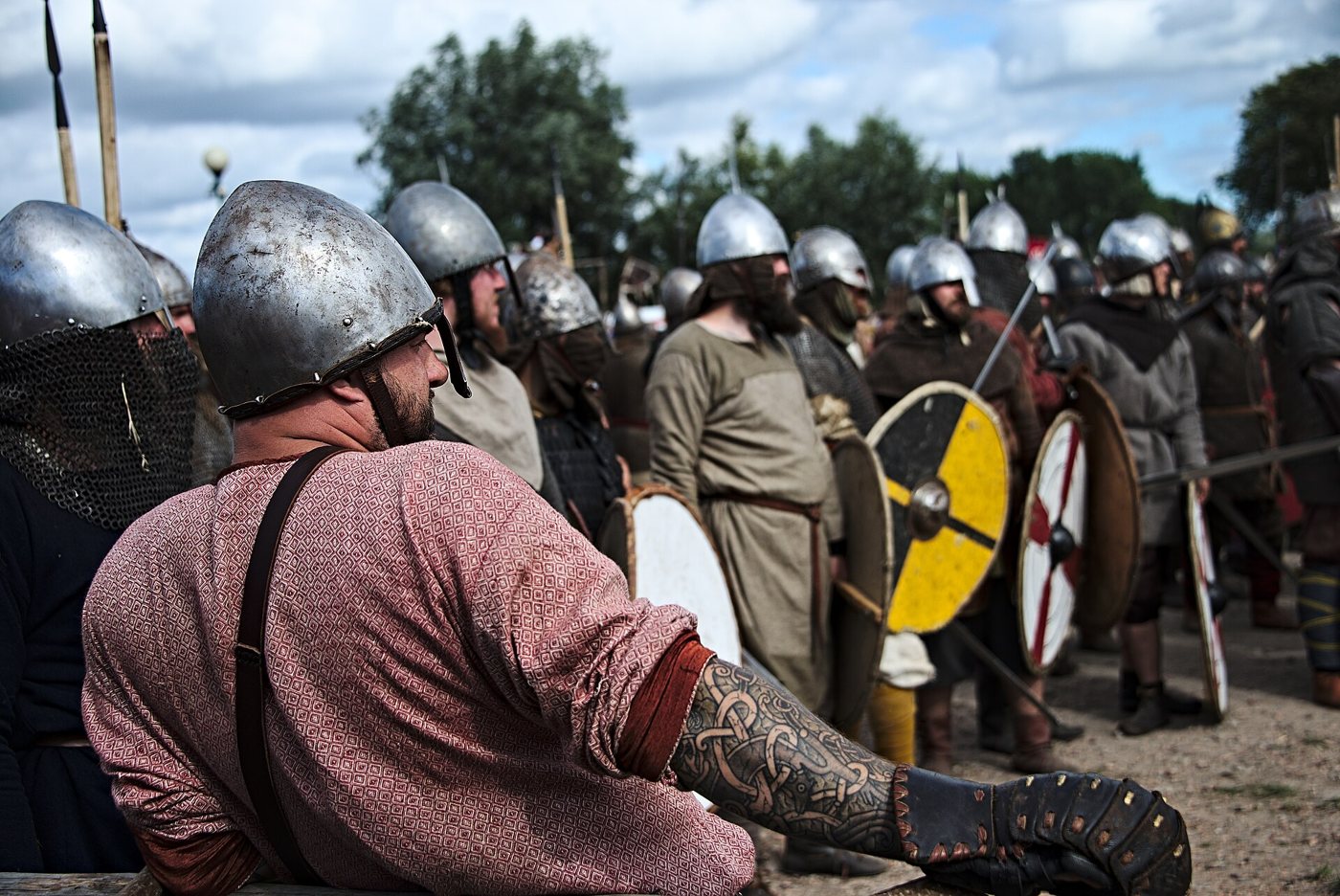
The Festival of Slavs and Vikings in Wolin, Poland, is held every year over a long weekend in late July or early August – in 2026 it ran from 30 July to 2 August. As of October 2026, the organisers have not yet announced the 2027 dates. Here is what to expect on the little island in the Dziwna, what tickets cost last time, how to get there from Germany, and why this particular spot at the mouth of the Oder is where the stories of Jumne, Jomsborg and Vineta come together.
It is half past eight in the evening and the sun is sinking over the lagoon. Boats drift on the river, somebody on the bank is beating a frame drum, and the dust of the afternoon battle is still hanging over the meadow. Hundreds of people in wool and linen sit around fires, mending mail shirts and grilling fish. This is not a fairground with plastic swords. It is one of the largest early medieval re-enactment gatherings in Europe, and it takes place where, a thousand years ago, Slavs, Scandinavians, Saxons and merchants from half the continent really did meet.
As of October 2026 the organiser, the Centrum Słowian i Wikingów Wolin–Jomsborg–Vineta (Centre of Slavs and Vikings), has not published a date for 2027. The official site, jomsborg-vineta.com, still shows the 2026 programme. Any 2027 dates you see on event aggregators are guesses based on the usual pattern, not announcements.
What we can give you is the track record. For years the festival has been held on the last weekend of July or the first weekend of August, usually over four days from Thursday to Sunday. The two most recent editions:
If the pattern holds, expect a weekend between late July and early August 2027. Book refundable. As soon as the date is official, we will add it to our guide to Viking festivals in 2027 and to our events calendar.
“Wolin” means two things: a large island between the Szczecin Lagoon and the Baltic, and a small town on its south-eastern edge. The town sits on the Dziwna (German: Dievenow), the easternmost of the three channels through which the lagoon drains into the sea. Right opposite the town centre, in the river itself, lies a small islet called Wyspa Ostrów (also known as Wolińska Kępa). That is where the Centre's open-air museum stands: a reconstructed early medieval settlement with rampart, gates, a harbour quay and dozens of houses you can walk into, built after excavation evidence from Wolin itself.
According to a paper by Wojciech Filipowiak, Michał Bogacki and Karolina Kokora, an archaeological and ethnographic open-air museum in Wolin was first proposed in 1958 but never realised under communist rule. The association behind today's Centre was registered in 2002, and the site opened in 2008. During the festival the museum is the beating heart: the historical part – camp, crafts and battles – runs on the island, while the town council organises the cultural programme with stages on the town meadows (Błonia).
The festival is older than the museum that hosts it. The organisers speak of a tradition going back to 1993, and the Polish Press Agency (PAP) repeats that date. The academic paper by Filipowiak, Bogacki and Kokora, however, gives 1992 as the year of the first Viking festival in Wolin. Either way, it started in the early 1990s, first as a Viking festival and later under its present name, Festiwal Słowian i Wikingów. According to PAP the 2025 edition was the 30th; the count runs slightly behind the calendar because not every year saw a festival.
The change of name is more than branding. Wolin was a Slavic town with Scandinavian residents and visitors, not a Viking colony, and the festival now says so in its title: Slavs and Vikings, in that order.
The programme changes every year with the theme, but the backbone stays the same. Here is 2026, per the official site.
The battles. This is what draws many visitors. Every afternoon the armies clash on the meadow by the Dziwna – in 2026 at around 4 pm, and at 2 pm on Sunday. Smaller formats join in, such as the “Bitwa o most”, the battle for the bridge, with heats on Friday and a final on Saturday. Re-enactment combat is scripted in its rules, not in its outcome: blunt weapons, agreed target zones, and shields that crack for real.
The crafts. Potters, smiths, goldsmiths, amber carvers, weavers, leatherworkers and boatbuilders work in the houses and tents. The Centre runs its own historical shipyard, building replicas of Slavic and Scandinavian plank boats and dugouts. Many re-enactors sell their work,; you will rarely see so many replicas of specific grave finds in one place.
Hands-on. Archery and javelin throwing for visitors, trying on kit, tastings of early medieval food, and workshops in casting, leatherwork, weaving and spinning.
Rituals, music and contests. An opening procession, re-enacted offering ceremonies, evening concerts of historically inspired music – in 2026 even a concert on the water and a shadow-and-fire theatre. And a classic with a wink: the contest for the most dignified beard and the finest braid.
For 2026 the organisers listed 35 złoty for a standard ticket and 25 złoty for a reduced one, sold online via tobilet.pl and at the gate. In 2025, according to PAP, entry to the Centre cost 32 and 22 złoty, while events in the town and on the meadows were free. Prices for 2027 have not been published; expect something in the same range, perhaps slightly higher.
In 2026 the site was open from 10 am until 7 or 8 pm, closing at 5 pm on Sunday, with concerts and fire shows running later. Bring some cash in złoty. Not every trader takes cards.
Wolin is not far from the German border, but there are several ways in. A few reliable pointers:
By car. From Berlin and points south, drive via Szczecin (Stettin) and then north on the S3 expressway to Wolin. Coming from the island of Usedom, go via Świnoujście (Swinemünde). Since 2023 a road tunnel under the Świna has linked the two halves of Świnoujście; before that, the only way across was by ferry. Parking is tight on festival weekend, so arrive early or take the train.
By train. Wolin lies on the Szczecin–Świnoujście railway line, and Szczecin is reachable from Berlin by regional train. From Usedom, the UBB island railway runs to Świnoujście Centrum, but Świnoujście's Polish main-line station is on the far side of the Świna, so you will need to cross, for example on the town ferry. Leave yourself a buffer.
Check timetables and ferries shortly before you travel; engineering works and rail replacement buses are not unusual in the region.
Wolin is a small town with a small number of beds, and 30,000 visitors in one weekend make themselves felt. Our advice: either book in Wolin itself very early – as soon as the date is out – or stay elsewhere. Świnoujście, Międzyzdroje on the island's Baltic coast and Kamień Pomorski are all within reach and have more capacity. If you are already on holiday on Usedom, the festival makes an easy day trip. With children, a base near the beach works well: battles in the morning, Baltic in the afternoon.
Now for the part we find most exciting. The festival is in Wolin for a reason. Beneath the town lies a trading centre that, in the 10th and 11th centuries, ranked among the most important on the southern Baltic – comparable to Hedeby or Birka. The full story is in our article Wolin & Jomsborg: The Metropolis at the Mouth of the Oder.
The site has a long prehistory, but the town that matters here grew up in the late 8th and 9th centuries. Archaeologists have found fortifications from the 9th century, and later a central stronghold with two fortified suburbs and harbour works along the Dziwna. Its backbone was the Pomeranians, the Slavic “people by the sea”, together with a network reaching from the Rhineland to Rus. The finds tell the story: Arabic silver coins, glass, pottery from several regions, Scandinavian jewellery and, above all, amber, worked here on a large scale. How long-distance trade worked in this period is explained in our article on Viking trade.
Digging in Wolin has a long history. German archaeologists led by Otto Kunkel and Karl August Wilde excavated in the 1930s and in 1941 published a volume titled “Jumne, ‘Vineta’, Jomsborg, Julin. Wollin”. After the war Polish archaeologists took over; from the early 1950s large-scale excavations began, shaped for decades by Władysław Filipowiak (1926–2014), long-time director of the National Museum in Szczecin.
The most famous sentence about Wolin was written by a man who never went there. Adam of Bremen, writing around 1075 in his history of the archbishops of Hamburg, describes the mouth of the Oder and a town he calls Iumne (the oldest manuscript has a form like uimne). His information came second-hand, partly from the Danish king Sweyn Estridsen.
Adam praises the town as a busy trading place for the “barbarians and Greeks” around it, and then comes the line quoted in every guidebook. In our own rendering:
It is truly the largest of all the cities that Europe contains, inhabited by Slavs and other peoples, Greeks and barbarians. Saxon newcomers, too, may live there on equal terms, provided they do not openly declare themselves Christians.Adam of Bremen, Gesta Hammaburgensis ecclesiae pontificum II.22 (Schmeidler's numbering), our own translation
Adam adds that although the inhabitants are still pagans, no people could be found more honourable or kinder in their manners and hospitality. The town, he says, is rich in the wares of all the northern nations. Then come the marvels: a “pot of Vulcan”, which the locals call Greek fire, and a threefold Neptune – the sea washing around the island in three different forms.
Another passage in Adam links Wolin directly to the Danish royal house. Towards the end of his life Harald Bluetooth came into conflict with his son Sweyn Forkbeard. According to Adam, Harald was wounded in battle, escaped by ship to the city of the Slavs “which is called Iumne”, was received kindly there against all expectation, since the inhabitants were pagans, and died of the wound a few days later (Gesta II.28 in Schmeidler's numbering). This happened around 987.
What is striking is how well this fits everything else we know. Harald had close ties to West Slavic rulers: his wife Tove, according to the contemporary Sønder Vissing runestone, was a daughter of the Obodrite prince Mistivoj, and Danish interest in the Oder mouth in the late 10th century is entirely plausible. The later sagas tell Harald's death quite differently – there he is killed by an arrow from Pálnatóki. Two versions, one dead king.
And then there is Jomsborg. Jómsvíkinga saga, written down in Iceland around 1200, tells of a fortress on the Wendish coast founded by Pálnatóki on land granted by the Wendish king Búrizleifr. Inside lives a brotherhood of warriors, the Jomsvikings: no women in the fort, no retreat from an equal foe, plunder shared out. The harbour supposedly held hundreds of ships, with a stone arch over its entrance. The brotherhood becomes famous through its defeat at the battle of Hjörungavágr against Earl Hákon in Norway, usually dated to around 986.
The saga is literature – good literature, but written two centuries after the events and full of motifs familiar from other heroic tales. That does not mean it is all invented. A place called Jóm already appears in skaldic verse around 1046, close to the events. Knýtlinga saga, from the 13th century, reports how King Magnus the Good of Norway and Denmark attacked and destroyed Jómsborg in 1043. And Adam, as we have seen, writes about Iumne.
Whether Jomsborg and Jumne were the same place, and whether that place was Wolin, has been argued over since the 19th century. The onomastician Alexandra Petrulevich has argued that at Jómi and Jumne share a single root – probably a Slavic word for the depression of the lagoon – and that Jómsborg is a Scandinavian formation built on it. That supports a location in the Wolin area, but it does not prove a fortress. Archaeologists have found no stronghold in Wolin that clearly matches the saga, and no harbour for hundreds of longships. Some scholars think of a Scandinavian base within or beside the Slavic town, for instance around the hill known as Srebrne Wzgórze (Silver Hill); others regard Jomsborg as an institution created by saga writers.
The third name in the museum's title is the most romantic. Around 1170 Helmold of Bosau copied Adam's account of Iumne almost word for word – and in his manuscript tradition the town appears as Vineta, probably a misreading of the old spelling beginning with “vi-” or “ui-”. Helmold adds that the town was destroyed by a Danish king.
From that word grew, in the early modern period, the legend of a rich city that sank beneath the sea for its pride and extravagance and still rings its bells on calm days. It was told above all off the coast of Usedom, and later placed elsewhere as well. Pomeranian historians have largely followed Adolf Hofmeister's work from the 1930s in equating Iumne, Vineta, Julin and historical Wolin. Only the legend ever sank.
Wolin's population was predominantly Slavic, as house construction, pottery, cemeteries and written sources show. A 9th-century source known as the Bavarian Geographer lists the Wolinians in the region with 70 strongholds. But Scandinavians lived in the town as well, and not just in passing: Scandinavian jewellery, weapons and burial customs are attested. Add Saxons, as Adam mentions, and merchants from further afield.
You may know the pattern from other sites in the region, such as Ralswiek on Rügen or Menzlin on the Peene: trading places where Scandinavians and Slavs lived together for the long term. For the bigger picture, read our article The Vikings in the Baltic & the Land of the Wends.
Wealth attracted ambition. Polish rulers reached for the Oder mouth: Mieszko I extended his influence into Pomerania in the 960s, although it is unclear how firmly Wolin was bound to him. Under Bolesław the Brave, around the year 1000, the Polish presence grew stronger – exactly what the 2025 festival theme referred to. Danish and Norwegian kings, for their part, saw the town as a pirates' nest. Magnus the Good's attack in 1043 is the best known, but not the only expedition from the North.
In the 12th century Pomerania was Christianised. Bishop Otto of Bamberg led missions in 1124 and 1128, visiting Wolin – called Iulin in his biographies – on his first journey. In 1140 Pope Innocent II established a diocese for Pomerania with its seat in Wolin. But the heyday was already over. Around 1170 King Valdemar I of Denmark and Bishop Absalon defeated the Pomeranians at the bridge of Julin, Danish campaigns in the following years hit the town hard, and the bishopric moved to Kamień Pomorski (Cammin) in the 1170s. You will often read that the Danes finally destroyed Wolin in 1173. The campaigns of the 1170s are well attested in Saxo Grammaticus and Knýtlinga saga, but a precise year for “the end” is more of a simplification than a firm finding. Wolin lived on as a small town. The metropolis vanished.
What fascinates us about Wolin is that the borders between “Slavic” and “Norse” blur here: Baltic amber, silver from the Caliphate, Scandinavian animal art – all on one quay. If you want to combine the festival with the major museums of the region, our guide Experience the Vikings: Museums and Sites has plenty of ideas.
For courage. For remembrance. For legends that live on.
When is the Festival of Slavs and Vikings in Wolin in 2027? As of October 2026 the organisers have not announced the dates. The festival is traditionally held over a long weekend in late July or early August; in 2026 it ran from 30 July to 2 August.
How do I get to the Wolin Viking festival from Germany? By car via Szczecin and the S3, or from Usedom via Świnoujście. By train via Szczecin; Wolin is on the Szczecin–Świnoujście line.
How much are tickets for the Wolin festival? In 2026 a standard ticket cost 35 złoty and a reduced one 25 złoty. Prices for 2027 have not yet been published.
Is Jomsborg the same as Wolin? The place Scandinavians called Jóm or Jomsborg most likely lay in the Wolin area. A Jomsviking fortress as described in the saga, however, has not been found archaeologically.
Did Adam of Bremen really call Wolin the largest city in Europe? Yes, in his chapter on the Oder mouth (Gesta II.22) he calls Iumne the largest city in Europe. It is a second-hand exaggeration that shows how important the trading place was.
Is the Wolin festival suitable for children? Yes. There is archery, javelin throwing, hands-on crafts and plenty to watch; just plan for noisy battles and crowds with small children.
Wolin & Jomsborg · The Jomsvikings · Viking festivals 2027 · Vikings on the Baltic · The Pomeranians · Harald Bluetooth.
Anyone exploring the Viking Age soon trips over strange words: blót, seiðr, ørlög, drengr, kenning. Many are misspelled …
Read more →The little blue symbol on your phone is over a thousand years old: two interlocking runes – the initials of the Viking …
Read more →Few questions reach us in the workshop as often as this one: „Which material actually suits my motif best?" Whether …
Read more →A dark slate plate, a brief beam of light, and where there was deep anthracite a moment ago, a bright, silvery-white …
Read more →
