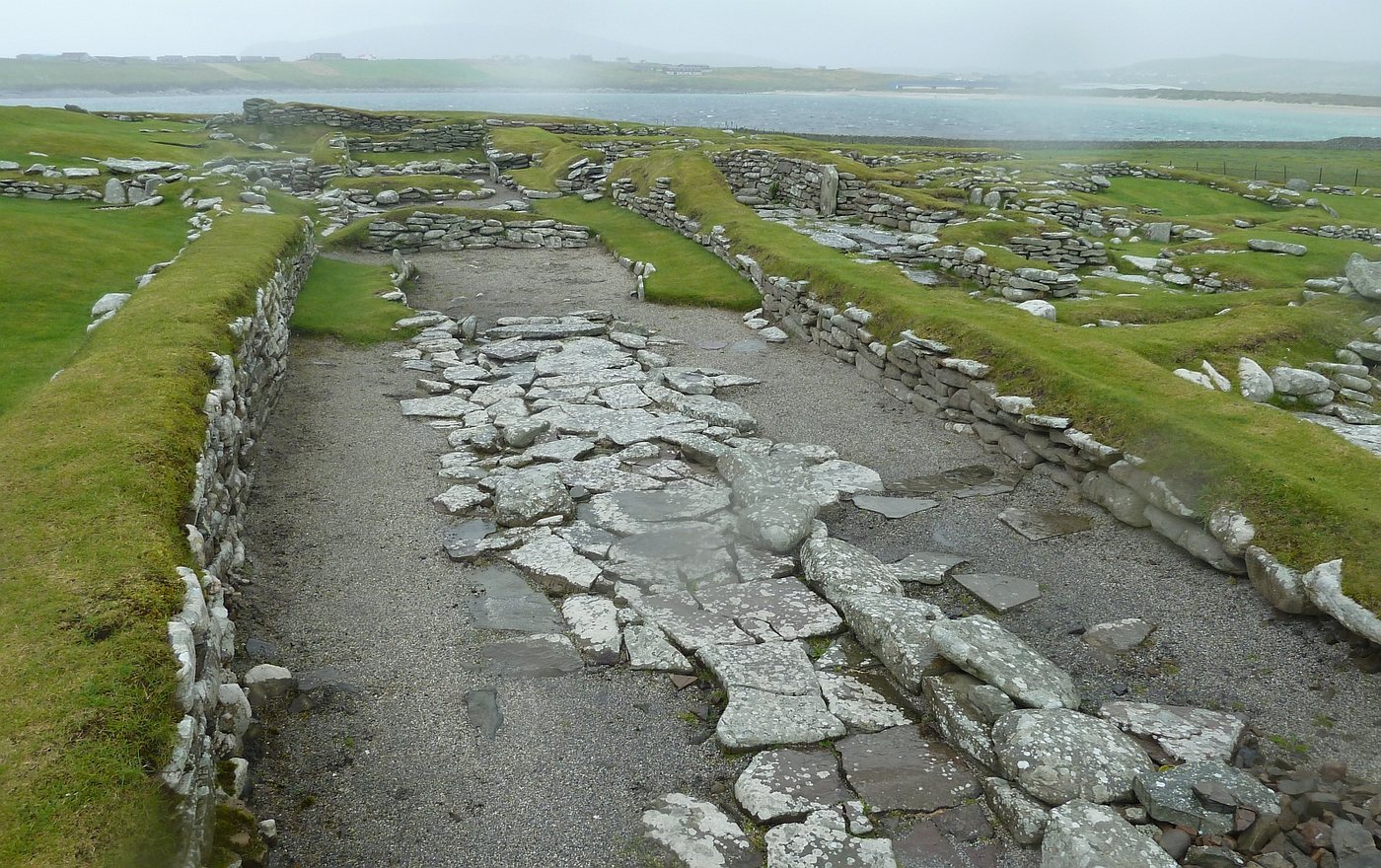
No jarl ever lived at Jarlshof. The name was made up by a novelist, Walter Scott, after a visit in the summer of 1814. And yet at the southern tip of Shetland, between the airport and the surf, lies one of the most important Norse settlement sites in the British Isles. A storm laid it bare, three generations of archaeologists dug it out. Bronze Age, Iron Age, Viking Age and early modern Scotland stand here literally on top of one another. Anyone who wants to know how Shetland became Norse starts here.
In the summer of 1814 Walter Scott spent six weeks sailing with the Commissioners of the Northern Lighthouses around the north coast of Scotland, to Orkney and Shetland. He kept a diary. At Sumburgh he saw the ruin of a late sixteenth-century mansion built by the Stewart earls of Orkney. Seven years later he put it into a novel.
The Pirate came out in Edinburgh at the end of December 1821 and in London two days later; the title page says 1822, which is why both years get quoted. In the novel the Mertoun family live in the remains of the earls' old house, and Scott calls it "Jarlshof", the earl's house. The word is an invention. There is no old place-name of that kind there; the place is Sumburgh, and inside that name sits Old Norse borg, a fortification.
Scott had no idea what lay beneath the house. That Norse settlers really had lived on this spot was shown only by archaeology – more than a century after the novel. The invented name stuck. It fits better than its inventor could have known.
In the 1890s a storm tore away part of the shore and exposed thick stone walls. The landowner, John Bruce of Sumburgh, had digging done from 1897 – by the standards of the day, which mostly meant clearing walls. Systematic work followed from 1925, when the site passed into state care.
In the 1930s Alexander Curle excavated for the Office of Works. He came upon a house that looked unlike anything beneath it: long, rectangular, with straight walls. It is regarded as the first securely identified Norse longhouse in the British Isles. Curle published his reports in the Proceedings of the Society of Antiquaries of Scotland. V. Gordon Childe, one of the great prehistorians of the twentieth century, also worked briefly on the site in 1937.
The decisive campaign was led by J. R. C. Hamilton from 1949 to 1952. His report, Excavations at Jarlshof, Shetland, appeared in 1956 and still shapes the picture. Hardly any digging has happened there since. Almost everything known about the site rests on excavations seventy years old and more – worth keeping in mind with every date.
Jarlshof is not a Viking site that happens to have older things underneath. It is a place where people built again and again because it was good: a sheltered bay, fresh water, fertile soil, fish on the doorstep.
The oldest houses are small oval Bronze Age buildings with thick stone walls. In the Late Bronze Age a bronzesmith worked here; fragments of his clay moulds survive. In the Iron Age came a broch, one of those round stone towers found only in the north and west of Scotland. Today it stands about two and a half metres high; originally it was probably several times that, and the sea has taken half of it. After it came wheelhouses, whose interiors are divided by stone piers like the spokes of a wheel. Those at Jarlshof are among the finest there are. Their last inhabitants lived in what Scottish archaeology calls the Pictish period.
Then came people from Norway. And after them, centuries later, the Scots with their mansion.
The oldest Norse house was some twenty metres long and five wide: a living hall with a central hearth, timber benches along the long walls and two opposing doors. Anyone who has read our piece on the longhouse will recognise the pattern at once. It is a house of the kind built in western Norway – only in stone and turf, because Shetland has hardly any trees.
Around this first house a farm grew over generations. Seven longhouses are counted, but they never all stood at once. Houses were lengthened, abandoned, rebuilt alongside; outbuildings were added: byres, a barn, a bathhouse or kiln. Historic Environment Scotland speaks of twelve to sixteen generations over which the farm grew and shrank, until in the thirteenth century a medieval farmhouse took its place.
The finds include steatite vessels, loom weights, combs, spindle whorls and slate slabs with incised drawings, ships among them. It is the inventory of a farm, not a war camp. The people of Jarlshof lived from livestock, grain and, increasingly, fishing.
When exactly the first house was built is disputed. Hamilton put the start around 800. Historic Scotland later moved it to about 850, and in 2000 Steffen Stummann Hansen argued that even this might be too early – partly because of certain ringed pins that fit a later date better. All that is certain is this: Norse settlement begins in the ninth century, and cannot be shown to begin earlier.
The Norse called the islands Hjaltland; by stages that became the name Shetland. In Orkneyinga saga, written down in Iceland around 1200, Hjaltland belongs to the domain of the earls of Orkney, but mostly stands in Orkney's shadow. The saga tells of the earls, after all, and they sat in Orkney.
Shetland appears mainly as a place of passage. One episode is set in the broch of Mousa, the best-preserved broch of all, only a few kilometres north of Jarlshof: around the middle of the twelfth century Erlend the Young flees into the old tower with Margaret, mother of Earl Harald Maddadsson, and Harald besieges him in vain. Egils saga knows Mousa too – a couple from Norway is said to have wintered there after a shipwreck. Both are saga scenes, written down centuries later. That the Norse knew the Iron Age tower and used it as a refuge is still believable.
Politically, Shetland was separated from Orkney in 1195. After a failed rising against King Sverre in which Earl Harald Maddadsson had been involved, the Norwegian king took Shetland under his direct rule. From then on it was Norwegian crown land, with its own assembly: the Lawting met on a small island in the loch of Tingwall, Old Norse Þingvǫllr, assembly field – the same name as Iceland's Þingvellir.
From the Old Norwegian of the settlers a language of its own developed in Shetland and Orkney: Norn. It belongs to the West Norse branch, like Faroese and Icelandic; linguistically the kinship with the Faroese is close.
Little in writing survives. There is a version of the Lord's Prayer and a ballad, Hildina, which the minister George Low wrote down on the island of Foula in 1774 – from a man who knew the text by heart but, as Low saw it, no longer understood it. At the end of the nineteenth century the Faroese linguist Jakob Jakobsen collected thousands of words and phrases in Shetland that had survived in the dialect. The last native speaker is often said to have been Walter Sutherland of Skaw on Unst, who supposedly died around 1850. That is a tradition, not a measurement.
The place-names speak more clearly than any manuscript. According to Stummann Hansen, some 95 per cent of Shetland's place-names are of Norse origin. Anyone reading names in -wick, -setter or -ness on today's map is reading Old Norse: vík bay, setr farm or shieling, nes headland.
The end of Norse Shetland came not with a sword but with a marriage contract. King Christian I of Denmark and Norway was to give his daughter Margaret a dowry when she married King James III of Scotland. He did not have the money. In 1468 he pledged his rights in Orkney, in 1469 his rights in Shetland, the latter for 8,000 Rhenish guilders. The contract allowed for redemption. It never happened. In 1472 the Northern Isles were formally annexed to the Scottish crown.
Scholars link the slow shift from Norn to Scots to these pledges. Scottish landlords arrived, Scots law pushed out Norwegian law. At Jarlshof you can see the change in stone: In the late sixteenth and early seventeenth centuries the medieval farm became a fortified house of the Stewart earls of Orkney. It is usually credited to Robert Stewart, with the rebuilding to his son Patrick, notorious in Shetland for his harshness; Historic Environment Scotland names Patrick as the builder. That is the house Scott saw as a ruin in 1814.
When the first Norwegians arrived, Shetland was not empty. The wheelhouses of Jarlshof had been lived in, nearby Old Scatness has buildings of the Pictish period, and on St Ninian's Isle in 1958 a schoolboy found, under a stone slab in a chapel, a silver hoard hidden around 800. There were Christian communities, then. What became of them is one of the most fiercely argued questions in North Atlantic archaeology.
Frederick Wainwright wrote in 1962 that the Picts had been "overwhelmed" politically, linguistically, culturally and socially. Anna Ritchie read coexistence into her excavations at Buckquoy in Orkney in the 1970s, with Pictish objects still in use in Norse houses. Brian Smith of Lerwick countered in 2001: the almost total replacement of place-names suggests that the native population was killed or driven out. Others read a more mixed picture in the genetics. A study by Goodacre and colleagues in 2005 estimated the Scandinavian share in the ancestry of present-day Shetlanders at around 44 per cent, roughly equal for men and women – a hint that whole families migrated. A sample taken today, though, says little about what happened to the Picts in the ninth century.
Displacement or mixing – the question is open, and we will not pretend otherwise. It probably was not the same everywhere. For the neighbouring islands, see our overview of the Vikings in Ireland, Scotland and the Isles and our piece on the Norse on the Isle of Man.
Archaeologically proven are the layers of settlement from the Bronze Age to the mansion, the Norse longhouse and its successors, the farm as a way of life, and the start of Norse settlement in the ninth century. The exact start is disputed.
Documented are Shetland's separation from Orkney in 1195, the Lawting, the pledge of 1469 and the annexation to Scotland in 1472.
Later tradition are the Mousa episodes in Orkneyinga saga and Egils saga, written down around 1200 and after, and the story of the last Norn speaker.
Modern interpretation is the fate of the Picts – and, not least, the name itself. Jarlshof is a novelist's idea of 1821. The place beneath it is real. For courage. For memory. For legends that live on.
The Earls of Orkney · The Faroese · The Vikings in Ireland, Scotland & the Isles · The Gall-Goídil · The Icelanders · The Norse on the Isle of Man.
_-_geograph.org.uk_-_2665446.jpg)