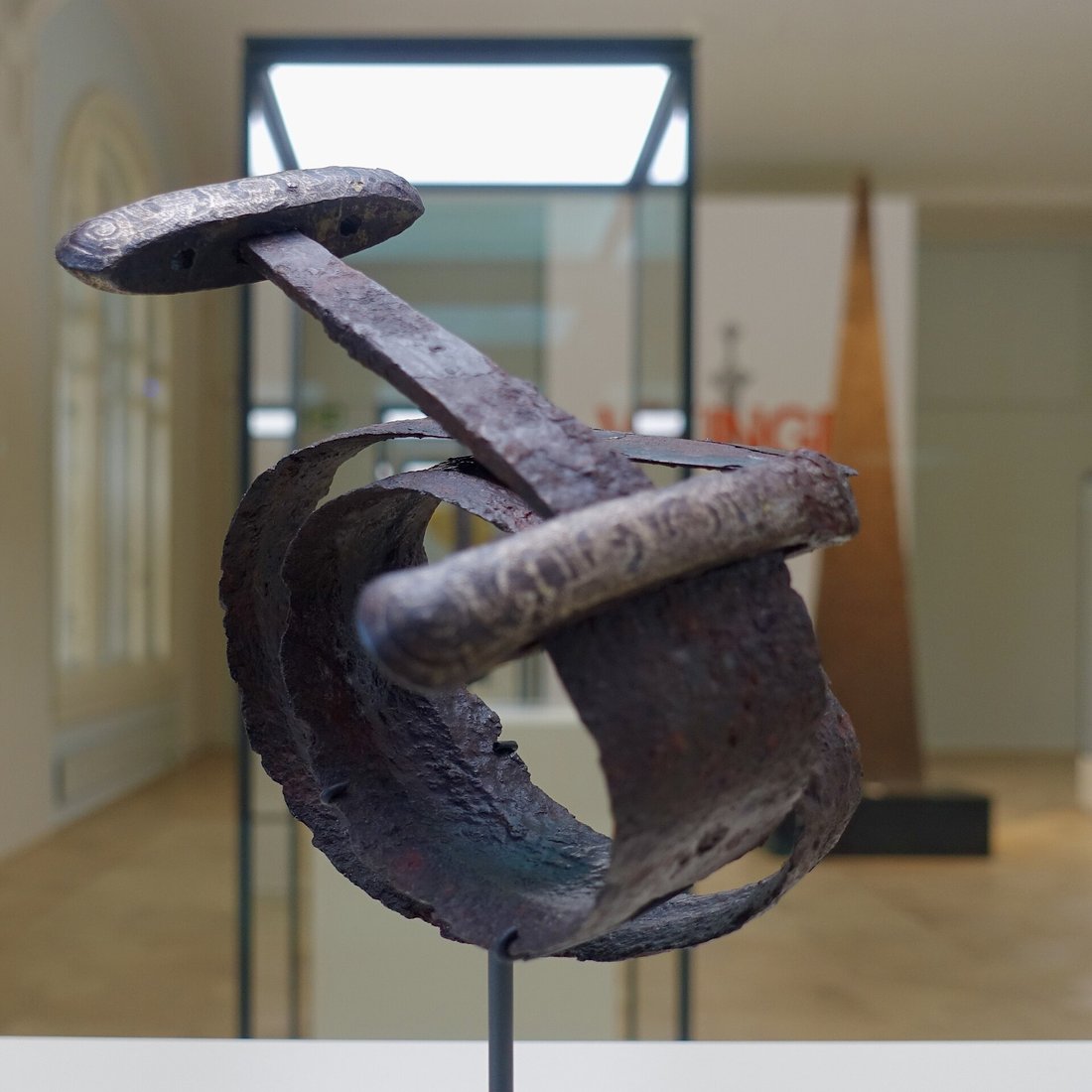
A sword folded double like a soft ribbon. A blade twisted like a corkscrew. A piece of iron that someone deliberately, and with real effort, made useless before it went into the earth or the fire. Archaeologists call it „killing" the weapon. It sounds brutal – yet it is one of the most moving customs of the Norse world, because behind it lies no urge to vandalise, but care, craft and a meaning we can still only half grasp.
When specialists speak of a „killed" weapon, they do not mean a blade that shattered in battle, nor a find eaten away by rust. They mean a sword that a person deliberately ruined before burial: bent, twisted, folded, often broken into several pieces. This treatment stands out sharply from everything else placed in a grave. Brooches, beads, tools – all of it went into the ground intact. The sword alone was singled out for punishment.
That very contrast is what makes the custom so telling. A broken drinking vessel might be an accident. A sword folded double never is. It is a conscious act that cost effort, and it was reserved for the most valuable, most charged weapon of the Viking Age. Anyone who wants to understand how the Norse thought about their blades will find here the most direct way in.
You cannot simply snap a good Viking sword over your knee. A carefully forged, often pattern-welded blade is springy and tough; it bends back rather than splintering. To fold such a sword double, or to twist it like a corkscrew, you must reheat it in a fire, clamp it, work it with tools. In other words: you need a forge, time and expertise.
The finds show the whole spectrum. Some blades are bent into a flat U, others closed into a ring, others spiralled or smashed into two or three pieces. Hanne Lovise Aannestad, who studied the custom for Norway, stresses that this treatment demanded „preparation, expertise and equipment". That is the decisive point: no one here was raging in the heat of the moment. Someone, with a steady hand and hot iron, destroyed a treasure – planned, laborious, intended.
For a workshop that works with metal and material itself, that is exactly what strikes home. The effort is part of the message. For more on the standing of such blades, see our deep-dive on the Viking sword.
Few topics gather as much confusion as destroyed weapons – almost always because two completely different things get thrown together. It pays to keep them apart before speaking of „the Vikings".
The first custom is the bog war-booty sacrifice: the equipment of a defeated army, gathered, wilfully destroyed and sunk into a lake or bog. That belongs to the Roman Iron Age and the Migration Period – roughly 200 to 400 AD, centuries before the Viking Age.
The second custom is the killing of the dead person's own sword in the grave: the personal weapon of one deceased, bent and buried with them. That is Viking-age, and it turns on a single death, not on victory over a foreign army. Both customs destroy iron on purpose – but for utterly different reasons. Anyone who equates them understands neither.
The great sacrificial bogs of southern Scandinavia hold the proof of the first custom. At Illerup Ådal in Jutland, excavations brought up more than fifteen thousand objects: spearheads by the hundred, shields, swords, the whole gear of a beaten invading army. Much of it had been deliberately made useless before deposition – blades bent, shafts broken, shield-bosses hacked. The same is true of Nydam and Ejsbøl.
The logic behind it is different from the grave. Those who had won a battle gave the losers' equipment to the gods of war who had granted the victory. The destruction served twice over: it made the booty unusable, so no one could enrich themselves on foreign iron, and it moved the weapons finally out of the human world and into the world of the powers. It has nothing to do with escorting a deceased into the beyond. It is a thank-offering after war – and it is roughly half a millennium older than the first longships. To understand the bog finds as a whole, see the Germanic army sacrifices.
The killed grave-sword of the Viking Age is a quite different matter. Here the weapon belongs to the dead person themselves. It is not the iron of a beaten enemy, but their own blade – the one they carried, perhaps inherited, perhaps named. And this blade is bent and given into the earth or the fire with them.
That weapons went with the man into the pyre is an old Norse-Germanic trait. Tacitus already describes it for the Germanic peoples, long before the Viking Age:
Sua cuique arma, quorundam igni et equus adicitur.Tacitus, Germania 27 – „To each his own arms; to some, the horse too is added to the fire." Translation: Glanz & Gravur
This line is some seven hundred years older than the Vikings and comes from the Continent – so it does not describe the Viking-age custom itself. But it shows a long line: the idea that the weapon belongs to the man and passes through the fire with him. Bending the blade is, in a sense, the sharpened, Viking-age form of this very old thought.
Now it becomes important to stay precise, because this is where most legends are born. From Norway we know around three and a half thousand Viking-age swords, the great majority from graves. Only a fraction of them are killed – deliberately bent or broken. One study of a sample of 1,163 swords found 119 bent pieces – about ten percent. Other assessments of the Norwegian material arrive at a good sixth, that is roughly sixteen percent.
However you count: it is a minority. The overwhelming majority of swords went into the grave intact. And one more thing is decisive: in Denmark the killing of the grave-sword is virtually unattested. The custom is above all Norwegian (and found in part further north and east), not pan-Scandinavian. To say „the Vikings killed their swords" mistakes a striking regional minority for a general practice.
What is secure: The deliberate bending, twisting and breaking of grave-swords is clearly documented archaeologically and required forge-work. In Norway it affects, depending on the sample, roughly ten to sixteen percent of grave-swords – a minority – and almost exclusively cremation graves. In Denmark the custom is all but unattested for grave-swords. The grave „killing" must be separated in date and purpose from the older bog booty-sacrifices (Illerup, Nydam). No written source describes the rite.
One detail is so clear that it is almost an answer in itself: killed swords are found almost only in cremation graves, hardly ever in inhumations. Where the dead were burned rather than laid out, the sword too was specially treated.
That carries an inner sense. Cremation is itself an act of transformation: the body passes through fire, is dissolved, carried into another form. A blade that is bent, broken, irreversibly changed fits the same logic – it too undergoes a transformation instead of remaining whole. Where the body went intact into the ground, the sword too tended to stay intact. This coupling of a destroyed blade and a burned body is one of the strongest hints that the bending was not about practicality alone, but about an idea of what should happen to a person and their things in death.
Why do it? The first great reading starts from the special role of the sword. A significant blade was, in the Norse world, almost a person: it had a history, changed owner across generations, sometimes bore its own name, was credited with luck or misfortune. Aannestad speaks in this connection of „charismatic objects" – things that possessed a kind of presence of their own, almost a life.
Against that background, bending reads as „killing" in the literal sense: one ends the object's life so that its spirit, its power, can follow the owner into death – or so that this power does not linger dangerously among the living. The weapon dies with the person because it belonged so closely to them that it should not outlive them. This is not a statement of the sources but a model of interpretation – yet it fits coherently with everything we know about the rank of the blade.
Beside the spiritual reading there is the sober one, and it does not exclude the first. A bent sword cannot be dug up again, refurbished and sold – the destruction protects the grave from robbery and the blade from reuse. That is practical thinking, and it suits an age in which burial mounds were indeed opened and plundered.
A third line is taboo: the weapon of a dead person may have been seen as no longer meant for the living. Its „career" ends with the owner; no one else should wield it. Whether one frames that spiritually (the spirit of the blade) or socially (no heir, no second owner, no reuse), the picture is the same in the end: this one blade belongs to this one person, and with them it is finished. Whichever reading one prefers, they explain the same behaviour from different angles.
The Norse did not invent the idea. Centuries earlier, Celtic warrior graves and votive deposits of the La Tène culture already show deliberately bent and folded long swords. There too, blades went destroyed into the earth or the water, as gift or as a final farewell to the weapon.
Care is needed only over one well-known confusion: ancient authors mock that Celtic swords bent already in battle – but that is an enemy topos about supposedly poor iron and has nothing to do with ritual bending. The deliberately killed sword in a deposit is a conscious act, not a material fault. The bent sword is thus a wide, old European pattern that existed long before and alongside the Viking Age. More on this in our piece on the Celtic La Tène swords.
And here the perhaps most important caveat: not a single written source describes the custom. No saga, no law, no chronicle explains why a sword is bent. The sagas know named blades that lie in burial mounds – Skofnung, Tyrfing – but no scene in which someone says, „We fold the sword to release its spirit."
That means: everything said about intent is inference from the objects, not testimony of the age. The finds are unambiguous – the behaviour is there, documented, repeated. The meaning, by contrast, we reconstruct. This honest limit is no weakness of the topic but its dignity: we stand before an act that mattered to people enough to sacrifice a treasure for it – and its reason remains, in part, hidden behind the fire.
The next time you see, in a display case, a sword folded into a ring, know that it is not a warrior's failure and not the wreck of a battle. It is the opposite. Someone stood before a fire and, with deliberation, with skill and with visible effort, made a treasure useless – for a person they were sending off, and for a reason we can only half reach.
That is exactly what makes the custom so moving. It unites hardness and tenderness in a single grip: you destroy the most valuable thing because it is the most valuable thing. Anyone interested in the weapons of the Norse in general will find the overview in our weapons lore – and will look at the bent sword with different eyes afterward.
Myth-check: „The Vikings killed their swords" is not quite true – it concerns a regional minority (chiefly Norway, hardly Denmark) and almost only cremation graves. The grave „killing" is NOT the same as the bog war-booty sacrifices: different era (Roman Iron Age, not Viking Age), different purpose (thanks for victory, not escort of the dead). A bent sword in a museum is not battle damage and not „bad iron", but a planned rite. And because no written source explains the custom, every reading of the motive is exactly that – an interpretation, not a testimony.
Illerup Ådal · The bog army-offerings · La Tène Swords · The Viking Sword · Weapon Lore.