Little is recorded about the Tarbelli, and that little is unusually solid. A geographer calls their land the richest in gold of all. A naturalist notes their hot and cold springs. And Caesar puts them at the head of a list of eleven peoples who surrendered in 56 BC. From these three splinters a people can be reconstructed, and at the same time one can show how brittle such reconstructions are. For with the Tarbelli of all peoples, the neat formula "Aquitanians were not Celts" runs straight into their own tribal name.
Most small ancient peoples exist for us only as a name in a list. With the Tarbelli it is different, and in exactly three directions. First: they are the people whose land antiquity expressly calls a land of gold. Second: their chief town is named after the water that comes out of the ground there, and that spring still flows. Third: their submission can be dated, because it stands in one of the most widely read Latin texts ever written.
That sounds like a lot. It is still very little. We know the name of not one single Tarbellian from pre-Roman times, no chieftain, no stronghold, no coin bearing their legend. We do not know what they called themselves, whether the recorded name was even their own, or in what language they pronounced it. What we have are Roman and Greek outside views of a region Rome found interesting because there was gold in it and an important road to Spain ran through it.
That is not a flaw to be talked away. It is the starting position. Whoever writes about the Tarbelli writes about what Rome wrote down about them, and has to say so.
In the summer of 56 BC Publius Licinius Crassus, a young legate of Caesar's and son of the triumvir, led twelve cohorts and a large body of cavalry into Aquitania. His task was to prevent auxiliaries from being sent from there into Gaul. The campaign ran through the Sotiates and their besieged town, then on against the Vocates and Tarusates. The Aquitanians brought in commanders from Hither Spain, men who had served for years under Sertorius and knew how to lay out camps and conduct sieges in the Roman manner. Caesar puts their force at some 50,000 men; after the battle, he says, scarcely a quarter was left.
These figures should be read for what they are: a general's rhetoric in a report to Rome. What matters is what comes next. The news of the defeat was enough, and an entire country capitulated without fighting again.
Hac audita pugna maxima pars Aquitaniae sese Crasso dedidit obsidesque ultro misit; quo in numero fuerunt Tarbelli, Bigerriones, Ptianii, Vocates, Tarusates, Elusates, Gates, Ausci, Garumni, Sibusates, Cocosates.
Caesar, Bellum Gallicum III,27; own translation
When this battle had been heard of, the greater part of Aquitania surrendered to Crassus and sent hostages of its own accord; among them were the Tarbelli, the Bigerriones, the Ptianii, the Vocates, the Tarusates, the Elusates, the Gates, the Ausci, the Garumni, the Sibusates and the Cocosates.
Eleven peoples in a single line, and the Tarbelli stand first. That is no accident of the pen: in such lists what comes first is usually what the reporter considers most important. Caesar closes the passage with a dry addendum, that a few remote tribes relied on the season, since winter was near, and simply omitted to do it. That too is information: the submission of Aquitania in 56 BC was not complete, it was sufficient.
The forms of the names vary. Some editions print Sibusates, others Sibuzates; the Ptianii are uncertain in the manuscripts, and Pliny later writes Begerri rather than Bigerriones. This is the normal state of affairs with foreign tribal names in Latin texts: they were taken down by ear, copied by scribes over centuries and assimilated to the familiar along the way. Anyone looking in such lists for exact ethnic units is looking for something the text does not supply.
What the list does supply very well is a grid. Rome registers a country by counting names, the same administrative logic we meet in Pliny's lists of peoples for the Rhineland. The names are the raw material out of which, a few decades later, the civitates were built.
The most striking report about the Tarbelli comes not from Caesar but from Strabo. He describes the coast of Aquitania as sandy and thin-soiled, good for millet and not much else, and then comes the sentence for whose sake this people is remembered at all: the gulf is held by the Tarbelli, in whose land the gold mines are the most important of all. In pits dug only to a slight depth, he says, they find slabs of gold as big as a hand can hold, which at times need but little refining; the rest is gold dust and nuggets, and even those require no great working.
That is a remarkably concrete statement. Strabo does not write "there is gold there" but describes the method of extraction, shallow and placer-like, without great technical effort, and the quality of the material. For a geographer who has much of his information at second hand, that is unusually close to the workshop floor.
Immediately afterwards he names the Convenae with their town Lugdunum and the hot springs of the Onesii, and a section later the silver mines of the Ruteni and the Gabali. Strabo's Aquitania is therefore not a fog but a map of resources: gold here, silver there, ironworks among the Petrocorii, linen manufacture among the Cadurci. Anyone who wants to understand the Tarbelli must read them inside that list. In it, they are the gold entry.
Caesar unintentionally supplies the technical explanation. During the siege of the Sotiates' town the defenders not only sallied out, they also drove tunnels under the Roman siege works. Caesar inserts a parenthesis: in this the Aquitanians are by far the most experienced, because in many places among them there are copper mines and quarries.
This is one of the most valuable asides in the whole book. It confirms Strabo from a completely different direction and with a completely different interest. Caesar wants to explain why a siege became difficult, not where gold lies. When two sources that are not copying each other take the same thing for granted for different reasons, that is a strong argument: mining was practised in Aquitania before the Roman conquest, and practised so routinely that it was militarily conspicuous.
The wealth in gold therefore no longer rests on Strabo's word alone. It rests on Strabo's word plus an independent observation about mining skill. That is not the same as a find spot, but it is considerably more than a traveller's note.
Archaeology can support the case only in part. In the hills around Itxassou, Louhossoa and Cambo-les-Bains old workings are known; a survey by the French geological service in the 1980s recorded several dozen ancient pits there. Geographically that fits Strabo splendidly.
Only their date is open. That these pits are pre-Roman has not been demonstrated; they may equally well have been opened in the imperial period, when Rome dug systematically for precious metal. Jean-Pierre Bost, who last treated the Tarbelli as a whole, puts it just as cautiously: the workings illustrate the report, they do not prove it.
There is also a trap in the names. The most important of these sites is known locally as "Camp de César". Such Caesar names are modern popular coinages in France and attach themselves to ramparts, pits and hills that have nothing to do with Caesar. They indicate that a place looks old. They are not a dating argument.
Caesar opens his work with the most famous sentence ever written about Gaul: that it is divided into three parts, inhabited by Belgae, Aquitani, and those who call themselves Celts and are called Gauls by the Romans. All three differ in language, institutions and laws. That is a statement about language, not merely about administration, and Strabo sharpens it: the Aquitani differ from the Celtic stock in build of body as well as in speech; they are more like the Iberians. Their boundary is the Garonne.
This classification has proved correct, and from a direction neither Caesar nor Strabo could have foreseen. The Latin votive and funerary inscriptions of the region contain some 400 personal names and about 70 divine names that cannot be explained from Celtic but do have roots that survive in Basque. Aquitanian was a language, or a language group, closely related to Basque, and it died out only in the early Middle Ages.
For our series this is the methodologically most interesting point of all. It shows that Rome did not invent ethnic groups but observed them, sometimes quite accurately. And it shows at the same time that we know this only because people centuries later had their native names cut into Latin stone.
And here the neat formula tips over. For the name of this Aquitanian people is best explained as Celtic. The usual derivation goes back to Gaulish tarvos, "bull", with an interchange of -v- and -b- common in the region; the Tarbelli would then be "the little bulls", fitting neatly beside their neighbours the Tarusates, who have been read as "sons of the bull".
Bost draws a far-reaching conclusion from this: the Tarbelli may have been an incoming Celtic group of the La Tène period that imposed its name on the native population and was itself absorbed into the Aquitanian world. Others divide the name differently and see in it the element bel, which is frequent in Aquitanian onomastics. Joaquín Gorrochategui points out that this very element remains ambiguous: it may belong to Basque beltz, "black", or to Celtic belo-, "white". An element that can mean black just as easily as white is of little use as evidence.
The result is unsatisfying and therefore honest: in the place and personal names of the territory the Aquitanian element predominates, while the tribal name itself is probably Celtic. A people can carry a foreign name. So do we.
The Aquitanian divine names are the strongest evidence that Celtic was not spoken here, and at the same time a model case of how unevenly transmission is distributed. Attested names include Baigorixo, Ilunno, Artahe, Leherenno and Arixoni. Several of them can be connected with Basque words: gorri "red", ilhun "dark", akher "he-goat". Luis Michelena, and after him Gorrochategui, made this material the load-bearing pillar of the Aquitanian-Basque connection.
Only the centre of gravity of these inscriptions lies in the east of the region and in the Pyrenean valleys, not on the Tarbellian coast. Anyone looking for a native divine name in Tarbellian territory itself is looking at thin evidence. The linguistic picture cannot simply be rolled out across the whole map; it is dense where people set up votive stones and thin where they did not.
A comparison helps. For the Celtic gods of Gaul we have names from Roman equations, from images and from place names; for the druids we at least have literary descriptions. For the Tarbelli we have none of that. What we can say about their beliefs, we say from the neighbourhood inwards, and that is something other than knowledge.
The second way in is the water. In his book on waters Pliny notes that in many lands beneficial springs gush forth, here cold, there hot, in some places both, as among the Tarbelli, an Aquitanian people, and in the Pyrenees, where only a small distance separates the two. That is a sober piece of natural history, not a report of wonders, and it still describes the situation today.
The place is named after it: Aquae Tarbellicae, "the waters of the Tarbelli". It is transmitted in several forms, Aquae Tarbelli, in the third century Aquis Tarbellicis, in the fourth Aquae Tarbellae, and alongside these Aquae Augustae. Ptolemy lists the town of the Tarbelli under the Greek name Hydata Augusta, that is, he gives the imperial form, not the tribal one. This is a small but pleasing proof that in Roman times two designations ran side by side: one after the people, one after Augustus.
The spring itself still delivers water of over sixty degrees Celsius in great quantity. It comes from a depth of roughly two kilometres, which accounts for its temperature and mineral content. Excavations around the basin have produced Roman piling, concrete layers, channels, marble basins and fragments of columns, and a lead sheet of the fourth century inscribed with an incantation. People therefore did not merely bathe at this water, they prayed at it, and did so into late antiquity.
Here matters become delicate, because here local tradition sets in. The hot spring of Dax is today called the Fontaine chaude or the "spring of the Nèhe", and in many accounts one reads that the Tarbelli worshipped their water goddess Nèhe there. Occasionally the name is connected with Nehalennia, the North Sea coastal goddess attested on several hundred votive stones in the Netherlands.
There is no ancient evidence for this equation. A divine name Nèhe is not epigraphically known from Dax; what is attested there are Roman dedications, for example to Jupiter and to Tutela. Nehalennia is attested more than a thousand kilometres away, in an entirely different linguistic and commercial world, and her connection with Gascony rests on similarity of sound, not on a testimony. The derivation is folk etymology, charming and unsupported.
The same applies to the foundation legend: a centurion is said to have wanted to drown his old, rheumatic dog in the Adour, the dog returned cured, he followed it and so discovered the hot mud. The story is charming and occurs in similar form at many European spa towns. It does not explain how a spring was discovered; it explains how a town tells itself its own importance.
Pliny lists the Tarbelli in his catalogue of Aquitanian peoples with an epithet: Tarbelli Quattuorsignani, "those of the four marks". Their northern neighbours are correspondingly Cocosates Sexsignani, "those of the six marks". The addition is post-conquest and administrative, Caesar does not know it, and in the whole of Gaul it occurs nowhere else.
It recurs exactly once, on a Latin inscription from Saguntum in Spain naming a Tarbellus IIII signanus. A man from distant Aquitania defining himself on the Mediterranean by reference to his homeland, and doing so with precisely this number.
What signani means has long been disputed. An older reading took it militarily, as "four standards", and out of that grew the neat online formula of a "confederation of four tribes". More recent scholarship, Paul-Marie Duval and Bost, reads it in a civil sense: the epithet denotes the smaller communities attached to the Tarbelli in the Roman reorganisation, four to the Tarbelli and six to the Cocosates. On that reading the number is not tribal memory but an administrative note. The question cannot be settled; one should merely not pretend that it has been.
The submission of 56 BC was not the end. Aquitania rose again, in 38 BC and once more in 29 or 28 BC, and the Tarbelli were among the last to do so. The second rising was put down by Marcus Valerius Messalla Corvinus, who celebrated his triumph ex Gallia on 25 September 27 BC. Only after that was the matter closed.
Rome nevertheless did not abolish the Tarbelli. In Agrippa's reorganisation of Gaul and the creation of the province of Aquitania around 16 BC they remained as one of the leading peoples of the region and had rural cantons attached to them. Their territory became a civitas with Aquae Tarbellicae as its capital. The community was thenceforth called the civitas Aquensium, the city of the people of the waters. The Verona list of provinces of 297 records it in that form.
It is a subtle process and worth a moment's attention. A people with a bull's name becomes a community with a water's name. Identity migrates from the ethnic group to the place and from there to a natural resource. Under Diocletian the town belongs to Novempopulana with Elusa as its metropolis; in the fourth century it lies, in both ecclesiastical and administrative terms, within a structure whose praetorian prefecture had its seat at Trier.
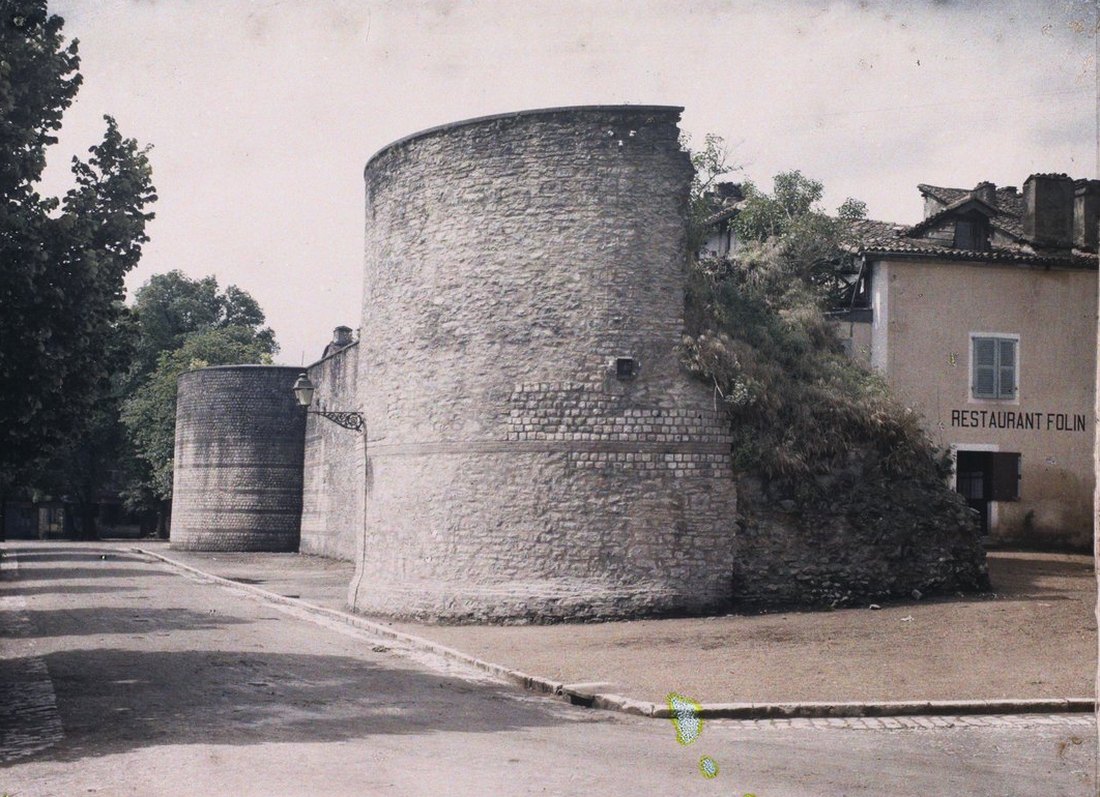
The largest surviving structure of the Tarbellian town dates from the period when the empire grew frightened. In the second half of the fourth century, probably between 350 and 375, a wall was laid around the town, 1,465 metres long, enclosing 12.6 hectares. It was more than four metres thick at the base, an estimated nine metres or so high to the wall-walk, and articulated by some forty semicircular towers; on the river side there are fewer, because the Adour already gave protection.
That this wall still stands in two stretches is a piece of luck. In the nineteenth century the town demolished most of it, and almost all the gates disappeared with it. The masonry shows the typical late antique hand: courses of small limestone blocks interrupted by layers of brick, with a core of mortared rubble between the faces.
A wall of this kind is no sign of flourishing. It shrinks a town that in the second century still covered some twenty hectares and possessed a forum, a civil basilica and a large thermal complex down to a defensible core. But it is the monument that survived, and it stands on the water that gave the people their second name.
The place name is one of the prettiest cases of linguistic erosion in Gaul. From the ablative Aquis in Aquis Tarbellicis came Old French "Acqs". Because one usually referred to the town with a preposition, that became "d'Acqs", and finally, once nobody heard the join any more, today's Dax. The tribal name fell away en route; what remained was the water.
For the Tarbelli themselves another afterlife is sometimes claimed, namely in the name of Tarbes. It sounds persuasive and should be treated with care. Tarbes lies in the territory of the Bigerriones, the people whose name survives as Bigorre; the town appears in the Middle Ages as Turba or Tarba and is usually explained from Gaulish trebo-, "dwelling, settlement". A connection with the Tarbelli is therefore not excluded, but it is conjecture. Anyone looking for a secure survival of a tribal name will find it in Bigorre, not in Tarbes.
And so to us. The obvious comparison is between two Roman spa towns: Aquae Tarbellicae on the Adour and the hot water of Aachen. The same naming logic, the same Roman use of hot springs, the same continuity to the present day. But one must be honest: the name "Aquae Granni" is not attested for Aachen in antiquity; it appears only in the Middle Ages, the place occurring in 765 simply as "Aquis". For Dax the ancient name is on record. For Aachen it is not.
The closer bridge is a literary one. Ausonius, a rhetorician from Burdigala and himself no Tarbellian but of the Bituriges Vivisci, wrote his most famous poem on the Moselle. In it he makes the rivers of Gaul yield precedence to the Moselle: the Dordogne, the gold-bearing Tarn, and at the end he says that the Tarbellian Adour too will first adore the divine power of its mistress before it plunges roaring into the sea. A fourth-century poem of the Moselle and Rhine names the river of the Tarbelli. These two ends of Gaul do not come closer together in literature than that.
The third bridge is archaeological and less peaceful. At Hagenbach on the Upper Rhine, not far from the find at Neupotz, a gravel pit yielded a hoard of more than four hundred individual pieces, among them 128 silver votive plaques. Their inscriptions point to Aquitania, to the sanctuaries at the foot of the Pyrenees; with them came hacked-up table silver and heavy jewellery. This is third-century plunder lost in the Rhine on the way home. Aquitanian divine names therefore lie in Rhine gravel, of all places where we engrave today.
There is no attested connection between the Tarbelli and the Rhineland. But there is this curious finding: two things from their world, the gold and the names of their gods, are more tangible on the Rhine than on their own coast. Sometimes a people is best transmitted where it never was.
The Tarbelli are named by Caesar (Bellum Gallicum III,27) among the eleven Aquitanian peoples who surrendered to Publius Crassus in 56 BC, and named first. Strabo (IV,2,1) counts them among the Aquitani, places them on the Bay of Biscay and calls their land the richest in gold of all, with shallow pits and pieces needing little refining. Caesar (III,21) independently confirms that the Aquitanians were the most experienced miners because of their copper mines and quarries. Pliny (NH IV,108) lists them as Tarbelli Quattuorsignani; Pliny (NH XXXI,4) knows hot and cold springs close together among them; Ptolemy (II,7,9) names their town Hydata Augusta. Ausonius attests the adjective "Tarbellian" for the Adour (Mosella) and for the Ocean (Parentalia 4,11); Tibullus and Lucan mention them in connection with the Pyrenees and the Adour. An inscription from Saguntum (CIL II 3876) names a Tarbellus IIII signanus. Aquae Tarbellicae, today's Dax, becomes the capital of the civitas around 16 BC and is recorded from the third century as the civitas Aquensium; the town wall of the second half of the fourth century measures 1,465 m and encloses 12.6 ha. That the Aquitanians were not linguistically Celtic is confirmed by some 400 personal and about 70 divine names in Latin inscriptions whose roots survive in Basque.
"Tarbelli Quattuorsignani means people of the four banners and proves a confederation of four tribes": the epithet is Pliny's, not Caesar's, and its meaning is open; Duval and Bost read it in a civil sense as a reference to four smaller communities attached later. "The Aquitanians were not Celts, so the Tarbelli were not either": linguistically the first half holds, yet the name Tarbelli of all names is best explained as Celtic (tarvos, "bull"); Gorrochategui shows that the alternative derivation through bel wavers between Basque "black" and Celtic "white" and settles nothing. "The Tarbelli worshipped the goddess Nèhe at the hot spring, related to Nehalennia": there is no ancient evidence for such a divine name at Dax, and the link to the North Sea goddess rests on similarity of sound. "A legionary's dog discovered the healing mud": a foundation legend, found in similar form at many European spa towns. "Tarbes is named after the Tarbelli": Tarbes lies in the territory of the Bigerriones, appears as Turba or Tarba and is usually explained from Gaulish trebo-; the secure survival of the tribal name leads to Bigorre, not to Tarbes. "The gold workings in the Basque Country are Strabo's pits": old workings are indeed attested there, their pre-Roman date is not, and the field name "Camp de César" is modern. And finally: Caesar's 50,000 Aquitanians are a general's rhetoric, not a count.
The Convenae · The Sotiates · The Ruteni · The Gabali · The Vellavi · The Arverni · The Santones.
All History & Finds articles →
The Vikings had no central state power. Law and politics arose at the assembly of free people – the Thing.
Read more →A handle that turned out too short, a fly at the bellows and over a thousand silver amulets in the earth: Thor's hammer …
Read more →