Some peoples gave themselves a name. Some had one pinned on them by their neighbours. And then there are the Convenae at the foot of the Pyrenees, whose name simply means: the ones who came together. No founding hero in it, no migration legend, no god. Just an administrative act that turned into an identity over four hundred years. Follow this people and you land in the most uncomfortable question in the study of antiquity: what is a people, anyway?
Convenae. Anyone with a little Latin hears it at once: convenire, to come together. The Convenae are the assembled ones, the gathered-up ones, and depending on the translator’s mood, the assembled rabble. The English Loeb edition of Strabo puts exactly that phrase in brackets. It is not in the Greek. It is the translator’s reading, resting on an ancient explanation that was itself already a reading.
That is remarkable. Most of the peoples’ names we know from Gaul say something about self-image or landscape: the Arverni, the Aedui, the Ruteni. With the Convenae the name is supposed to describe nothing beyond the fact that somebody herded them together. A people as a collective term. A people as a file note.
The story you find everywhere hangs on one sentence by one author. Around AD 406 the church father Jerome, writing in Bethlehem, produced a polemic against a Gallic priest named Vigilantius. To finish him off, Jerome went after his origins: Vigilantius came from bad stock, from brigands and Convenae.
… de latronum et Convenarum natus est semine, quos Cn. Pompeius edomita Hispania, et ad triumphum redire festinans, de Pyrenaeis iugis deposuit et in unum oppidum congregavit, unde et Convenarum nomen accepit.
“… he is born of the seed of brigands and of gathered-up folk, whom Gnaeus Pompeius, once Spain had been subdued and while he was hurrying back for his triumph, brought down from the ridges of the Pyrenees and gathered into a single town – and from this the name of the Convenae took its origin.”Jerome, Contra Vigilantium 4 (Migne PL 23, col. 356); translation: Glanz & Gravur
Taken literally, that places the foundation in 72 or 71 BC, at the end of the Sertorian War, as Pompey marched back out of Spain. A neat, concrete date. Except that Jerome wrote roughly five hundred years after the event, sat at the far end of the Mediterranean, and had no historical interest at all – only a polemical one. He wanted to smear an opponent, not date a town. Isidore of Seville later copied the passage almost word for word into his Etymologies; that makes him a copyist, not a second witness.
Vigilantius was no heresiarch. He was a priest from the south-west of Gaul who wrote against the veneration of relics, night vigils and the exaltation of monasticism. Jerome, who defended all of it with passion, answered in the register he is notorious for: mockery of names, origins and homeland. Vigilantius came from Calagurris in Spain, modern Calahorra – and Jerome ties Pyrenean brigands, the Convenae and the Spanish Vettones, Arevaci and Celtiberians into a single insult.
The provenance of the notice has to be kept in mind. The most famous sentence ever written about the Convenae comes from a hit piece in which the Convenae are merely the means to an end. That does not make it automatically false. It does make it a sentence nobody should treat like a foundation charter.
The two authors who lived far closer to Pompey say astonishingly little. In the early 1st century AD Strabo describes the hill country behind the coast and in it the land of the Convenae, containing the city of Lugdunum and the hot springs of the Onesii, most beautiful springs of most drinkable water (Geography IV,2,1). A chapter later he notes that the Romans granted the Latin right to certain Aquitani, among them the Ausci and the Convenae (IV,2,2). Of Pompey, of brigands, of any regrouping there is not a word.
Pliny lists the Convenae among the Aquitanian peoples (Natural History IV,108) and slips in a remark that is unique in his whole catalogue: mox in oppidum contributi Convenae, Begerri, Tarbelli Quattuorsignani … – “next, grouped together into a town, the Convenae, the Begerri, the Tarbelli of the Four Signs …”. Paul-Marie Duval noticed that Pliny uses this formula nowhere else. The passage is still not clean: the participle is plural and stands in front of a long row of peoples, so whether it applies only to the Convenae or to several of them is a matter of interpretation. What is certain is that already in the 1st century somebody connected this name with the idea of being lumped together.
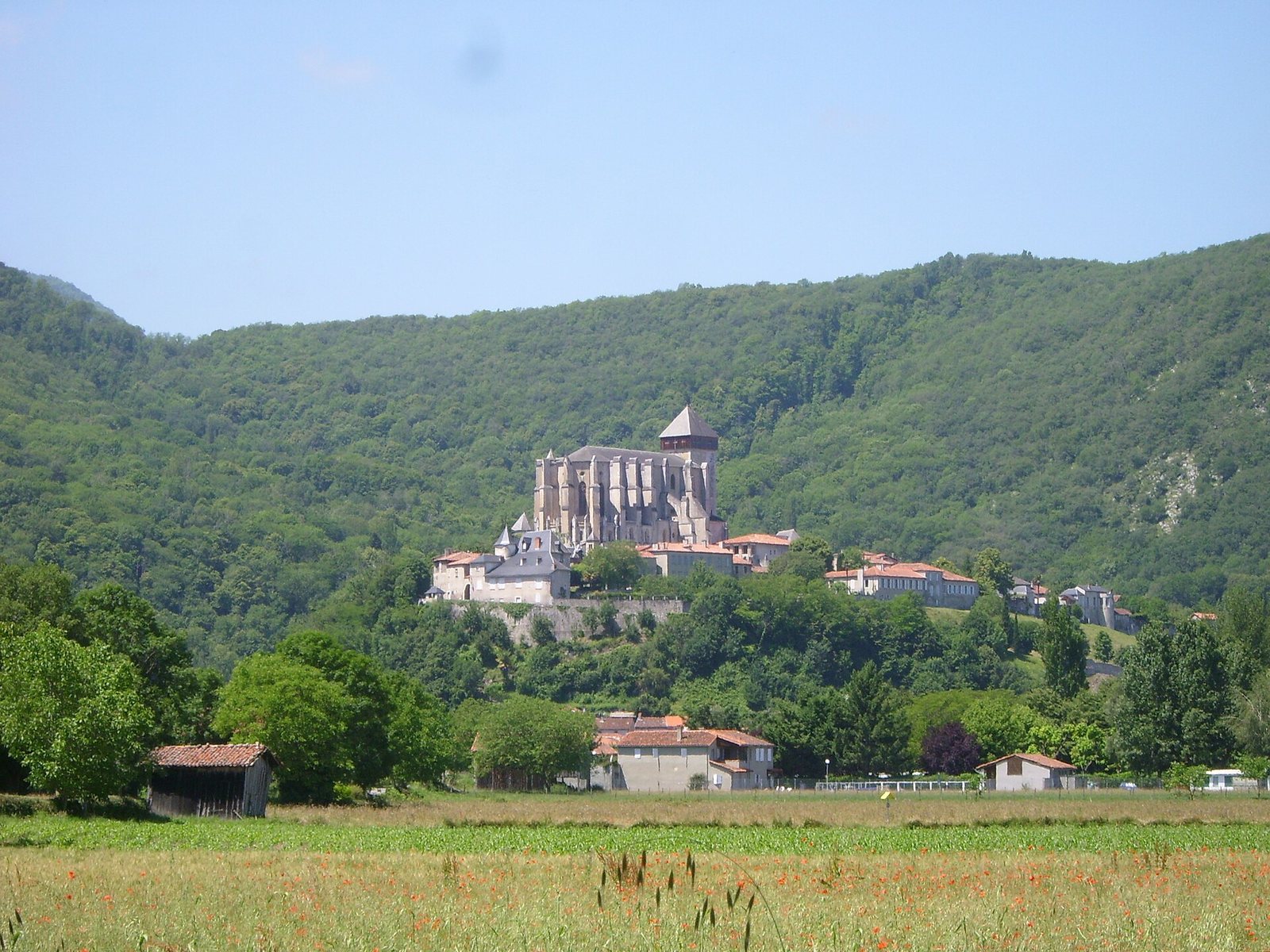
Saint-Bertrand-de-Comminges is one of the best investigated Roman sites in south-west France. Digging began in the late 19th century and went large-scale from 1928 under Bertrand Sapène, who found the forum and traced the line of the circuit wall. And yet one negative result still wrecks every reconstruction: nothing of a Pompeian foundation has been found.
The excavations on the upper-town hill were carried down to the natural subsoil. No pre-Roman material came up, and the authors of the Carte archéologique de la Gaule conclude that there was no protohistoric hilltop settlement on the rock. Robert Sablayrolles takes the Pompeian oppidum to have been a modest frontier post, a northern counterpart to Pompaelo, modern Pamplona, set there to hold the passes Pompey had used to cross from the Ebro valley. Simon Esmonde Cleary points out that Jerome’s word oppidum can equally mean a garrison post. A military post leaves fewer traces than a town – but even that has not turned up.
Here a blog that usually writes about Celtic warriors and Celtic religion has to be awkwardly honest. The Convenae sat in Aquitania, and in the judgement of antiquity Aquitania was precisely not Celtic. In the very first sentence of his war commentaries Caesar separates the Aquitani from Gauls and Belgae by language, institutions and law. Strabo is blunter: the Aquitani differed from the Gauls in build and in speech, and were more like the Iberians.
Modern linguistics agrees with them. From the country between Garonne, Pyrenees and Atlantic we know some two hundred indigenous personal names and around sixty divine names, all preserved in Latin inscriptions of the 1st to 3rd centuries. They cannot be explained from Celtic, but they can from Basque: andere beside Basque andre, lady; ombe or umme beside ume, child; sahar beside zahar, old; bels beside beltz, black. Aquitanian counts today as a Vasconic language and as a close relative, possibly the direct ancestor, of Basque. There is no continuous text in it at all – only names on stone.
Of all things, the chief town carries a Celtic name. Lugdunum, fortress of Lugus, the same formation as the great Lugdunum on the Rhône, modern Lyon. To tell them apart, the genitive of the people’s name was attached: Lugdunum Convenarum, the Lugdunum of the Convenae. Ptolemy lists the place as a colonia, the Antonine Itinerary gives it as Lugudunum, and on the inscription of the Gallic customs administration it appears abbreviated as Lugd(uni) Conv(enarum).
A Celtic place name in the middle of a territory whose divine and personal names are almost all non-Celtic – Esmonde Cleary reads this as a sign that the line between Gauls and Aquitani was less sharp than Caesar drew it. Borders in the head and borders on the ground are two different things. Eastwards, beyond the defile of Boussens, began the land of the Volcae Tectosages of Toulouse; to the north sat the Ausci, to the west the Bigerri. Whoever crossed the passes brought words along.
The real act of foundation belongs not to Pompey but to Augustus. When Gallia Comata was carved into provinces around 16 to 13 BC, the upper Garonne passed from Narbonensis to the new province of Aquitania – and the frontier post became the capital of a civitas Convenarum. To this period belong a victory trophy, a cult of Roma and Augustus, and the first street network, still running as a radiating pattern towards a central crossroads.
Whether Rome was recognising an existing community or inventing one is the core question. Esmonde Cleary leans to the second answer: because there is barely a trace of a distinct people before the conquest, he treats name and civitas as a Roman administrative convenience and the group feeling of the Convenae as a product of the Roman period. One can picture it very soberly. A governor needs tax districts, court districts, recruiting districts. He draws lines around valleys. And a few generations later the people inside those lines really do say “we”.
What grew out of it was no village. The Roman town lay not on the rock but on the alluvial plain below. The radiating street network gave way to an orthogonal grid; the old crossroads, by then built over, was marked with a circular monument that the excavators call the sanctuary of the crossroads. Around the forum and its temple the standard equipment of a provincial capital accumulated across the 1st century: two large bath buildings, a theatre on the eastern edge, a palaestra put up between AD 20 and 40, and a covered market, the macellum, built in the years 15 to 40 and rebuilt to much the same plan after a fire towards the end of the 2nd century.
Around the turn of the 2nd and 3rd centuries a military camp was added at the eastern edge, remodelled in the second half of the 4th. Out at the site of Coupéré a burnt-down palaestra was replaced by a large aristocratic house, given underfloor heating in the middle of the 3rd century and later turned over to burials in a funerary basilica. Across the Garonne at Valcabrère a tall Roman funerary pillar still stands, and the mediaeval church of Saint-Just rests partly on ancient piers beside a Roman cemetery. Around the upper-town hill a wall of 885 metres was finally drawn, enclosing a roughly triangular area of about 4.43 hectares.
Economically the town hung on one line and one stone. The line was the Garonne, which comes down out of the mountains and carries goods north. The stone was the marble of Saint-Béat.
Lugdunum Convenarum held the only station of the quadragesima Galliarum in the whole of Aquitania, the imperial customs of the Gauls, levying two and a half per cent on the value of goods. Anyone coming down the upper Garonne paid here. Marble and wool were among the dutiable goods, along with the flocks that moved seasonally over the passes between Gaul and the Iberian peninsula. How heavily the central Pyrenean routes were really used is disputed: Christian Rico stresses the primacy of the coastal passes, while Robert Sablayrolles holds that the middle crossings were in genuine use, at least for seasonal pack transport. The two are not exclusive – heavy freight takes the coast, everyday traffic takes the shorter road.
The marble from the quarries of Saint-Béat is the most interesting argument in this whole story. It was worked early in the Roman period and first served a local market: the public buildings of the capital, plus the votive altars and cinerary caskets of the countryside. In late antiquity came the big business, the richly carved Aquitanian sarcophagi, sold across Novempopulania and well beyond, where they effectively held a monopoly.
The heaviest blocks went down the Garonne on rafts; lighter pieces such as veneers travelled by cart or pack mule. Along the Garonne the road was doubled on both banks so that animals and wagons were spared repeated fordings. Worked stone also went up the side valleys as far as the Val d’Aran, where altars and cinerary chests in Pyrenean marble turn up reused. Esmonde Cleary sees in this stone-working culture the real material expression of Convenae identity. No inherited costume, no tribal jewellery, no coin type of their own made them recognisable – a craft did. That is a thought an engraving workshop can do something with.
Of the religion of the Convenae we know almost only what stands on marble: around 360 votive altars carrying short texts, nearly all of them private dedications. The public cult of the civitas can barely be reconstructed from them. About sixty deities are named, Roman and indigenous. Jupiter leads with 53 dedications, Mars follows with 34. Among the indigenous names are Erge at Montsérié, Leherennus at Ardiège, Sutugius at Saint-Plancard, and also Ilun, Arixon, Erriapus and the Aquitanian Abellio.
How these names relate to Mars and Jupiter is a live dispute. An older view read the Roman divine name as a cloak under which the local god carried on, and treated the sequence of names as stages of romanisation. Jean-Luc Schenck-David and Patrick Le Roux argue the other way: Mars was worshipped as Mars, and the local deities were associated with him rather than hidden underneath him. Anyone writing about ancient religion should take that distinction seriously. A double name is not yet proof of a disguise.
Now for the story that made many people hear of this place at all. Josephus reports that in AD 39 the emperor Caligula stripped the tetrarch Herod Antipas – the Herod of the Gospels – of his power and banished him to Lugdunum in Gaul; Herodias followed him. In the Jewish Antiquities the place of exile is Lugdunum in Gaul, in the Jewish War it is Spain.
That is where the trouble starts. There was more than one Lugdunum. Lyon was a provincial capital and the obvious address for an imperial banishment; Lugdunum Convenarum lay close to Spain and so fits the notice in the Jewish War rather better. Both identifications have supporters, neither is proven, and the widespread claim that the Spanish reference makes Lyon impossible goes too far: Saint-Bertrand is not in Spain either. Tell the story as an open question and it stays both exciting and true.
What is documented
Three ancient mentions carry the whole case: Strabo, Geography IV,2,1 (the land of the Convenae with the city of Lugdunum and the hot springs of the Onesii) and IV,2,2 (Latin right for the Ausci and the Convenae) · Pliny, Natural History IV,108 (Convenae in the list of peoples, with the unique addition in oppidum contributi) · Jerome, Contra Vigilantium 4 (the Pompey notice). Ptolemy records Lugdunum as a colonia.
Epigraphically attested: the civitas Convenarum, the later promotion to colonia (a dedication to the Genius Coloniae) and the station of the quadragesima Galliarum, the only one in Aquitania.
Archaeologically secure: forum with temple, the circular sanctuary at the old crossroads, the macellum (AD 15 to 40, rebuilt after a fire), two bath buildings, theatre and palaestra, a military camp, an early Christian basilica, an upper-town wall of 885 m around roughly 4.43 hectares, and the funerary pillar at Valcabrère.
Around 360 marble votive altars name some sixty deities. The quarries of Saint-Béat supplied the late-antique market for Aquitanian sarcophagi.
The traditional end of the ancient town is a civil war. In 585 the pretender Gundovald, who claimed to be a son of Chlothar, fled across the Garonne to Convenae ahead of King Guntram’s army. Gregory of Tours tells it in the seventh book of his Histories, chapters 34 to 38, and he tells it well: the city crowns an isolated height with no other mountain near; a great spring at the foot of the hill is enclosed by a very strong tower, reached by a covered way, so that water can be drawn without anyone being seen.
Gundovald enters at the beginning of Lent, has the townspeople bring all their supplies inside the walls – and then shuts them and their bishop out. On the fifteenth day of the siege the attackers push forward wagons with rams under wattle-and-plank roofs and are met with showers of stones and vessels of burning pitch and grease. Bishop Sagittarius walks the ramparts in armour and throws stones with his own hands. Duke Bladast sets fire to the church house and slips away in the confusion. In the end Mummolus, Sagittarius, Chariulf and Waddo sell their lord for a promise that their own lives will be spared; Gundovald is led out of the gate, pushed down the slope, struck on the head by a hurled stone and left unburied. After that, Gregory writes, the town and its churches were burnt, and nothing was left but the naked ground.
A magnificent piece of storytelling. Only Gregory was not there. He sat as bishop in Tours, wrote between 585 and 594, and had every reason to stage the fall of a usurper as a divine judgement. And the spade is silent: Robert Sablayrolles found no destruction layer matching 585 and reads the siege as a literary construction, arguing instead for a gradual abandonment reaching into the 8th century. Inside the walls of the upper town people went on living from the 5th to the 7th century, only on a smaller scale.
The bishopric outlived the town. A bishop of the Convenae is attested from the middle of the 5th century, when Sidonius Apollinaris lists the see among the vacant bishoprics of the Visigothic kingdom, and bishops appear at councils down to the late 7th century. Then it goes quiet for almost half a millennium.
Around 1080 Bertrand de l’Isle-Jourdain, a knight connected to the counts of Toulouse, becomes bishop of Comminges – the dates given range between 1078 and 1083. He holds the office for nearly half a century, until his death in 1126. He builds the cathedral with its Romanesque cloister, brings church reform to his mountain diocese, and turns the old Convenae hill into a stage on the road to Santiago de Compostela. In 1309 Clement V, himself once bishop of Comminges, makes him a saint. Ever since, the place has carried his name: Saint-Bertrand-de-Comminges. The cathedral now shows three styles stacked on each other – Romanesque of the 12th century, Gothic of the 14th, Renaissance work and the organ of the 16th – and since 1998 it has been World Heritage as part of the routes of Santiago de Compostela in France.
Meanwhile the name of the people passed to the landscape. In the 6th century it appears as Convenas and Combinias, and through a sound shift from -mb- to -mm- it became Comminges. The people Rome scraped together outlasted the fall of its town by a millennium and a half – as the name of a district. The commune itself now has 243 inhabitants.
Myth check
“Pompey founded the town in 72 BC.” That stands in exactly one author, five hundred years later, in a piece of invective. Despite extensive excavation no Pompeian settlement layer has been found. Possible, even plausible – proven it is not.
“Convenae simply means the assembled rabble.” That is the ancient reading, taken from Latin. Esmonde Cleary treats it as folk etymology; Henri Gavel and Jean-Claude Dinguirard propose on phonological grounds an indigenous name *Komben-. The inscription that would settle it has not turned up.
“The town had up to 30,000 inhabitants.” That figure comes from a general survey of urban development (Bairoch 1988), not from the excavated evidence; other accounts say 10,000. Both are estimates, and the spread mainly shows how little is known.
“Herod Antipas died here.” Josephus names Lugdunum in Gaul in the Antiquities and Spain in the Jewish War. Whether Lyon or Lugdunum Convenarum is meant remains open – the Spanish reference favours the Pyrenees but does not rule Lyon out.
“In 585 the town went up in flames.” So Gregory of Tours tells it, and he was not there. A matching burnt layer is missing; Sablayrolles reads the siege as a literary construction and reckons with slow decay into the 8th century. The frequently mentioned Vandal sack of 405 and Gundovald’s fall from the Matacan rock are later additions – in Gregory he is simply pushed down the slope.
This is why the Convenae are more than a footnote. With the Arverni or the Aedui, a name, coins, oppida, a royal house and a war against Caesar all line up; that looks like a people as one imagines one. With the Convenae almost none of it is there. No coinage of their own, no great oppidum, no recognisable material culture before the conquest. There are a few fortified hilltop sites of the late Iron Age in the later territory – the Castéra near Bagiry, the spur at Piroque, the so-called Camp de César near Lespugue with traces of ironworking – but none can be tied to a distinct culture.
And yet four hundred years later there are people who call themselves Convenae, who have a capital, who set up altars to their gods in home-quarried marble, and who give their name to a district that still exists. So a people can come into being. It needs neither shared descent nor a migration legend, only, sometimes, an administrative boundary, a market place and a few generations of time. The insight is uncomfortable, because it also works the other way round: much that appears in history books as an ancient tribe may be a later act of tidying-up – by the Romans, by the chroniclers, or by scholarship. Anyone working on the Celtiberians, the Vaccaei or the smaller peoples of the Celtic world trips over it again and again.
You do not have to drag the Convenae into the Rhineland to learn something here. They were never here, and their language has nothing to do with what was spoken between Meuse and Rhine. But the procedure is very familiar in our own region.
When Agrippa brought the Ubii across the Rhine and gave them a new place near Cologne, the result was a civitas with a chief town, an altar and an administrative boundary – and out of the chief town later came the Colonia. Rome moved, merged, named and renamed peoples here too; the names on the votive stones of our Germanic neighbourhood are to a good extent Roman ordering terms. Standing in a workshop in Alsdorf near Aachen means standing in rewritten country, where the borders between Celts, Germani and Romans were always more porous than the maps in schoolbooks suggest. Which is exactly why we would rather send an honest explanation along with a design than an invented family tree.
And because the circle closes so neatly: what made the Convenae recognisable from outside was no coat of arms and no myth, but the way they handled stone. A people you know by their craft. There are worse things to be.
The Sotiates · The Vellavi · The Helvii · The Arverni · The Aedui · The Celtiberians · The Vaccaei.
