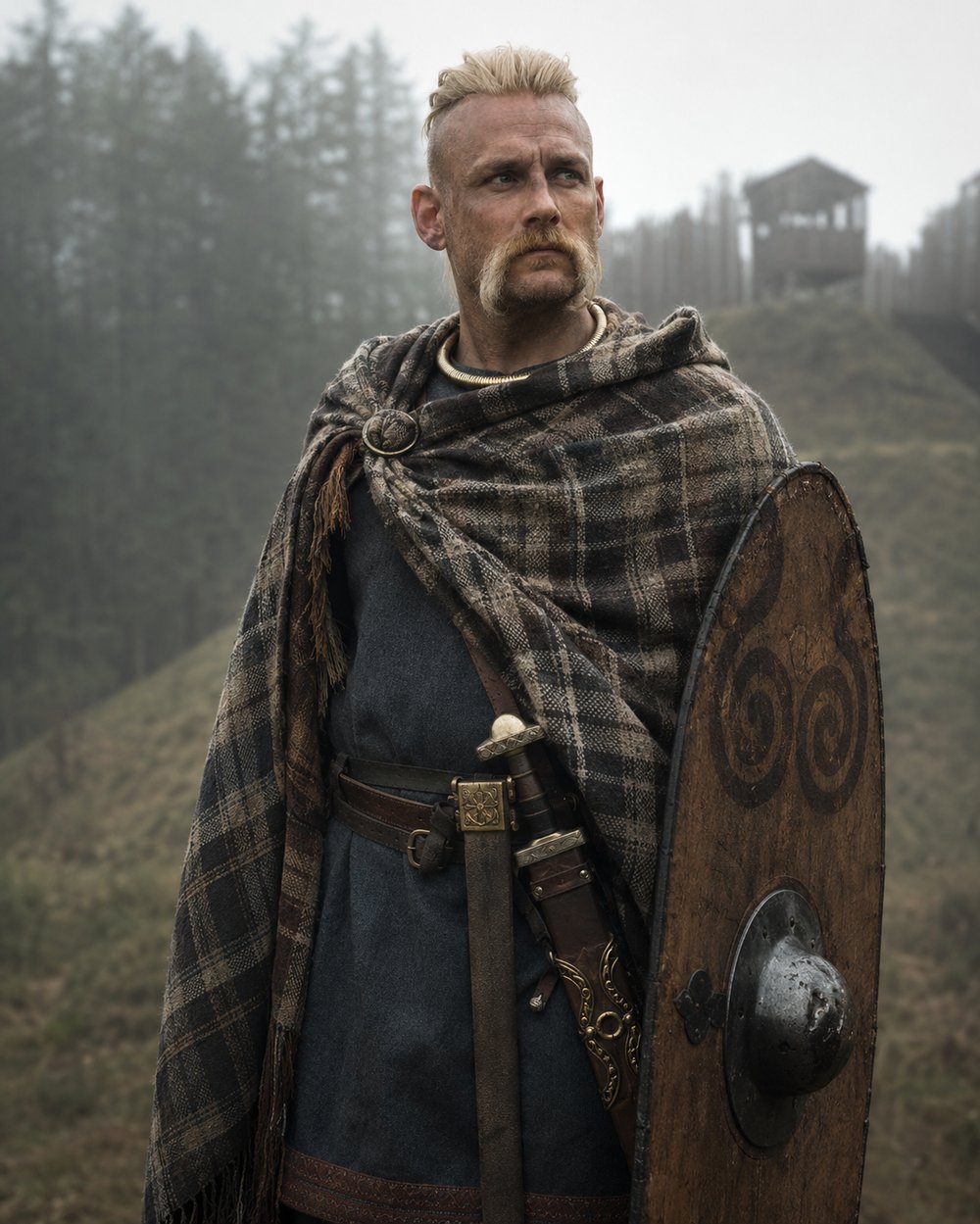
The Helvii lived between the Rhone and the Cevennes, in what is now the Ardeche. They were small, unspectacular and left no fame in their own land. And yet we owe them one of the most human scenes in the whole Gallic War – and an interpreter whom Caesar called a friend.
Most Gallic peoples appear in Caesar as armies: so many thousand men, so many hostages. The Helvii appear differently. They appear as a family. A father with Roman citizenship, two sons, an interpreter in chains, a leader who marches into battle on his own initiative and dies there. That is unusual – and it is why a people who never amounted to more than a footnote in high politics is drawn surprisingly sharply in the sources.
We know less about the Helvii than we would like, and more than a group of their size has any right to leave behind. Both things are true. What follows keeps them apart: what the texts actually say, and what modern scholarship builds on top of it.

Helvian territory lay west of the Rhone, on the northern edge of the Roman province, roughly in today's department of Ardeche – more precisely the lower Vivarais. In the north their border climbed to the crest of the Cevennes, meeting the Gabali and the Vellavii; to the west lay Arvernian land. To the south were the Volcae Arecomici, to the north-east the Segovellauni, and across the river the Allobroges. The Rhone itself formed the natural eastern boundary.
It is a hard, beautiful country: narrow river valleys, limestone gorges, and above them the basalt plateaus of the Coiron. Stand there today and you see at once why Rome wanted this strip of land. It is the corridor between the Mediterranean and the Gallic uplands – and the door to the Arverni lies immediately beyond it.
The decisive point is often missed: the Helvii did not belong to “free” Gaul but to the Roman province of Gallia Transalpina, later the Narbonensis. By the second century BC at the latest they were a frontier people on the Roman side. Everything they do in the Gallic War only makes sense against that background. They did not fight Rome. They covered Rome's back.
The evidence is thin but solid. Caesar names them several times and explicitly calls them a civitas, not a mere pagus – a political community with its own fortified centres. Strabo lists them as Ἐλουοί (Elouoi) and starts his catalogue of the peoples between Garonne and Loire with them, coming from the Rhone. And Pliny the Elder, listing the towns of Latin right in the Narbonensis, names an “Alba Helvorum”. That is all. There is no Helvian chronicle, no legend, no epic.
Before the Roman town there were hilltop settlements. The best known lies on the plateau of Jastres above the plain of Aubenas: Jastres-Nord, built against a cliff edge, with Jastres-Sud a kilometre to the south, a large rectangular walled enclosure of some twelve to thirteen hectares. Claude Lefebvre excavated there from 1974 to 1993 and found dense occupation inside.
The remarkable thing is not the construction but the ending: the site seems to have been abandoned deliberately in the early first century AD, just as the new town was rising on the plain below. No fire, no conquest, no drama. People simply moved. For a community that had joined the Roman side early, that is a very fitting image.
Around 83 BC the Roman governor Gaius Valerius Flaccus granted Roman citizenship to the leading man of the Helvii. Afterwards he was called Gaius Valerius Caburus: praenomen and family name taken over from his patron, the Celtic name kept as a cognomen. Caesar mentions this grant specifically when introducing his son.
This is more than a personnel note. It shows that in southern Gaul, a full generation before the Gallic War, Romanisation had already reached entire leading families. Caburus' sons grew up bilingual and with two homelands: Celts by descent, Roman citizens by law. It is exactly that double nature that made one son so valuable to Caesar.
In 58 BC Caesar is in a delicate position: the Aeduan Dumnorix is suspected of colluding with the Helvetii, and his brother Diviciacus is Caesar's ally. Caesar describes how he handles the conversation – and the wording is the real evidence: cotidianis interpretibus remotis, “after the everyday interpreters had been removed”, he speaks with Diviciacus through Gaius Valerius Troucillus.
Caesar calls him princeps Galliae provinciae, a leading man of the province of Gaul, and familiaris suus, his personal friend, in whom he placed the highest trust in all matters. A Roman commander sends his professional interpreters out of the room and lets a provincial do the translating. Trust here is not asserted; it is demonstrated.
And here a fine philological problem begins. In book 1, chapter 19 the manuscripts call the man Troucillus. In chapters 47 and 53 he is Procillus. Both forms stand in the transmitted text, and both almost certainly mean the same person: the same son of the same Caburus, the same friend of Caesar, the same role.
Most scholars assume one man. The reason many specialists now prefer “Troucillus” is a classic argument from textual criticism: Troucillus is the harder reading but a linguistically sound Celtic name, whereas Procillus looks like a Roman one – and copyists tend to turn the unfamiliar into the familiar, not the reverse. That is not proof. You will meet both spellings in the literature, and anyone who tells you the matter is settled has not read the footnote.
A few chapters later the interpreter becomes an envoy. Caesar is to negotiate again with the Suebian king Ariovistus but considers a personal meeting too dangerous. He sends two men: Marcus Metius, bound to Ariovistus by ties of hospitality, and Gaius Valerius Procillus, “a young man of the highest merit and cultivation” (summa virtute et humanitate adulescentem).
Caesar gives three explicit reasons for the choice: the man's reliability, his knowledge of the Gallic language – which Ariovistus had learned through long contact – and the fact that the Germans could have no cause to wrong him. That is precisely what went wrong. Before his assembled army Ariovistus shouted at the envoys, asking whether they had come to spy, refused to let them speak and threw them in chains. That was a breach of the law of nations, and Caesar reports it as such.
After the battle against Ariovistus comes the scene for which this article exists. Caesar places it almost at the end of book one, just before the campaign is wound up – at the point where an author normally sums up rather than allows himself feeling.
C. Valerius Procillus, cum a custodibus in fuga trinis catenis vinctus traheretur, in ipsum Caesarem hostes equitatu insequentem incidit. Quae quidem res Caesari non minorem quam ipsa victoria voluptatem attulit, quod hominem honestissimum provinciae Galliae, suum familiarem et hospitem, ereptum ex manibus hostium sibi restitutum videbat.
“Gaius Valerius Procillus, as he was being dragged along in flight by his guards, bound in triple chains, ran straight into Caesar himself, who was pursuing the enemy with his cavalry. And this circumstance brought Caesar no less pleasure than the victory itself: that he saw the most honourable man of the province of Gaul, his friend and guest-friend, snatched from the hands of the enemy and restored to him.”Caesar, De bello Gallico I,53; translation: Glanz & Gravur
Immediately afterwards Caesar reports what Procillus told him: that in his presence the lots had been consulted three times about him, whether he should be burned to death at once or kept for another occasion, and that by the favour of the lots he had come through unharmed. A man standing in chains while others cast lots over his burning – and surviving because the lot said no three times.
Two things can be seen here. First the matter itself: divination by lot is well attested for the Germanic world, Tacitus describes it at length a century and a half later, and part of modern scholarship reads the episode as a planned human sacrifice. Caesar's sentences alone cannot prove that; he reports only what his friend told him.
Second, the narrative purpose. For this Helvian Caesar uses the great Roman value-words: virtus, humanitas, fides. He calls him the most honourable man of the province. And he sets his joy at the rescue beside the defeat of an entire army. The French scholar Christian Goudineau even pointed out how odd it is that Caesar should stress that this Gaul spoke Gaulish – as though it needed explaining. Possibly Procillus had been educated so thoroughly in the Roman manner that his mother tongue became worth mentioning. That remains a conjecture; but it fits everything else.
In 52 BC Helvian territory becomes militarily important. Lucterius, a Cadurcan in the service of Vercingetorix, wins the Ruteni over to the Arverni, takes hostages from the Nitiobroges and Gabali, and pushes towards Narbo against the province. Caesar hurries south, posts garrisons and orders part of his forces, together with the reinforcements brought from Italy, to muster “among the Helvii, who border on the territory of the Arverni”.
From there one of the most famous marches of the entire war sets out. In the depth of winter Caesar crosses the Cevennes, which – as he writes himself – divide the Arverni from the Helvii, has snow six feet deep cleared away, and falls upon a country that believed itself safe behind the mountains “as behind a wall”. The land of the Helvii was the springboard.
The price came the same year. Vercingetorix sent the Gabali and the nearest cantons of the Arverni against the Helvii, the Ruteni and Cadurci against the Volcae Arecomici, and worked on the Allobroges at the same time. Caesar then records what happened in one cool sentence: the Helvii engaged their neighbours sua sponte – of their own accord, that is without Roman orders – and were driven back; Gaius Valerius Donnotaurus, son of Caburus and leading man of the community, fell along with many others, and the rest were forced back inside their towns and walls.
It is the same family name. Donnotaurus – Celtic for something like “noble bull” – was the brother of the man Caesar had personally freed from chains twelve years earlier. The family that owed Rome its citizenship paid Rome with the life of its head. On the later fate of Procillus the sources are completely silent.
One detail shows how unromantic this alliance really was. In his account of the civil war Caesar has the envoys of Massilia explain that they owe something to both commanders: Pompey had publicly granted them lands of the Volcae Arecomici and the Helvii, while Caesar had assigned them the conquered Salluvii. In other words: Rome had given Helvian land away, to a Greek city, as a political reward.
Caesar does not say why. The common explanation – that the Helvii had backed the wrong side in the war against Sertorius in the 70s and were punished for it – is a plausible reconstruction by modern historians, not a statement in the sources. The equally common conclusion that Caesar returned the land to them after Massilia's defeat is likewise an inference, not a recorded event.
The Roman-period capital of the civitas Helviorum lay beside the present village of Alba-la-Romaine at the foot of the Coiron. Pliny lists it as a town of Latin right; Ptolemy has the name Alba Augusta, usually – though not demonstrably – referred to the same place. Excavation there began in the early nineteenth century, became systematic in the 1930s and resumed from 1964.
The resulting picture is a town of some 30 hectares with an estimated circuit of about four kilometres, with a monumental centre, forum, baths, houses with mosaics and hypocausts, a sanctuary linked to the centre by a processional way, and a carefully built network of water channels. The theatre was built in three phases – first as an earth-and-timber structure on the stream bank, then under Claudius, then in the early second century – and in its developed form is estimated to have held about 3,000 spectators on twenty-two rows of seats. There is no reliable population figure for the town; every number in circulation is an extrapolation.
From the third century onwards the signs of retreat multiply at Alba: the theatre is given up, stones from the sanctuary are reused elsewhere. The bishop's seat moves to the Rhone at Viviers, Latin Vivarium – hence the regional name Vivarais and, by a long detour, the identity of a whole landscape. Whether that move happened in the fourth or only in the fifth century is not answered uniformly in the literature.
That leaves the wine. Marcel Le Glay described Alba as the centre of a farming region with a marked emphasis on viticulture; an inscription names several professional guilds of the town, among them the utricularii, usually connected with transport and therefore often with the wine trade – an interpretation, not a wording. Pliny is frequently added to the case, since he describes a heavy-bearing vine called helvennaca. The name is tempting. But at that point Pliny makes no connection to the Helvii himself; his raisin-wine example refers explicitly to the Vocontii. So we file this as open: charming, unproven, not to be sold as fact.
One find brings the Helvii surprisingly close to our own workshop. In the northern part of Bonn a Roman tombstone survives that is regarded as the oldest known gravestone from the town. The inscription reads: P(ublio) Clodio P(ubli) f(ilio) Vol(tinia) Alb(a) mil(iti) leg(ionis) I an(norum) XLIIX stip(endiorum) XXV h(ic) s(itus) e(st) – Publius Clodius, son of Publius, of the tribus Voltinia, from Alba, soldier of the First Legion, aged 48, twenty-five years of service, here he lies.
“Alba” alone is not an unambiguous place-name; there were several. The tribus Voltinia, however, points to the Narbonensis, and so Alba Helviorum is regarded as this man's most likely home. If that is right, a son of that small people on the Rhone served in the Legio I Germanica on the Lower Rhine and was buried at Bonna – a thousand kilometres from the Cevennes, and barely sixty from our workshop in Alsdorf. That is how the empire tied its edges together.
The Helvii were a Celtic civitas west of the Rhone, inside the Roman province. Caesar attests them as a frontier people (BG VII,7–8: mustering point and starting point of the march over the Cevennes). Gaius Valerius Caburus received citizenship from C. Valerius Flaccus; his son served Caesar in 58 BC as interpreter (BG I,19) and as envoy to Ariovistus (BG I,47), was put in chains and freed during the battle, the lots having been consulted three times about burning him (BG I,53). In 52 BC the Helvii were defeated and Gaius Valerius Donnotaurus, son of Caburus and princeps civitatis, fell (BG VII,65). In the civil war commentaries Caesar notes that Pompey granted Helvian land to Massilia (BC I,35). Strabo calls them Ἐλουοί; Pliny lists “Alba Helvorum” among the towns of Latin right (NH III,36). Archaeologically secure are the hilltop sites of Jastres (excavated 1974–1993) and the town at Alba-la-Romaine with forum, baths, sanctuary, water system and a three-phase theatre.
“Procillus” and “Troucillus” are two manuscript forms; that they denote one man is the consensus, but it is a reconstruction, and neither spelling is proven. The Helvii were neither a Germanic nor a Ligurian people – no ancient source says so. Nor are they identical with the Helvetii: both names probably share the Celtic element elu- (“many, rich”), which makes the names related, not the peoples. The same applies to the Germanic Helvecones in Tacitus – pure similarity of sound. A Helvian druidic centre is an invention; no source mentions druids among them. The link between the vine helvennaca and the Helvii is not made by Pliny. That the Helvii were punished for supporting Sertorius, and that Caesar later gave the land back, are scholarly readings, not source statements. The attribution of the Bonn tombstone to Alba Helviorum is likely but not provable, and population figures for Alba are estimates.
The Arverni · The Helvetii · The Allobroges · The Vocontii · The Ruteni · The Celtic Warriors.
All History & Finds articles →
The most famous eyewitness account of the Vikings comes not from the North, but from Baghdad. In 921 the Caliph sent …
Read more →