 Not every Gaulish tribe ended under Rome's sword. The Vocontii kept a rare independence as allies – and even produced one of the great historians of antiquity.
When Celts and Rome are mentioned, one thinks of conquest and downfall. The Vocontii tell another story: that of a people who came to terms with Rome and in return kept an extraordinary degree of freedom. Their territory lay in the pre-Alps between the Rhône and the Alps, in the area of today's Drôme and Vaucluse departments – a land of hills, river valleys and lavender fields, considered fertile even in antiquity.
The Vocontii were a large and respected tribe of southern Gaul. They controlled important routes between the coast and the Alpine passes and had two chief towns: Vasio (today's Vaison-la-Romaine) and Dea Augusta (today's Die). Unlike many Gaulish tribes, whose power was concentrated in a single oppidum, the Vocontii lived in a landscape spread over several centres. The geographer Strabo names them expressly among the more important peoples of the region.
When Rome made southern Gaul the province of Gallia Narbonensis in the late 2nd century BC, most tribes came under direct Roman administration. The Vocontii, however, received a rare status: that of a civitas foederata, an allied community with its own law. They kept their internal institutions, their local self-government and an autonomy unusual in Roman Gaul. This status was the expression of a shrewd political arrangement: whoever got along with Rome could preserve more than those who fought to the bitter end.
The most famous son of the Vocontii was the historian Pompeius Trogus. He lived in the time of Emperor Augustus and wrote the Historiae Philippicae, a comprehensive world history in 44 books. His work survives only in a later abridgement (the Epitome of Justin), but it was one of the most important historical works of Roman antiquity. That a member of a Gaulish tribe wrote a world history in Latin shows how deeply the Vocontii had grown into the Greco-Roman world of learning – and how false the cliché of the "wild, uneducated Gaul" is.
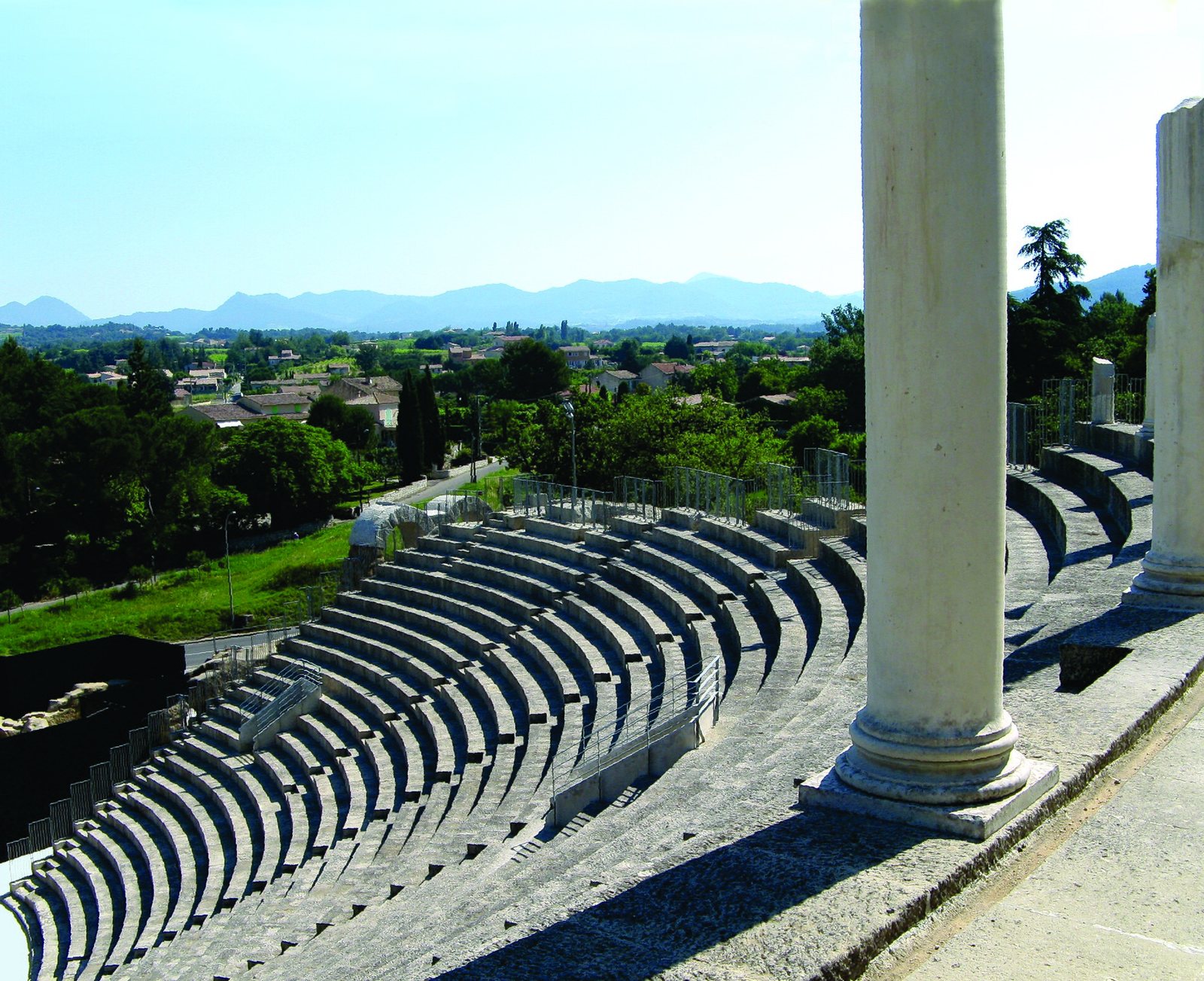
The religion of the Vocontii shows the same fusion. In Dea Augusta the goddess Andarta was worshipped, a Celtic protective and perhaps war goddess whose name recalls the British Andraste; the Roman place-name Dea ("goddess") preserves her cult to this day in the town's name Die. Alongside stood the usual Roman deities. In Vaison-la-Romaine, excavations have laid bare a rich Gallo-Roman town – with theatres, villas and mosaics – showing how prosperous the land of the Vocontii became under Rome.
The Vocontii are the counter-image to the Salluvii, their southern neighbours: where those perished in war and the oppidum of Entremont fell with them, the Vocontii chose the path of accommodation – and thereby preserved more of themselves. Their example shows that the "Romanisation" of Gaul was no simple process of victory and defeat but knew many paths: resistance, adaptation, alliance. For an honest picture of the Celtic world both stories belong together – that of the conquered and that of the allies.
Roman and Greek authors report on the Vocontii – above all Strabo and, indirectly, the work of their own countryman Pompeius Trogus. To this is added the rich archaeology of Vaison-la-Romaine and Die, which draws the picture of a prosperous Gallo-Roman culture. Where the texts judge or abbreviate, archaeology asks about the finds. We keep evidence and interpretation apart: the special status as civitas foederata is well attested; the exact extent of the tribal territory and the reading of individual cults remain subjects of research.
Unusual for a Gaulish tribe was the double structure of the Vocontii: in Vasio (Vaison-la-Romaine) and Dea Augusta (Die) they had two important centres. Both developed under Rome into prosperous towns with fora, temples, baths and theatres. In Vaison-la-Romaine excavations have laid bare whole districts with splendid houses, colonnades and mosaic floors – one of the most impressive testimonies of Gallo-Roman town life anywhere. That a single tribe supported two such centres speaks for its size and wealth.
The special status as an allied civitas foederata was only the beginning. Over the generations the Vocontii grew ever deeper into the Roman commonwealth: their upper class received Roman citizenship, young men made careers in the military and administration, and in Pompeius Trogus the tribe even produced a Latin historian of rank. This peaceful integration is the opposite of the bloody road Caesar later took in the rest of Gaul. The Vocontii show that "becoming Roman" did not have to mean only subjugation but could also be a self-chosen ascent.
Despite all Romanisation the Celtic root remained visible – above all in religion. The goddess Andarta, whose name still echoes in the town name Die (from Dea, "goddess"), was a protective deity of the Vocontii; votive inscriptions attest her cult. Alongside her, native spring and mountain deities were worshipped next to the great Roman gods. This mixture of Celtic heritage and Roman form is typical of the Gallo-Roman world: the old powers of the land did not vanish, they only put on new garments.
Anyone walking through Vaison-la-Romaine today literally moves over the history of the Vocontii. The extensive excavation fields with their residential quarters, the well-preserved Roman theatre and the finds in the local museum make the town one of the most important archaeological sites in southern France. They tell of a tribe remembered not through downfall but through clever adaptation – and one that proves the Celtic story knows far more than only war and defeat against Rome.
The position of the Vocontii was their capital. Their territory commanded the passages between the Rhône plain and the Alps – routes over which goods, people and armies moved. This control of important routes made the tribe valuable to Rome and partly explains the generous allied status: a reliable ally at a key point was worth more than a subdued but discontented people. From the wool of their flocks and the wine of their valleys to the trade along the roads – the Vocontii grew prosperous under Rome without wholly losing their character.
"Among the better-known peoples are the Vocontii, the Salluvii and the Cavares."after Strabo, Geographica IV (public domain, own translation)
The Salluvii · The Allobroges · Celtic Princely Graves.
All History & Finds articles →
Vikings and Aachen? Sounds like two worlds with nothing to do with one another. Yet in the winter of 881/882 the …
Read more →