 At the mouth of the Rhône, around the stone oppidum of Entremont, sat a league of Celto-Ligurian tribes: the Salluvii. Their fall gave "Provence" its name.
If you ask where Rome first clashed seriously with the Gauls of southern France, the trail leads to the Salluvii (also Salyes, Latin Salluvii/Salyes). They were not a single tribe but a league of Celtic and older Ligurian groups in Provence, between the lower Rhône, the Durance and the coast. Their downfall in the late 2nd century BC was the beginning of Roman rule in Gaul – and the origin of the name "Provence".
The Salluvii sat on an old cultural frontier. Here the Celtic world of Gaul met the older Ligurian population of the Mediterranean. Ancient authors therefore often called them "Celto-Ligurians". This mixture shaped their culture: fortified hilltop settlements (oppida) of dry rubble stone, a warlike noble class and a pronounced head cult, which the finds document especially vividly. In the hinterland lay Massalia (Marseille), a powerful Greek trading colony with which the Salluvii by turns traded and feuded.
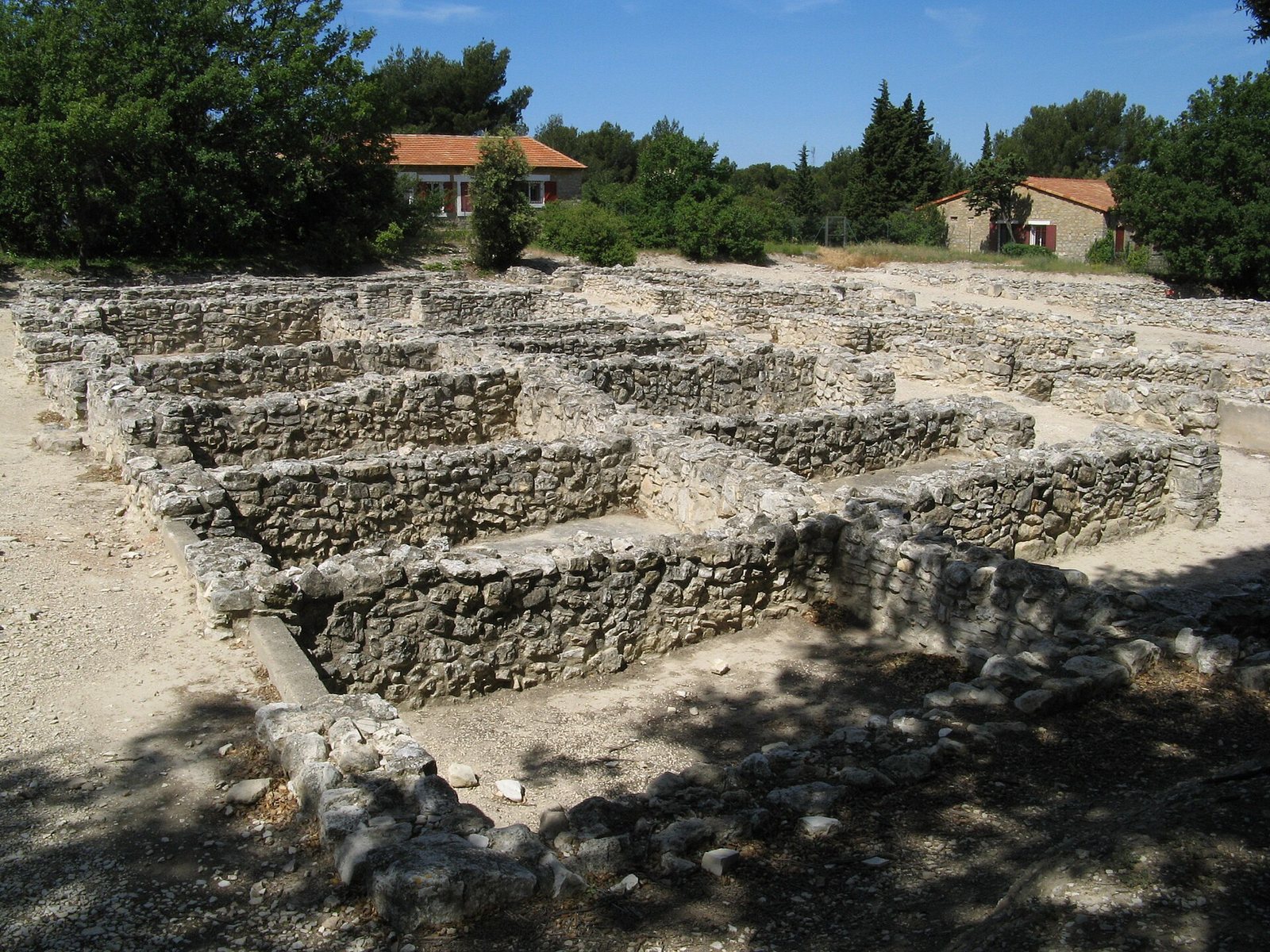
The centre of the league was the oppidum of Entremont on a plateau above today's Aix-en-Provence. Excavations there have laid bare a densely built, planned stone town with ramparts and towers – and the famous testimonies of the head cult: pillars and lintels carved with severed heads, and stone seated statues of warriors. From the nearby sanctuary of Roquepertuse comes the well-known lintel with niches that held real skulls. For the Celts the head was the seat of the life-force – the enemy's head a trophy and object of power. Greek and Roman observers were at once fascinated and appalled.
Because the Salluvii kept pressing allied Massalia, the trading city called on Rome for help. In 125–123 BC Roman armies marched into Provence; in 123 BC Entremont was captured and destroyed. The consul Sextius Calvinus founded a fortified base at a spring below the plateau: Aquae Sextiae, today's Aix-en-Provence. With victory over the Salluvii and their allies, Rome secured the land link to Spain and laid the foundation of the first Gaulish province.
A few years later, around 121 BC, Rome organised the conquered land as the province of Gallia Narbonensis – for the Romans simply "the province" (provincia nostra). From exactly this came the regional name Provence. So the Salluvii, though defeated themselves, left their indirect mark on the land: their fall made southern Gaul Roman core territory, long before Caesar subdued the rest of Gaul. Their leader Teutomalius fled after the defeat to the neighbouring Allobroges – and so drew them, too, into the next war with Rome.
For the Salluvii we rely on Greek and Roman authors (Strabo, the summaries of Livy, later geographers) – that is, on the view of their enemies and neighbours. All the more important is the archaeology: Entremont and Roquepertuse are today key sites of the Celtic art of southern Gaul, and the stone sculptures can be seen in the museum at Aix. Where the texts judge ("cruel head cult"), archaeology asks soberly about finds and context. Here too we keep evidence and interpretation apart.
The fall of the Salluvii dragged their neighbours in with them. Their fugitive prince Teutomalius found refuge with the Allobroges, who then also went to war with Rome; in 121 BC Rome crushingly defeated the Allobroges and the Arverni under King Bituitus. Across the conquered land Rome soon laid the Via Domitia, the first Roman road in Gaul, linking Italy with Spain. The land of the head cult and the stone towns became a thoroughly organised province of roads, cities and viticulture – yet the Celto-Ligurian population did not vanish; it merged into the Gallo-Roman culture of Provence.
Hardly anywhere can the interplay of Celts and the Mediterranean be grasped as well as with the Salluvii. Through neighbouring Massalia, Greek goods, wine and ideas flowed into the hinterland; Celtic chieftains drank from imported vessels and drew inspiration from Greek models. At the same time the Salluvii held to a deeply Celtic practice: the cult of severed heads. At Entremont and in the sanctuary of Roquepertuse were found pillars with skull-niches, stone warrior statues seated cross-legged, and depictions of captured heads. For the Celts the head was the seat of soul and power; to keep the head of a strong enemy meant to bind his strength. Greek and Roman observers described this with a shudder – but for the Salluvii it was religion and honour at once, not mere horror. This tension between Mediterranean refinement and an independent Celtic tradition makes them one of the most fascinating peoples of southern Gaul.
The Salluvii lost their war, but they shaped the land to this day. Out of their destroyed centre grew Aix-en-Provence, one of the loveliest cities of southern France; their stone sculptures now count among the treasures of Celtic art and stand in the museum at Aix. The name of the province Rome founded after their fall became the name of a whole region: Provence. And yet much remains interpretation: we know their language only from names, their religion only from stones, their politics only from the reports of their enemies. What we know for certain is that a self-assured mixed people of Celts and Ligurians lived here whom Rome had to take seriously, and that their fall was the beginning of that fusion from which the Gallo-Roman world and, in the end, today's southern France emerged.
The destruction of Entremont in 123 BC was more than a military victory; it was a turning point. For the first time Rome established itself permanently north of the Alps, and from the fortified camp of Aquae Sextiae grew the first lasting Roman town in Gaul. Only two decades later, in 102 BC, the general Marius defeated the advancing Cimbri and Teutones at this very place. The Salluvii stood at the start of this chain: their resistance and fall drew Rome deeper and deeper into Gaul, until Caesar subdued the whole land half a century later.
"The Ligurians and the Celts mixed with them inhabit the land above Massalia."after Strabo, Geographica IV (public domain, own translation)
The Allobroges · The Celtic Warriors · Celtic Princely Graves.
All History & Finds articles →
The Viking battle was no wild scramble but a hard struggle shield to shield. A look at tactics and weapons beyond the …
Read more →