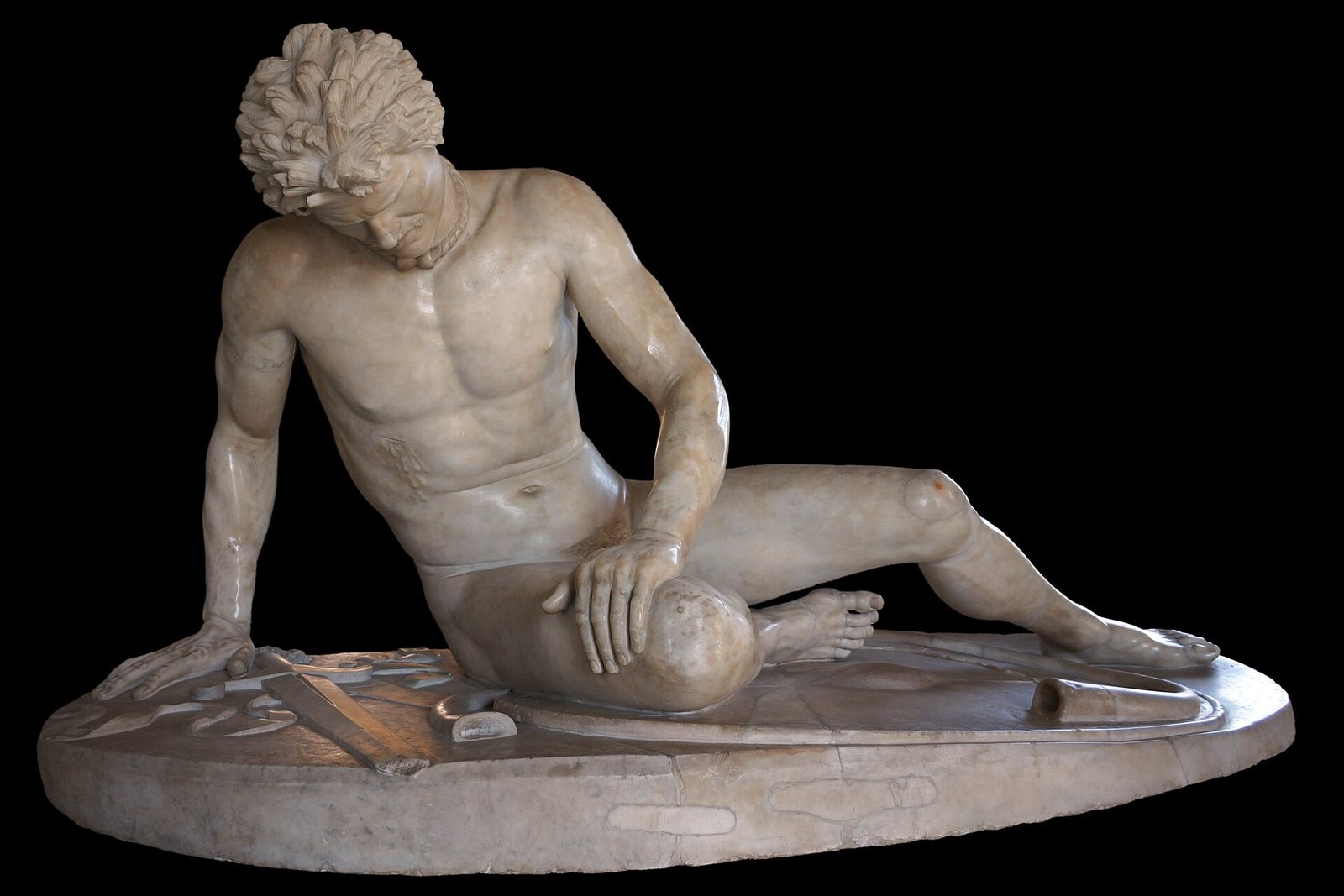
The Celtic warriors of the La Tène period were notorious in antiquity. Greek and Roman authors describe tall, strong fighters who attacked with a long iron sword, tall shield and wild charge – often accompanied by deafening noise from war horns (the carnyx).
Their most striking mark was the torc, an open neck ring, often of gold. It was jewellery, a mark of rank and a protective sign at once. Ancient authors even report warriors who went into battle wearing only the torc – naked fearlessness as a demonstration of power. The torc is to this day one of the best-known pieces of Celtic jewellery.
For Celts the head counted as the seat of the soul and of power. Ancient sources report that warriors took the heads of slain enemies as trophies and kept them. Archaeological finds (such as skull niches in sanctuaries of southern Gaul) support that the head held special significance – how much of this was everyday and how much exceptional remains open.
"Wits must he have who wanders wide, but all is easy at home."Hávamál 5, after Henry A. Bellows 1923 (public domain)
The Celtic warriors put the ancient world into fear and amazement at once. Greeks and Romans described them as large, wild fighters who stormed into battle with impetuous courage. Yet behind the terrifying image stood a highly developed warrior culture.
Many Celtic warriors wore the torque, an open neck-ring of gold or bronze. It was status symbol, ornament and perhaps protective sign at once – one of the most impressive marks of Celtic fighters.
Into battle the Celts marched with the carnyx, a towering war trumpet with an animal head. Its piercing sound was to frighten the enemies and spur on their own ranks – an acoustic terror over the battlefield.
Ancient authors report that Celtic warriors took the heads of slain enemies as trophies. For the Celts the head was regarded as the seat of the soul and power – a practice gruesome to the Romans, sacred to the Celts.
The Celtic warriors are the image of courage, gold and terror – fearless, splendidly adorned and fascinating to this day. More on their world in the Celtic princely graves.
Celtic Princely Graves · Celtic Religion · The Druids · The Morrígan · Esus.
All History & Finds articles →
Without their ships the Vikings would never have become Vikings. The longship was the high technology of its time …
Read more →