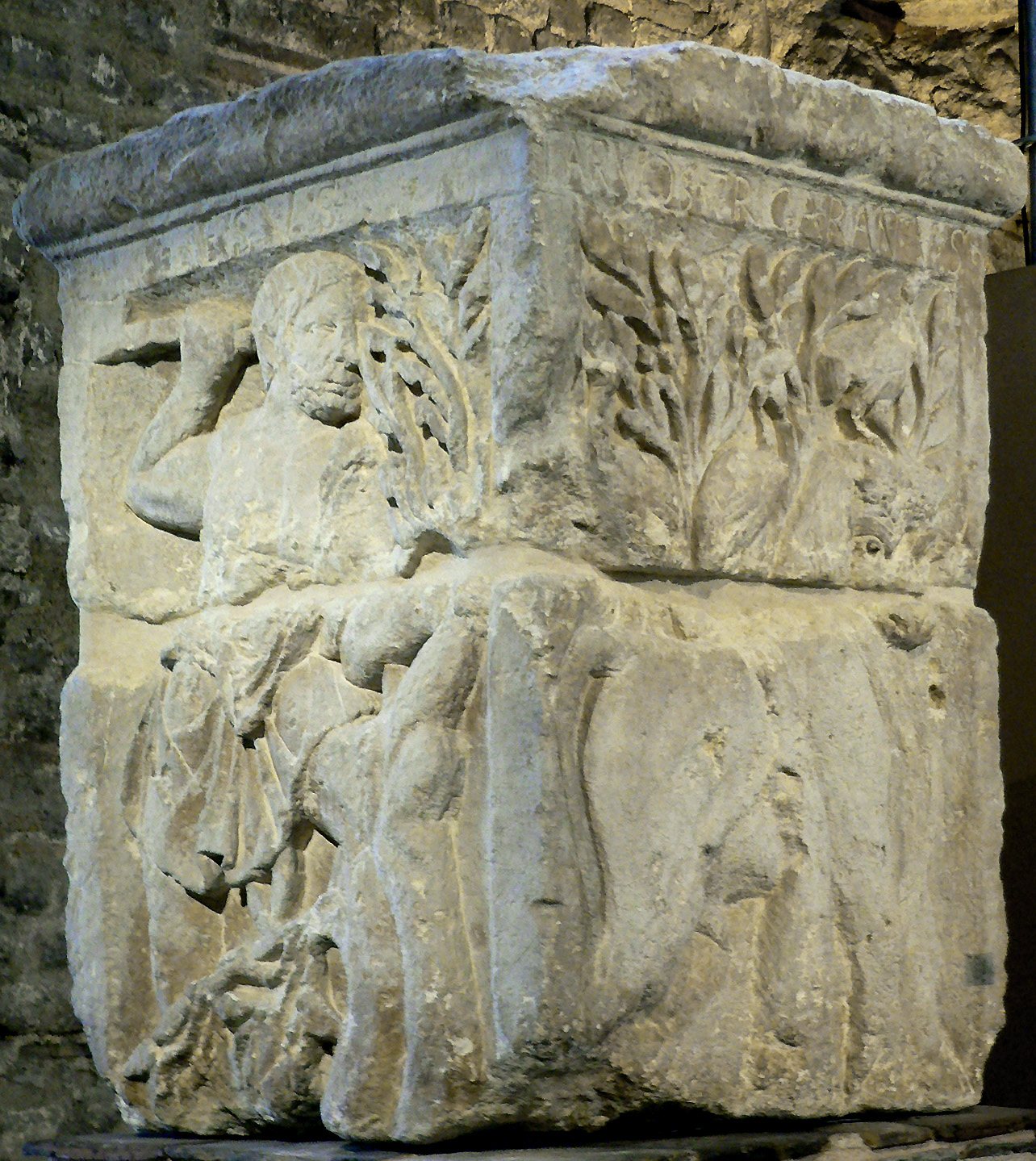
Esus was one of the three great Gaulish gods whom the Roman poet Lucan names in one breath: Taranis, Teutates and Esus. His name is often interpreted as "the lord" or "the good/mighty one". Unlike most Celtic gods, we even have images of him.
On the Pillar of the Boatmen in Paris (1st c. AD) Esus appears as a bearded man working a tree with a tool (axe or billhook). On a related relief from Trier a bull with three cranes stands beside it (labelled in Latin Tarvos Trigaranus, "bull with three cranes"). What this scene means is unresolved to this day – it is one of the great riddles of Celtic religion.
A late-antique commentary on Lucan claims that humans were sacrificed to Esus by hanging them on trees. Such notes are to be read with caution: they come centuries after the events and often served to cast the "barbarian" Celts in a bad light.
"Wits must he have who wanders wide, but all is easy at home."Hávamál 5, after Henry A. Bellows 1923 (public domain)
Esus was one of the important gods of the Gaulish Celts. His name is often interpreted as "the lord" or "the good/mighty one". He is depicted as a bearded man felling a tree with an axe – a puzzling, powerful image.
His most important testimony is the Pillar of the Boatmen in Paris from the 1st century. There Esus appears as a tree-feller – on a neighbouring relief stands the bull Tarvos Trigaranus with three cranes. Both images evidently belong together.
What the tree-felling and the bull mean is unclear to this day. Perhaps a creation or fertility myth, perhaps a sacrificial image. Esus is among the gods whose images we have – but whose stories are lost.
The Roman poet Lucan names Esus together with Taranis and Teutates. Later commentators claimed that humans were sacrificed to him. Whether that is true is uncertain – such reports often served to demonise the "barbarians".
Esus is the great question mark among the Celtic gods – a god we see only in image, but whose story is lost. More in the overview Celtic Religion.
Celtic Religion · Taranis · Teutates · Lugh · Cernunnos.
All Festivals & Belief articles →
The old Norse people did not think of a person as a sealed self inside a skin. A life involved more powers than that: a …
Read more →A word that tastes of cold air and carved staffs: Gandreið. The “magic ride” carries us to the dark frontier of Norse …
Read more →For our ancestors death was no taboo but a passage accompanied with care. They closed the dead one's eyes, made him …
Read more →The Germanic year knew no spring – only summer and winter. And its feasts followed the rhythm of field and war. Snorri …
Read more →