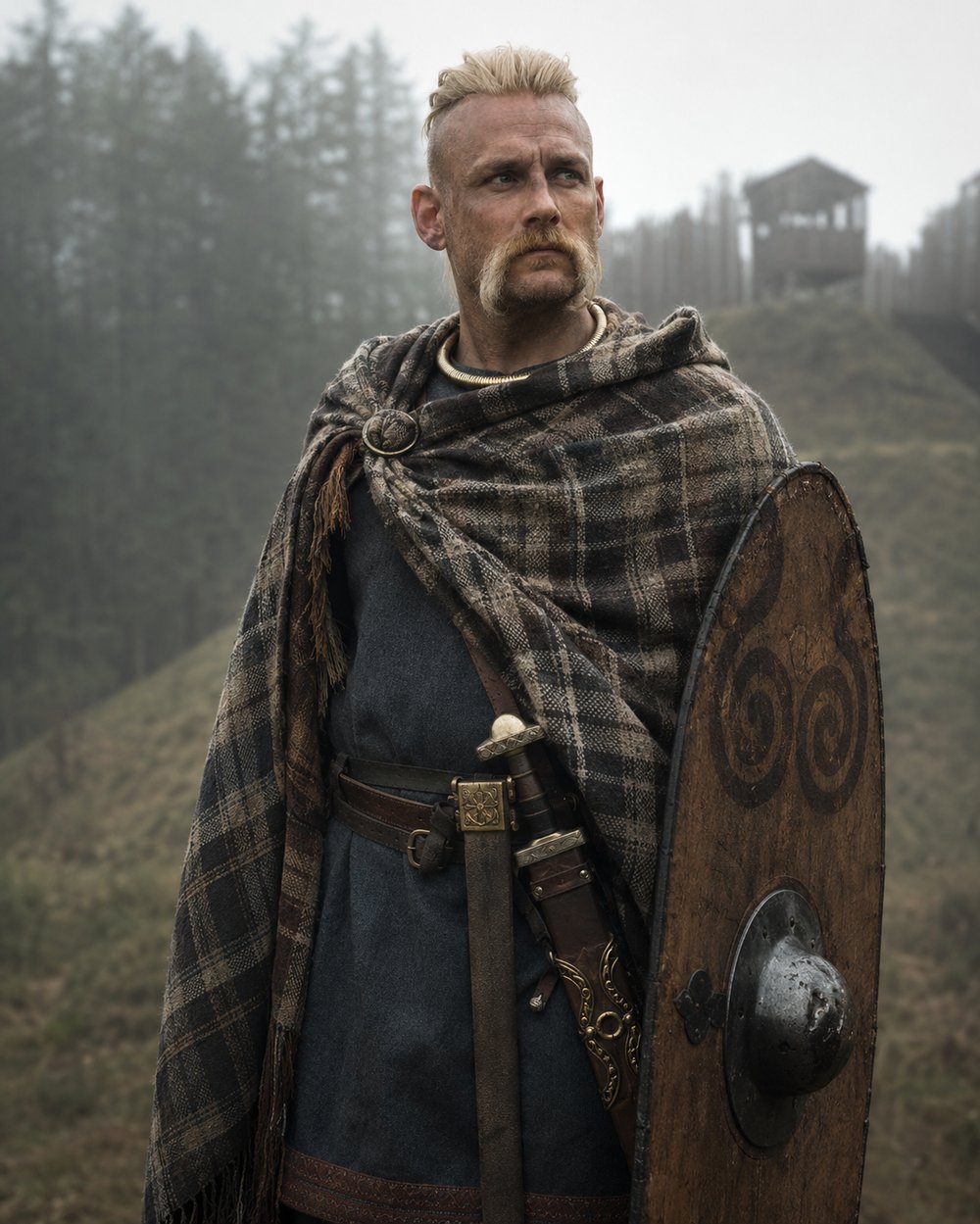
 They appear in world history for roughly two pages, then vanish again. And those two pages contain one of the most astonishing passages in all ancient ethnography: six hundred men sworn to live with their leader and to die with him. Caesar adds, drily, that nobody had ever been found who broke the oath. The Sotiates are a textbook case of how much, and how little, a single source can carry.
Essentially everything we know about the Sotiates comes from three chapters of a Roman general's despatch. Caesar names them in the third book of his Bellum Gallicum (III,20–22), Pliny the Elder later lists them among the peoples of Aquitania (Naturalis historia IV,108), and Cassius Dio retells the episode some two and a half centuries afterwards. That is the entire ancient record. After that, silence.
This is not unusual. Most peoples of Gaul are known to us only because they stood in the way of a Roman army. But for a people this small, the yield is unusually rich: we get a cavalry engagement, an ambush, a siege, a name — Adiatuanus — and an institution for which there is no better description anywhere in the Celtic world.
Caesar defines Aquitania in the very first sentence of his work: it runs from the Garonne to the Pyrenees and to that part of the Ocean which lies towards Spain (BG I,1). And he states explicitly that Gauls and Aquitani differ from one another in language, institutions and laws. That is remarkably precise for a man who otherwise generalises freely — and modern linguistics broadly agrees: the Aquitanian personal and divine names of Roman inscriptions belong to a non-Celtic, pre-Basque layer.
The Sotiates sat on the northern edge of that zone, south of the Garonne, in what is now the Pays d'Albret. North of them began the Celtic world of the Santones and the Bituriges; south of them lay Aquitania proper. Borderland, in other words — and borderland is rarely tidy.
The question is still open. Several things point to Celtic. Their leader carries a clean Gaulish name: Adiatuanos is derived from the Gaulish root adiantu- ("eagerness, desire, striving"), cognate with Middle Welsh add-iant "wish", giving something like "eagerly striving for rulership". The word soldurius is likewise taken by Xavier Delamarre and Pierre-Yves Lambert as a Latinised Gaulish *soldurio-. And Nicolaus of Damascus, who tells the story independently of Caesar, simply calls the Sotiates Celts.
Against that: the suffix -ates in ethnic names occurs in Aquitania just as it does in Gaul, and at Sos itself Aquitanian personal names are attested — the northernmost known. Joaquín Gorrochategui takes both the name and the institution as Gaulish; Theo Vennemann has tried instead to explain sol-durii from Basque. The honest summary: the Sotiates lived, fought, struck coins and organised themselves like a Gaulish people. Whether they were Gauls settled on the marches of Aquitania or Aquitani Celticised before Caesar arrived has not been decided.
The campaign against the Sotiates is not a war of its own but a sideshow. In 56 BC the Atlantic coast was ablaze: the Veneti had detained Roman officers and half of Armorica joined them. Caesar therefore dispersed his army (BG III,11) — Labienus to the Rhine, Sabinus to the Venelli, Decimus Brutus to the fleet. And Publius Crassus, the triumvir's son, was sent to Aquitania with twelve cohorts and a large body of cavalry, with orders to stop auxiliaries from moving north.
Aquitania, Caesar writes, is by extent and population a third of Gaul. That is an authorial claim, not a statistic — and it makes his young legate's success larger than it was.
Caesar explains at unusual length why Crassus proceeded so methodically: in precisely this region, only a few years earlier, the legate Lucius Valerius Praeconinus had been defeated and killed with his army, and the proconsul Lucius Manlius had been forced to flee after losing his baggage train. Scholarship usually places Manlius' defeat in the Sertorian war. In Rome, then, Aquitania counted as a place where one could lose.
So Crassus secured the grain supply, gathered auxiliaries and cavalry, and had experienced fighting men summoned by name from Tolosa, Carcaso and Narbo — the towns of the Roman province bordering Aquitania. Then he marched into Sotiate territory.
The Sotiates were ready. Their strength, Caesar says explicitly, was their cavalry — equitatuque, quo plurimum valebant. They attacked the Roman column on the march and opened a cavalry action. When their horsemen were driven back and the Romans pursued, they suddenly revealed the infantry they had posted in ambush in a valley, and fell on the scattered pursuers.
This is not an impetuous "barbarian charge". It is a planned holding action with a prepared ambush — exactly the class of tactics Caesar elsewhere tends to deny Celtic warriors. The fighting was long and bitter, he writes; the Sotiates believed the safety of all Aquitania rested on their courage. Only when they were worn down by wounds did they turn to flight.
Crassus pressed on without pause and immediately began to besiege the Sotiate oppidum. Because the defenders resisted stoutly, he brought up vineae (protective sheds) and siege towers. The Sotiates answered on two fronts: with sorties, and with mines — cuniculi — driven under the Roman ramp and the sheds.
Here Caesar makes one of his best remarks. He explains the skill in wholly practical terms: in this the Aquitani are by far the most expert, "because in many places among them there are copper mines and quarries" (aerariae secturaeque). Not a word about savagery, not a word about gods — a trade explains a military technique.
Caesar makes the same observation years later at Avaricum: the Bituriges pulled the siege ramp out from under him, "and all the more expertly because there are great iron mines among them and every kind of tunnelling is known and in common use" (BG VII,22). The same mechanism twice: where ore is dug, people can dig against Roman siege works too.
One point of precision: Caesar ascribes the skill to the Aquitani in general, not specifically to the Sotiates, and he does not say where the mines lay. Turning this into a mining district around Sos goes beyond the text. What the sentence does document is the Roman perception: these people could dig, and better than others.
The Sotiates sent envoys and asked to be received in surrender. Crassus agreed; they were ordered to hand over their arms — and while the Romans were wholly occupied with that, on another side of the town the man who held the chief command attempted a breakout. Here Caesar halts his own narrative and inserts an explanation longer than the scene itself:
cum DC devotis, quos illi soldurios appellant, quorum haec est condicio, ut omnibus in vita commodis una cum iis fruantur quorum se amicitiae dediderint, si quid his per vim accidat, aut eundem casum una ferant aut sibi mortem consciscant; neque adhuc hominum memoria repertus est quisquam qui, eo interfecto cuius se amicitiae devovisset, mortem recusaret.
"… with six hundred devoted men, whom they call soldurii. Their condition is this: that they enjoy all the good things of life together with those to whose friendship they have given themselves; and if anything befalls those men by violence, they either bear the same fate together with them or take their own lives. And so far, within human memory, no one has been found who refused death once the man had been killed to whose friendship he had devoted himself."Caesar, Gallic War III,22; translation: Glanz & Gravur
The breakout failed. Shouting rose from the rampart, the legionaries ran to arms, there was fierce fighting, and Adiatuanus was thrown back into the town. The ending is remarkable: he obtained from Crassus that he should nonetheless be included in the same terms of surrender. Six hundred men sworn to die therefore had to go on living.
Caesar is not describing a bodyguard in the modern sense but a reciprocal contract: shared livelihood, shared standing — and shared death. The word he uses first, devoti, belongs to the vocabulary of consecration. One gives oneself away.
The striking thing is that we have a second, independent witness. Nicolaus of Damascus, a contemporary of Augustus, described the same institution; it survives in a quotation in Athenaeus (Deipnosophistae VI,54), in the book on hangers-on and dependants of all things. There the leader is Adiatomos, king of the Sotiani, "a Celtic tribe", and the six hundred are called Silodurioi, a word Nicolaus renders as "bound by oath". They shared his clothing and his food and died with him, whether he fell in war or died of illness.
So the institution is not Caesar's invention. It also fits a known framework: elsewhere Caesar describes Gaulish nobles surrounded by ambacti and clients, the wealthier the man the more of them (BG VI,15). The soldurii are that arrangement sharpened and sealed with an oath of death.
Anyone reading the passage thinks at once of two others. First of Tacitus, writing a century and a half later on the Germanic retinue: to have survived one's leader and withdrawn from the battle is lifelong disgrace (Germania 13–14). For us here in the Rhineland that is the nearest bridge — the idea that loyalty is not a feeling but a legal bond links the world on the Gélise with the world on the Meuse and Lower Rhine, where Caesar had faced the Nervii a few years earlier.
Second of the Iberian devotio: Plutarch reports in his life of Sertorius that Spanish leaders were attended by men sworn to die with them. And that is no idle comparison — in the same campaign narrative, only a chapter later (BG III,23), the Aquitani summon commanders from Nearer Spain, veterans of Sertorius, who teach them Roman camp craft. The world of the Celtiberians lay closer to the Sotiates than Rome did.
Even so: the retinue in Tacitus, the soldurii in Caesar and the Iberian devotio in Plutarch are three different texts from three different centuries about three different regions. That a common Indo-European institution lies behind them is a plausible scholarly reading — it does not follow from the sources themselves.
It is worth being clear about the kind of text this is. Caesar was not present; he was on the Atlantic coast at the time. He reports a campaign fought by his legate, and the report served in Rome as both accounting and advertisement. The Sotiates have to be brave so that the twenty-year-old Crassus can be great — Caesar says as much almost openly when he writes that the Romans wanted to show "what they could achieve without the commander-in-chief and without the other legions, under a very young leader".
How far perspective turns the picture is shown by Cassius Dio. In his account (Roman History XXXIX,46) Crassus loses a few soldiers during the negotiations "by a trick" of the enemy, and what follows is vengeance for treachery. Caesar's desperate breakout by a cornered leader becomes, in Dio, an ambush. The same event, two readings, and neither author was an eyewitness.
Caesar calls it only oppidum Sotiatium, "the town of the Sotiates", and says it was "fortified both by the nature of the place and by hand" (BG III,23). It is traditionally identified with Sos in Lot-et-Garonne, and the arguments are good: the place-name derives from the ethnic name, and the site fits. The plateau above the confluence of the Gueyze and the Gélise covers some 15 hectares, falls steeply to the valleys, and was closed on its accessible side by an earthwork rampart fronted by a ditch. On Philippe Gardes' assessment, occupation phases of the 6th, the 4th to 3rd and the 2nd to 1st centuries BC, and of the Augusto-Tiberian period, can be identified there. A nearby 3rd-century BC burial with a La Tène-type sword shows that Celtic prestige goods reached this area — a faint echo of what is known from the great Celtic princely graves further east.
And yet: no inscription and no find at Sos names the Sotiates. The identification is probable, but it is not proven; alternative locations have been proposed. The siege evidence that would settle the matter has not been found.
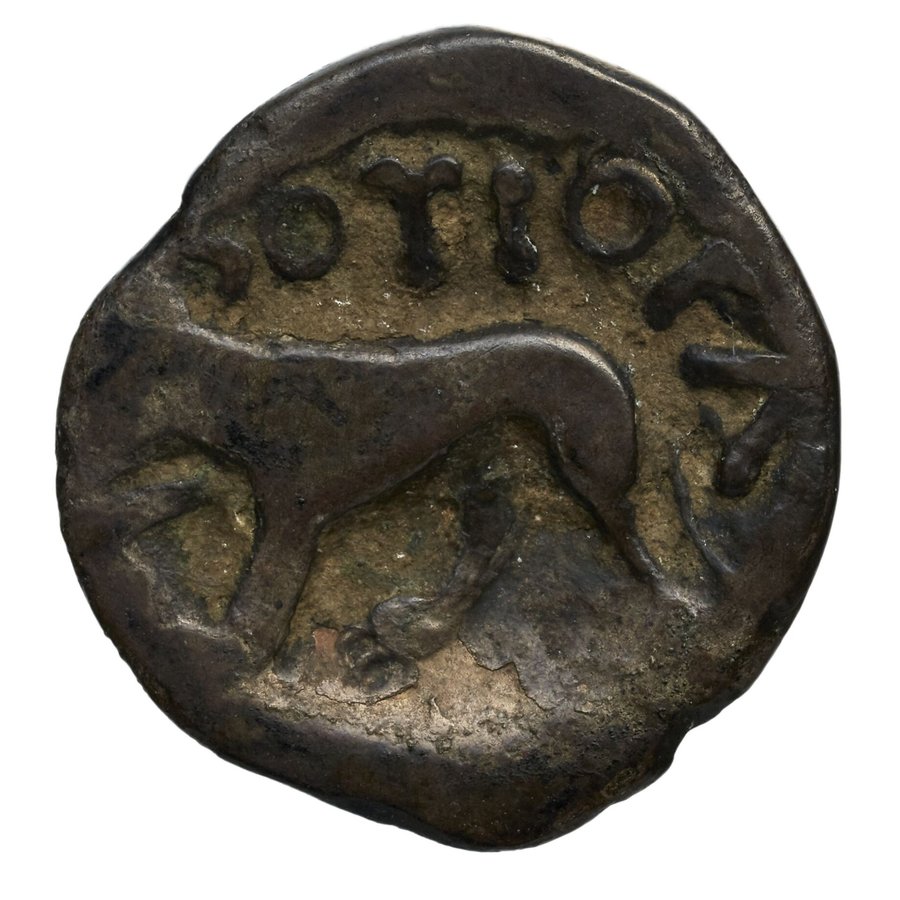
Remarkably, Adiatuanus did not disappear after the defeat. Coins exist bearing the legend REX ADIETVANVS and, on the reverse, a wolf walking to the left together with a mention of the Sotiates. On current assessment these issues were struck only after the conquest — the man therefore kept his royal title under Roman overlordship. The piquant detail: Caesar never calls him rex, only that he held summam imperii, the chief command — the same formula he uses for war-leaders such as Viridovix, not the one he gives the kings of the Arverni. Nicolaus, by contrast, simply calls him king. Which is right remains open.
Crassus moved on to the Vocates and Tarusates, won the decisive battle, and received the surrender of almost all Aquitania (BG III,27). The Sotiates themselves appear afterwards only in Pliny, between the Elusates and the Osquidates Campestres. Under the Empire they lost their separate standing: an inscription from Sos names the ordo Elusatium, the council of the Elusates (CIL XIII 548) — the place now belonged to their community, and it remained in the diocese of Eauze until the 9th century. What survived is the name. The small town of Sos is still called after a people of whom we know almost nothing, except that six hundred of their men were prepared to die together — and then did not have to.
Because three chapters contain everything that makes history both difficult and beautiful: a precise attestation, a second independent witness, a place we probably but not certainly know, a trade that explains a military technique, and an oath nobody can verify. Read on about the Cadurci or the Lemovices and you find the same pattern: a great deal of Caesar, very little stone, and the honest gap in between.
The textual record is secure: Caesar, BG III,20–22, reports the campaign of Publius Crassus against the Sotiates in 56 BC, their strong cavalry, the infantry ambush in the valley, the siege of the oppidum with sheds and towers, the defenders' counter-mines, and the surrender with the handing over of arms and hostages. The wording of the soldurii passage in III,22 is secure, as is the fact that Nicolaus of Damascus described the same institution independently (transmitted by Athenaeus VI,54). Pliny, Naturalis historia IV,108, lists the Sottiates among the peoples of Aquitania between the Elusates and the Osquidates Campestres. The inscription CIL XIII 548 from Sos names the ordo Elusatium. Coins with the legend REX ADIETVANVS exist. Iron Age occupation phases are archaeologically attested on the plateau of Sos.
Sos is probable, not proven. The identification of the oppidum Sotiatium with Sos rests on the place-name and on fitting topography and occupation sequence. So far no find and no inscription there proves the name of the Sotiates or the siege of 56 BC; alternative proposals exist.
The leader's name varies. Manuscripts and scholarship offer Adiatunnus, Adiatuanus, Adcantuannus and further forms; the Greek tradition writes Adiatomos, the coin legend ADIETVANVS. Presenting any one of these as "the correct" form pretends there is a document.
"King" is interpretation. Caesar writes only that he held the chief command. He is called king first by Nicolaus and by the — probably post-conquest — coin legend.
The comparison with Germania and Iberia is modern. That the soldurii, the retinue in Tacitus and the Iberian devotio are forms of one shared institution is a scholarly reading, not a statement in the sources. No ancient text makes the connection.
"Celtic" and "Aquitanian" are not clean categories here. The leader's name is Gaulish, Aquitanian personal names are attested at Sos itself, and the suffix -ates occurs in both language areas. Whether the Sotiates were incoming Gauls or Celticised Aquitani is open.
The mining note is not specific to the Sotiates. Caesar ascribes the skill to the Aquitani as a whole and names no site. A "mining centre at Sos" is not in the text.
The Celtic Warriors · The Cadurci · The Lemovices · The Celtiberians · The Bituriges.
All History & Finds articles →
One late-summer day in 1066, a Norwegian army marched through northern England certain of victory – and a few hours …
Read more →