Some peoples leave behind vast empires. Others leave behind a single sentence. The Segusiavi managed neither, but they left something better: a place. On their land, exactly where the Rhone and the Saone meet, the Romans founded a colony in 43 BC that became the capital of the three Gallic provinces and eventually the city of Lyon. Pliny the Elder records this in five words, and those five words are the reason it is worth spending a few pages on an otherwise quiet people between the upper Loire and the Rhone.
The Segusiavi – Latin Segusiavi, Greek Segosianoi in Strabo, Segousiantoi in Ptolemy – lived in the plain of Forez, in the heart of the modern département of Loire, with extensions into the département of Rhône. Their land stretched from the Forez mountains in the west to the confluence of the Rhone and the Saone in the east.
That is an unspectacular landscape in a spectacular position. Anyone travelling from the Roman province in the south into inner Gaul passed through here. Anyone moving goods from the Rhone to the Loire, and thus towards the Atlantic, did the same. The Segusiavi did not sit at the edge of the world; they sat at a junction.
Their neighbours became far more famous: the Aedui to the north, the Arverni to the west, the Allobroges to the south-east. In the ancient texts the Segusiavi almost always stand in the second row – and that is exactly what makes them such a good example of how Rome handled mid-sized peoples.
The first element of the name is uncontroversial. The Celtic root sego- means victory, force or strength, and it turns up across the Celtic world in place names, personal names and tribal names alike. Xavier Delamarre lists it accordingly in his standard dictionary of Gaulish.
The second element, however, is a problem. The specialist literature simply calls it difficult. The translation circulating online as the Victorious Ones, or those worthy of victory, is a suggestion rather than a secure analysis. It only sounds self-evident because it has been repeated often enough.
So the honest position is this: the name almost certainly contains the word for victory. What stood behind it – an epithet, a divine name, a place name from which the tribal name was derived – we do not know. That is unsatisfying, but it is the state of scholarship.
The Segusiavi first appear when Caesar marched north in 58 BC. In the first book of the Gallic War the notice is flat and functional: Inde in Allobrogum fines, ab Allobrogibus in Segusiavos exercitum ducit. Hi sunt extra provinciam trans Rhodanum primi. – "From there he leads the army into the territory of the Allobroges, and from the Allobroges to the Segusiavi. These are the first people beyond the province, across the Rhone."
That is not a description, it is a map reference. What Caesar is telling his Roman readers is: here the familiar world ends and free Gaul begins. For him the Segusiavi are a threshold, not a subject.
One should not make anything heroic out of it. Being named first says something about the narrator's route, not about the importance of the people named. But it does say something about geography: anyone coming from the south met them before anyone else.
The Segusiavi were not a sovereign people in any modern sense. Caesar lists them explicitly among the clients of the Aedui. This clientage was a real political system: a powerful people offered protection and arbitration, and the smaller one supplied troops in war and followed its patron's foreign policy.
There is much to suggest that the Segusiavi had previously belonged to the Arvernian camp and only switched sides once Arvernian power collapsed after 121 BC. That change is not directly attested; it is inferred from coin distribution and from the general political weather. As a hypothesis it is good. As a stated fact it would be too much.
The consequence matters more than the detail. Through the Aedui, who liked to describe themselves as brothers of the Roman people, the Segusiavi were tied to Rome at an early date. That explains a great deal about what happened to them later.
In the year of the great revolt, 52 BC, the Segusiavi appear twice. First Vercingetorix orders the Aedui and the Segusiavi, who border the province, to raise ten thousand infantry, with the Allobroges as the target of the operation. The Segusiavi therefore supply men for the Gallic cause because their protecting power says so.
Then comes the famous passage before Alesia. Caesar lists the contingents of the relief army and names the Aeduan clientage outright: Haeduis atque eorum clientibus, Segusiavis, Ambivaretis, Aulercis Brannovicibus, Blannoviis, triginta quinque milia. Immediately afterwards, in the same sentence, come the Arvernian clients, among them the Gabali and the Vellavii.
The Segusiavi therefore stand at precisely the point in the text where Caesar lays out the map of dependencies. Their name appears not as an actor but as an entry in a schedule. That is the typical evidence base for a people of this size.
The single most important notice about the Segusiavi comes not from Caesar but from Pliny the Elder. In his list of the peoples of the province of Lugdunensis there is a sentence of five words that contains more history than whole chapters of other authors.
Segusiavi liberi, in quorum agro colonia Lugudunum.
Pliny the Elder, Naturalis historia IV,107; own translation
The Segusiavi, a free people, in whose territory lies the colony of Lugudunum.
Two statements in one breath: the Segusiavi hold a special status, and Lyon stands on their ground. Strabo independently confirms the second point when he places Lugdunum in the country of the Segosiani. Two ancient witnesses agreeing on a people of this size is a rarity.
The Latin word liberi is a legal term. A civitas libera was largely exempt from direct supervision by the provincial governor, kept its own constitution and its own courts, and was usually relieved of certain dues. It was a privilege granted by Rome – and one Rome could withdraw at any time.
It emphatically does not mean independence. A free community lay inside the empire, paid Rome its tribute in one form or another, and had no foreign policy of its own. Freedom here meant: we interfere less.
No source says why the Segusiavi received it. The obvious explanation is that they had not distinguished themselves as enemies during the Gallic War, that they belonged through the Aedui to the pro-Roman camp, and that they were prepared to hand over the most valuable piece of their territory.
For a long time Lyon counted as a Roman foundation on empty ground. Since the excavations at the Clos du Verbe Incarné, and above all since 2014, that no longer holds: on the plateau of Fourvière a stretch of murus gallicus was uncovered, the characteristic Celtic wall of timber framing, stone and earth.
That establishes beyond doubt that a fortified Celtic settlement stood on the hill before the Roman colony was founded. Whether it was a principal settlement, whether it belonged to the Segusiavi, and whether the great sanctuary some scholars suspect stood there, all remain interpretation. The rampart is evidence; everything beyond it is reading.
The silence of the written sources is striking. Neither Caesar nor any other ancient author mentions anything at this commanding point before 43 BC. Archaeology has supplied what literature left out.
The foundation of the colony is well attested. Cassius Dio reports that Roman settlers had been driven out of Vienne by the Allobroges and were camped at the confluence of the Rhone and the Saone. The senate instructed Lucius Munatius Plancus, governor of unconquered Gaul, to found a city for them there.
The date is 43 BC, and according to Pliny and Strabo the site lay on Segusiavian ground. The colony carried the epithet Copia and its founder's family name in its titulature; the full forms vary in the sources and in later additions, which is why they are best not quoted as if they were a charter.
Whether the Segusiavi surrendered the land willingly is not recorded. The prevailing scholarly view today is that there was a negotiated cession with compensation – and the free status in Pliny looks suspiciously like exactly such a compensation. It cannot be proved.
What became of the colony dwarfs anything its neighbours achieved. Lugdunum received, on the slope of the Croix-Rousse, the federal sanctuary of the three Gallic provinces, where delegates of some sixty Gallic communities assembled. The city became the seat of imperial administration for Gaul and one of the largest mints in the west.
For the Segusiavi this had a concrete consequence: at least one member of their people is attested by inscription as chief priest at that federal sanctuary. Apparently you can hand over the ground and still make a career on it.
The relationship is therefore better imagined as a split than as a displacement. One territory became two worlds: a Roman metropolis, and beside it a Gallic civitas that went on managing its own affairs.
The Segusiavi received their new principal town under Augustus, a good fifty kilometres west of Lyon: Forum Segusiavorum, modern Feurs. The name already tells you the founding idea – forum means market and public square, not stronghold.
The town was laid out generously. Scholarship reckons with a built-up area of some eighty hectares and a rectangular street grid. Rescue excavations from the late 1970s onwards uncovered the forum, with the triad usual in the western provinces: a temple with cryptoporticus gallery, a central square lined with shop porticoes, and the basilica and curia group. The forum building is now dated early, to the decades around the turn of the era.
To this were added a theatre, baths, aqueducts, rich private houses and cemeteries. An inscription names Tiberius Claudius Capito, a priest of Augustus, who had the theatre of Feurs rebuilt in stone – a neat demonstration that the local elite did the building here, not a Roman administration.
Before the Roman planned town, power sat on the heights. The most important known site is the oppidum on the spur of Essalois above the exit of the Loire gorges: some six and a half hectares of fortified area, a stone rampart about four metres wide, several gates, crafts ranging from smithing to bronze casting, and imported wine amphorae in quantity.
Further north, also on the Loire, lie the oppida of Joeuvre and Crêt-Châtelard. Joeuvre produced, in Joseph Déchelette's excavations in the early twentieth century, the well-known bronze pendants in boar and horse form now displayed at Roanne.
Essalois burned twice and was finally abandoned around 25 to 20 BC – almost exactly the period in which the new capital was rising down in the plain. The move from the heights to the plain can be read clearly in the archaeology.
The second major settlement of the Segusiavi is Rodumna, modern Roanne. Unlike Essalois it was open from the start, without a rampart, laid out around 150 BC at a crossing of the Loire and at the meeting of several trade routes. After the conquest it grew into a settlement of several thousand people.
Roanne became known for its pottery. The painted bowls of the so-called Roanne type are a regional type fossil, and alongside them stand weaving workshops and the production of wine amphorae, which points to local viticulture by the first century BC at the latest.
Feurs too depended on the ceramic trade, but differently: two substantial lots of samian mould bowls from Lezoux were found there. The Segusiavian capital was evidently a hub through which moulds and wares passed onward – a place of transit rather than a centre of production.
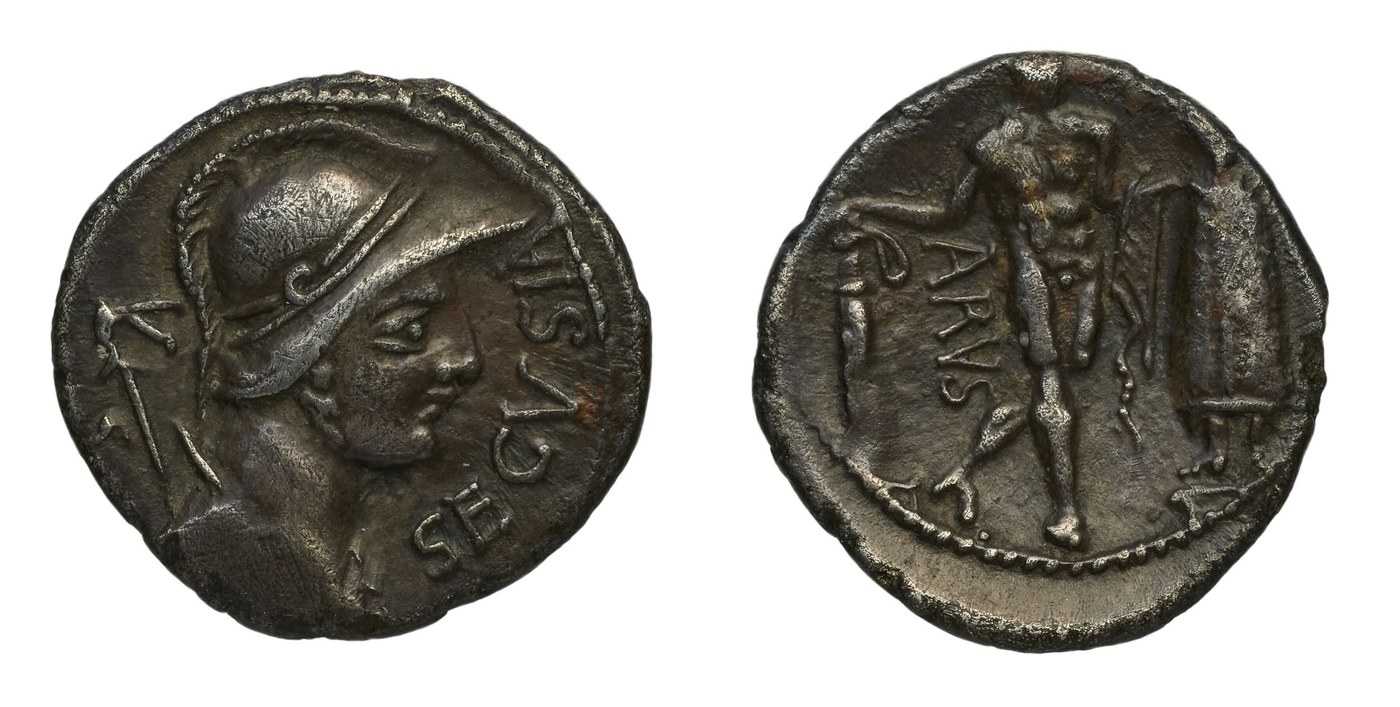
Unlike some neighbouring peoples, there is no negative finding here. A very rare silver coin is attributed to the Segusiavi, a quinarius carrying the legend SEGVSIAVS on the obverse and ARVS on the reverse. The obverse shows a helmeted head in Roman manner, the reverse a figure of Hercules – a singular case in Gallic coinage.
The attribution was long disputed, but has been regarded as settled since an example was found in a secure archaeological context at Lyon. A specimen from a hoard dated to 39 BC suggests that striking began around 43 BC, that is, precisely in the years of the foundation of the colony.
To these should be added potin coins of the large head type in a variant that occurs almost exclusively in the Forez, and, most remarkably, a coin die for a gold issue found on the bank of the Loire in 2007. A die for gold coinage is a rare find anywhere in Europe and argues that striking was carried on here on a serious scale as early as around 200 BC.
The position that had enriched the Segusiavi turned Lugdunum into a hub. Strabo describes the city as the starting point of four great roads: south to the Mediterranean coast, west to the Atlantic, north-west to the Ocean – and north to the Rhine, by way of Langres, Trier and Cologne.
That is the beginning of a traffic axis running all the way to our own corner of the world, starting at the confluence which Pliny places on Segusiavian ground. Anyone in the Roman Rhineland with southern wine, oil or samian ware on the table benefited from a network whose southern node had been built on the land of this small people.
On a smaller scale the territory remained a corridor as well. The long-distance road from Lyon to Saintes ran through Feurs, and the great Gier aqueduct that supplied Lugdunum crossed Segusiavian ground. They provided the subsoil for other people's infrastructure.
The decline began early, and not through war. By the end of the second century Feurs and the little spa town of Aquae Segetae were losing weight, while rurally anchored Roanne kept its workshops. The wealthy families withdrew to their estates, or went straight to Lyon and Rome.
The decisive blow came with Diocletian's administrative reform around AD 297/298. The civitas of the Segusiavi lost its independent standing and was absorbed into the territory of Lyon. Feurs is thus a textbook case of what scholarship calls an ephemeral capital: a town that lost its rank as the chief place of a civitas in the course of late antiquity.
The finding is hard and checkable. The Notitia Galliarum, the late antique register of Gallic communities, lists for the province of Lugdunensis Prima only the communities of Lyon, the Aedui and the Lingones, plus two forts. A civitas Segusiavorum no longer appears. There never was a bishopric of Feurs; ecclesiastically the territory belonged to Lyon.
And yet this people survived – as a landscape name. Forum Segusiavorum became, in the early middle ages, the pagus Forensis, the country of the people of Feurs, and from that came the name Forez, borne by the plain, the mountains and later the county. The place name itself still appears as Forum in the tenth century and had shifted to Fuer by the thirteenth.
Anyone speaking today of the Plaine du Forez is therefore using the Latin market name of a town that Rome laid out for a Celtic people – the tribal name itself was lost along the way and survives only inside the second element of the ancient town name.
It makes a neat closing image. The Segusiavi gave Lyon its ground and lost their own capital to Lyon. What they kept is a landscape name which, strictly speaking, is not their tribal name at all, but that of their Roman marketplace.
The existence and approximate location of the people are secured by four ancient authors: Caesar, Pliny, Strabo and Ptolemy. Caesar names the Segusiavi as the first people beyond the province across the Rhone (BG I,10), as suppliers of troops in the revolt of 52 BC (BG VII,64), and explicitly as clients of the Aedui (BG VII,75). It is further certain that Pliny calls them liberi and places the colony of Lugdunum expressly in their territory, and that Strabo confirms the same independently. Archaeologically secure are the oppidum of Essalois, the open settlement of Rodumna, the pre-Roman occupation beneath the forum of Feurs, the Augustan foundation of Forum Segusiavorum with forum, theatre and baths, and the murus gallicus on the plateau of Fourvière. The coins bearing the legends SEGVSIAVS and ARVS have been regarded as Segusiavian since an example was found in a secure context at Lyon. Finally, it is certain that no civitas Segusiavorum appears in the late antique Notitia Galliarum.
First: the Segusiavi have nothing to do with the Segusini of Susa in Piedmont. Both names contain the root sego-, but the Segusini are a separate Alpine people in the valley of the Dora Riparia, attested among other places on the Arch of Augustus at Susa. Similarity of name is not proof of kinship. Second: translating the tribal name as the Victorious Ones is a proposal; the second element is regarded in the literature as unexplained. Third: the older identification of the oppidum of Essalois with Caesar's Uxellodunum has been abandoned. Fourth: Lugdunum was not uninhabited before 43 BC, but the murus gallicus proves only a fortification – that the Segusiavian chief settlement or a great federal sanctuary stood there is interpretation, not evidence. Fifth: liberi in Pliny does not mean independent, but privileged within the empire. And sixth: the decline of Feurs began decades before the first Germanic incursions; burnt layers on their own date a fire, not a culprit.
The Aedui · The Arverni · The Allobroges · The Gabali · The Vellavi · The Ruteni · The Helvetii.
All History & Finds articles →
Long before the Viking Age and before the Icelandic Edda there was Germanic cult – and one of the most striking stood …
Read more →