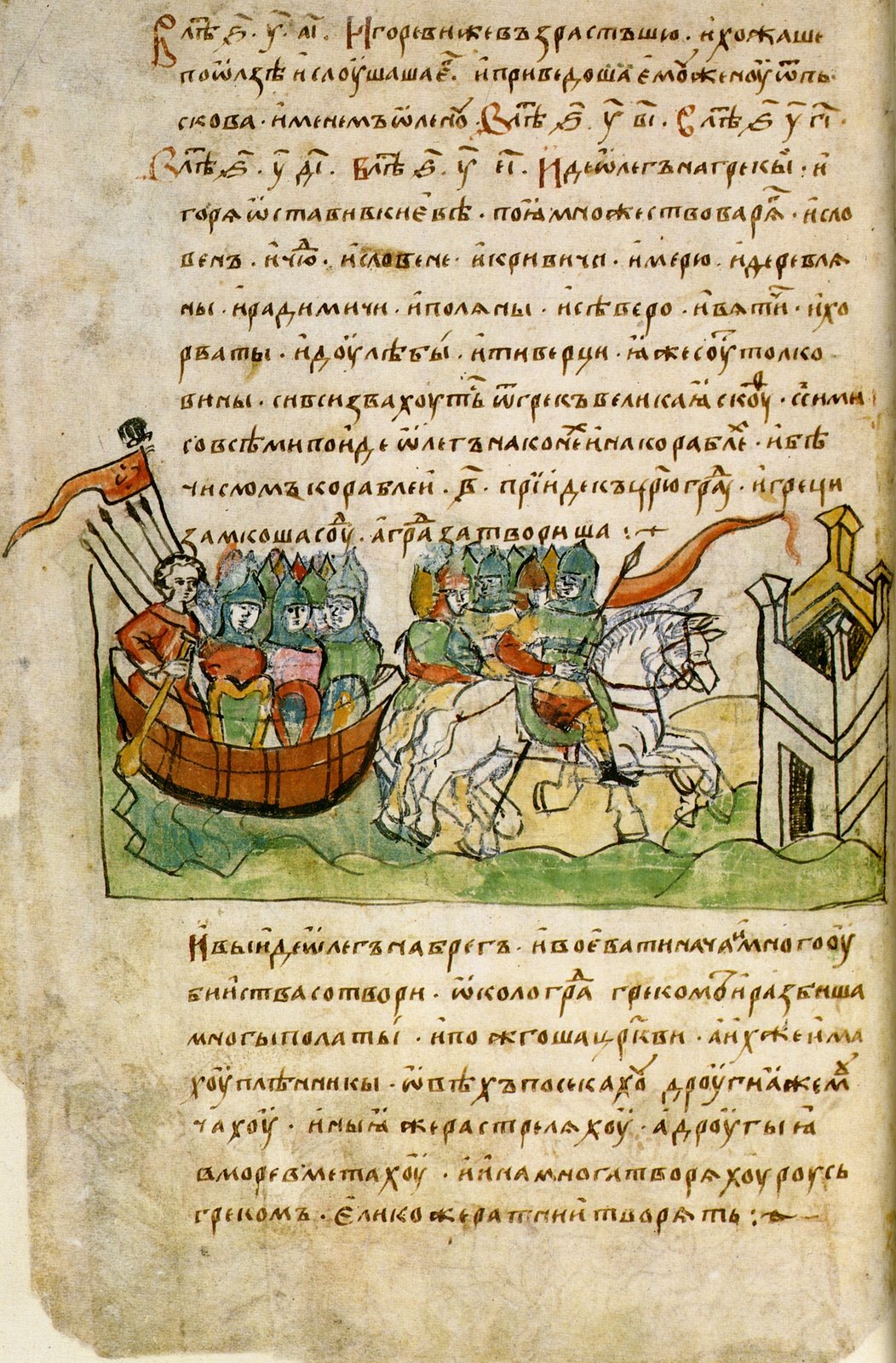
Karl. Inegeld. Farlof. Veremud. So begins a list in a Russian chronicle of the early twelfth century, and no reader in Kiev can have thought of his neighbours on seeing these names. They are the envoys who, in the autumn of 911, concluded a treaty for Prince Oleg with the emperor in Constantinople. Thirty-three years later a second, much longer list followed. Together these treaties are the densest register of Rus names from the tenth century – and legal documents that show what the men from the north really wanted on the Bosporus: trade, law and safe conduct.
The Primary Chronicle, in Old East Slavic Povest' vremennych let, "the Tale of Bygone Years", is the founding narrative of Kievan Rus. It was compiled in Kiev in the early twelfth century; tradition attributes it to the monk Nestor of the Caves Monastery, and it survives in redactions of 1116 and later. The oldest complete manuscripts are younger still: the Laurentian Chronicle of 1377 and the Hypatian Chronicle of the fifteenth century.
For the ninth and tenth centuries the chronicler works with legends, oral tradition and a chronology of his own making. Yet in the middle of this material stand texts that sound entirely different: dry, articled treaty clauses with oath formulas, dating lines and lists of names. These are the treaties of the Rus with Byzantium. The chronicler did not invent them, he copied them. That is why they carry so much weight for the early history of the Rus.
Under the year 6415 of the Byzantine world era, that is 907, the chronicle tells of Prince Oleg's campaign against Constantinople. The story is famous and legendary: two thousand ships, ships on wheels sailing overland, poisoned wine that Oleg sees through, and at the end a shield he hangs on the city gate. The Greeks pay, and Oleg sends five men to the emperors: Karl, Farlof, Vel'mud, Rulav and Stemid.
The terms the chronicler then lists are more solid than the story around them. Rus merchants are to receive provisions for six months – bread, wine, meat, fish and fruit – and bath houses as often as they like. They are to lodge in the quarter of Saint Mamas, outside the walls. They may enter the city only by one gate, unarmed, no more than fifty at a time, accompanied by an imperial official. For the voyage home they get anchors, ropes and sails.
Oleg and his men swear, the chronicle says, by their weapons, by Perun their god and by Volos, the god of cattle. It is the earliest point at which the chronicle names these two gods – and it is a Christian chronicler who preserves them.
Under the year 6420 follows the treaty proper, dated to 2 September; by our reckoning that is 2 September 911. It opens with a list of names:
My ot roda ruskago, Karly, Inegeld, Farlof, Veremud, Rulav, Gudy, Ruald, Karn, Frelav, Ruar, Aktevu, Truan, Lidul, Fost, Stemid, iže poslani ot Olga, velikago knjazja ruskago …
"We of the Rus kin, Karl, Inegeld, Farlof, Veremud, Rulav, Gudy, Ruald, Karn, Frelav, Ruar, Aktevu, Truan, Lidul, Fost, Stemid, who are sent by Oleg, great prince of the Rus …"Primary Chronicle, year 6420 (911), after the Laurentian manuscript in Latin transliteration; spellings vary between manuscripts (e.g. Rjuar, Stemir); our translation
All five names from 907 recur here, Vel'mud in the form Veremud, alongside ten new ones. That is one of the reasons the 907 text is distrusted – more on that shortly.
The treaty itself is a piece of international law. Whoever kills another, Rus or Greek, is to die where he killed. If he flees and has property, it goes to the dead man's kin, but the killer's wife keeps what the law allows her. Whoever strikes with a sword or a vessel pays five litrae of silver according to the "law of the Rus". Thieves who resist may be killed; stolen goods are repaid threefold. Shipwrecked crews are helped, captives ransomed, runaway slaves returned. Men from Rus may enter the emperor's army if they wish. If one of them dies in the empire without a will, his property goes to his kin in Rus.
Picture the situation: two legal worlds agreeing on rules for when things go wrong. The phrase "law of the Rus" is the earliest hint that the Rus had a law of their own to which one could appeal at all.
That most of these names are Scandinavian was shown by the Danish linguist Vilhelm Thomsen as early as 1877, and at its core that has not changed. Inegeld is usually read as Ingjaldr, Farlof as Farulfr, Veremud as Vermundr, Ruald as Hróaldr, Frelav as Friðleifr, Ruar as Hróarr, Stemid as Steinviðr. Karl is Karl, a common name in the north too. These equations are not arbitrary: they follow regular rules by which Norse sounds were rendered in Old East Slavic.
With other names the ground gets thinner. Gudy, Karn and Truan have several possible models. Aktevu is barely interpretable; for Aktevu and Lidul a Finnic origin has also been suggested. Even the boundary between Lidul and Fost is not certain – some scholars read a single name. Anyone who wants "Farulf, envoy of Oleg" engraved on a pendant may go ahead. Anyone who wants to translate Aktevu should honestly add that nobody can do so with confidence.
The "Rus kin" the envoys speak of is not an ethnic identity in the modern sense. It is a group around the prince in Kiev whose leading men around 900 evidently still largely bore Norse names. Where the name Rus comes from and how a warrior elite became a realm we tell in our pieces on the Rus and on the route from the Varangians to the Greeks.
The second great treaty followed a disaster. In 941 Prince Igor attacked Constantinople and lost much of his fleet to Greek fire. This attack is attested by Byzantine historians too and by Liudprand of Cremona, whose stepfather witnessed it as an envoy in Constantinople. A second attempt was followed by a new treaty, placed in the chronicle under 6453. It names the emperors Romanos, Constantine and Stephen. Since Romanos I Lekapenos was overthrown in December 944, the treaty must have been concluded before then; hence the date 944.
The list of names is much longer than in 911 – well over fifty, depending on how one counts – divided into envoys and merchants. And it is built differently. Every envoy represents someone: Ivor is Igor's envoy, Vuefast that of his son Svyatoslav, Iskusevi that of Princess Olga. Then come further members of the princely house, among them people with Slavic names such as Volodislav and Predslava, and a woman called Sfandr, described as the wife of one Uleb, who sends her own representative.
This is a glimpse of a society. Most names are still Norse. But at the prince's court Slavic names appear, women have their own envoys, and merchants stand by name in a treaty between states. Igor's son is already called Svyatoslav, his grandson Vladimir. Within two generations the princes' names change language.
The treaty of 944 is stricter than that of 911. Formerly, it says, envoys carried gold seals and merchants silver ones. Now the prince is to send charters stating how many ships he is sending. Whoever arrives without a charter is detained. That is control: the aim is to tell traders from raiders. Rus merchants may not winter in the Saint Mamas quarter, and the amount of silk they may take away is capped. The Rus promise not to attack the Byzantine possessions in the Crimea around Cherson and not to winter at the mouth of the Dnieper.
At the end both sides swear, and here it gets especially dense for us. The Rus who are not yet baptised lay down their shields, their naked swords and their rings and swear by Perun. The baptised Rus swear in the church of Saint Elias in Kiev. The chronicle names this church explicitly and says that many Varangians were Christians. We have written about oaths on rings in the north in The oath rings. That pagans and Christians on the Dnieper in the mid-tenth century swore to the same treaty side by side says a great deal about those years.
Igor did not live long with the consequences. Around 945 he was killed by the Drevlians when he came to collect tribute a second time.
How reliable are these texts? For 911 and 944 scholars largely agree: they are translations from Greek. They follow the formulas of the Byzantine chancery, their legal terms fit the tenth century, and they contain details a twelfth-century chronicler could hardly have invented, such as the imperial names of 944. The Byzantinist Jana Malingoudi showed in 1994 how closely they match Byzantine diplomatic practice. Presumably copies drawn up for the Rus side were kept in Kiev.
907 is another matter. No Byzantine author mentions a campaign by Oleg in that year. The terms of 907 do not stand as a self-contained document but are scattered through the narrative, and all five names also appear in the list of 911. Many historians therefore regard the 907 text as the chronicler's construction, assembled from the treaty of 911 and perhaps from an older trade agreement otherwise lost. Others see 907 as a genuine preliminary treaty. The question is open. All that is certain is that Oleg, the shield on the gate and the ships on wheels belong to legend.
The dates themselves need caution too. The dating line of 911 is considered reliable; the chronicle's chronology for the ninth and early tenth centuries as a whole is not.
Contemporary documents are the treaties of 911 and 944 in their Old East Slavic translation, even though we know them only through a twelfth-century chronicle and manuscripts of the fourteenth and fifteenth centuries. Add to them Byzantine accounts and Liudprand of Cremona for the attack of 941.
Doubtful is the treaty of 907 as a document in its own right.
Later tradition is the story around Oleg – ships on wheels, poisoned wine, the shield on the gate – and the chronology of the early period.
Modern interpretation covers the equations of the names with Norse forms, well founded for most, open for some, and the question of what "of the Rus kin" meant exactly around 900. How things went on when Northmen came to the Bosporus no longer as envoys but as a bodyguard is told in Miklagard and the Varangian Guard and in the overview The Vikings in the East.
Fifteen men who gave their names for the record in Constantinople. Their graves we do not know; their names we do. For courage. For memory. For legends that live on.
The Rus (Kiev) · Miklagard and the Varangians · The Varangian route · The Vikings in the East – Varangians, the Rus & Byzantium · Staraya Ladoga and Gnezdovo · The Ilmen Slavs · The Ingvar Expedition.