Some time in the 750s someone on the Volkhov felled trees to build a house. The tree rings in those logs are the oldest dates for the settlement the Norse later called Aldeigjuborg. A hundred and fifty years later, upstream of Smolensk on the Dnieper, the dead were burned in boats and laid in wooden chambers beneath mounds that are still counted in thousands. Between these two places lies a question that has been argued over in Russia for two hundred and fifty years: how Scandinavian was early Rus?
Staraya Ladoga lies on the Volkhov, a little over ten kilometres above the point where the river flows into Lake Ladoga. Coming from the Baltic, you sailed through the Gulf of Finland, up the Neva, across the lake and then up the Volkhov. Further south lay Lake Ilmen, and from there rivers and portages led to the Volga or the Dnieper. Ladoga was the first gateway into this river network, which we describe in detail under the eastern route.
The Norse called the place Aldeigja or Aldeigjuborg. In all likelihood the name was borrowed from a Baltic-Finnic river name, not the other way round. That alone is a clue: the first people Scandinavians dealt with here spoke a Finnic language.
Staraya Ladoga has been excavated since the late nineteenth century, systematically since 1938 under Vladislav Ravdonikas and later under Anatoly Kirpichnikov and others. The waterlogged soil has preserved wood, and wood can be dated by its rings. On this evidence the lowest occupation layer, known as horizon E3, belongs to the 750s; the year 753 is often cited.
It pays to be precise about what that date says. It dates the oldest building timber found so far. It does not say who built the house. The same early layer has produced tools and craft waste whose best parallels are in Scandinavia, but also objects from the Finnic and Baltic world. From the start the settlement was a place where several groups met. Who "founded" it cannot be answered from excavation, and the question may be the wrong one.
Why people came is clear: silver. Ladoga has produced one of the earliest finds of Arabic dirhams in Europe, a hoard whose latest coin was struck in 786/87. Silver from the Caliphate flowed up the Volga and through Ladoga to the west – to Gotland, to Birka, to Hedeby.
The best-known single object is a four-sided wooden stick, found in 1950, a little over forty centimetres long, from a layer of about 840–865. It carries a long inscription in short-twig runes. What it means is open: since the 1950s half a dozen readings have been proposed, from skaldic verse to charms to a note about a spindle. All that is certain is that someone here was writing Old Norse in the ninth century.
There are also metal amulets with runes, combs, jewellery and equipment of Scandinavian type. Across the river, on the Plakun, lies a cemetery of about a dozen low mounds. The dead were cremated, and several graves contained rivets suggesting boats. Most scholars regard the Plakun as a Scandinavian burial ground of the ninth and tenth centuries. Nearby are large mounds, called sopki in Russian, which belong to a different, local burial tradition.
Science has added a new perspective. In 2019 T. Douglas Price, Vyacheslav Moiseyev and Natalia Grigoreva analysed strontium isotopes in the teeth of fifteen individuals from the cemetery of St Clement's church at Staraya Ladoga, Christian graves of the eleventh and twelfth centuries. At least five of them had not grown up locally; their values are consistent with the Mälaren region of central Sweden. Long after the Viking Age, then, people were still coming to Ladoga from there – and staying.
Aldeigjuborg appears several times in Icelandic tradition. According to the thirteenth-century Heimskringla, Earl Eiríkr Hákonarson went east around the year 1000, ravaged the land and burned Aldeigjuborg; Snorri relies here on a praise poem attributed to a skald named Eyjólfr. Later, Ingigerd, the Swedish king's daughter who married Prince Yaroslav of Kyiv, is said to have received Aldeigjuborg as a bridal gift and handed it to a Swedish earl called Rögnvaldr.
These stories are valuable because they show how naturally Ladoga belonged to the Norse world. But they were written two to three centuries after the events, in Iceland, by people who had never seen Ladoga.
About thirteen kilometres west of Smolensk, where the Svinets flows into the Dnieper, lies Gnezdovo. Here the routes from the north met the Dnieper, and anyone heading for Kyiv and Constantinople had to cross the portages between the rivers. Gnezdovo was the transfer point. It flourished in the tenth century, roughly between 920 and 960.
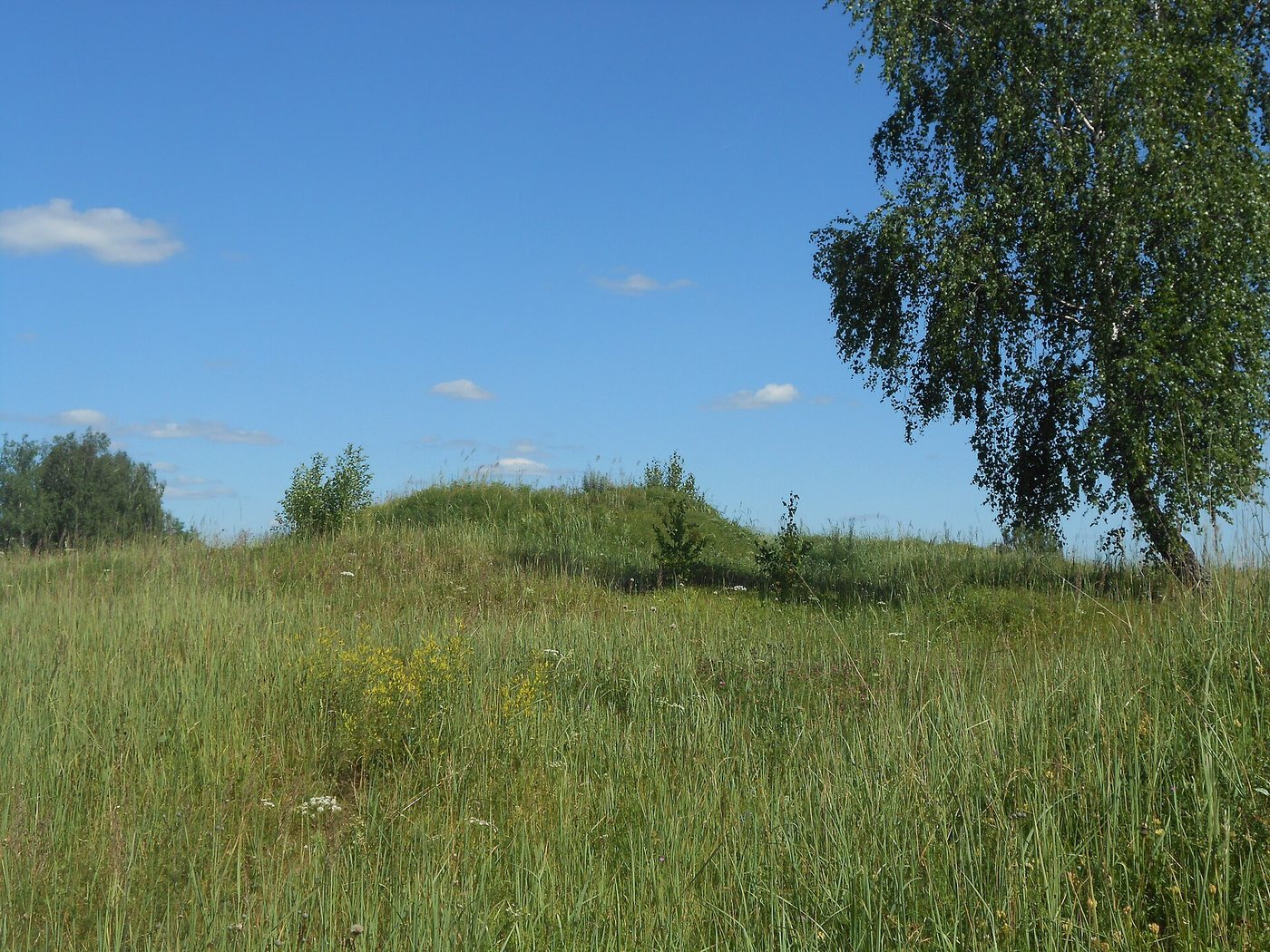
Gnezdovo is famous for its graves. Estimates suggest there were originally three to four thousand burial mounds in several groups, the largest mound cemetery of the Viking Age in Europe. Since the first excavation in 1874 well over a thousand have been investigated. There is also a fortified settlement, open settlement areas and several hoards with Arabic and Byzantine coins.
Most of the dead were not Scandinavians. Judging by burial rite and grave goods, most graves belong to Slavic and Baltic groups – this was the land of the Krivichians. But some graves clearly follow Scandinavian custom: cremations in boats, women with oval brooches of the kind known from Birka, Thor's hammer rings, weapons and riding gear. How large that share was depends heavily on which features one accepts as "Scandinavian". The figures in the literature vary widely; a cautious count arrives at a few dozen certainly Scandinavian burials, while other estimates are much higher.
One small find from Gnezdovo shows how mixed this world was: a tenth-century amphora bears a short word in Cyrillic script. It is regarded as one of the oldest East Slavic inscriptions of all. What it means – the contents of the jar or its owner's name – is disputed.
In the early eleventh century Gnezdovo was abandoned. Its role passed to nearby Smolensk.
Among the Scandinavian graves at Gnezdovo the chamber graves stand out. A large pit was dug and lined with timber, and the dead were laid in it unburnt, often clothed and with rich grave goods, sometimes with a horse, sometimes with a second person. A mound was raised over it.
This type of grave is found across a wide area in the tenth century: at Birka and Hedeby, at Timerevo near Yaroslavl, at Shestovytsia near Chernihiv, and in Kyiv itself. It is the mark not of a people but of a class. Those buried this way belonged to an elite that lived, fought and mourned in similar ways across great distances – from Lake Mälaren to the Dnieper. People of Scandinavian origin had a firm place in that elite. Which language was spoken at their graves the chambers do not reveal.
The story everyone knows is in the Russian Primary Chronicle, the Tale of Bygone Years. It was compiled in Kyiv at the beginning of the twelfth century, around 1113; the monk Nestor is traditionally regarded as its author. Under the year 862 it relates that the northern peoples, Slavs and Finns, drove the Varangians back across the sea, then fell into strife and finally summoned Varangians of the Rus:
Zemlja naša velika i obilna, a narjada v nej nět.
"Our land is great and rich, but there is no order in it."Povest' vremennych let, s.a. 6370 (862); simplified transliteration, our translation
Three brothers came, Rurik, Sineus and Truvor. According to one manuscript Rurik settled first at Ladoga, according to others at Novgorod. From him descended the ruling house of the Rus.
This is a dynasty's foundation legend, written some two and a half centuries after the events for its descendants. The dates for the ninth century were calculated after the fact. That Rurik existed is possible, but no contemporary source confirms it. What is remarkable is that the chronicle presents the rulers of Rus themselves as Varangians from beyond the sea – the princes of Kyiv in the twelfth century evidently had no problem with a foreign origin. What happened next at Novgorod and on Lake Ilmen we tell elsewhere.
The role of the Scandinavians has been debated since the eighteenth century. German scholars at the St Petersburg Academy, Gottlieb Siegfried Bayer and Gerhard Friedrich Müller, read the chronicle literally and saw the Varangians as founders of the state. Mikhail Lomonosov objected vigorously. Two camps grew out of this: Normanists, who stressed the Scandinavian share, and anti-Normanists, who minimised or denied it. In the Soviet period the anti-Normanist view was long the official line. Since the 1960s, when the Leningrad archaeologist Leo Klejn opened the debate, things have calmed down.
Today most archaeologists and historians, in Russia and in the West, work from a picture that proves neither of the old camps entirely right. Scandinavians were there, early and in influential positions – as Ladoga, Gnezdovo and Timerevo show, as the Frankish Annals of Saint-Bertin show when they identify envoys of the Rhos as Swedes as early as 839, and as the mostly Norse names of the envoys in the treaties between the Rus and Byzantium show. But they were a minority in a world of Slavs, Finns and Balts; they adopted the language, gods and customs of their neighbours, and within a few generations their descendants were Rus. The name Rus itself is usually traced via Finnish Ruotsi, "Sweden", to a Norse word for rowing; even that is not entirely undisputed. More on the realm that grew out of this is in the Rus and the realm of Kyiv.
Archaeologically attested are the settlement at Ladoga from the 750s, Scandinavian objects and burials there and at Gnezdovo, the chamber graves, the dirham hoards and people from the Mälaren region in the Ladoga churchyard.
Contemporary evidence covers the Rhos of 839 in the Annals of Saint-Bertin and the Norse names in the tenth-century Rus treaties.
Later tradition covers the summoning of Rurik and his brothers in the Primary Chronicle of the early twelfth century and Aldeigjuborg in the Icelandic sagas of the thirteenth.
Modern interpretation covers the answers to who founded Ladoga, how large the Scandinavian share at Gnezdovo was and where the name Rus comes from.
On the Volkhov and the Dnieper, people met who knew how to understand each other even when they spoke different languages. That may be the most honest sentence one can say about early Rus. For courage. For memory. For legends that live on.
The Rus (Kiev) · The Ilmen Slavs · The Varangian route · The Men of the Rus Treaties · The Krivichs · The Vikings in the East – Varangians, the Rus & Byzantium.

