Of the Slavic groups that stood before Thessalonica in the seventh century, most are known to us from a single report of an attack. After that, the sources fall silent. One group is different: the name Strymon reappears two centuries later – on lead seals, in a court precedence list, in tax districts. This is not because the people survived. It is because of the river. The Strymon valley is the corridor between Thessalonica and the interior; whoever holds it holds the road. The empire had to administer this space – and the name of the space endured, while the people who briefly lent it their name vanished from the texts. This article traces how a statement of origin became a tribal name, and a tribal name an administrative district. And it marks clearly where our knowledge ends.
The history of the early South Slavs on the Aegean is a history of names that flare up briefly and go out again. Baiunetes, Berzetes, Belegezites – they appear in a list, act in one episode, and are gone. Who they were, what they called themselves, whether they understood themselves as a group at all: we do not know.
The Strymon is the exception, and for a reason that has nothing to do with the people. The name belonged first to a river. Rivers do not disappear. And because this particular river formed a decisive passage, militarily and logistically, the Byzantine Empire needed an administrative term for it. A geographical description became an official district – and the name outlasted the group by centuries.
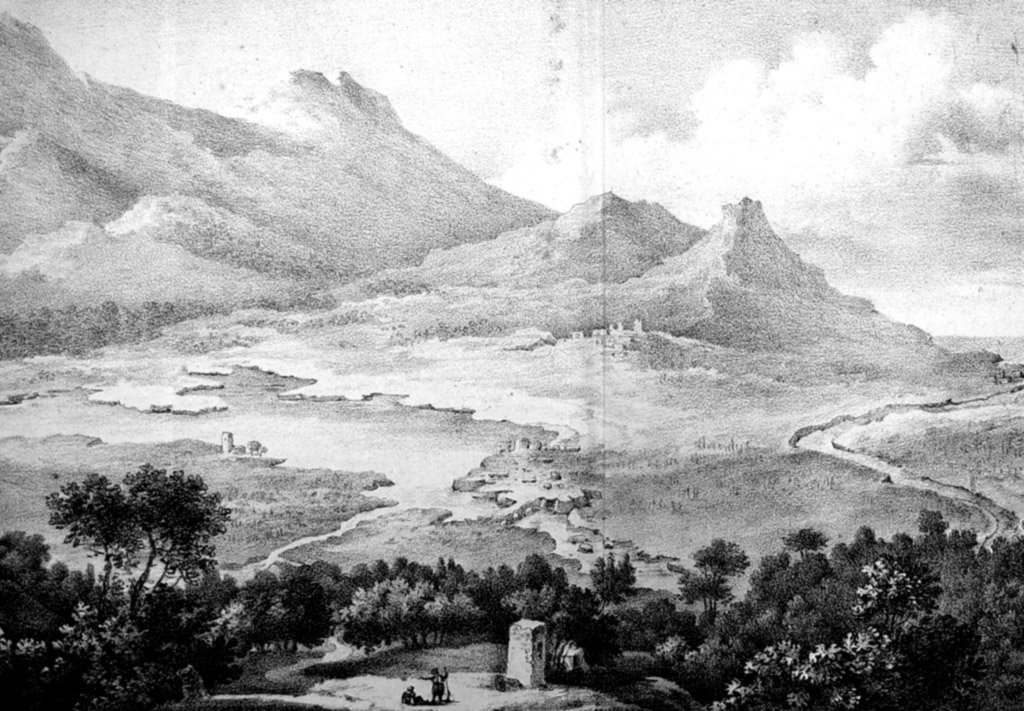
The river rises in present-day Bulgaria on Mount Vitosha, runs first west, then south, and cuts through several gorges on its way. Its catchment covers roughly 17,300 square kilometres, today divided between Bulgaria, Greece, North Macedonia and Serbia. The decisive bottleneck is the Rupel gorge between the Belasitsa and Sengelska ranges, where the river passes from the Bulgarian basin into the plain of Serres.
Beyond that, the valley opens into a broad landscape reaching down to the mouth in the Strymonian Gulf near Amphipolis. The present-day view is misleading: the lower course was canalised in 1930, Lake Achinos drained, Lake Kerkini impounded. In antiquity and the Middle Ages this was marshy, difficult ground – which made the few firm crossings all the more important. At Amphipolis stood a wooden bridge whose piles reach back to the late sixth century BC and which was maintained over very long periods. It is the only surviving ancient wooden bridge in Greece.
In this world rivers are not boundary lines but guide lines. The same logic carried the route of the Varangians from the Baltic to the Black Sea centuries later: whoever commands a watercourse commands movement along its banks – and sooner or later is obliged to administer it.
The principal source for the Slavic groups around Thessalonica is the second book of the Miracles of Saint Demetrius, written by an unknown author probably in the last two decades of the seventh century. The authoritative edition remains that of Paul Lemerle (Paris 1979/1981).
And here comes the first surprise. The text does not speak of a people called Strymonites. It speaks of Sclavenes who come from the Strymon – a statement of origin, not an ethnonym:
Σκλαβῖνοι οἱ ἀπὸ τοῦ Στρυμόνος
"Sclavenes who are from the Strymon"Miracula S. Demetrii, Book II, in the form quoted by Max Vasmer, Die Slaven in Griechenland, Berlin 1941, p. 178; free translation: Glanz & Gravur
The fixed form Strymonitai, which appears in every modern account, is traced by Vasmer to John Kaminiates – an author of the early tenth century. Some two hundred years therefore separate the thing from its name.
That the name is late can be checked against a second passage. The second book of the Miracles opens with a list of the groups that combined against the city under Chatzon around 615. It names Drugubites, Sagudates, Belegezites, Baiunetes and Berzetes.
The Strymonites are absent from that list. This is more than a footnote: the oldest catalogue does not know them. They appear only a generation later, in connection with the revolt following the death of Perboundos – and there as the people of a particular river. Anyone writing that the Strymonites feature in the name-catalogue of the Miracles has conflated two different passages.
The conflict began with a single man. Perboundos, described in the sources as ruler of the Rhynchinoi, spoke Greek, dressed in Byzantine fashion and kept a residence in Thessalonica. When the city's eparch reported plans against the city, the emperor had him arrested and taken to Constantinople.
What followed is remarkable: the Rhynchinoi and the people of the Strymon sent a delegation to court together with envoys from Thessalonica, asking for clemency. Lemerle regards this as unique – it reveals a relationship between the city and its neighbours that has little to do with the conventional image of a barbarian assault. Perboundos escaped, was recaptured, escaped again and was finally executed. The siege that followed is told at length elsewhere: with the Sagudates and the Drugubites.
For our question, the geography of the blockade matters most. The three rebel groups divided the land around Thessalonica between them: the people of the Strymon took east and north, the Rhynchinoi the south, the Sagudates the west. The coast was worked by ships. For two years there were three or four raids a day, by land and by sea; livestock was driven off, agriculture ceased, maritime traffic stopped.
This division is no accident. East and north of Thessalonica is precisely the direction from which the road to Constantinople arrives – the Via Egnatia. Whoever sits there cuts off not merely the city's hinterland but its link to the empire.
The decisive assault took place, on Lemerle's reconstruction, from 25 to 27 July 677. And here the source records something that popular accounts almost always omit: the people of the Strymon did not take part. Some three miles short of the walls they halted and turned back.
The author of the Miracles presents this as the first intervention of Saint Demetrius. That is the language of a hagiographer, not a causal analysis. Why the group actually broke off, we do not know – Lemerle expressly calls the reason unknown. The consequence is clear enough: the brunt of the assault was borne by the Rhynchinoi and the Sagudates. It is worth stating the finding soberly: the most frequently cited role of this group in the most famous event of its history consists in not having attacked.
There is a second reason why this particular name stayed in the empire's memory. For as long as the Arab fleet lay before Constantinople, any help for Thessalonica was a question of what forces remained. Once that threat had passed, the emperor sent an army through Thrace – and from this point the text names only one group: the people of the Strymon.
They learned of it in time, occupied passes and strategic positions and called on neighbours for help. It availed nothing. The imperial troops defeated them, the settlements near the city were abandoned and the inhabitants withdrew inland. A grain fleet under strong escort then reached Thessalonica. Afterwards the Slavs asked for negotiations; how these ended, the text does not say.
Militarily this was a punitive expedition. In administrative terms it was the moment when the empire defined the Strymon region as a problem of its own – and therefore as a unit of its own.
Honesty is required at this point. For these events the text of the Miracles gives no year at all, only an indiction, the fifth. Every date is inference.
The proposals have differed widely: 634 for Tafel, 644 to 649 for Antoniades-Bibicou and Evert-Kappesova, 657/658 for Diehl, 687/688 for Dvorník and Jireček, 692 for Grégoire. The reconstruction that has prevailed is Lemerle's, placing the execution of Perboundos in early 676, the assault in July 677 and the imperial campaign in the summer of 678 – because only this fits the simultaneous war with the Arabs. Stratos moved the beginning slightly earlier. To write "677" is therefore to write a very well-argued hypothesis, not a date from the source.
Barely a decade later the empire struck out again. In 688/689 Emperor Justinian II marched through Thrace and Macedonia as far as Thessalonica, subdued Bulgars and Sclaviniae and thereby reopened the overland connection. Large numbers of Slavs were shipped across at Abydos and settled in the Opsikion; from them he raised a special corps whose strength is given as some 30,000 men.
The ending is well known and belongs among the bitter chapters of this history: at Sebastopolis in 692/693 around 20,000 of these men went over to the Arabs, and the emperor had those who remained killed along with their wives and children. Two points of precision: Theophanes does not name the commander – the form Neboulos comes from a different strand of transmission. And the people of the Strymon are not expressly named in any of these reports. This is context, not evidence.
Between the seventh and the ninth century the narrative sources leave a gap for the Strymon region – but the administration does not. An archon of the Strymon is attested for the eighth century, and in the same century the Strymon appears as a kleisoura, a pass district, within the theme of Macedonia.
The word is precise. A kleisoura is neither a tribal territory nor a province but a district of barriers and passages. The empire defined the region by what made it militarily significant – by its narrows. Comparable things happened elsewhere: with the Ezeritai and Milingoi in the Peloponnese, integration ran through fixed payments; here it ran through control of the roads.
When the kleisoura became a theme in its own right is disputed – and the debate is worth following, because it shows how thin the foundations are. A passage in Theophanes under the year 809 may already presuppose a separate unit. Yet the Taktikon Uspensky, the list of offices from around 842/843, contains no governor of the Strymon. A series of lead seals names archontes and strategoi of the Strymon from the second quarter of the ninth century. And the strategos tou Strymonos first appears securely in a precedence list in the Kletorologion of Philotheos of 899.
Lemerle and Pertusi place the foundation in the late 840s, during the campaigns of Theoktistos. Treadgold argues instead for around 896, as a response to the Bulgarian ruler Symeon. Both positions are defensible; the transmission does not permit a decision. Only the outcome is certain: a river name had become the title of an office.
The theme covered the land between the Strymon and the Nestos, between the Rhodope mountains and the Aegean; its capital was Serres, and its further cities included Philippi, Christoupolis and Chrysopolis. At roughly the time of the theme's foundation the bishop of Serres was raised to archbishop – an indication consistent with a new administrative centre.
In the late tenth century the territory was divided: into Strymon proper, also called Chryseuba or Chrysaba, and a New Strymon, known solely from the Escorial Taktikon of around 971 to 975. Oikonomides read Chryseuba as a Hellenised form of a Slavic place name. The theme was subsequently joined with Thessalonica and later with Boleron, did not survive 1204 as a separate unit, was restored in 1246 and disappeared for good in the 1340s.
The ninth century brought a new factor into the valley: the Bulgarian realm. In 809 Khan Krum destroyed a Byzantine army on the Strymon. In the same period Emperor Nikephoros I pursued a massive resettlement policy; Theophanes reports under 809/810 that Christians from every theme were compelled to sell their property and move into the Sclaviniae – and he calls the procedure outright a deportation. In 837 the Smolyani in the Rhodopes rose; the Bulgarian ruler Presian intervened and pushed as far as Philippi. How these events relate to the Slavic population of the Bulgarian realm is the subject of a debate of its own.
A saint's life yields something too: Mutafčiev made it probable that a Slavic revolt described in the Life of Gregory of Dekapolis concerns the Strymon region – the saint travelled from Christoupolis to Thessalonica around 815. The corridor remained unsafe.
For the early tenth century we have an eyewitness in John Kaminiates: he lived through the capture of Thessalonica by the fleet of Leo of Tripoli in 904 and was taken prisoner. His account is informative about the Slavic surroundings of the city. In the plain, he writes, lie villages whose inhabitants – Drugubites and Sagudates – pay their taxes to the city, while others pay tribute to the neighbours beyond the frontier. And when the attack came, the defence posted "all the Sclavenes gathered from the neighbouring regions" as archers at the most favourable points on the wall.
Precision matters here, precisely because the opposite is often claimed: among the tax-paying villages Kaminiates names the Drugubites and the Sagudates – he does not name the Strymonites in that role. The suggestion occasionally voiced in the literature that Strymonites assisted the attackers comes from the commentary of modern editors, not from the text. Anyone wishing to trace an arc from attacker to taxpayer must trace it for the Drugubites and the Sagudates, not for the people of the Strymon.
That leaves archaeology – and it offers no substitute here. There is no group of finds that can be assigned to "the Strymonites". Florin Curta has examined, for neighbouring Macedonia, what seventh-century finds actually show: sunken-floored buildings without datable associated material, clay pans that appear there later than north of the Danube, coin hoards pointing rather to high-ranking Byzantine owners, and cemeteries continuing late antique traditions and indicating Christian communities tied to the empire. His conclusion is blunt: on the archaeological evidence, no Slavic settlement of Macedonia in the seventh century can be demonstrated.
Behind this lies a methodological problem that reaches far beyond the region. Sebastian Brather has shown that ethnic identity is a social construct that cannot be read off material goods. A brooch, a house type, a pot shape are not identity papers. This holds for the Elbe Slavs as much as for the Strymon.
That leaves place names. In 1941 Max Vasmer catalogued the Slavic geographical names of Greece region by region, including the area of Serres, Nigrita and Siderokastron. The material is rich, and it demonstrates beyond doubt that Slavic was spoken in the Strymon valley over a long period.
Vasmer himself, however, urged caution, and did so with notable sharpness. Greek and Bulgarian forms of a name diverge; often, he wrote, the Slavic forms are mere orthographic conversions of the Greek, additionally exposed to learned intervention. Separating genuinely popular Slavic names from learned-puristic ones was urgently necessary, he argued, but could only be done reliably through fieldwork on the spot. Until that happened, learned Slavicisations would hinder research rather than help it. One should add: a toponym attests a language, not a particular group. No place name states that Strymonites lived here.
What remains is an unspectacular but clear finding. The group we call the Strymonites is scarcely ever graspable in the sources under that name. It appears as "the Sclavenes from the Strymon" – named after a river, just as the neighbours to the south were named after the Rhechios. Both names are external descriptions of place, not transmitted self-designations.
The reason for the long afterlife lies in the landscape. The Strymon valley controls the exits of the passes from the interior into the Macedonian coastal plain, and it is crossed by the Via Egnatia, the main link between Thrace and the empire's second city. Such a space remains an administrative problem regardless of who happens to live in it. That is why the name returns – as a kleisoura, as a seal legend, as a theme, as a tax district.
The path from enemy to subject was no moment of conversion but an administrative process running over generations: first campaign, then frontier control, then office, then taxation. Comparable paths were taken by the Serbs, the Croats and the Carantanians – each differently, each at a different pace. And anyone interested in how easily such names are confused will find the most instructive example among the Dregovichi and the Drugubites: two names that sound alike, two entirely separate histories.
What remains is a landscape with a road, a narrows and a name. The people who sealed off the east and north of Thessalonica in the seventh century and turned back three miles from the wall have left us no word of their own. That is no reason to rewrite their history – it is the reason to tell it carefully.

The Sagudates · The Drougoubitai · Melingoi and Ezeritai · The Slavs of Bulgaria · The Serbs · The Croats · The Carantanians.
All History & Finds articles →
Exactly one word survives of the Sturii: their name, in the genitive plural, buried in a list. No chieftain, no battle …
Read more →