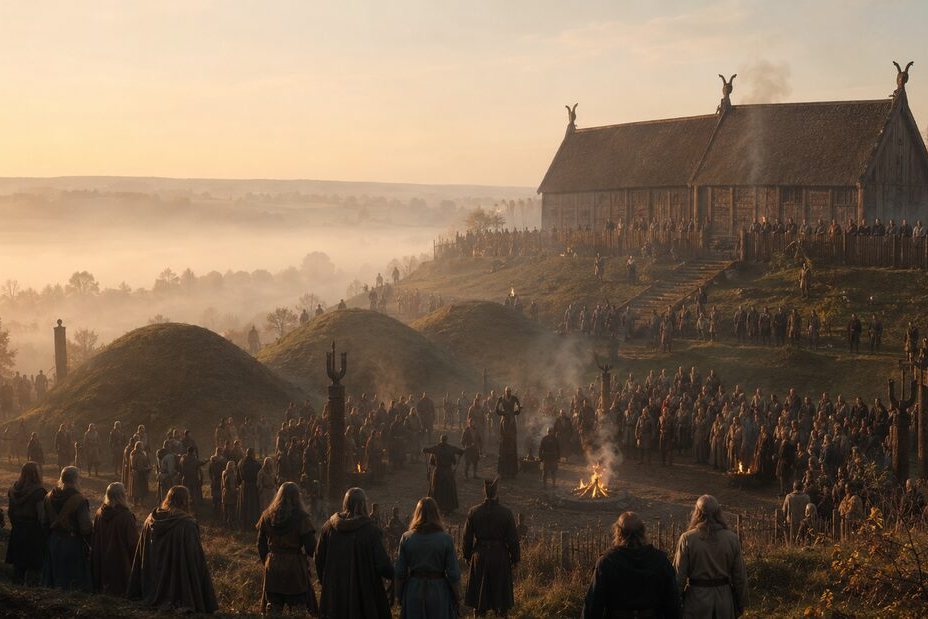
 Some peoples survive in a single sentence. The Slavic groups who joined Asparuh's Bulgars on the lower Danube in 680 are among them. A Byzantine monk writing more than a century later names them once: the so-called Seven Tribes and the Severi. Out of that sentence grew a state that would be Constantinople's most dangerous neighbour for three centuries, and out of that state grew a people. What we securely know is remarkably little. What has been made of it is remarkably much. This article tries to keep the two apart.
Everything hangs on one source: the Chronographia of Theophanes the Confessor, written around 810 to 814 in Constantinople. Under the year of the world 6171, which corresponds to 679/680, he describes how the Bulgars under Asparuh crossed the Danube, defeated a Roman army, and established themselves in the country north of the Balkan range. There, he writes, they subdued the resident Slavic tribes, the so-called Seven Tribes, together with the Severi. That is all. Not a single tribal name is given. No leader, no place, no number apart from the seven. The second witness, Patriarch Nikephoros, covers the same events in his Breviarium at roughly the same date and leaves the Slavic groups out almost entirely. That is the complete written record. Every tribal name, boundary and treaty that appears in popular accounts is reconstruction.
The century before 680 had already redrawn the map. From the early sixth century onward, Slavic-speaking groups crossed the Danube, first as raiders and then as settlers. Byzantine authors call them Sclaveni and Antes. After the collapse of the Danube frontier under the emperor Phokas and during the Avar wars of the early seventh century, Roman administration in the interior failed. Cities such as Serdica, Naissus and Marcianopolis lost their function, and the surviving population withdrew to the coastal strips and the fortified harbours. What remained was a wide, barely governed landscape occupied by many small, independent Slavic communities. Two generations later Asparuh arrived in precisely that vacuum. Further west the same movement produced the groupings from which the Serbs, the Croats and the Carantanians later emerged.
Almost everything we know about how these people lived comes from hostile observers. Procopius of Caesarea writes in the Gothic Wars, book VII, chapter 14, that the Sclaveni and Antes are not ruled by one man but have lived from of old under a form of popular rule, so that everything affecting them is referred to the assembly. They believe, he says, that one god, the maker of the lightning, is lord of all things, and they sacrifice cattle to him; they also sacrifice to rivers, nymphs and other spirits. He mentions neither temples nor idols. The Strategikon attributed to the emperor Maurice, a military handbook of the late sixth or early seventh century, gives them a chapter of their own (XI,4): they are numerous and hardy, they live at forest edges and along rivers, they fight from ambush rather than in the open, and they refuse to be governed. These are valuable texts, but they are intelligence reports written for an enemy, not self-descriptions.
For the Slav-settled regions lying outside imperial administration the Byzantines coined the term Sklavinia. It denotes neither a people nor a state but a territory: Slavs live there, our law does not apply. As a fixed expression it becomes clearly visible mainly from the later eighth century onward; for 680 Theophanes still speaks of the neighbouring Sclavenian nations. The direction of view matters: Sklavinia is an outside label from Constantinople, not a self-designation. That the Byzantines did use names where they knew them is shown by the Miracles of Saint Demetrius from Thessalonica. In its second book, dealing with seventh-century events, groups such as the Drugubitai, Sagoudatai, Rynchinoi, Belegezitai and Berzetai appear by name and in some cases with their leaders. For the Seven Tribes on the Danube, nobody does this.
The other half of the story comes from the steppe. Theophanes describes Kubrat's realm north of the Black Sea, which he calls Old Great Bulgaria, and Kubrat's five sons, who ignored their father's instruction to stay together and went their separate ways. The narrative is visibly literary in construction: it explains the arrival of the Bulgars on the Danube through the model of a squandered inheritance, and it condemns them in the same breath. The chronicler wrote at a time when Bulgaria under Krum had become a deadly threat, and he leaves his readers in no doubt about what to think of these newcomers. The third son, Asparuh, moved west across the Dnieper and the Dniester and settled in a district Theophanes calls the Onglos, which he considered impregnable from both sides. Where the Onglos lay is still an open question; most scholars look for it in the Danube delta.
The emperor Constantine IV had just survived the Arab siege of Constantinople and could turn to the Danube. He led an army and a fleet against the Onglos. Nikephoros describes how the Bulgars, faced with this force, withdrew into their fortifications, while the Romans could not close with them because of the marshy ground. Then the emperor left the camp to have his gout treated at Mesembria. A rumour spread that he had fled; the army dissolved into headlong flight although nobody was pursuing it. Only then did the Bulgars follow. It is worth noting that neither Byzantine author presents this defeat as an achievement of the enemy but as an accident in their own camp. That too is source criticism: the account protects the emperor's honour.
What followed is the passage that mattered. The Bulgars crossed the Danube, reached the district of Varna near ancient Odessos, and found a land protected in the rear by the river and in front by the mountain passes and the sea. Then they reorganised the population they found there:
Having spread out in that place, they subdued the resident tribes of the Sclavenes, the so-called Seven Tribes; and they settled the Severi from the forward pass of Beregaba towards the eastern parts, and in the southern and western districts, as far as Avaria, the remaining six tribes, which were tributary to them.Theophanes the Confessor, Chronographia, AM 6171 (ed. de Boor I, p. 359); translation: Glanz & Gravur
The Greek phrase for the pass is apo tes emprosthen kleisouras Beregabon, from the forward defile of Beregaba, most probably the modern Rish Pass in the eastern Balkan range. The Severi thus received the eastern flank, the side facing the emperor. The six remaining groups were placed south and west, as far as the frontier of the Avar khaganate. This is not a random distribution but a border defence system: whoever made this arrangement had a strategic plan.
Theophanes uses a verb of subjugation for the relationship between Bulgars and Slavs, and he calls the six tribes tributary. This is exactly where interpretations part company. One school reads the passage literally: a mounted steppe elite subdued a farming majority. Another regards the wording as Byzantine administrative language. For Constantinople there was only rule or submission, and an alliance of barbarians on equal terms would have been hard to express within that worldview. In favour of the second reading is the fact that the Slavs were posted at the passes and along the Avar frontier, that is, at the most dangerous points, which normally presupposes trust, and that over the following centuries they appear not as a subject population but as the load-bearing population of the realm. The available texts cannot settle the question. Anyone who asserts a voluntary alliance is interpreting just as much as anyone who speaks of conquest.
After the defeat the Bulgars pushed south. Constantine IV had to give way and concluded peace in 681, undertaking to make annual payments. Theophanes records this with undisguised bitterness: it was extraordinary to hear, he writes, that the ruler to whom all nations east and west, north and south paid tribute had been beaten by this newly risen people. The event is remarkable in legal terms as well. The empire thereby recognised a foreign power on ground it continued to regard as Roman, and paid for the privilege. This is why 681 counts as the foundation date of the First Bulgarian Empire. It is worth remembering that the date comes from Byzantine chronology and that no text of the treaty survives.
How Constantinople treated Slavs it could lay hands on is shown by Constantine's son. In 688/689 Justinian II campaigned against the Sklaviniai in Macedonia, forced his way through to Thessalonica, and deported a very large number of people to Asia Minor, into the theme of Opsikion. From them he raised a special corps of a reported thirty thousand men, which Theophanes calls a chosen people; its commander was a man named Neboulos. In 692 or 693, at the battle of Sebastopolis against the Arabs, some twenty thousand of these men went over to the enemy. Justinian responded by killing those who remained, together with their families. The figures, like almost all figures from this period, are unreliable, but the direction is unmistakable: to the empire these people were manpower to be moved about. Against that background it becomes easier to understand why the groups on the lower Danube preferred an arrangement with Asparuh to one with the emperor.
Theophanes the Confessor, Chronographia AM 6171 (ed. de Boor I, 356-359) reports Asparuh's march across the Dnieper and Dniester, the settlement in the Onglos, the Roman defeat in the summer of 680, the subjugation of the so-called Seven Tribes and the Severi, the settlement of the Severi from the pass of Beregaba eastwards and of the remaining six groups south and west as far as Avaria, and the peace of 681 with an annual tribute. Patriarch Nikephoros, Breviarium 35-36, transmits the same campaign, including the emperor's gout and the panic flight of the army, but does not treat the Slavic groups. On the Roman image of the Slavs: Procopius, Bella VII,14; Maurice, Strategikon XI,4; Miracula Sancti Demetrii, book II, which names individual groups around Thessalonica. On Byzantine policy towards the Slavs: Theophanes AM 6180 and AM 6184 (the campaign of 688/689, the special corps under Neboulos, the defection at Sebastopolis). For 767 Theophanes names the Severian leader Slavun, who did harm in Thrace and was seized by the Byzantines: the only individual from this milieu known by name.
Archaeology supplements this picture; it does not replace it. For the seventh and eighth centuries, north-eastern Bulgaria and the lower Danube yield numerous small settlements with sunken-floor huts of roughly three to four metres a side and a stone oven in one corner, together with handmade pottery. The dead were cremated and the remains frequently placed in urns. Zhivka Vazharova published these cemeteries systematically in the 1970s and attributed them to the Slavic groups. Alongside them stand the large bi-ritual necropolises such as Novi Pazar near Pliska, where cremations and inhumations occur side by side. The classic reading runs: cremation Slavic, inhumation Bulgar. More recent work, for instance by Uwe Fiedler, is considerably more cautious, because on many sites the two rites are spatially separated and chronologically staggered. A burial rite is a practice, not an identity card.
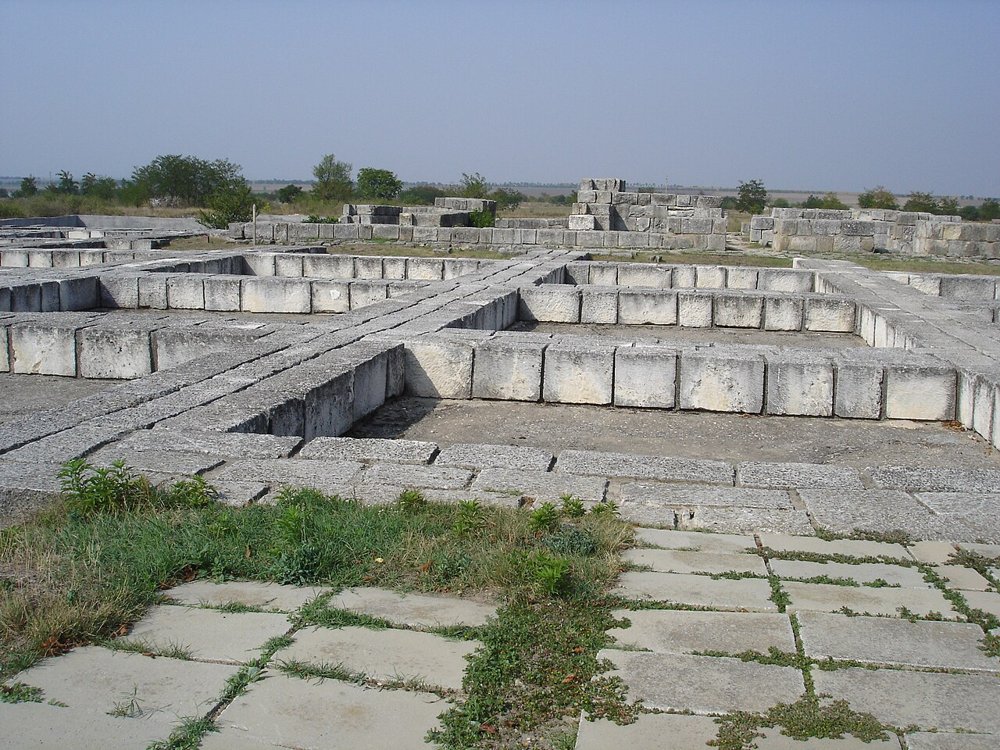
The centres of the young realm are impressive and are readily over-interpreted. Pliska, with its outer earthen rampart, encloses an area of some twenty-three square kilometres, at whose centre lies a stone inner fortress of about forty-eight hectares. This is less a city in the Mediterranean sense than a fortified zone of lordship containing islands of settlement. Preslav became the second capital at the end of the ninth century and is famous for its painted architectural ceramics. Pliska also produced a bronze rosette with seven rays, found in 1961, thirty-eight millimetres across and inscribed with signs of the so-called Murfatlar type; its meaning remains unresolved, with readings ranging from amulet to harness fitting to prayer or oath formula. Finally there is the Madara Rider, a UNESCO World Heritage site since 1979, a relief cut high into the rock face and surrounded by three Greek inscriptions naming Tervel, Krum and Omurtag.
The Seven Tribes are never named in any source. Every list of seven tribal names circulating online or in popular books is a modern construction. Whether the seven is even a count, rather than a formula or a collective label, is unresolved. Whether the Slavs were subjugated or concluded an alliance turns on a single verb in Theophanes and is read in opposite ways; the source is Byzantine and committed to a scheme of rule and submission. The Madara Rider is neither securely dated nor securely interpreted: Tervel, Krum and Omurtag have all been proposed, the inscriptions were added afterwards, and the monument belongs to the Bulgar rather than the Slavic visual tradition. The origin of the name Bulgars is unresolved; the popular derivation from a Turkic verb meaning to mix is a nineteenth-century hypothesis. The Balkan Severi share their name with the East Slavic Severians on the Dnieper, but a connection is not thereby proved. And finally: direct lines from these early medieval groupings to present-day nations are politics of history, not evidence. The subject remains contested in south-eastern Europe; we report the state of the sources and take no national position.
The decisive change happened over the following two centuries, and it happened quietly. A numerically small ruling stratum speaking a Turkic language faced a Slavic-speaking majority. In the end the whole realm spoke Slavic. Two political decisions accelerated this: the Christianisation under Boris I, who was baptised in 864/865 and took the name Michael, and the reception from 886 onward of the disciples of Cyril and Methodius, expelled from Moravia. In the schools of Ohrid and Preslav the Cyrillic script developed out of the Glagolitic model, and under Boris's son Simeon, who ruled from 893 to 927, Old Bulgarian became the language of church and administration. The military arrangement of 680 had become a people with its own script and its own literature. Comparable but very differently shaped paths were taken by the groupings in the east, such as the Tivertsi, the Ulichi and the Dulebes, who were absorbed into the world of the Kievan Rus, and in the north by the Obotrites, Sorbs and Pomeranians.
We are a small family workshop in Alsdorf and we work with a laser and slate, not with manuscripts. But anyone who cuts signs into material ought to know what he is cutting, and ought to be able to tell what has been handed down from what somebody added later. With the Seven Tribes the difference is unusually easy to see: a single sentence by a foreign chronicler on one side, an entire national image on the other. We prefer to stay with the sentence.

The Serbs · The Croats · The Carantanians · The Severians · The Rus (Kiev).
