 Few early Slavic peoples have a record as famous and as thin as the Dulebes. A single drastic passage in the Rus Primary Chronicle made them unforgettable: Avar lords yoking Slavic women to their carts, and a proverb still alive in Russian today. Let us follow the story, separate evidence from interpretation, and see what linguistics and the spade actually deliver.
The Dulebes — Old East Slavic Дулѣби, Ukrainian Duliby, Czech Doudlebi, in scholarship also Dudlebi — belong to those early Slavic groupings about whom we know too little to fill a book and too much to ignore. They appear as one of the tribal unions of the Slavs between the sixth and the tenth centuries. What remains of them is a few lines in a chronicle written down roughly five hundred years after the events it describes, a handful of place names scattered across Central Europe, and a proverb. That is little. But it is an honest little, and precisely for that reason it repays close reading: the Dulebes show, as if in a teaching example, how early medieval history is made — out of memory, out of literature, out of names in the landscape and sherds in the ground, which rarely tell the same story.
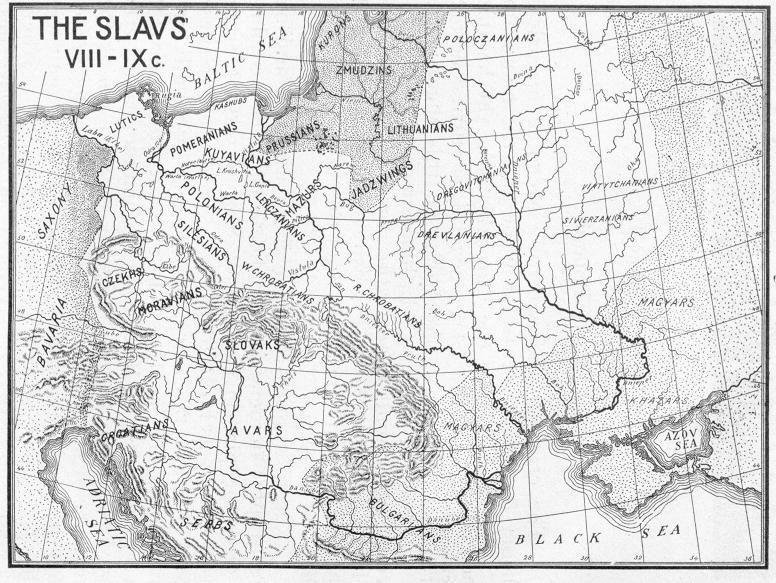
The Primary Chronicle places the Dulebes clearly: they sat along the Bug, where the Volhynians are now to be found. The river meant is the Western Bug, so the region of present-day western Volhynia in north-western Ukraine, reaching into eastern Poland and southern Belarus. This is a landscape of river valleys, forest edges and marshland, where settlements string themselves along watercourses — and at the same time a hinge between the Carpathian region, the Vistula basin and the Dnieper. Whoever lived here did not live off to one side but on a seam. The chronicle lists the Dulebes in its great catalogue of peoples alongside the other East Slavic groupings, of whom the Polans and the Drevlians later became the best known.
Everything we think we know about the Dulebes hangs on the Povest vremennych let, the so-called Primary or Nestor Chronicle. It was compiled around 1113 in Kyiv; the attribution to the monk Nestor is now regarded as uncertain, and scholarship treats the work as a repeatedly revised compilation. It does not survive in the original: the oldest manuscript is the Laurentian copy of 1377, followed by the Hypatian Codex of around 1425 and further, still younger witnesses. Between the Avar onslaught of the late sixth century and the oldest surviving leaf lie a good seven and a half centuries. That does not void the report — but it forbids reading it as a protocol. What we have is memory that has passed through oral tradition, monastic learning and editorial intent.
The antagonists are called Obry in the chronicle — the Avars. They reached the Carpathian Basin from the Central Eurasian steppe in 567/568 and built there, under their khagan Bayan, an empire that dominated eastern Central Europe for more than two hundred years. Their instruments of power were mounted archers, a tightly organised court, and a network of dependent peoples, among them numerous Slavic groups. For Byzantium they were for decades the most dangerous opponent on the Danube. Their end came from the west: in 791 Charlemagne advanced along the Danube while his son Pippin of Italy attacked from the south-east; in 795/796 the Ring, the khagan's principal seat, was taken and the famous Avar treasure carried westward. The Frankish Avar wars dragged on until about 803.
The one passage that secured the Dulebes their place in memory stands in the undated introductory section of the chronicle. It is short, drastic, and quoted to this day in every account of early Slavic history.
These Obry made war upon the Slavs and harassed the Dulebes, who were themselves Slavs, and did violence to the women of the Dulebes. When an Obre wished to travel, he had neither horse nor ox harnessed, but gave command that three or four or five women should be yoked to his cart and draw him. Thus they harassed the Dulebes. But the Obry were great of body and proud of spirit, and God destroyed them.Primary Chronicle (Povest vremennych let), undated introductory section; own rendering from the Old East Slavic text
Note how the scene is built: it is not merely a report but a moral lesson. The humiliation is described concretely, the arrogance of the masters named, and the closing line supplies the moral outright — God destroyed them. That is the hand of a chronicler looking for meaning in history, not of a war correspondent.
Immediately after the scene the chronicle adds that the Obry all perished, leaving neither heir nor descendant, and that from this a winged phrase arose in Rus: pogibosha aki obre — they perished like the Avars. The chronicler expressly marks it as a saying current in his own day. It counts as one of the oldest proverbial expressions in East Slavic, attested by the eleventh century at the latest, and it still means: vanished without a trace. Historically it fits remarkably well. After the Frankish blow the khaganate disappears as a political force; in ninth-century Frankish sources Avars appear only as subjects. A people becomes a figure of speech — a rare case in which language outlasts rule.
The chronicle does not stand alone. Contemporary Byzantine authors describe the same field of tension, only from the south. Procopius of Caesarea writes in the mid-sixth century that the Sclaveni and Antes are not governed by one man but have from ancient times lived in a popular rule, so that everything of consequence is referred to the community. The Strategikon attributed to the emperor Maurice advises Roman commanders to use every means to prevent the Slavs from uniting under a single ruler — they are numerous, hardy in bearing heat, cold and scarcity, and absolutely refuse to be governed. Menander Protector further reports how khagan Bayan demanded tribute from a Slavic leader and had his envoys killed for their pains; in 578 Bayan campaigned with Byzantine help against these Slavs and burned their settlements.
A western parallel is particularly striking. The seventh-century Frankish Chronicle of Fredegar reports that the Avars came year after year to winter among the Wends, took their wives and daughters, and exacted levies; the Slavic warriors had to march in front and bear the first shock of battle. Out of this oppression grew the revolt in the course of which the merchant Samo rose to become leader of the Wends around 623/624. The resemblance to the Dulebe passage is conspicuous: sexual violence, tribute pressure, an empire that consumes its subjects. Whether the Primary Chronicle drew on a related tradition, whether both go back to a widespread narrative pattern about steppe domination, or whether these are two independent memories of the same regime, remains open and is debated.
The name of the Dulebes does not stick to Volhynia. Cosmas of Prague names in his chronicle (written 1119–1125) a fortified settlement called Doudleby in southern Bohemia, part of the Slavnik lands; the village still exists. In the Pannonian and eastern Alpine region the form Dudleipa recurs: a charter of Emperor Louis II lists Tudleipin among the possessions of Archbishop Adalwin of Salzburg, the Conversio Bagoariorum et Carantanorum (c. 870) mentions a church at Dudleipin built by prince Pribina, a letter of King Arnulf of 891 names a comitatus Dudleipa, and as late as 1060 a Dulieb appears on the upper Drava. Geographically this leads into the country between Bad Radkersburg and Leibnitz on the Mur, into the neighbourhood of the Carantanians. Further names of this type occur in Poland, Slovenia, Croatia, Bosnia and Serbia — where the Serbs and Croats later become visible.
The origin of the name is disputed. The Polish chronicler Jan Długosz helped himself in the fifteenth century to an eponymous ancestor called Duleba — a typically medieval solution of no historical value. What deserves serious attention is the proposal of Oleg Trubachyov, who derives Proto-Slavic *dudlěbi from a West Germanic *daud-laiba-, roughly inheritance of the deceased or land left behind by the dead. That would suit a situation in which Slavic groups moved into regions previously abandoned by Germanic populations. If the derivation is right, we have here the remarkable special case of a Slavic ethnonym with a Germanic etymology. Valentin Sedov combined this with the assumption that the Dulebes originally lived near West Germanic territory in the orbit of the Przeworsk culture and later belonged to the Prague-Korchak culture. None of these reconstructions can be proved.
The soil of Volhynia yields a clear picture for the sixth and seventh centuries, only not an ethnic one. Characteristic is the Prague-Korchak culture: unfortified settlements beside water with usually eight to twenty farmsteads, rectangular semi-subterranean pit houses with a stone oven in one corner, handmade undecorated pottery in the form of tall pots with a truncated conical body, and cremation as the dominant rite, in flat graves as well as under mounds. Add to this individual fortified sites such as the hilltop settlement of Zimno on the Bug, investigated since the 1970s. One is tempted simply to assign all this to the Dulebes. That is exactly the temptation to resist: an archaeological culture is a distribution map of find types, not a tribe. Pots travel, people change their names, and no sherd tells us what its owners called themselves. Comparable caution applies to the later Sorbs and other West Slavic groupings.
The chronicle itself supplies the resolution: the Dulebes do not vanish, they are renamed. On the Bug appear the Buzhans, whose name simply means the river; out of them in turn come the Volhynians, named after a place and a region. The so-called Bavarian Geographer of the ninth century credits the Busani with 231 strongholds — a figure to be read as an order of magnitude, not a census. For the year 907 the chronicle lists Dulebian troops in Oleg's army before Constantinople, and in 981 Vladimir subjugated the region for good when he took Peremyshl, Cherven and other towns from the Lyakhs. With that Volhynia becomes part of Kievan Rus, as the land of the Krivichs had before it. The tribal name becomes the name of a land, and the land becomes a principality.
What remains is a name reaching from Volhynia to Styria, a story of oppression that nobody forgot, and a proverb about empires that vanish without a trace. That is a surprising amount for a people with no writing of their own, no chronicler of their own, and not a single find that can be assigned to them with certainty. Some of it is history, some of it literature, and the honest answer consists in keeping the two apart rather than filling the gaps with fantasy. That is exactly how we treat our motifs in the workshop in Alsdorf: we engrave what can be documented and say plainly where interpretation begins. A laser-engraved piece carrying an honest story lasts longer than one telling an invented one.

The Rus (Kiev) · The Polans · The Drevlians · The Carantanians.
