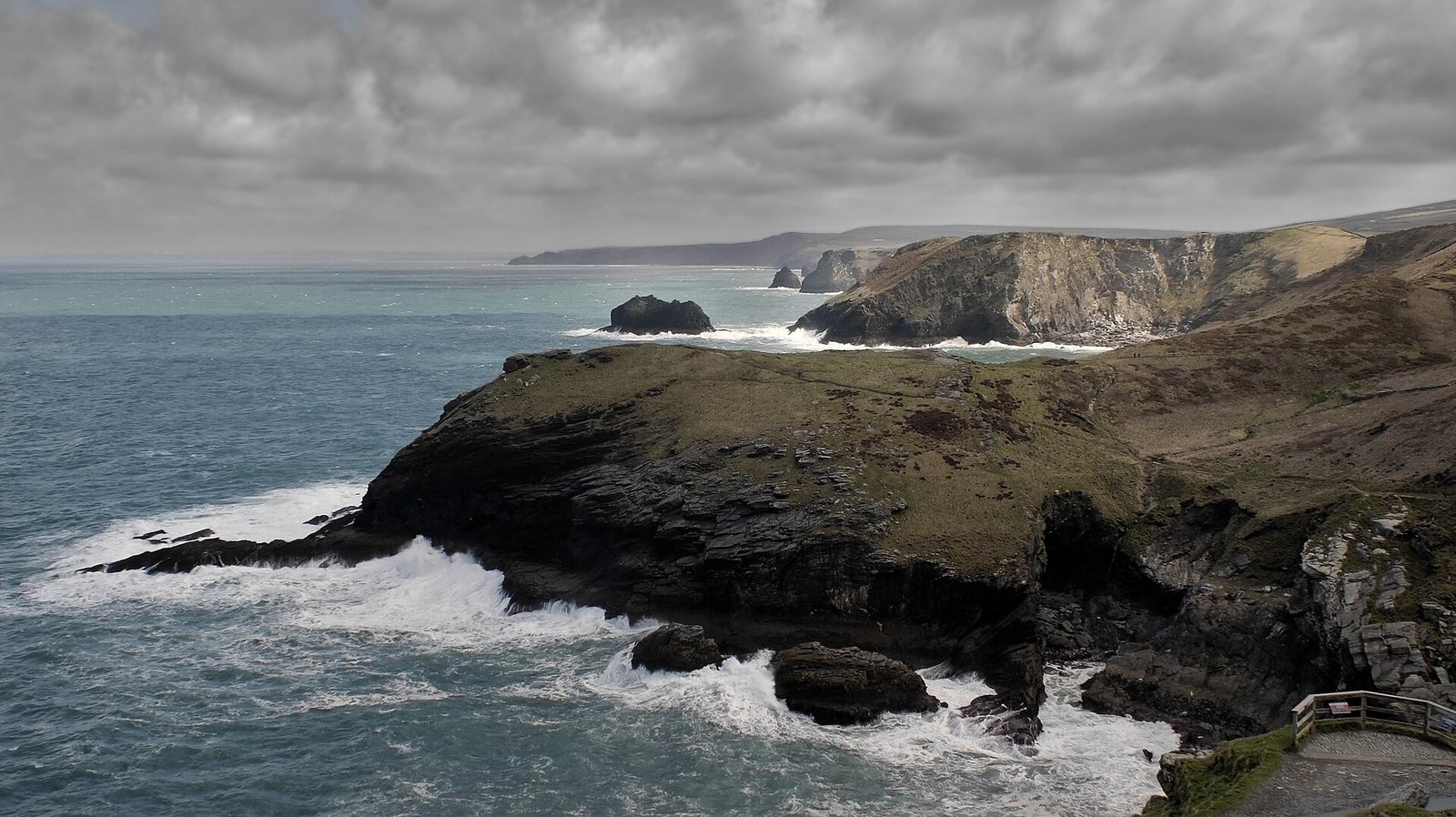
The Dumnonii were a Celtic people in the far south-west of Britain – in today's Cornwall and Devon (whose name derives from them).
"The inhabitants of the headland Belerion … dig the tin and skilfully work it."after Diodorus, Library 5 (public domain, own translation)
The Dumnonii lived on the far south-western tip of Britain – in today's Cornwall and Devon. Their land, called Dumnonia by the Romans, was a peninsula of moors, cliffs and tin veins, far from the power centres of the south-east. This peripheral position shaped their history for centuries.
The region became famous for its tin. The ancient author Diodorus describes how the inhabitants of the Belerion peninsula won the metal and brought it to an island called Ictis, where traders bought it. Tin was the raw material without which there was no bronze – and Britain was one of its most important sources.
From Ictis the tin travelled through Gaul to the Mediterranean, to Massalia (Marseille) and beyond. Thus distant Cornwall was part of a Europe-wide trade network long before the Romans. The wealth of the Dumnonii rested on this grey metal that held the ancient world together.
When Rome conquered Britain, the south-west stayed on the margin. There were hardly any Roman-style towns, hardly any villas – life went on in native roundhouses and farmsteads. The Dumnonii kept more of their Celtic character than the Romanised tribes of the east.
For that very reason British culture survived here when Rome had long gone. In the early Middle Ages the Christian kingdom of Dumnonia lived on; places like Tintagel attest an elite with long-distance trade contacts to the Mediterranean – an echo of the old tin routes.
The Dumnonii have not vanished – their name lives on. From Dumnonii came the county of Devon, while neighbouring Cornwall as Kernow preserved its own Celtic language into modern times. A people at the end of the world whose legacy still stands on the map.
The Dumnonii link two worlds: the rugged Cornwall of cliffs and moors and the wide net of ancient trade that carried their tin to the Mediterranean. That their name lives on in "Devon" and their land in "Kernow" to this day makes them tangible. Such stories of trade, craft and persistence we at GLANZ & GRAVUR like to tell – from the sources rather than from fantasy.
The Dumnonii lead to the western end of the Celtic world. Continue with the Silures and Veneti.

The Britons · The Silures · The Veneti · The Celtic Warriors · The Atrebates.
