 Where the great rivers of Eastern Europe rise close together sat a powerful East Slavic league: the Krivichs. At their trading place of Gnyozdovo, Slavic farmers and Norse warriors met.
The Rus founded their realm not in empty space but on the lands of East Slavic tribes. One of the most important was the league of the Krivichs (Old Russian Krivichi). They sat at the heart of the Russian watershed – where the Daugava (Western Dvina), the Dnieper and the Volga rise close together. Anyone who wanted to control the east had to pass through their land. That is exactly why it became one of the key nodes of the Varangian road "from the Varangians to the Greeks".
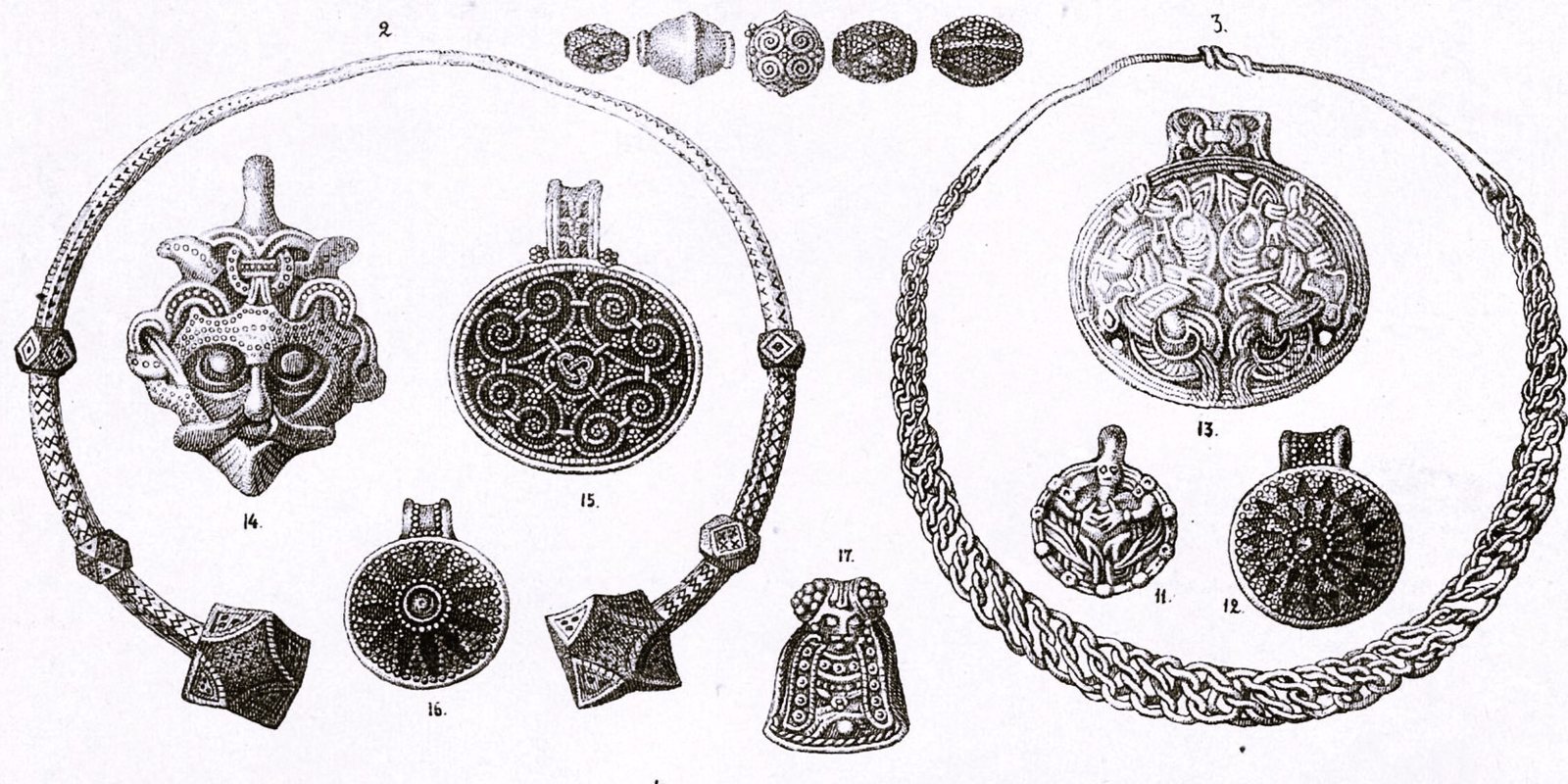
The territory of the Krivichs covered the areas around Smolensk, Polotsk (on the Daugava) and Izborsk/Pskov in the north. Here lay the decisive land bridge of the portages: boats were dragged overland between the river systems to travel from the Baltic to the Black Sea and the Volga. Whoever controlled these transfer points controlled the long-distance trade. Archaeologically the Krivichs are recognisable, among other things, by their characteristic long barrows and by ornament forms such as certain temple-rings that served as a costume marker.
Near today's Smolensk lies one of the largest early-medieval sites in Eastern Europe: Gnyozdovo. At its height in the 10th century the burial ground is estimated to have held several thousand barrows. The finds show a mixed society: Slavic pottery beside Scandinavian brooches, weapons and Thor's hammers, together with Arabic dirhams and Byzantine goods. On one clay vessel was found one of the oldest inscriptions in the Old Russian language. Gnyozdovo is thus a model of the fusion from which the Rus arose – the trading place belonged to the land of the Krivichs but was a meeting point of many peoples.
In the Primary Chronicle the Krivichs appear as one of the tribes involved in the "calling of the Varangians" and drawn early under the rule of the Rus princes. Their town of Smolensk became an important stage on the road from Novgorod to Kiev; Polotsk grew into an independent principality that later at times struggled for independence from Kiev. The Krivichs supplied warriors and merchants for the emerging realm and so became one of its load-bearing peoples.
As with many East Slavic tribes, the tribal name faded with the rise of the principalities and the church: Krivichs became inhabitants of Smolensk, Polotsk and Pskov, and the league became landscape. Yet the name lived on – in Latvian, Russia is still called Krievija and a Russian krievs, named after the once-neighbouring Krivichs. So they are a building block of several nations at once: Russia, Belarus and, through the principalities of Polotsk and Smolensk, the history of the Baltic lands too.
The main written source is the Primary Chronicle (Povest vremennykh let), which, however, was written down only some 250 years after the early events and survives only in later copies – its early dates must be read with caution. The counterweight is provided by archaeology: Gnyozdovo, the long barrows, coin hoards and settlement finds allow a picture independent of the texts. Where chronicle and find meet, the history becomes reliable; where only the chronicle speaks, we mark it as interpretation.
Out of the land of the Krivichs grew Polotsk, one of the earliest and most independent principalities of the Rus. The chronicle tells of Prince Rogvolod and his daughter Rogneda, whom the young Vladimir took by force as his wife after slaying her father – a dark episode showing how the Rus princes brought the old tribal centres under their control. What the north needed was traded: furs, wax, honey and slaves went downstream, Arabic silver and Byzantine goods upstream. The Krivichs sat at the switch-point of this flow – rich, contested and indispensable.
The material culture of the Krivichs is grasped above all through their graves. Characteristic are the long barrows (Russian dlinnye kurgany), elongated earthen banks in which cremations were laid over generations – a custom clearly distinct from the round mounds of other regions. Added to this are typical costume elements such as certain temple-rings, which served as a female identifying mark and give the Krivichs an archaeological signature of their own. Across their land ran one of the great silver streams of the early Middle Ages: tens of thousands of Arabic dirhams reached the north over the river routes, and the trading places of the Krivichs were a bottleneck of this traffic. The systematic study of Gnyozdovo began in the 19th century and continues to this day – hardly any site shows the fusion of Slavic, Baltic, Finnic and Scandinavian influences as clearly as the heartland of the Krivichs.
The Krivichs belong to those peoples who live on in no single modern state and yet are embedded in several. Out of their centres of Smolensk and Polotsk grew principalities that helped shape the history of Russia, Belarus and the Baltic region; their name survived in the Latvian word for Russia. They were no fringe people but sat at the switch-point of the greatest long-distance trade network of their time, where Norse rowers, Slavic farmers and Baltic and Finnic neighbours met. For the Viking world they are an important building block: without the rivers and portages of the Krivichs there would have been no road from the Varangians to the Greeks, and without that road no Rus. So the Krivichs are a quiet giant of early East European history: almost forgotten, but everywhere in the foundations.
"And the Krivichs, who sit at the headwaters of the Volga, the Dvina and the Dnieper …"after the Primary Chronicle (Povest vremennykh let), public domain, own translation
The Rus (Kiev) · The Ilmen Slavs · Ibn Fadlan & the Rus.
All History & Finds articles →
Without their ships the Vikings would never have become Vikings. The longship was the high technology of its time …
Read more →It is not two centimetres tall and weighs nine grams – and yet it set off one of the most exciting debates in Norse …
Read more →