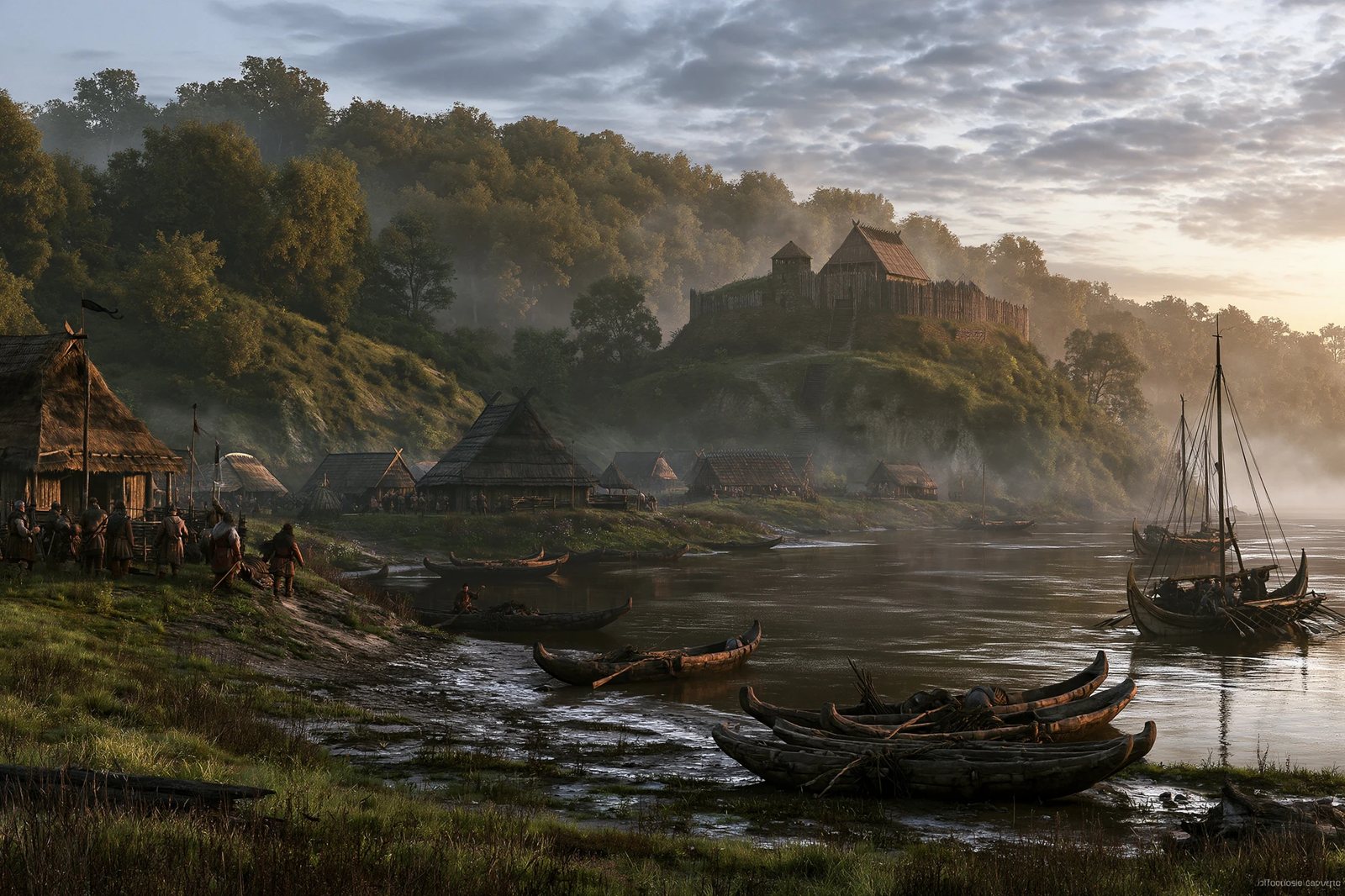
 Tell the story of the origin of Kiev and the Kievan Rus, and there is one East Slavic tribe you cannot pass by: the Polans. The Primary Chronicle calls them the wisest and most respected of the East Slavic peoples – and ascribes to them the founding of Kiev by the three brothers Kyi, Shchek and Khoriv and their sister Lybid. From their land on the middle Dnieper grew one of the great realms of the Middle Ages.
The East Slavs of the early Middle Ages were not a single people but a bundle of related tribes spread across the wide forests and river landscapes of today's Russia, Ukraine and Belarus. Krivichs, Drevlians, Severians, Radimichs, Vyatichi – each sat by its river, in its patch of forest. But one of these tribes was to give the whole region its centre: the Polans, the "people of the fields" on the middle Dnieper, in whose land the city of Kiev arose.
The name "Polans" (Old East Slavic Polyane) derives from the Slavic word pole for "field" – the "people of the open field". Thus they differed from their neighbours already in name: while the Drevlians ("forest people") sat in the dense woods to the north of them, the Polans lived in the more open, more fertile landscape on the right bank of the middle Dnieper, around the later Kiev. It was good farmland on one of the great rivers of Eastern Europe – and precisely this position made them rich and important.
For the Dnieper was more than a river: it was the backbone of the famous trade route "from the Varangians to the Greeks", which ran from the Baltic across the Russian rivers to Byzantium. Whoever sat on the middle Dnieper sat on the main artery of East European long-distance trade – between the north with its furs, slaves and Scandinavian silver, and the rich south with Constantinople, silk and gold.
Our main source for the Polans is the Primary Chronicle (the "Tale of Bygone Years"), compiled in Kiev in the early 12th century. It hands down the famous founding legend of the city. According to it, three brothers lived among the Polans – Kyi, Shchek and Khoriv – and their sister Lybid. Each sat on one of the hills above the Dnieper. The eldest, Kyi, gave the city its name: Kiev (Kyiv) means "(the city) of Kyi".
And there were three brothers: the one named Kyi, the second Shchek and the third Khoriv, and their sister was Lybid … and they built a town and named it after the eldest brother Kiev.Primary Chronicle / Povest vremennykh let (paraphrased)
The chronicle stresses that Kyi was no mere ferryman, as some claimed, but a prince who even travelled to Constantinople and was honoured there by the emperor. Such details show how much the chroniclers of the 12th century wanted to endow their city and its founding tribe with dignity. Whether Kyi really existed is unprovable – the legend was written down centuries after the alleged events.
The Primary Chronicle also tells how the Polans came under pressure after the death of the brothers. The mighty realm of the Khazars – a steppe people with a great khaganate to the south – demanded tribute from them. The Polans, so the chronicle, then gave "a sword from each hearth". The Khazar elders are said to have regarded the sword – a double-edged weapon – with concern: their own tribute, received from other peoples, were single-edged sabres; a people that paid double-edged swords would one day take tribute from the Khazars themselves.
This sword anecdote is a typical chronicle foreshadowing: it announces that the Polans, and the Rus growing out of them, would one day defeat the Khazars – which indeed happened, when the Kievan prince Svyatoslav shattered the Khazar realm in the 10th century. Whether the scene ever happened is unimportant; it shows how the chronicle tells the rise of the Polans as predestined.
The decisive change came with the Varangians – Scandinavian warriors and traders who dominated the Russian river routes in the 9th century. According to the chronicle the princes Askold and Dir, then Oleg of Novgorod, went down the Dnieper and made Kiev the centre of their rule. Oleg is said to have declared that Kiev should be "the mother of the cities of the Rus". From the land of the Polans thus grew the heart of the Kievan Rus – that realm in which Norse Varangians and Slavic tribes merged into a new power.
In this process the Polans lost their contour as a separate tribe. Their name disappears from the sources because it was no longer needed: the people on the middle Dnieper were now no longer "Polans" but "Rus" – members of the Kievan realm. Just as the individual tribes dissolved into a larger political union, so too the tribal name dissolved into the name of the realm.
The chronicle draws the Polans with striking sympathy – and that is no accident. It was, after all, written in Kiev, in the old land of the Polans. Therefore the Polans appear especially civilised: they are said to have had "quiet and gentle customs", reverence for their kin, ordered marriages. Quite differently the chronicle depicts the neighbouring tribes – the Drevlians, for instance, are said to have lived "bestially", without proper marriage, killing their dead in feuds. The Radimichs, Severians and Vyatichi are said to have dwelt in the forests.
This contrast is no neutral ethnography but self-praise of the Kievan centre: the chronicle's own ancestors, the Polans, are presented as the civilised core out of which the realm rightly grew, while the neighbours count as crude. One must therefore read these judgements with caution – they say more about the perspective of the chroniclers than about the actual customs of the tribes.
Of all the East Slavic tribes the Polans left the most lasting trace: not in a surviving name as with some Germanic or Celtic tribe, but in a city that is among the oldest and most important of Eastern Europe. Kiev, founded in the land of the Polans, became the "mother of the cities of the Rus", the religious centre after the baptism of 988, the starting point of East Slavic history to which Ukrainians, Russians and Belarusians still refer today.
So the Polans are more than one tribe among many. They are the ground on which one of the great cultures of Europe grew – and another example of how, out of a small people of the fields by the river, through trade, legend and the merging with Norse warriors, a realm could arise. At GLANZ & GRAVUR we tell such Slavic roots just as honestly as the Germanic and Celtic ones: with a clear eye for what the sources say, and for what remains legend. Thus the Polans round off the East Slavic branch of our history of peoples – the people of the fields, from whose earth Kiev grew.

The Rus (Kiev) · The Drevlians · The Radimichs · The Severians.
All History & Finds articles →
Long before there were Germanic peoples – some 4,300 years ago – people in today’s Saxony-Anhalt raised a vast ring of …
Read more →