 A people who resisted the Kievan Rus longer than almost any other, and about whom we barely know where they lived. The Ulichi left no town that can be excavated and no name that can be securely explained. What remains of them is a handful of lines in a chronicle and a very long argument among scholars.
Anyone working through the East Slavic tribes sooner or later runs into a name that never sits in the same place on two maps: the Ulichi, in Old East Slavic uliči or ugliči. Sometimes they are placed on the lower Dnieper, sometimes between the Southern Bug and the Dniester, sometimes along the Black Sea coast. This is not carelessness on the part of modern cartographers. The uncertainty is already in the sources.
The Ulichi belong to the peoples listed in the Primary Chronicle's catalogue of the Slavs, alongside the Polianians, the Derevlians, the Severians and the Radimichi. Unlike those, they never became the core of a principality. They appear in the record almost exclusively when they are at war with Kiev, and they vanish from it as soon as that war is decided.
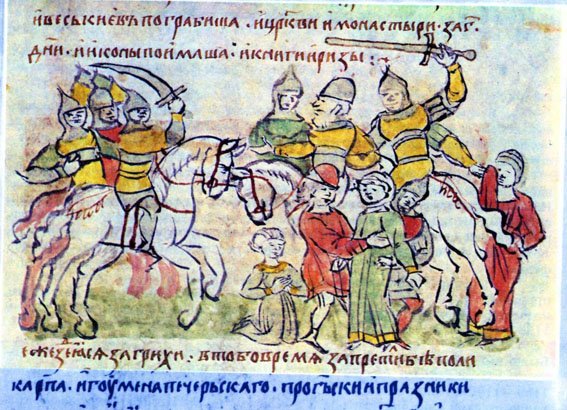
The manuscripts themselves could not agree. The chronicles write uliči, ugliči, uluči, ulučiči, ulutiči, ulcy, lutiči. Vasily Tatishchev already connected the name with the river Orel, a left tributary of the Dnieper: under the year 1183 the Hypatian Chronicle states explicitly that the Rus call that river Ugol, meaning corner or angle. Aleksei Sobolevsky preferred ulučje, the bend of a river.
Twentieth-century linguistics settled on the first line of argument. Valentin Kiparsky and Oleg Trubachev derive the name from Proto-Slavic uglъ, the corner. Trubachev went further and explained the form uliči as a Turkic rendering of an older ugliči, which presupposes that Slavic and Turkic-speaking neighbours lived side by side here for a long time. The derivation from ulica, meaning street, which is popular in general-interest writing, has no support in the specialist literature. A minority view connects the variant lutiči with the West Slavic Liutizi and reads the name totemically as a wolf name. That is attractive and unproven.
Everything we believe we know about the Ulichi comes from a single textual family: the Kievan chronicle tradition, accessible through the Povest vremennykh let and the Novgorod First Chronicle. In the form we read them, these were compiled around 1113 and later still. The oldest surviving manuscripts are the Laurentian Codex of 1377 and the Hypatian Codex of about 1425.
Between the events of the ninth and tenth centuries and their writing down lie 150 to 250 years; between the writing down and the surviving copies, another two to four centuries. Reading these texts means reading the past as twelfth-century Kiev wanted it arranged. That does not make the notices worthless. It only forbids treating them as a protocol.
The famous sentence of the tribal catalogue reads, in the Laurentian Codex: the Uluchi and the Tivertsi sat along the Dniester and reached as far as the Danube; there were many of them; they sat along the Dniester as far as the sea, and their strongholds stand to this day. On that basis the Ulichi are mapped west of the Dniester, and that is exactly how countless atlases show them.
But the Hypatian Codex has the Dnieper here instead of the Dniester, and other manuscripts read along the Bug and along the Dnieper. Either a copyist made a mistake, or an older version meant something different from a younger one. Which reading is original cannot be decided. The same uncertainty affects the Tivertsi, who are named in the same sentence.
The oldest notice about the Ulichi belongs to the period before Oleg. In the textual strand preserved in the Novgorod chronicle, Askold and Dir are said to have ruled in Kiev over the Polianians and to have been at war with the Derevlians and the Ulichi. If that sentence is old, the Ulichi at that time were not on the distant Dniester but within reach of Kiev.
Following the entry for 885, in which Oleg subdues the Radimichi, the chronicle takes stock: Oleg ruled over the Polianians, the Derevlians, the Severians and the Radimichi, but with the Ulichi and the Tivertsi he was at war. That is a strikingly honest note. It says that here the grip of the Kievan apparatus closed on nothing. Consistently enough, the Ulichi are absent from the muster of Oleg's campaign against Byzantium in 907.
That the Ulichi are not an invention of later Kievan monks is secured by an independent source. In De administrando imperio, written between roughly 948 and 952, Emperor Constantine VII Porphyrogenitus describes the four Pecheneg districts beyond the Dnieper. Of the district of Iabdiertim he says that it is neighbour to the tributary territories of the country of Rus, to the Ultines, the Dervlenines, the Lenzenines and the rest of the Slavs.
The Dervlenines are unquestionably the Derevlians. The Ultines are generally identified with the Ulichi. That gives us a contemporary, non-Slavic witness placing the Ulichi in the same neighbourhood as the oldest Kievan textual layer: on the steppe frontier south of the Derevlians, not on the distant Dniester. They may also appear in the tenth-century Hebrew Josippon, listed between Khazars, Pechenegs and Bulgars, though that identification is old and uncertain.
A third text is frequently quoted: the Descriptio civitatum et regionum ad septentrionalem plagam Danubii, the so-called Bavarian Geographer of the ninth century. Its list contains the entry Unlizi populus multus civitates CCCCXVIII, a numerous people with 418 strongholds; some renderings read 318.
Two reservations belong with it. First, the equation of Unlizi with the Ulichi is a conjecture and nothing more; the list contains dozens of names that nobody can assign with confidence, among them the wholly obscure Vuizunbeire, which is occasionally dragged into the discussion without any argument to support it. Second, the stronghold figures in this list are schematic. They run to well over five hundred and describe an impression of size rather than counted ramparts. Turning that single line into an empire of 418 fortresses is a misreading of the source.
The densest notice about the Ulichi stands not in the Primary Chronicle but in the younger recension of the Novgorod First Chronicle, in the undated section that goes back to an older Kievan text. Prince Igor, it says there, sat in Kiev and made war on the Derevlians and the Ulichi.
And he had a commander named Sveneld; and he subdued the Ulichi, laid tribute upon them and gave it to Sveneld. And one single stronghold did not surrender, named Peresechen; and he sat around it for three years, and took it only with difficulty.Novgorod First Chronicle, younger recension, Commission copy; Old East Slavic: „И бѣ у него воевода, именемь Свѣнделдъ; и примучи Углѣчѣ, възложи на ня дань, и вдасть Свѣньделду. И не вдадяшется единъ град, именемъ Пересѣченъ; и сѣде около его три лѣта, и едва взя." Own translation from the edition by A. N. Nasonov, Moscow and Leningrad 1950.
Three years in front of a single stronghold is an enormous figure by tenth-century standards. Sieges of that length are barely attested anywhere in eastern Europe at the time. Whether the number reports a real duration or is a narrative formula for exceptional stubbornness cannot be decided.
The place has never been identified. In 1844 Nikolai Nadezhdin pointed to the village of Peresecina, some 26 kilometres from Orhei in present-day Moldova, and almost every historian followed him, including Nikolai Barsov, the founder of Russian historical geography. But archaeological survey around Moldovan Peresecina has produced no trace of an Old Rus town.
Boris Rybakov argued in 1950 for the opposite: the Peresechen of the first half of the tenth century must have lain in the Dnieper basin south of Kiev. A place of that name appears there in the events of 1154 and in the list of Rus towns compiled at the end of the fourteenth century. The whole question turns on a circle: whoever places the Ulichi on the Dniester looks for Peresechen there, and the other way round. It is also possible that two places carried the name.
The annalistic part of the Novgorod chronicle assigns the events to specific years. Under 940: in this year the Ulichi submitted to tribute to Igor, and Peresechen was taken; in the same year he gave their tribute to Sveneld. Under 942: he gave the same Sveneld the Derevlian tribute as well. Under 945: the retinue complains that Sveneld's men are equipped with weapons and clothing while they themselves go bare. Igor then goes to the Derevlians a second time, and is killed.
So the most famous death in the early history of the Rus hangs on the subjugation of the Ulichi. Two entire tribute districts had been assigned to a single man, and the retinue that had been passed over drove its prince into the overreach that killed him. Whether the chroniclers found this connection or constructed it is an open question; as narrative it is built rather too well not to raise suspicion.
These year numbers, however, are not reliable in the slightest. The same Novgorod manuscript dates Igor's campaign against Constantinople to 920 and Oleg's to 922. Byzantine sources fix the first to 941 and the second to 907 and 911. The early chronology of this chronicle is therefore demonstrably displaced by decades. The year 940 for Peresechen is nevertheless quoted routinely as a date in the literature. It is a convention, not a measurement.
Immediately after the siege notice comes the sentence that could explain the entire geography of the Ulichi: they had sat down along the Dnieper, and afterwards they came between the Bug and the Dniester and settled there. If that is accurate, a people moved west ahead of Kiev's grip and ahead of the Pechenegs, and the contradictory locations in the manuscripts would not be an error at all, but the memory of two different moments in time.
Aleksei Shakhmatov, and Rybakov after him, argued precisely along those lines. In this reconstruction the Ulichi originally sat at the bend of the Dnieper, withdrew northwards under pressure from the steppe, lost Peresechen and then moved into the forest-steppe on the Southern Bug, where they became neighbours of the Tivertsi and the Dulebians.
Archaeologically the Ulichi cannot be caught. The sites in the Dnieper, Bug and Dniester region belong to the Prague-Penkovka tradition and its successor, the Luka-Raykovets culture of the eighth to tenth centuries, which extends from the eastern Carpathian region to the middle Dnieper. Nothing in that material culture distinguishes one stretch of land from another. Dmitri Berezovets assigned the Slavic sites of the Tyasmin basin to the Ulichi in 1963, and Petro Khavliuk pointed in 1969 to the numerous hillforts on the Southern Bug whose lower layers belong to the tenth century.
Both are assignments made out of the chronicle, not findings out of the soil. Valentin Sedov said so plainly: no territory of the Ulichi can be outlined on archaeological criteria. The ring-forts of the Echimauti and Alcedar type on the Dniester are usually attributed to the Tivertsi instead.
A people of this name existed and was hostile to Kiev: that is attested by the oldest Kievan textual layers and, independently, by Emperor Constantine VII around 950 with his Ultines. The narrative structure of the chronicle is also secure as a text: Sveneld subdues the Ulichi, receives their tribute and later the Derevlian tribute as well, and the resentment this produces in the retinue leads into Igor's death. Almost everything else is not secure: not the meaning of the name, not the location of the settlement area, not the site of Peresechen, not the year 940, not the three years of siege.
Peresechen is routinely called the „capital of the Ulichi" in popular accounts and located at the Moldovan village of Peresecina. The chronicle calls it only a stronghold that would not surrender, and excavation near Peresecina has produced no Old Rus town. A second common error: the Ulichi are often described as the tolkoviny, the interpreters in the Rus muster. That word stands in the Primary Chronicle in the entry for the campaign of 907, where it refers to the Tivertsi and not to the Ulichi, who are not mentioned in 907 at all. Igor's muster of 944 likewise lists the Tivertsi, not the Ulichi. And the 418 strongholds of the Bavarian Geographer are a schematic figure from a list in which other peoples are credited with more than five hundred.
After the middle of the tenth century the chronicles fall silent about the Ulichi. What happened in those decades can only be sketched. The Pechenegs controlled the steppe north of the Black Sea, the trade route to Byzantium had to be secured under arms, and the forest-steppe between the Bug and the Dniester became a corridor. A people that had lost its strongholds, changed its land and had to deliver its tribute to a foreign commander stopped appearing as an entity of its own.
It did not die out. It was absorbed: into the population of the Bug and Dniester region, which later fell within the orbit of Halych, and into the Kievan Rus, whose chroniclers listed the tribes only as prehistory. The transformation of tribes into landscapes is the normal course of these centuries; with the Ulichi it simply succeeded unusually completely.
A name whose meaning is disputed. A stronghold nobody has found. Three years of siege nobody can verify. And a tribute grant that cost a prince his life. That is little, and it is more honest than the maps that give the Ulichi a neatly bounded territory.
The value of the case lies precisely there. The Ulichi show how thin the foundation is on which the tribal map of early eastern Europe rests, and how much work sits between one line of chronicle and one coloured area in an atlas. Anyone who has thought that through on a single example will read the chapters on the large, well-documented tribes differently too.

The Tivertsi · The Drevlians · The Polans · The Rus (Kiev) · The Severians.
All History & Finds articles →
On a field south of Lund, where today only a small church stands, lay for almost a thousand years one of the largest …
Read more →No place stands more for the pagan cult of the North than Gamla Uppsala: the golden temple, the great sacrifice every …
Read more →