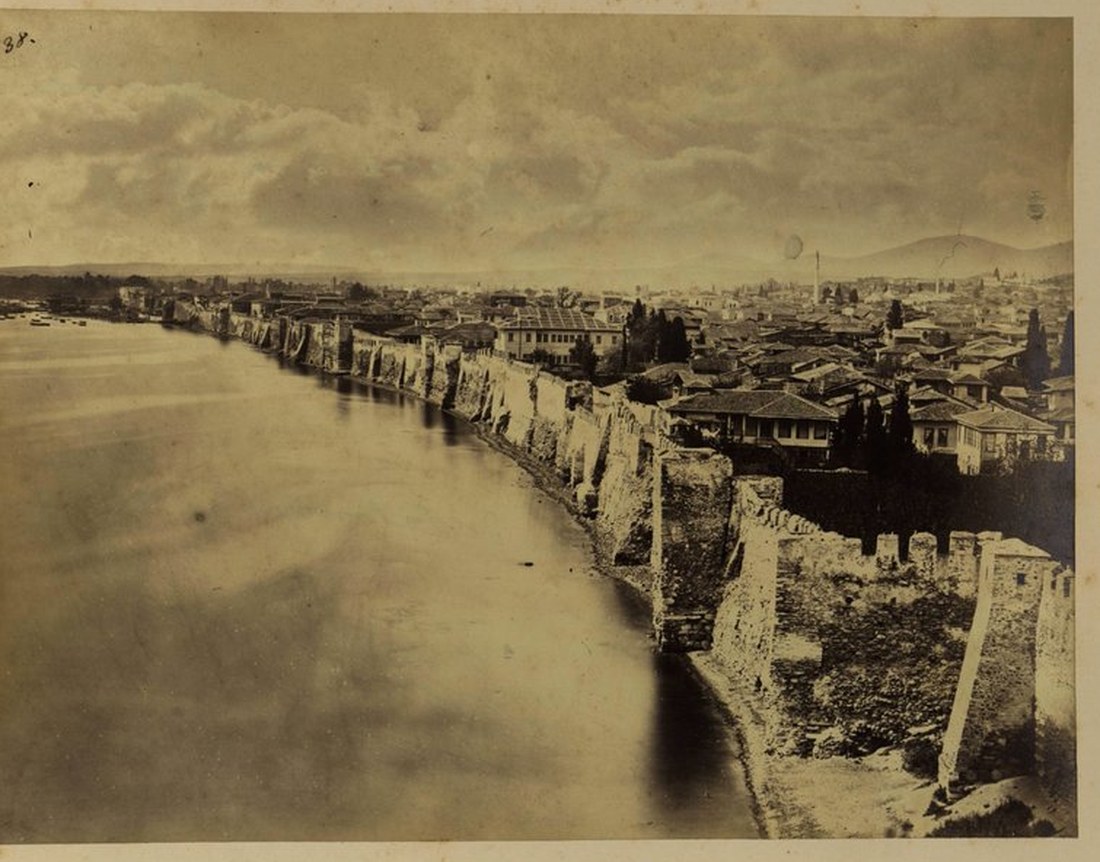
There are peoples we know everything about, and peoples of whom we know a name. The Sagudates belong to the second kind. They enter recorded history as a single word in a list, written down in a Greek manuscript by people who encountered them as enemies. And yet this thin record carries a story one would not expect: inland people who learned the sea. Men who hollowed out tree trunks, stretched planks and hides across them, and used them to attack one of the largest cities of the eastern Mediterranean from the water. The Sagudates appear twice in the same book of miracles, roughly sixty years apart, and both times there are ships beside them. This article asks what the source says, what has been inferred from it, and where scholars still disagree.
The Sagudates – Greek Σαγουδάται, Latin Sagudates – appear for the first time in a series of five names. They stand there among other groups, without explanation, without any statement of origin, without a word about what they called themselves. Whoever wrote the text assumed that his readers in Thessalonica knew who was meant. We no longer do.
That is the starting point for everything that follows. The Sagudates are not a people whose history we can narrate. They are a name surrounded by a small number of observations, all from the same pen, all from the perspective of a besieged city. What we can say about them is less a history of a people than a working report on how much can be drawn from a few lines – and where those lines stop bearing weight.
One clarification first, not self-evident in south-eastern European subjects but necessary: early medieval groups are not identical with modern nations. No straight road runs from the Sagudates of the seventh century to any modern state. Drawing such a line is contemporary politics, not history. This article does not draw it.
The source is the Miracula Sancti Demetrii, the miracles of Saint Demetrius. Demetrius was the patron saint of Thessalonica, and the collections transmitted under his name relate how he saved his city again and again. Two collections survive: the first is by Archbishop John and was composed in the early decades of the seventh century; the second is anonymous and was probably assembled in the 680s. The Sagudates occur in the second.
One has to be clear about what kind of text this is. A book of miracles pursues a theological purpose. It sets out to show that the saint is powerful and that the city stands under his protection. Every defeat suffered by the attackers is evidence in this text, every deliverance an argument. The author is not a chronicler recording events for posterity but a preacher instructing his congregation.
Even so, this book is simply irreplaceable for the history of the Balkans in the seventh century. The remaining record is largely silent. Anyone who wants to know what happened around Thessalonica between 600 and 700 cannot avoid the miracles of Demetrius – and must at the same time examine every line to see whether it observes something or is trying to prove something.
We owe the text in its present form to Paul Lemerle, who published a critical edition in 1979 and added a separate commentary volume in 1981. Only this edition made the miracles of Demetrius a usable historical source. An important practical point: Lemerle's French translation and the modern English renderings are protected by copyright. What may be quoted freely is the Greek wording itself; all translations in this article are the author's own free renderings.
Harder than the text is the chronology. The author almost never names a year. He dates by indictions, that is, by position within a fifteen-year tax cycle, and that alone yields no date. Every year given in the literature for these events is a reconstruction. It should be treated as one.
How far such reconstructions can diverge is shown by the history of scholarship. For the great assault on the city, the years 634, 647, 687/688 and 692 were proposed in the nineteenth and twentieth centuries. Only Lemerle offered an argument that has largely prevailed: on his reckoning the arrest of Perboundos falls in early 676, the blockade begins in the summer of 676, the great assault takes place in July 677, and the affair ends in the summer of 678. So anyone reading "676 to 678" is reading a very well-argued proposal – not a transmitted date.
The first chapter of the second collection carries a heading that already names the theme: it is about the building of ships. A leader called Chatzon gathers a large host, and the text lists the groups it was made up of. The Sagudates stand in second place. The dating varies; the usual figure is around 615, while Greek scholarship also works with a range of 614 to 616.
τὸ τῶν Σκλαβίνων ἔθνος … τῶν τε Δρουγουβιτῶν, Σαγουδατῶν, Βελεγεζιτῶν, Βαϊουνητῶν, Βερζητῶν καὶ λοιπῶν
Miracula S. Demetrii II,1; the spelling of the names varies in the manuscript tradition; own translation
the people of the Sklavenes … namely the Drugubites, Sagudates, Belegezites, Baiunites, Berzites and the rest
That is the entire yield. Five names, an "and the rest", not another word about the Sagudates as such. Everything that books and websites report about this people hangs on this line and on a second passage in the same book, some sixty years later. Anyone claiming more is inferring.
What the text ascribes to this gathering of groups is remarkable: they were the first, it says, to work out how to build a boat from a single hollowed trunk. That is factually wrong – logboats are thousands of years older than the seventh century and attested across half of Europe. But for the author it was new, because it was new for his city. Suddenly there were boats coming out of the hinterland.
The logboat, Greek μονόξυλον, is the simplest serious watercraft there is. A trunk, hollowed, smoothed, tapered at the ends. It requires no sawmill, no rivets, no shipyard, no guild – it requires a large tree, axes, fire and patience. That is precisely why a group with no maritime tradition could put a fleet on the water within a short time.
A logboat is shallow, nimble and dangerously unstable. It sits badly in a swell and forgives no inattention. For rivers, lakes and sheltered stretches of coast it is excellent; for open water it is essentially unsuitable. That it was nonetheless used for sea voyages says less about the boat than about the people in it.
Here lies the real development that can be read out of the text, and it is larger than any battle. A population that came from the land acquired the sea within one or two generations: it learned where one can put ashore, how long one may stay on the water, when the wind turns in the Thermaic Gulf. Knowledge of that kind appears in no source. It shows up in the consequences.
The most interesting technical note in the whole passage concerns not the boat but its superstructure. Those who stayed with the boats, the text says, intended to cover them with timbers and hides in order to protect the oarsmen against stones thrown from the city wall and against missiles. That is no longer a logboat in the plain sense. It is a logboat that somebody has modified for a particular purpose.
The difference is worth stating. A boat carrying goods or warriors only has to float. A boat meant to run in under a defended wall has to let the man at the oar survive while stones come down from above. The step from one to the other is a step from a means of transport to a piece of military equipment, and it presupposes that somebody thought the problem through beforehand.
Later in the same book the account goes further: the boats are lashed together in order to seal off the coast. That too is not an improvised idea but a technique one has to know. Individual trunks become a formation.
The text names a bay called Kellarion where the boats anchored, and it lets three days pass in which they cruise some two miles off the walls and search the shoreline. Only on the fourth day does the attack come. Those three days are narratively pointless and historically revealing: somebody reconnoitred the city from the water.
A harbour city looks different from the sea than from the land. The strong points lie elsewhere, and so do the weak ones. The account itself betrays what the attackers were aiming at: a postern near the church steps, and a stretch where no wall stood but only a palisade and a beam construction hidden in the water barred the way. These are not randomly chosen targets. They are the product of systematic looking.
It was that hidden beam barrier, of all things, that undid the boats. They ran into it, jammed fast and could not be worked free. The author credits this to the saint; a hydraulic engineer would credit it to whoever built the barrier. Both readings stand side by side in the same paragraph, and only one of them is in the text in so many words.
The attack failed. The account describes how the boats ran into one another, capsized, and men in the water hindered each other until the assault became a crush and the crush became a dying. A rising wind scattered the remainder. Descriptions of this kind are a fixed form in siege narratives; how much of it is observation cannot be decided.
Chatzon himself was captured. The text relates that he had consulted an oracle beforehand as to whether he would enter the city, and that he was given an affirmative answer – without being told in what manner. He did get in: as a prisoner. Men of standing hid him out of self-interest; women brought him out of the house, and he was dragged through the city and stoned.
This episode should be read soberly. It is at once a report of a lynching and an edifying tale about the fulfilment of an ambiguous oracle – a motif thoroughly familiar from ancient literature. The author needs it because it carries his message. Whether it happened this way, nobody knows.
The following chapter reports a second and larger siege: the defeated turn to the khagan of the Avars, collect gifts and promise plunder. The khagan comes with an army, with stone-throwers, protective sheds, battering rams and wooden towers. After thirty-three days of unbroken siege a peace is agreed. This event is usually placed in 617 or 618.
For the Sagudates, what matters most here is what is not written: the text does not name them. It speaks generally of Sklavenes, of Bulgars and other peoples under Avar leadership. Anyone writing the Sagudates into this siege is supplementing the source.
The episode is instructive nonetheless, because it shows the balance of force. The groups of the hinterland could press the city but not take it. A regular siege required the khagan – and even he withdrew after a little over a month.
The fourth chapter of the second collection opens with a sentence worth pausing over: the Sklavenes, the neighbours of the city, were keeping the peace. There was, then, a condition in which people lived side by side. It was destroyed not by a raid but by an administrative decision.
Perboundos was ruler of the Rhynchines. He spoke Greek, dressed in Byzantine style and kept a residence in Thessalonica. The city prefect reported a suspicion to the emperor, the emperor ordered his arrest, and Perboundos was sent in irons to Constantinople. What followed is remarkable: Rhynchines and Strymonites, together with envoys from the city, sent a joint embassy to the emperor asking for clemency – not for acquittal. Lemerle rightly stressed how unusual this is. Here neighbours are negotiating with one another, not civilisation with barbarism.
Perboundos escaped with the help of an imperial interpreter, was found after forty days near Bizye, brought back, planned a second escape, and stated openly that if he got away he would raise all the neighbouring peoples against the city. He was then executed. Only this death triggered the war. The text says so unambiguously: from that point on the Strymonites, the Rhynchines and the Sagudates armed against Thessalonica.
Now the Sagudates appear for the second and last time in the miracles of Demetrius – and again in connection with ships. What follows is the only passage in the entire record in which they are assigned a task of their own.
The three groups agreed on a division of the hinterland. The Sklavenes of the Strymon took the eastern and northern side, the Rhynchines and the Sagudates the western or south-western – readings and translations differ here, but the western side is assigned to the Sagudates in every version. And explicitly: the ships were to take the coast jointly. The sea was therefore not the responsibility of a single group but the shared task of all three.
That is more precise than it sounds. A harbour city lives by its seaward side. Blockading it only by land cuts off an arm; occupying the coast as well cuts off its air. The division shows three groups that had coordinated, knew their strengths and were following a plan. Florin Curta has noted that the attackers appear better organised here than in any preceding siege, with dedicated units of archers, slingers and spearmen.
For two years, the text says, three or four thrusts were made against the city every day. Anyone who stepped outside the wall was killed or taken. The harvest lay in the fields, the livestock was gone, seaborne traffic stopped. The author describes a famine and makes no secret of whom he holds partly responsible: his own upper class, which had sold the stored grain to foreign ships just before the blockade began.
Conditions became so bad that citizens defected to the besiegers. The besiegers sold these defectors on into the interior, fearing they had too many strangers in their own camp. It is one of the bleakest passages in the book, and one of the more credible, because it flatters nobody.
The city was finally saved by another Slavic group. The Belegezites, settled in Thessaly on the Pagasetic Gulf, kept peace with Thessalonica and sold grain. The city sent ten ships and everything else that would float, and fetched wheat and pulses. Anyone wanting to turn this siege into a picture of "the Slavs against the Byzantines" has to ignore that voyage.
The absence of the ships' crews was the opportunity. For the decisive assault the besiegers brought in the Drougoubites, a large group north-west of the city with expertise in building siege engines. Lemerle thinks it likely that they supplied essentially the machines and perhaps their crews. The attack began on the twenty-fifth of July of the fifth indiction – by Lemerle's reckoning in 677 – and lasted three days.
Then something happened that the author books as the first miracle: the Strymonites turned back three miles from the city. The text is silent about the reason. That left the Rhynchines and the Sagudates, and these attacked, as it is expressly said, partly from the land and partly from the sea, with many oarsmen. It is the only moment in which the Sagudates stand in the record with weight of their own.
The assault failed. According to the account the saint intervened in person several times, among other things to repel an attack by the Drougoubites on a postern at a place called Arktos – a passage some scholars read as indicating that the attackers briefly got inside the city. On the evening of the twenty-seventh the besiegers withdrew and left the machines behind. It is striking that these machines, for which the Drougoubites had been brought in, play no discernible role in the narrative.
After the failed assault the blockade did not end; it shifted. The text reports that the attackers now turned to the sea, and that they no longer used only logboats but ships capable of sailing in open water. With these they raided the merchant traffic of the northern Aegean, pushed into the Hellespont and reached the Propontis as far as the island of Prokonnesos – a good part of the way to Constantinople.
Measured against the starting point, that is the real finding of this text. Roughly sixty years separate the hollowed trunks of the first chapter from the seagoing ships of the fourth. In that time coastal raiding had become a capability an empire had to take seriously. The author mentions it in passing; it is the most interesting aside in the entire book.
The affair was ended by the emperor. As soon as the Arab threat to Constantinople had passed, an army marched through Thrace against the Strymonites and defeated them, and a grain fleet carrying sixty thousand measures of wheat put in at Thessalonica. The besiegers then asked for peace. What that peace looked like the text does not say.
One often reads that the Sagudates lived between Thessalonica and Berroia. That sounds more definite than the evidence allows. Lemerle himself writes that their territory is unknown; as a plausible location on the evidence of the sources he names the area west of the Axios. The familiar statement is an inference from the division of tasks during the siege, not an independent testimony. Toponymic evidence pointing unambiguously to this name is not known to me.
Still more caution is needed with the name itself. "Sagoudatai" has no accepted derivation. The form does not look like a clearly Slavic name, and Lemerle even considered a non-Slavic origin conceivable for the group, which later merged into its Slavic-speaking surroundings. Derivations from place names circulate; none of them is secure. When one does not know where a name comes from, one should say so rather than guess.
On archaeology one can be brief: there is no site that can be assigned to the Sagudates. This is not a failure of research but a methodological limit. An archaeological culture is not a people. Sebastian Brather has shown how fragile ethnic interpretations of early finds are; pottery forms, house plans and brooches denote craft traditions and contact networks, not group names.
The problem is sharpened by a fundamental debate. In The Making of the Slavs Florin Curta argued that "the Slavs" were to a considerable degree a Byzantine ordering category: a name assigned by observers on the Danube frontier in order to label processes they could not otherwise grasp. Group formation on the frontier then becomes, in the texts, a people. His thesis has not gone unchallenged, and the straightforward migration narrative still has its defenders. But the warning is justified, especially for a name like that of the Sagudates, which occurs in a single text.
The collective term "Sclaviniae" should likewise be used with care. It is a Byzantine outside designation and a modern ordering word; the miracles of Demetrius simply speak of peoples. An administrative term for something that never called itself that is not a description of a constitution.
There is a late trace, and it is remarkable. John Kaminiates, who described the capture of Thessalonica by Arab naval forces in 904 as an eyewitness, mentions villages in the city's hinterland whose inhabitants – Drougoubites and Sagudates – pay their taxes to Thessalonica, while others pay tribute to neighbours living further off. He expressly stresses the close commercial relations that benefited both sides as long as things stayed peaceful.
The same text reports that in 904 the defenders stationed the Sklavenes gathered from the surrounding districts on the walls as archers. Drawing the arc from 615 to 904, one sees the same names in three different roles: first as attackers from the seaward side, then as treaty partners and taxpayers, finally as bowmen on the wall of the same city.
Equally instructive is what is missing. For the Drougoubites, integration into the empire can be read off institutions: a bishopric suffragan to Thessalonica, a command district called Drougoubiteia, a lead seal of a fiscal official. For the Sagudates nothing of the kind is known to me – no bishopric, no command district, no seal bearing their name. They appear in Kaminiates as villagers alongside the Drougoubites and then vanish from the record. Missing evidence is no proof of non-existence, but it is a finding.
What is left at the end is a slender but not empty holding. The Sagudates were a group in the hinterland of Thessalonica, traceable under that name between the early seventh and the early tenth century. They belonged to those who acquired the sea. They sustained a blockade for two years, coordinated their tasks with neighbours, and on 25 July 677 spearheaded an assault that came close to succeeding. And two hundred years later people of that name were paying taxes to the city their forebears had tried to take.
That is little compared with what is known about neighbours further afield – about the Ezerites and Milingoi in the Peloponnese, for instance, whose tribute rates an emperor recorded himself, or about the Slavs of the Bulgarian realm. But it is enough for a story that is not about peoples at all but about a skill: inland people learned the water, and a great city had to discover that its safest side had become its most vulnerable.

The Drougoubitai · Melingoi and Ezeritai · The Slavs of Bulgaria · The Serbs · The Croats · The Carantanians · The Dregovichi.
All History & Finds articles →
No other piece of iron turns up in Germanic graves as often as the seax, and none is as thoroughly misunderstood. It is …
Read more →