 A grave almost 9,000 years old, from the time of the last hunter-gatherers of central Europe – and in it a woman, buried with an antler headdress, with animal teeth, bones and red ochre. The "Shaman of Bad Dürrenberg" is one of the oldest and richest burials in Europe. It opens a window into the spiritual world of the Middle Stone Age – a world without writing, without metal, without towns, but full of ritual, knowledge and awe.
In the summer of 1934, workers in the spa park of Bad Dürrenberg – south of Halle in Saxony-Anhalt – came upon a grave while building a water pipe. What at first looked like an ordinary burial turned out to be a scientific sensation: the grave of a woman, covered with red ochre and surrounded by an extraordinary quantity of grave goods. Only later scientific dating revealed the true age – around 9,000 years, in the middle of the Mesolithic. She is one of the oldest tangible personalities of Germany.
Burials from the Mesolithic are rare, and rich burials rarer still. Most people of this era left barely a trace. The woman of Bad Dürrenberg, by contrast, was laid to rest with great effort: in an upright, almost seated position, her body covered in bright red ochre. This iron-rich earth is, across countless cultures, the mark of special, ritual burials – the colour of blood and life that accompanied the dead into another world. Whoever was buried like this was no lesser figure in their community.
The dead woman was aged about 25 to 40. The care of her burial, the quantity and selection of grave goods and the unusual body position all suggest that she held a prominent position – no ordinary huntress or gatherer, but a person whose death the community answered with an extraordinary ritual.
Beside the woman lay an infant. Modern DNA analyses have shown that the two were related – across several generations. Whether the child entered the same grave at the same time as her or much later is a matter of research. Certain, however, is that the deliberate connection of woman and child across generations underlines how significant this person – and her bloodline – must have been to the people of her time.
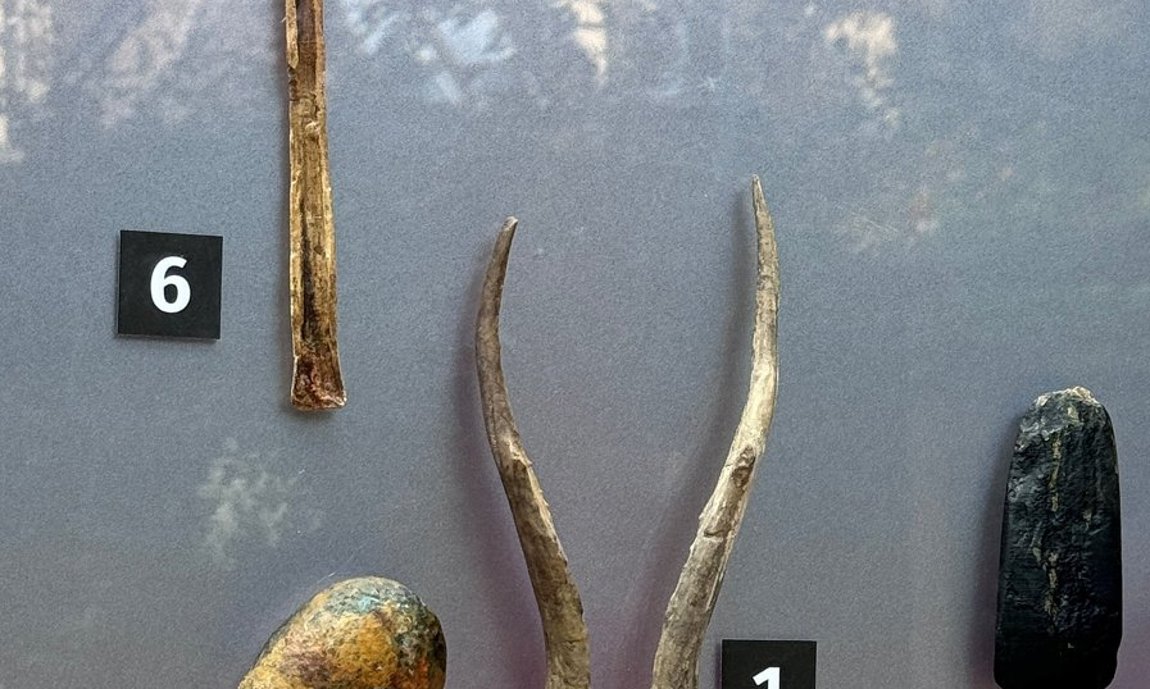
The most enigmatic find is a headdress made of red-deer antler: a piece of skull with two attached antler beams, perforated at the edges, evidently worn on the head. Comparable antler "frontlets" are known from several Mesolithic sites across Europe, for example in England. They are associated with ritual transformation, with the boundary between human and animal, and with special persons. Whoever wore such antlers on their brow stood, symbolically, no longer only in the world of humans – but between the worlds.
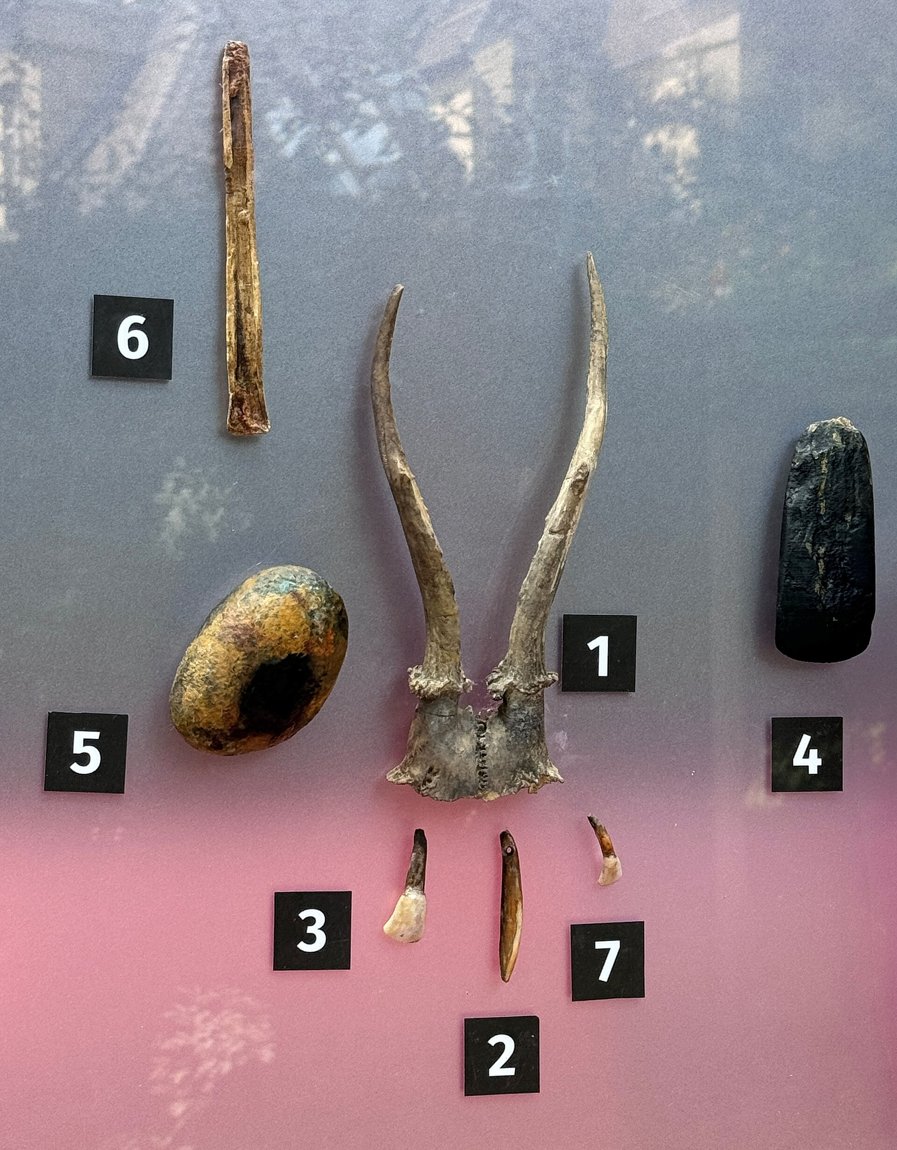
In all, the grave held several dozen objects: pierced teeth of roe deer and wild boar as pendants, tools of bone, flint blades, a polished stone, remains of a turtle shell and bird bones, among them a crane. Some served as jewellery, some as tools, some probably as ritual implements. In their combination these things form the picture of an equipment that no ordinary grave of this era possessed – rather a "toolkit" for tasks beyond the everyday.
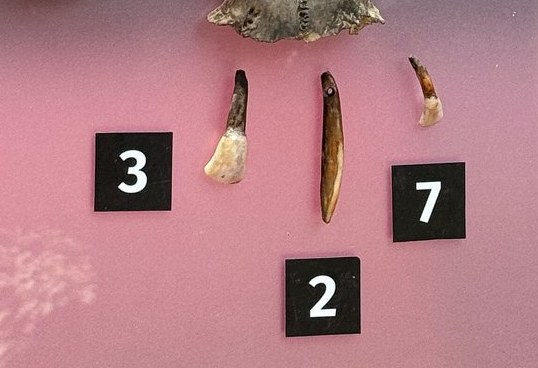
Her jewellery tells of a world in which humans were utterly close to animals. Pierced teeth of roe deer and wild boar, strung into necklaces, were at once adornment and probably amulet – signs of the hunt, of strength and of protection. Whoever wore the teeth of the prey carried a part of its power. In this ancient idea – jewellery as a bearer of meaning, not mere decoration – lies a bridge into our own time.
The term "shaman" is an interpretation – but a well-founded one. The abundance and kind of grave goods, the antler headdress, the careful, ochre-covered burial: all this points to a person with a special, probably religious and healing role. In many hunter-gatherer cultures worldwide there were people who mediated between the world of the living and the world of spirits, ancestors and animals – healers, seers, ritual leaders. Into precisely this role the woman of Bad Dürrenberg fits convincingly.
In 2021 and 2022 her genome was decoded. Like other central European hunter-gatherers of her time she probably had blue eyes and darker skin – an image that clearly contradicts our common cliché of the "fair-skinned early European" and shows how much people have changed since. In addition a skeletal peculiarity was found in the area of the uppermost cervical vertebra, which under certain head movements could have triggered physical reactions. Whether such traits contributed to her special status remains a fascinating but cautiously handled conjecture.
On the basis of the well-preserved skull and the genetic data, researchers have reconstructed her face. From bone, figures and probabilities emerged the image of a concrete woman – a rare, moving moment in which a 9,000-year-old human seems to look back at us. Such reconstructions are always a scientifically supported approximation, not a photograph; yet they bring the distance of the Stone Age into tangible closeness.
The woman lived long before farming, metal and permanent villages. Her world was that of the hunters, fishers and gatherers after the end of the Ice Age: small, mobile groups in a regrowing wilderness of forests, rivers and lakes, rich in game, fish and plants. In this world knowledge was the real power – knowledge of the behaviour of animals, of healing plants, of weather and seasons, of the invisible forces suspected behind everything. People who embodied and knew how to interpret this knowledge enjoyed high standing.
Bad Dürrenberg shows impressively that women could hold outstanding religious and social roles already 9,000 years ago. It is tempting to draw a line to later seers – to the Germanic völva and her seiðr, to the seer Veleda, to the wise women of the Icelandic sagas. But caution is needed here: between the Mesolithic and the Viking Age lie many millennia. There is no unbroken "shamanic tradition". What remains across time is a deep human pattern: the respect for those who seem to mediate between the worlds.
The original of the shaman holds a place of honour in the State Museum of Prehistory in Halle – the same house as the Nebra Sky Disc. At the state garden show 2024 in Bad Dürrenberg her story stood at the centre, and at the find site in the spa park one remembers one of the oldest "personalities" of the country. From a nameless grave of 1934 she has become a figure who moves people – proof of how much the question of our origins still occupies us today.
The Shaman of Bad Dürrenberg is more than an old find. She was a human being who, 9,000 years ago, lived, healed, interpreted and led rituals – and to whom her community gave a grave of extraordinary care. In her we meet the ancient human longing to understand the invisible, and the honour that people paid to those who gave this longing a face. Exactly this fascination for seers, symbols and the mysterious carries our own work to this day – every sign we engrave stands in this long line of interpreting and preserving.
Seiðr – the magic art · Women among Germani & Vikings.
All History & Finds articles →
Without their ships the Vikings would never have become Vikings. The longship was the high technology of its time …
Read more →