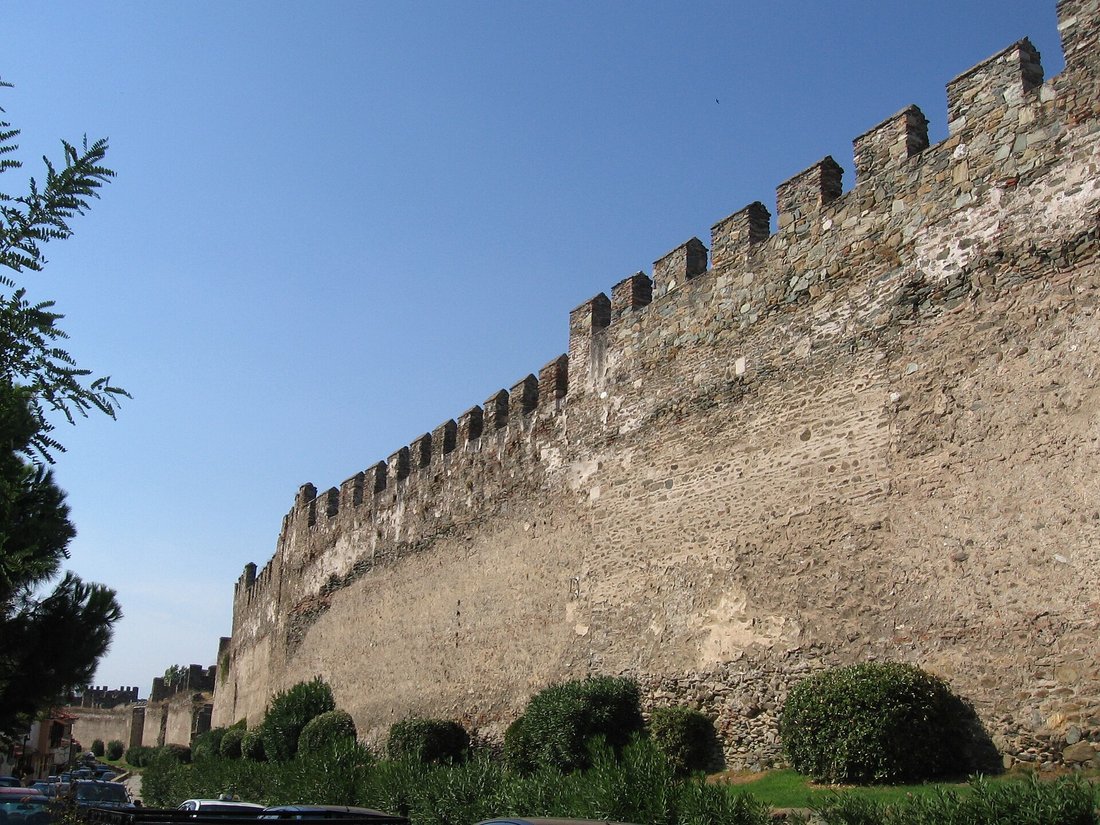
Not a single sentence in their own language survives from the Drougoubitai. What we know about them comes from the records of a city that defended itself against them: from the Miracles of Saint Demetrius, written down in Thessalonica in the seventh century. There they appear as neighbours, as opponents, as suppliers of siege engines, and as a people whom an emperor ordered to feed strangers with grain. Two centuries later a Byzantine bishopric carried their name, and in the tenth century an administrative district did too. This article works through the sources step by step, separates the attested from the interpreted, and names one of the most persistent confusions in early Slavic history.
The Drougoubitai – in Greek Δρουγουβῖται, and in the manuscripts also Δραγοβῖται – belong to those early medieval groups known to us exclusively through foreign eyes. They left no chronicle of their own, no inscription, no treaty text. Everything that can be said about them comes from Greek texts written in Thessalonica or Constantinople, that is, in places where they were perceived as a threat, a source of revenue, or a mission field.
This is not a minor detail but the decisive methodological precondition. A group that appears only in the records of its opponents is described in those records in whatever way serves the narrative purpose. We learn when it attacked, when it kept still, when it delivered goods. We learn nothing about what it called itself, how it organised its affairs, or whether it understood itself as a unit at all.
Anyone writing about the Drougoubitai therefore inevitably writes about the limits of what sources can achieve. That is precisely what makes them interesting: they show how much, and how little, can actually be said about early Slavic groups in the Balkans.
The main source is a collection known under its Latin title Miracula Sancti Demetrii: Greek texts about the miracles of the patron saint of Thessalonica. It consists of two very unequal books. Book I was compiled around 610 to 620 by John, archbishop of Thessalonica, and consists of fifteen homilies intended to be read aloud to the congregation. Book II was composed in the 680s by an unknown author and reads far more soberly, almost like a report.
For our subject, Book II is the text that matters. Its author knows the city's Slavic neighbours by name, distinguishes between individual groups, and in one passage explicitly calls them neighbours. Book I, by contrast, speaks only of barbarians in general. The difference came at a price in transmission: Book II was copied far less often and survives in a single manuscript.
The authoritative critical edition is that of Paul Lemerle, published in two volumes in Paris in 1979 and 1981. Anyone who cites the Drougoubitai is in practice always citing Lemerle's text and Lemerle's paragraph numbering, even where the secondary literature fails to say so.
The Drougoubitai enter the record not as acting figures but as an entry in a list. Book II of the Miracles describes an attack launched against Thessalonica by Slavic groups acting independently of the Avars; scholarship usually places it around 615. The author names the peoples involved, and the Drougoubitai stand first.
τῶν Δρουγουβιτῶν, Σαγουδάτων, Βελεγεζιτῶν, Βαϊουνητῶν τε καὶ Βερζητῶν καὶ τῶν λοιπῶν ἐθνῶν
Miracula S. Demetrii II,1 (numbering after Lemerle); own translation: Glanz & Gravur
… of the Drougoubitai, Sagoudatai, Belegezitai, Baiounitai and Berzitai and the remaining peoples …
This list is the foundation of all further research. It shows that the defenders of Thessalonica already distinguished between several neighbouring groups in the early seventh century, and that these groups could act together without therefore forming a single power. Where exactly each group lived the text does not say. The usual locations – Drougoubitai north and west of the city, Belegezitai on the Thessalian gulf – are inferences from later mentions, not statements of the source.
The Miracles almost never give a year. The author dates by indictions, a fifteen-year fiscal cycle that cannot be resolved unambiguously without further clues. Every year given in the literature is therefore a reconstruction.
The chronology accepted by most scholars today is Lemerle's. It arranges the events roughly as follows: an Avar-Slav attack in 586 or 597, a night raid in 604, the attack of the Slavic coalition under Chatzon around 615, a thirty-three-day Avar-Slav siege in 617 or 618, and finally the great two-year Slavic blockade of 676 to 678 with the main assault from 25 to 27 July 677.
Earlier scholars reached very different results. For the great siege, 634, 647, 657/658, 685 to 687 and 692 have all been proposed. Lemerle's solution prevailed because it alone satisfies every indication in the text at once: the time elapsed since the earlier sieges, the identity of the reigning emperor, and that emperor's entanglement in a simultaneous war against the Arabs. Andreas Stratos moved the beginning back to 675. This is no marginal question: it determines the political setting in which the Drougoubitai acted at all.
Here a widespread simplification must be corrected. The Drougoubitai were not among the groups that began the blockade. The trigger was the execution of Perboundos, whom the text calls ruler of the Rhynchinoi – a man who spoke Greek, dressed in Byzantine fashion, and even kept lodgings in Thessalonica. After his death the Rhynchinoi rose, then the Strymonitai and the Sagoudatai. Other groups stayed away, and the Belegezitai even took the city's side and later sold it grain.
The Drougoubitai entered the picture only when the besiegers saw an opportunity: a large part of Thessalonica's fighting men had sailed off to obtain food from the Belegezitai. The attackers therefore asked the Drougoubitai for help, and expressly so because they understood the construction of siege engines.
During the assault of 25 to 27 July, Saint Demetrius is said to have appeared in person, on foot and carrying a cudgel, to repel an attack by the Drougoubitai against a postern called Arktos. Some commentators read this as a veiled indication that the attackers actually penetrated the city. On the evening of the 27th the Slavs broke off the assault and abandoned their engines, which were taken inside.
The statement that the Drougoubitai were able to build siege engines is the most concrete thing any source says about them, and at the same time the most interesting. It contradicts the image of loose groups without technical means. Anyone who builds throwing machines and assault gear needs carpenters, rope-makers, smiths, experience with tension and leverage, and an organisation capable of holding such work together for weeks.
Where this skill came from the text does not say. Experience gained during the Avar sieges, in which heavy equipment was displayed, is conceivable; so are defecting or captured Roman specialists. Both are speculation.
Lemerle himself restrains the imagination here: he considers it likely that the Drougoubitai supplied the equipment and perhaps its crews rather than an army of their own. And the account itself concedes that the engines played no discernible part in the fighting. A people fetched for its technical skill is nevertheless something other than a people that merely raids.
The second major scene also stands in Book II. A Bulgar named Kuber, whom the Avars had set over a population settled in the region of Sirmium, rose against the khagan and moved south with these people, the so-called Sermesianoi. Among them were descendants of deported Romans who had preserved their Christian traditions.
Kuber asked the emperor for permission to settle. The emperor agreed and instructed the neighbouring Drougoubitai to supply the newcomers with food. Later Kuber and his confidant Mauros, who bore the titles patrikios and archon of the Sermesianoi and the Bulgars, attempted to seize Thessalonica; the attempt failed.
This passage is historically more valuable than it first appears. An emperor who can order the Drougoubitai to make deliveries is not treating them as an external enemy but as a quantity within his own order: tributary, addressable, in a sense integrated. Here the Drougoubitai appear not as attackers but as the granary of the hinterland.
One basic feature emerges from the Miracles that holds for the whole early Slavic history of the Balkans: the individual groups did not act as one. In 615 the Drougoubitai stand in a coalition; in 676 to 678 they are at first absent and then appear only as technical support. The Belegezitai supply the besieged city with wheat and pulses. The Strymonitai turn back in the middle of the assault.
Anyone who paints these groups as a closed front against Byzantium is projecting back an image the sources do not support. The same is true of the opposite view: they were not harmless farmers drawn into conflict by accident either. The blockade lasted two years, caused famine and enslavement, and ended only when the emperor could free up troops after defeating the Arab fleet.
Similar patterns appear later in the Peloponnese, where the Ezeritai and Milingoi were obliged to pay more only after a revolt, and in north-eastern Bulgaria among the Slavs of Bulgaria.
The usual derivation traces the name to a Proto-Slavic formation normally reconstructed as *Drъgъvitji, from a word *drъgъva meaning swamp or marsh. The Drougoubitai would thus simply be the people from the wet ground – a settlement name, not a title of honour.
This reading is well founded but it is not a document. It rests on linguistic reconstruction, and Greek scribes rendered the Slavic reduced vowel ъ inconsistently: sometimes as ο, sometimes as ου, sometimes as α. Precisely from this arise the forms Drogoubitai, Drougoubitai and Dragobitai that stand side by side in the literature.
The underlying principle matters: an ethnonym tells us something about the perspective of those who used the name, not necessarily about the origin or self-image of those named. Names travel, names recur, and identity of name is no proof of kinship.
This brings us to the most delicate point. The same name occurs several times in the sources, and its three bearers must be kept apart.
First, the Drougoubitai near Thessalonica and in the Macedonian region, the subject of this article. Second, a group of the same name located in Thrace; some scholars regard the two as distinct peoples, while Predrag Komatina, for example, holds the differing spellings to be mere renderings of one and the same name. Third, and most consequential, the East Slavic Dregovichi on the Pripyat.
For Constantine VII Porphyrogennetos, in chapter 9 of De administrando imperio, uses precisely the form Δρουγουβῖται for the East Slavic tributaries of the Rus. He names them there alongside the Vervians, Krivichians and Severians as the regions to which the Rus princes set out in November on the poliudie. A tenth-century Byzantine author thus uses the same Greek name for a people on the Pripyat as for a people near Thessalonica. That the two names belong together etymologically is plausible; that they denote the same group does not follow.
The strongest evidence that the Drougoubitai were a fixed quantity for Byzantium is ecclesiastical. From 879 at the latest a bishopric of Drougoubiteia is attested as a suffragan of the metropolis of Thessalonica; the episcopal seat is sought west of the city, in the area of Pella.
This is remarkable. A bishopric named after a people rather than a city reveals two things: that the group remained identifiable as a population unit, and that the church treated it as a pastoral district of its own. For early Slavic groups on Byzantine soil this is neither unique nor the rule.
At the same time a caveat applies. The name of a bishopric does not prove that all its inhabitants still spoke Slavic, and it says nothing about when Christianisation occurred. It proves only that the name lived on officially in the ninth century.
In parallel the name became part of secular administration. Nicolas Oikonomides suggested that at about the same time the group was placed under a Byzantine military governor with the title of strategos. The Escorial Taktikon, a precedence list from the years 971 to 975, records a strategos of Drougoubiteia.
In the late tenth and the eleventh centuries Drougoubiteia is then attested as joined with the themes of Thessalonica and Strymon into a single province. A lead seal of office from the eleventh century names a Michael Skleros as protoproedros and anagrapheus – that is, tax assessor – of Drougoubiteia. Such seals are gold for administrative history precisely because they have no narrative agenda.
The whole path is thus legible: a name in a list of enemies becomes an ecclesiastical district, then a military command, then a fiscal unit. At the end there is no longer a people but a regional designation.
That path was not peaceful. After the end of the great siege Byzantium repeatedly pressed its advantage militarily. In 688 or 689 Justinian II led a campaign through Thrace and Macedonia as far as Thessalonica, subdued Slavic groups and resettled large numbers of them in Asia Minor.
A century later, in 783, the logothete Staurakios travelled on behalf of the empress Irene from Constantinople via Thessalonica to the Peloponnese and forced the Slavic groups of the region to pay dues. In the ninth and early tenth centuries the area lay between Byzantium and the Bulgarian realm; only the campaigns of Basil II around 1018 established Byzantine rule permanently.
Resettlement, tribute demands and church organisation worked together here. What the sources do not offer is any statement about how those affected experienced it. Here too the basic rule of this article applies: the silence of the record is itself a finding.
For the southern Balkans the early Slavic traces are thin and hard to date. The usual markers are handmade pottery of the so-called Prague type, sunken-floored huts and cremation burials in simple urn pits. Such finds exist in northern Greece and North Macedonia, but they are widely scattered and rarely well dated.
The decisive point is a negative one. There is no group of finds that can be assigned to the Drougoubitai. No settlement, no cemetery, no object bears any indication of this name. Florin Curta has argued in several works that pottery types cannot serve as evidence of Slavic identity at all – a position that has not gone unchallenged but that permanently unsettled twentieth-century practice.
The treasures of Vrap and Ersekë in Albania, which Joachim Werner and Ivan Mikulčić connected with Kuber and the Sermesianoi, are likewise an interpretation and not a proof. Anyone citing them as evidence for the Drougoubitai is combining two uncertain attributions.
The name does not vanish with the seventh century. John Kaminiates, who reports the capture of Thessalonica by Arab naval forces in 904, mentions the Drougoubitai as inhabitants of the region around Veroia. In the thirteenth century archbishop Demetrios Chomatenos writes that they ruled the land from Veroia as far as Skopje.
Both passages must be read with care. Kaminiates' work survives only in fifteenth-century manuscripts; for that reason, and because of supposed anachronisms, Alexander Kazhdan held it to be a later forgery. Most scholars today do not follow him and regard the text as a genuine tenth-century testimony, but the debate took place and deserves mention.
Chomatenos, for his part, writes a good six hundred years after the name first appears. Whether he still means a population group or already an established regional designation cannot be decided from the passage alone.
One final and particularly problematic thread leads into the history of dualist movements. In western lists of heretical churches of the twelfth century, an ecclesia Dragovitiae appears alongside churches of Bulgaria, Melingia, Romania and Dalmatia. A bishop Nicetas, assigned to this strand, is said to have presided in 1167 over an assembly at Saint-Félix in southern France.
The connection to the name of the Drougoubitai suggests itself but is uncertain for two reasons. First, the location of Dragovitia is disputed: proposals range from Aegean Macedonia to the region south of Philippopolis in Thrace – that is, precisely the zone where the second, Thracian bearer of the name is also suspected. Second, the central text itself is contested. The so-called Charter of Saint-Félix is known only through a printing by Guillaume Besse of 1660; Monique Zerner and others have considered a modern forgery, Bernard Hamilton has argued for authenticity, and a colloquium held in 1999 reached no final verdict.
As long as both questions remain open, the Bogomil trail can be mentioned but not treated as an established continuation of the Drougoubitai story.
That leaves the question of place names. The village of Drugovo near Kičevo in North Macedonia is frequently cited, occasionally also names such as Dragovishtitsa. Such echoes are striking and are regularly adduced in the literature.
At the same time they are methodologically delicate. A place name first recorded late may preserve an old ethnonym, but it may equally well derive from a personal name, a river name, or the same swamp root quite independently. Without a chain of attestations bringing the name as close as possible to the period in question, every derivation remains a proposal.
Similar caution applies to other Slavic groups whose names appear to survive in the landscape, from the Carantanians in the Alps to the West Slavic groups on the Baltic.
What remains is a narrow but clear finding. A Slavic-speaking population settled in the seventh century in the hinterland of Thessalonica and in the Macedonian region. It could attack, it could deliver, it possessed craft skills. Byzantium took it seriously enough as a counterpart to order grain deliveries from it, to dedicate a bishopric to it, and to take its name into the language of administration.
Everything beyond that is interpretation. This applies above all to the question of how this group relates to present-day nations. Greek, North Macedonian and Bulgarian readings of the early medieval Balkan Slavs differ considerably; they depend less on new sources than on national historical narratives of the nineteenth and twentieth centuries. Anyone working historically names these positions as positions and draws no line from the seventh century to the present.
The same holds for the Byzantine accounts of the Serbs and the Croats: they describe groups of their own time, not the forerunners of modern states. The Drougoubitai are a good example of how much history a single name can hold, and how little may be read out of it.
Certain is this: the Drougoubitai appear in the second book of the Miracula Sancti Demetrii among the Slavic-speaking neighbours of Thessalonica. They stand in the list of groups that moved against the city together around 615. During the great blockade – 676 to 678 in Lemerle's chronology – they were brought in by the besiegers because of their knowledge of building siege engines, and during the assault of July 677 an attack by the Drougoubitai was directed against a postern. An emperor instructed them to supply Kuber's people with food. From 879 a bishopric of Drougoubiteia is attested as a suffragan of Thessalonica, in the Escorial Taktikon of 971 to 975 a strategos of the same name, and in the eleventh century a tax official on a lead seal. John Kaminiates places them around Veroia in the early tenth century, Demetrios Chomatenos between Veroia and Skopje in the thirteenth.
Almost everything else is uncertain. The Drougoubitai near Thessalonica, the group of the same name in Thrace and the East Slavic Dregovichi on the Pripyat must not be equated, even though Constantine VII uses the same Greek form for the last of these. The term Sklavinia is an external designation of Byzantine and western chanceries and becomes current only from the late eighth century; the Miracles simply speak of peoples. The dates of the sieges are reconstructed, not transmitted. The locations of the individual groups are inferences. Archaeologically not a single group of finds can be assigned to the Drougoubitai; the treasures of Vrap and Ersekë are an interpretation. The Bogomil church of Dragovitia is neither securely located nor is its most important textual witness undisputed. And every line drawn from a seventh-century group to a present-day nation is politics of history, not evidence.

Melingoi and Ezeritai · The Serbs · The Croats · The Slavs of Bulgaria · The Carantanians · The Dregovichi · Miklagard and the Varangians.
