 Between the Pripyat and the Berezina, in a landscape of bog, black alder carr and slow creeping water, an East Slavic population lived in the ninth and tenth centuries whose very name gives them away: the Dregovichi, roughly the people of the mire. They appear in the Primary Chronicle, they appear — probably — in the work of a Byzantine emperor, and they left behind a handful of very distinctive ornaments in the burial mounds of southern Belarus. What is solid, what remains interpretation, and why their land happened to sit on the edge of the great Varangian route: let us take our time with it.
Most early medieval ethnic names are opaque to us. The Dregovichi are the exception: their name can be resolved with reasonable confidence, and it describes neither an origin, nor an ancestor, nor a god, but simply the ground these people lived on. Old East Slavic dregva or dryagva means mire, quaking ground, trembling bog — the word survives in Belarusian dryhva and northern Ukrainian dryahovyna. The philologist Max Vasmer connected it with Lithuanian drėgnas, damp or moist. Read this way, the Dregovichi are simply the inhabitants of the wet country.
That is not a poetic flourish but a geographical description, and anyone who has stood on the upper Pripyat in spring will confirm it. Still, the caveat matters: the etymology is plausible and carries most of the field, but it is not finally proven. One open question is whether the word is itself a Baltic loan — the region was Baltic-speaking before the Slavic settlement, and language contact there is the rule rather than the exception.
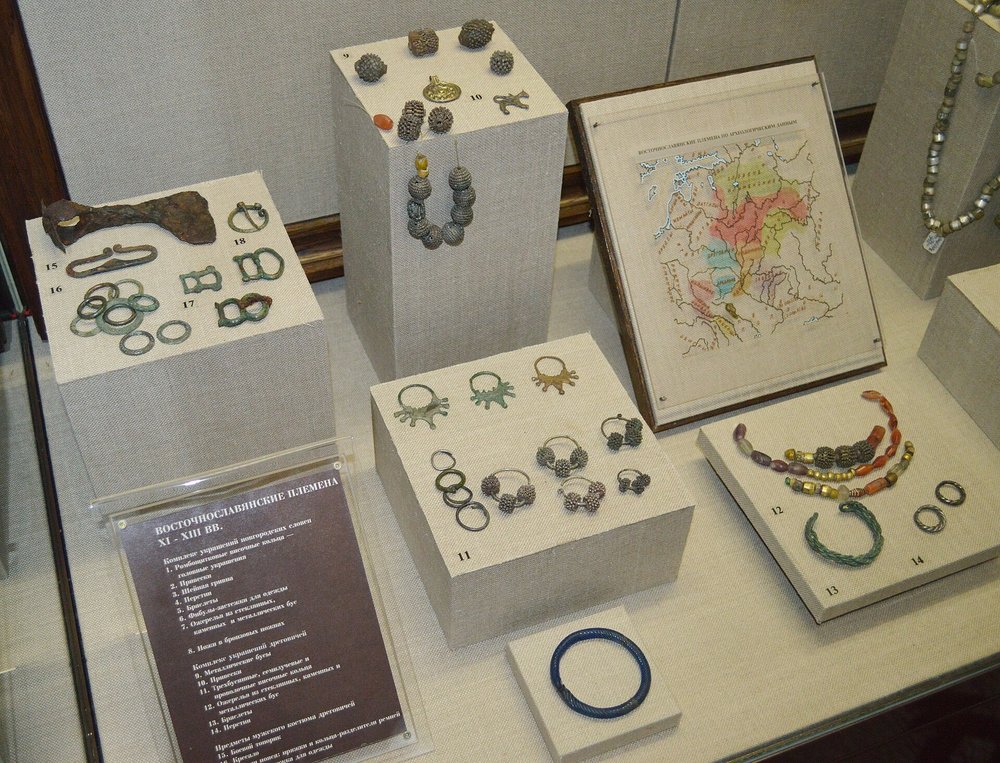
The Primary Chronicle is generous with them: they settled, it says, between the Pripyat and the Dvina, and called themselves Dregovichi. That sounds like an enormous territory, reaching from present-day Ukraine almost to Latvia. Archaeology paints a more modest picture. On Valentin Sedov's mapping, the core Dregovichi territory of the tenth to twelfth centuries reaches just south of the Pripyat, east to the Dnieper, north-east roughly to the watershed of the Drut and the Berezina, and north to a line running from Barysaw to Zaslawye. It does not reach the Dvina: the Polotsk Krivichi held that river.
The discrepancy is instructive. A chronicler writing in Kiev around 1113 orders landscapes by large, memorable rivers. He draws a line from waterway to waterway, not from village to village. Anyone looking for the boundaries of the Dregovichi today has to ask the spade rather than the manuscript — and the distribution map answers differently from the text.
Polesia, the great marshy basin on both sides of the Pripyat, is one of Europe's stranger landscapes: a shallow trough where meltwater stands for weeks in spring, threaded with sandy ridges on which villages sit like islands. For settlers this cuts two ways. First, protection: cavalry cannot pass, and anyone who does not know the paths does not get through at all. Second, restriction: arable land exists only on the dry rises, and traffic runs on water, or in winter on ice.
That very isolation is probably why the Dregovichi existed as a distinguishable group at all. The earliest Slavic sites in the region — settlements and cemeteries of the sixth and seventh centuries with Prague-Korchak type pottery — lie exclusively in the far south, along the Pripyat. A broad and practically uninhabitable belt of bog separates them from the other areas of the same culture. A population that lives for a few generations behind a swamp develops its own habits, its own patterns, its own jewellery. The marsh did not merely name the Dregovichi; it made them.
The main source is the Povest vremennykh let, the Tale of Bygone Years, commonly called the Primary Chronicle. It was compiled in Kiev around 1113, and it survives not in the original but in late copies: the Laurentian manuscript dates to 1377, the Hypatian to about 1425. A good five hundred years separate the events of the ninth century from the oldest surviving page.
What the chronicle says nonetheless carries weight, because it is the only continuous view from the inside that we possess. Its catalogue of peoples lists the Dregovichi among the East Slavic groups, alongside the Drevlians, the Polianians, the Severians and the Radimichi. And it records that the Dregovichi had a rule of their own — their own knyazhenie, their own princedom, just as the Polianians had one and the Drevlians had one. The Dregovichi appear in the chronicles until the middle of the twelfth century; Slutsk and Kletsk are still expressly called Dregovichi towns under the years 1116 and 1149.
The strongest independent testimony comes from Constantinople. Between about 948 and 952, Emperor Constantine VII Porphyrogenitus described in his handbook De administrando imperio how the Rus travelled down the Dnieper each year in dugout boats to Byzantium — and how they spent the winter. Chapter 9 names the tributary Slavic districts, and among them stand the Drougoubitai, whom there is good reason to identify with the Dregovichi: they appear in the same breath as the Krivichi and the Severians, that is, alongside neighbours who fit geographically.
When the month of November begins, their chiefs at once leave Kiev with all the Rus and set out on the poliudia — which means the rounds — that is, to the Slavic districts of the Vervians, the Droughoubitai, the Krivichians, the Severians and the rest of the Slavs who pay tribute to the Rus. There they are maintained through the winter; but when April begins and the ice of the Dnieper breaks up, they return to Kiev.Constantine VII Porphyrogenitus, De administrando imperio, ch. 9 (mid-tenth century), own translation
These few lines are worth more for the Dregovichi lands than pages of legend. They show a fixed system: the Rus sit in Kiev, they travel the frozen country in winter, they live on what the Slavic districts render up, and in spring the accumulated yield — furs, wax, honey, slaves — is shipped south down the Dnieper. In this arrangement the Dregovichi are not a marginal note but an entry in a Byzantine emperor's ledger.
Caution is needed here, because the same name turns up a second time, a thousand kilometres to the south. The Drougoubitai or Draguvites were a South Slavic group settled in the seventh century around Thessalonica and Veroia. They appear in the Miracles of Saint Demetrius, they took part in the unsuccessful sieges of Thessalonica, and by 879 a bishopric of Drougoubiteia is attested. These are not the Dregovichi.
Linguistically, though, the two names belong together: both go back to the same root for swamp. Some scholars, Predrag Komatina among them, regard the relationship as beyond doubt and even consider that the Balkan group originally came from the region of the Pripyat marshes. That is a hypothesis, not a fact — and a textbook case of how easily a shared name seduces us into inventing migrations. A name meaning marsh dwellers can arise independently in any marshy country.
The place where Dregovichi history condenses is called Turov (Belarusian Turaŭ). The Primary Chronicle mentions it under the year 980 and links it with a prince named Tur who, the chronicle says, came from abroad, much as Rogvolod did at Polotsk. Simon Franklin and Jonathan Shepard note that Turov appears to have been a recent foundation at that point, possibly Tur's own. Whether this Tur was a historical person or a back-formation from the place name is open; founder-princes whose names happen to match their towns exactly are a familiar pattern in medieval chronicle writing.
Turov was shrewdly sited: on a spit of land between two rivers, in the middle of a landscape that dictated every attacker's route, and at the same time on the waterway that runs by the Pripyat into the Dnieper and thence to the Black Sea. That Turov in particular was the Dregovichi centre is nowhere stated in so many words; it is an inference from the chronicle data, argued by scholars such as Arseni Nasonov and Boris Rybakov — well founded, but inference all the same.
What follows is the road from regional grouping to province. Around 988 Vladimir the Great installed his son Sviatopolk as prince of Turov — an eight-year-old, which makes the point plainly enough: Turov was now a post within a dynasty, not an entity in its own right. Later it passed to Iziaslav and his descendants; in the twelfth century it grew into the Principality of Turov and Pinsk, with towns such as Pinsk, Slutsk, Kletsk and Mazyr. In the fourteenth century the territory passed to the Grand Duchy of Lithuania.
One point matters for our subject: the borders of the twelfth-century principality of Turov are not the borders of the tenth-century Dregovichi. Historians of the nineteenth century tried exactly that — to reconstruct the tribal map from the political one — and failed. A principality grows and shrinks with inheritance divisions and wars; a costume province follows different laws.
The real source for the Dregovichi lies under grassy mounds. Hundreds of kurgans in their territory have been opened since the early nineteenth century; Vladimir Zavitnevich alone excavated some 700 mounds in 82 cemeteries between 1885 and 1892. A further 400 or so followed in the 1920s and 1930s. A bitter detail from the history of the discipline: the find assemblages and the entire excavation documentation of the Belarusian archaeologists of those years were destroyed in the Second World War. Of many of those digs, only what had already been printed survives.
The evidence itself shows a clear shift. The older mounds contain cremations; the changeover to inhumation takes place in the second half of the tenth and the very beginning of the eleventh century — the period of the Christianisation of Rus, though the two should not be equated too hastily. Typical are burials laid on the old ground surface beneath the mound, mostly with the head to the west. In the north of the territory there are wooden grave chambers, so-called domoviny, and grave goods with a distinctly Baltic flavour: bracelets with stylised snake-head terminals, horseshoe brooches, spiral rings, belt fittings of Latgalian type.
One find type counts as the Dregovichi signature: large hollow metal beads densely covered with granulation — minute soldered spheres producing a grainy, glittering surface. In the necklaces they sit as one or two showpieces at the centre; they are attested in more than 120 burials. Alexander Spitsyn already identified them as characteristic in 1899, and Sedov made them his principal mapping criterion. The occasional label beads of the Minsk type is misleading — they have nothing to do with Minsk or the Minsk principality.
Alongside them come ring-shaped temple rings with overlapping or one-and-a-half-turn terminals, often several per woman, anywhere from two to twelve. These rings, however, are not exclusively Dregovichi; they serve only to fine-tune the northern and eastern limits, since they are absent from Krivichi and Radimichi mounds. And here honesty is required. Jewellery shows costume habit, craft tradition and supply route. It shows whose feasts you attended and whose workshop you bought from. It does not show descent. A costume marker is not an ethnicity.
North of the Pripyat, Balts lived before the Slavs — archaeologically visible through the Tushemlya-Bantserovshchina and Kolochin cultures. The Slavic expansion northwards can be traced in the mound material from the ninth century onwards, along the Dnieper and the Berezina and up the left tributaries of the Pripyat. It did not replace the resident population; it absorbed it.
The detail shows it. The north of the Dregovichi area is richer in grave goods than the south, with Baltic-influenced forms, while the southern mounds along the Pripyat are barely distinguishable from those of the Drevlians, the Polianians or the Dulebs. The anthropological series likewise split into two groups along the Pripyat. Even everyday language betrays it: in parts of Belarus burial mounds are called not kurgans but kaptsy — from Lithuanian kapas, grave. Precisely where Balts lived before the Slavs came.
And here the marshland meets the Norse world. The Dnieper, whose right bank the Dregovichi territory abuts, is the middle stretch of the route running from the Baltic by way of Novgorod and Kiev to Byzantium — the road from the Varangians to the Greeks. The Kievan Rus was the power that controlled this corridor, and Constantine's note on the poliudia describes exactly how the hinterland was plugged into it.
That is why the necklaces of Dregovichi women contain things that did not come out of the bog. Carnelian beads are attested in 36 mound groups, rock crystal beads in nine — semi-precious stones that reached the north over the Volga and Dnieper routes from the Orient, and that turn up in the same period in Scandinavian graves and Gotlandic hoards. Add to them spindle whorls of pink Ovruch slate, the pyrophyllite stone that occurs at only one deposit in all of Eastern Europe and was traded across Rus from the tenth to the thirteenth century. A farmer's wife in Polesia, then, spun with a weight quarried in Volhynia and wore a bead that had crossed half a continent. This is the quiet, well-documented side of the Viking Age: not the raid, but long-distance trade reaching the last farmstead in the marsh.
In the north of the Dregovichi lands, where the Svislach valley formed the boundary with the Krivichi, a place called Menesk is first recorded in 1067 — modern Minsk. The occasion is not a civic anniversary but a battle: on 3 March 1067 Vseslav of Polotsk met the sons of Yaroslav the Wise on the river Nemiga. Half a century later the Dregovichi are no longer named as an acting force; the chronicles mention them for the last time around the middle of the twelfth century.
In their place a different sort of fame appears: Cyril of Turov, born in that same town in the 1130s, bishop, preacher, author of a cycle of Easter sermons in ornate Church Slavonic. Barely more than a hundred years separate the granulated bead in the kurgan from Cyril's metaphors — and an entire change of world. The stone church of Turov, built in the middle of the twelfth century, was destroyed by an earthquake on 3 May 1230; its foundations came to light again in excavations in the early 1960s, together with sarcophagi of slate.
Finally, the separation that matters most for a subject this thin on sources. Much of what circulates about the Dregovichi mixes a twelfth-century chronicle note with a twentieth-century distribution map and a twenty-first-century national narrative. Let us keep the strands apart.

The Rus (Kiev) · The Drevlians · The Radimichs · The Krivichs · The Polans.
