In nineteen days an English king had to face down two invasions at opposite ends of his kingdom. He won the first so completely that twenty-four ships sufficed to carry home the survivors of a fleet of three hundred. Three weeks later he was dead, his army broken, his country handed out to strangers. What happened on the ridge near Hastings on 14 October 1066 comes to us from four sources that contradict one another – and from an embroidery that the nineteenth century patched up.
Edward the Confessor died on 5 January 1066, childless, after twenty-three years on the throne. His new abbey church at Westminster had been consecrated only days before; he was buried there. The day after his death, Harold Godwinson was king.
The Anglo-Saxon Chronicle reports that Edward briefly regained consciousness on his deathbed and commended his widow and the kingdom to Harold's protection. What that meant in law was open to interpretation even then – and that is exactly what the following months were fought over. Harold was no king's son. He was the most powerful earl in England, brother-in-law to the dead king, and he was chosen by the witan.
The coronation alone is a lesson in source criticism. John of Worcester writes that Ealdred, archbishop of York, crowned Harold. Every Norman source, and the Bayeux Tapestry, names Stigand of Canterbury – a man whose position was canonically dubious. That is not a detail, it is the argument: a king crowned by an unlawful archbishop is an unlawful king. Harold had refused to let Stigand consecrate one of his own churches. That he would then have chosen him to crown him is unlikely.
William, duke of Normandy, was a distant kinsman of the dead king. Edward's mother Emma came from the Norman ducal house, and Edward himself had spent most of his life in exile in Normandy. Norman writers claim that Edward promised William the succession around 1051. English sources know nothing of it.
Then there is the oath. In 1064 or 1065 Harold was driven onto the French coast, fell into the hands of the count of Ponthieu and ended up at William's court. There, say the Normans, he swore on relics to support William's claim. The Bayeux Tapestry shows the scene with a caption saying that here Harold swore the oath to the duke. The English sources are silent about that too. So we have a story told by one side only – and a side that badly needed it.
It is worth remembering who these Normans were. Normandy had been handed to a Norse warlord some hundred and fifty years earlier; the line goes back to Rollo and the fleets on the Seine, which we cover under the Vikings in France. And the English throne had been in Scandinavian hands before: fifty years earlier, Cnut the Great had taken it and kept it.
Harold expected William. Through the whole summer of 1066 he waited on the south coast with army and fleet. The problem was supply and harvest: most of his levy were farmers. On 8 September he sent them home.
Nine days later the attack came – from the north. Harald Hardrada, king of Norway, had landed with a large fleet, together with Tostig, Harold's own brother. On 20 September they beat the levies of earls Edwin and Morcar at Fulford. On 25 September Harold stood in front of them after a forced march and destroyed them at Stamford Bridge. Hardrada fell; Tostig fell. Of more than three hundred Norwegian ships, twenty-four were needed to take the survivors home.
That was the last great northern venture of its kind, which is why 1066 counts for many as the end of the Viking Age. How it came about, and what is actually attested about the battle, is in our pieces on Stamford Bridge and on Harald Hardrada. Here only one thing matters: Harold's best troops had a forced march the length of England and a battle behind them.
William's fleet had been ready since about the middle of August. For weeks adverse winds held it in Normandy. Only at the end of September could it cross – three days after Stamford Bridge.
On 28 September the Normans landed at Pevensey in Sussex. They moved on to Hastings, threw up a wooden castle and began to ravage the countryside. That was deliberate: Sussex was Harold's own family land. Burn there and the king has to come.
He came. Harold heard of the landing while still in the north, rode to London, stayed about a week to raise a new levy, then marched south – another week or so, at an estimated forty-three kilometres a day. On the evening of 13 October he took position on a ridge north-west of Hastings, some eleven kilometres from the Norman castle. William came out to meet him on the morning of the 14th.
Why Harold did not wait for more men is one of the great open questions. He had won Stamford Bridge by exactly this method, speed and surprise. His country was burning. His claim was young. None of those answers is certain.
The battle began around nine in the morning and lasted until dusk. For a medieval field battle that is extraordinarily long. Most were decided in two or three hours.
The numbers are modern estimates and they vary widely: seven to twelve thousand men for William, roughly half infantry, a quarter cavalry and a quarter archers; five to thirteen thousand for Harold, almost all on foot and with very few archers. No contemporary source gives figures that can be trusted.
Harold's men stood in a shield wall along the crest. As long as it held, the Norman cavalry could do nothing; horses do not charge a solid wall of shields and axes. Arrows helped little, because they had to be shot uphill or stuck in the shields. The first Norman assault failed, and on the left wing panic broke out when a rumour went round that William had fallen. William of Poitiers reports that the duke pushed back his helmet and showed his face to stop the flight.
What decided the day was then the opposite of standing firm. Parts of the Norman army fell back, the English broke out of the wall to pursue, and were cut down in the open by the cavalry. Whether the first retreat was genuine and only afterwards became a tactic is disputed. That it happened more than once, the sources agree. The shield wall thinned. At some point it tore.
This is where it gets interesting, because you can almost watch a legend assemble itself decade by decade.
The Anglo-Saxon Chronicle, the English voice, says only that he fell. No arrow, no detail.
The Carmen de Hastingae Proelio, a Latin poem of 835 lines attributed to Guy of Amiens and probably written as early as 1067, describes four Norman knights cutting the king down: the first drives through shield and chest, the second strikes off his head, the third opens his belly, the fourth severs his thigh. No arrow appears.
William of Jumièges, writing in the late 1060s, has Harold fall in the very first assault, pierced with mortal wounds. William of Poitiers, William's own chaplain, describes the dead king as unrecognisable, identified only by certain marks. That too sounds like close combat, not an arrow.
The arrow first appears in Amatus of Montecassino, probably in the early 1080s – whose Latin text is lost and survives only in a fourteenth-century French translation, which does not help. Baudri of Bourgueil, early in the twelfth century, mentions an arrow but not where it struck. William of Malmesbury, writing in the 1120s, says an arrow pierced the brain. Only Henry of Huntingdon, some seventy years after the battle, is explicit:
et ipso in oculo ictus corruit
"and he himself fell, struck in the eye"Henry of Huntingdon, Historia Anglorum, written in the 1130s; English rendering our own
In his Roman de Rou, begun in 1160, Wace joins the two together: first the arrow above the right eye, then the knights. That is the version everybody now knows.
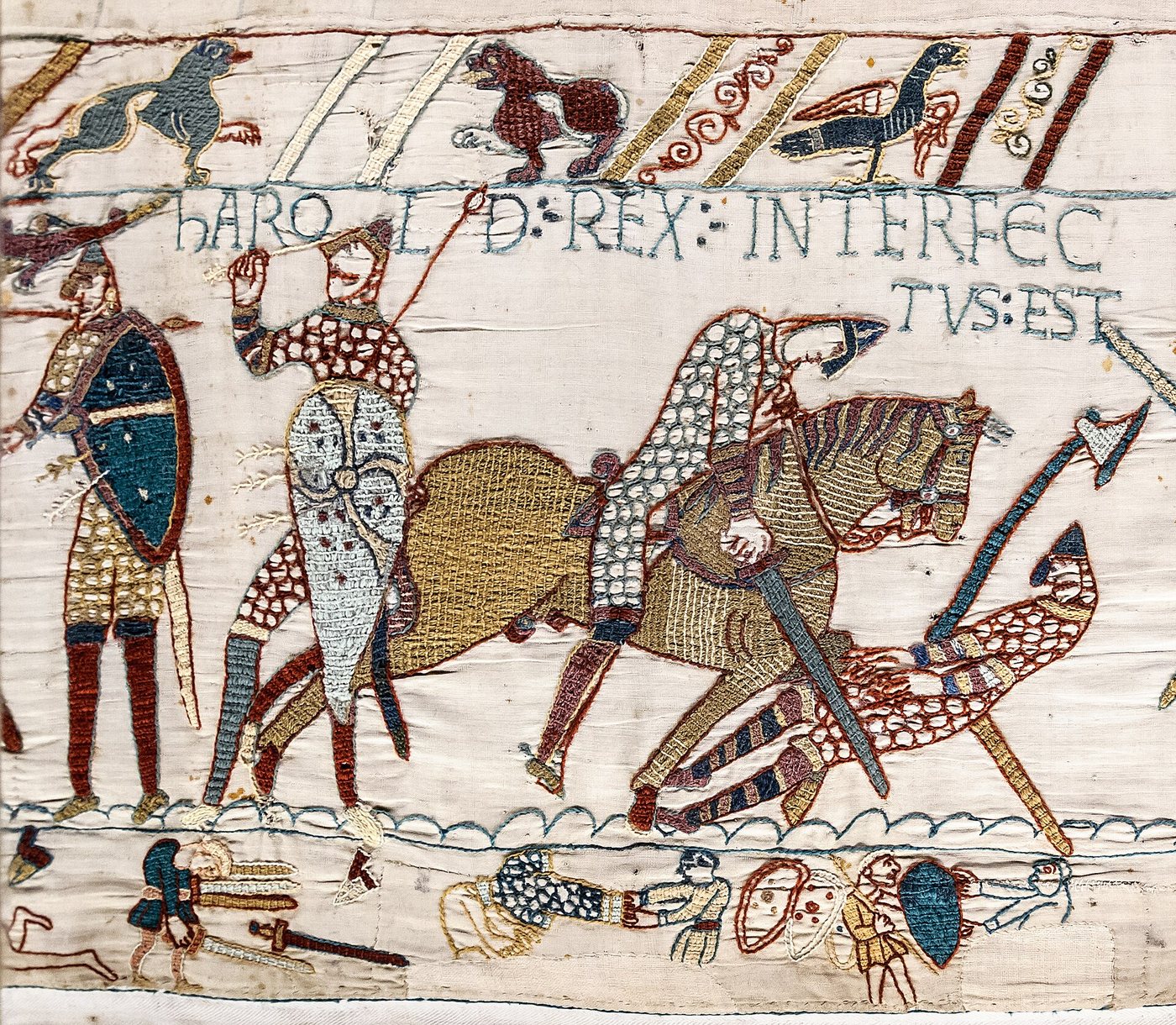
And the tapestry? The famous scene carries the caption:
HIC HAROLD REX INTERFECTUS EST
"Here King Harold is killed"Bayeux Tapestry, caption to the battle scene; English rendering our own
Beneath that line stand two figures: a man clutching at his head, and next to him an axeman being cut down by a rider. Which of them is Harold is argued about to this day. The engravings of the eighteenth century – Benoît in 1729, Montfaucon in 1730, Lancelot in 1733 – show the first figure holding a spear or an unfletched shaft, at any rate no arrow in the eye. The arrow appears first in the drawing Charles Stothard made for the Society of Antiquaries from 1816; whether he found stitch holes from fletchings or found what he expected to find is an open question. Later in the nineteenth century the tapestry was heavily repaired, this figure more thoroughly than most. The golden arrow is in all likelihood nineteenth-century needlework.
None of the main sources is neutral, and it pays to know where each one stands.
The Bayeux Tapestry is about sixty-eight metres long and some fifty centimetres high, wool on linen, nine panels sewn together, fifty-eight scenes with Latin captions. It was made in the years after the conquest, probably at the instigation of Bishop Odo of Bayeux, William's half-brother – and most likely in England, in the orbit of Canterbury. The end is missing, an estimated metre and a half, probably showing William's coronation. Since 10 September 2026 it has hung on loan in the British Museum, until 11 July 2027: for the first time since it was made, back in the country whose conquest it shows.
William of Poitiers was chaplain to the victor and wrote between 1071 and 1077; Antonia Gransden showed how far his work is panegyric. The only known manuscript is lost, the text survives solely through a printed edition of 1619, and it lacks both beginning and end – it opens and closes mid-sentence.
The Anglo-Saxon Chronicle is terse, preserved in several versions, and the only voice of the losing side. The Carmen was long held to be a twelfth-century forgery, precisely because it is so detailed; the view now generally accepted dates it to 1067.
William did not march straight on London, where Edgar Ætheling, the last shoot of the old royal house, was proclaimed king. He went by Dover and Canterbury, then in a wide arc around the city through Wallingford to Berkhamsted, where the English magnates submitted. On 25 December 1066 he was crowned at Westminster – by Ealdred of York, the same man who had probably crowned Harold eleven months earlier.
Resistance went on for years; in the winter of 1069–70 William's forces systematically devastated Northumbria. The English aristocracy was dispossessed: the Domesday Book of 1086 shows that south of the Tees only around five per cent of the land was still in English hands. On the battlefield William had an abbey built, whose high altar stood, by tradition, on the spot where Harold fell. Where Harold lies nobody knows for certain; Waltham Abbey, which he had refounded himself, is the best known tradition.
And the Viking Age? That it ends in 1066 is a historians' convention, not something contemporaries felt. Scandinavian fleets still came to England afterwards, in 1069 and 1075. But the direction had changed: whoever crossed the Channel now spoke French. How England lived alongside the north between Lindisfarne and Hastings we set out in our overview of the Vikings in England.
Contemporary evidence gives the dates: Edward's death on 5 January, Harold's coronation on 6 January, Fulford on 20 September, Stamford Bridge on 25 September, the landing on 28 September, the battle on 14 October, William's coronation on 25 December. The shape of the day is attested too: shield wall, failed assaults, withdrawals, collapse towards evening.
From the victor's camp come Edward's supposed promise of the throne, Harold's oath on the relics, and the coronation by Stigand. That does not automatically make any of it false. It means only one side asserts it.
Later tradition is the arrow in the eye: some fifteen years after the battle a bare arrow, seventy years after a hit in the eye, about a hundred years after a complete scene. To which one may add the arrow in the tapestry itself, which is in all probability nineteenth century.
Modern interpretation covers the troop numbers, the question of whether the feigned flight was planned, and the labelling of 1066 as the end of an age.
What remains is a day on which an exhausted army stood for nine hours and then did not. For courage. For memory. For legends that live on.

Stamford Bridge 1066 · Harald Hardrada · Rollo of Normandy · The Vikings in France & Normandy · Cnut the Great · The Danelaw.