Five names stand in a single sentence in Tacitus, and one of them belongs to the Helvecones. After that, the record goes silent. No ruler, no battle, no treaty, no second sentence. Anyone who wants to understand this people has to understand something else instead: how ancient ethnography manufactures lists, how fragile the journey of a word through a thousand years of copying really is – and why the spade between the Oder and the Vistula turns up a great deal, but not one single name.
There are ancient peoples we can argue about because too much survives: contradictory figures, competing campaign reports, inscriptions that refuse to match the chronicles. And there are peoples like the Helvecones, whom we have to argue about because almost nothing survives. Their entire ancient record consists of one word in an enumeration. Tacitus names them second among five peoples he calls the strongest of the Lugian league, and then moves straight on to livelier material: the sacred grove of the Nahanarvali and the black-painted night fighters of the Harii.
This is not a gap that diligence could close. There is no undiscovered source waiting to surface. That is precisely what makes the Helvecones such a useful case: they let us watch how knowledge about the Germanic world is actually assembled – and where it stops. A people consisting of a single word forces honesty.
Tacitus wrote the Germania around AD 98. In chapter 43 his gaze travels east, beyond the mountain ridge that in his mental map divides Suebia. Out there, he says, live very many peoples, and the most widely extended name among them is that of the Lugii. Then comes the sentence on which everything hangs:
ultra quod plurimae gentes agunt: ex quibus latissime patet Lugiorum nomen in plures civitates diffusum. valentissimas nominasse sufficiet, Harios, Helveconas, Manimos, Helisios, Nahanarvalos. – Beyond it live very many peoples; among them the name of the Lugii extends most widely, spread across several communities. It will be enough to have named the strongest: Harii, Helvecones, Manimi, Helisii, Nahanarvali.Tacitus, Germania 43; translation: Glanz & Gravur (original text in the public domain)
Nominasse sufficiet – it will be enough to have named them. Those three words deserve attention. Tacitus is telling us himself that he is cutting the list short. He has more names and chooses not to give them, because his Roman audience carries no map of Silesia in its head. The list is a selection, and we do not know what the selection criterion was.
The Helvecones do not stand alone in that chapter. Tacitus works his way northward: first he names the Marsigni, Gotini, Osi and Buri, who close the rear of the Marcomanni and Quadi. Of these, he writes, the Marsigni and Buri recall the Suebi in language and dress, while language itself proves the Gotini to be Gaulish and the Osi Pannonian – and therefore, in his reckoning, not Germanic at all. Only afterwards does his eye cross the mountains to the Lugii.
That matters. In one and the same chapter Tacitus uses language as a criterion of belonging, and he pointedly does not apply it to the Lugian peoples. About the Helvecones he tells us neither what tongue they spoke, nor how they lived, nor where exactly they sat. Everything modern handbooks say on those points is inferred from context – not taken from the text.
Tacitus phrases himself with striking care. He does not write “the Lugii” but Lugiorum nomen, the name of the Lugii, and says it is in plures civitates diffusum, spread across several communities. Latin knows the same construction from nomen Latinum or nomen Sueborum: it denotes an overarching belonging, not a tribe with a chieftain and boundary posts.
The Helvecones, then, were not subjects of the Lugii. They were one civitas under that umbrella – with their own name, presumably their own assemblies and their own law. How tightly the umbrella held is unknown. Günter Neumann connected the name of the Lugii with a root *lug-/*leug- meaning “to swear, to bind oneself by treaty” in Celtic and Germanic; a *Lugjōz would then be the oath-comrades, those belonging to a sworn league. Helmut Castritius finds this the most plausible reading. It is not certain: Celtic explanations exist too, and none has won the field.
Here the case turns genuinely philological – and genuinely interesting. The transmitted form is Helveconas. That is an accusative plural, governed by nominasse. No nominative exists anywhere in the ancient record. Nowhere do “the Helvecones” appear as the subject of a sentence, because in no ancient text do they do anything at all.
The forms under which we look them up today are therefore back-formations. From the accusative Helveconas scholarship has produced both Helveconae and Helvecones – two different nominatives from one ending, depending on which declension you assume. Dictionaries need a headword; antiquity had none to offer. German scholarship accordingly writes Helveconen or Helvekonen more or less at will. So this people has not merely an uncertain homeland and an uncertain language, but strictly speaking not even a secure form of its own name.
That we can read the line is a piece of luck with several near-disasters attached. The Germania did not survive antiquity in a flood of copies. The text hangs on a single medieval manuscript, the Codex Hersfeldensis, written between roughly 830 and 850 and kept at Hersfeld Abbey. In 1425 a monk from Hersfeld told the humanist Poggio Bracciolini in Rome what lay there; in 1431 Niccolò Niccoli catalogued the contents and noted, of the Germania, simply: twelve leaves.
In 1455 Enoch of Ascoli carried the codex to Italy. There it was taken apart, copied – and disappeared. The original has never resurfaced. What we possess are copies of copies of a book nobody has seen for more than five centuries.
The most important surviving witness is the Codex Aesinas, rediscovered in 1902 in a private library at Jesi. Its Agricola section contains eight leaves in Carolingian minuscule that are generally taken to be genuine remnants of the lost Hersfeld codex. The Germania in it is not: folios 66 to 75 were written out entirely by the humanist Stefano Guarnieri in the fifteenth century, deliberately imitating the older script. In other words, for our sentence about the Helvecones no Carolingian leaf survives at all – only a Renaissance hand following a lost exemplar.
The manuscript then led an eventful life. In 1943 an SS detachment searched the owners’ properties for it; the family had been warned, and the codex sat in an overlooked chest. It took water damage in the Arno flood of 1966. Since 1994 it has been held in the national library in Rome. These are the threads on which a people’s name hangs.
A copyist who knows Latin corrects unconsciously whatever he understands. With proper names he cannot – no expectation carries him. That is exactly why, in chapter 43, it is the ethnic names that wobble most. Depending on the edition you read Lugiorum or Lygiorum, Harios or Arios, Helisios or Elysios, Nahanarvalos or Naharvalos. For the Helvecones themselves, alongside Helveconas the variant Helvaeonas is attested – an instructive case, since slipping between c and ae is a trivial copying error.
For etymology this is close to fatal. Any derivation presupposes a secure phonetic shape. If it is already disputed whether the middle of the word held a c or a diphthong, then every proposed meaning rests on a foundation that is itself in motion.
Scholarship is not helpless all the same. The name is generally taken as Germanic. Most often the first element is connected with a Germanic root *elwa-, “yellow, bright” – which would make the Helvecones roughly “the bright ones” or “the fair ones”. Alexander Falileyev records this derivation; Neumann counts the name among the securely Germanic ones in the Lugian list, alongside Harii and Helisii.
One should not turn that into hair colour. Ethnic names derived from colour are rare in this region, and Falileyev warns explicitly against moving too fast with the Lugian names: in his reading the league was formed by speakers of both language families, and almost every member name carries both a Celtic and a Germanic possible etymology. “The bright ones” is a well-argued proposal, not a result.
A second ancient author appears to help. Around AD 150 Claudius Ptolemy records in his Geography a people called the Ailouaiones or Alouaiones. Ever since Johann Jacob Hofmann in the seventeenth century, many have treated the equation Helvecones = Ailouaiones as settled, and the Latinised form Aelvaeones has haunted reference works since.
The identification rests on name resemblance alone, and it carries two serious problems. First, Ptolemy pointedly does not count the Ailouaiones among the Lugii. His three Lugian subgroups are the Omanoi, the Dounoi and the Bouroi – no Helvecones anywhere. Second, the geography does not fit comfortably: Ptolemy places the Ailouaiones on the run south from the coast between the Rutikleioi and the Burgundiones, that is in the northern Vistula region, whereas Tacitus puts the Lugii far inland beyond the mountains. Two authors, two maps, one name meant to join them.
This makes the evidence not worse but more instructive. Klaus Tausend has pointed out that the lists differ systematically: in Ptolemy every tribe counted as Lugian bears an apparently pre-Germanic name, while in Tacitus Germanic and pre-Germanic names stand side by side – with the Manimi as the one outlier from the Germanic series. Tausend reads a process out of this: an originally pre-Germanic grouping clustered around a shared sanctuary, into which Germanic tribes moved from the late second century BC onwards.
Whether the reconstruction holds is open. What is certain is that ancient lists are not censuses. They reflect what one informant, at one moment, considered worth naming. Two lists fifty years apart can describe the same landscape and still share hardly a name, without a single person having moved house.
Tacitus never set foot in Germania. He worked in Rome, from older literature, from reports by officers, traders and envoys, and for an audience that expected instruction and sharp edges in equal measure. For the far side of the Danube the information was thin; what arrived were names – often exonyms, often picked up from neighbours, often reshaped by Roman ears.
That is how a list like the one in chapter 43 comes about: five names, of which one attracts a detailed cult notice and one a dramatic war scene, while the remaining three simply stand there. Not because nothing could have been said about them, but because no tellable anecdote was to hand. The Helvecones are a shadow not because they were insignificant – Tacitus explicitly ranks them among the strongest – but because they lacked the story that would have held a Roman reader.
Only this is secure: in Germania 43 Tacitus names five peoples as the strongest under the name of the Lugii, the Helvecones among them, and locates the league beyond a mountain ridge within Suebia. It is further secure that the Lugii as a large group appear in Strabo (7.1.3) within the realm of Maroboduus, take part in the overthrow of Vannius in the Annals (12.29–30), and in AD 92 send envoys to Domitian in Cassius Dio (67.5.2), who sends them a hundred horsemen. Everything else – the homeland, language, alliance behaviour and later fate of the Helvecones specifically – is inference from context, not the statement of a source.
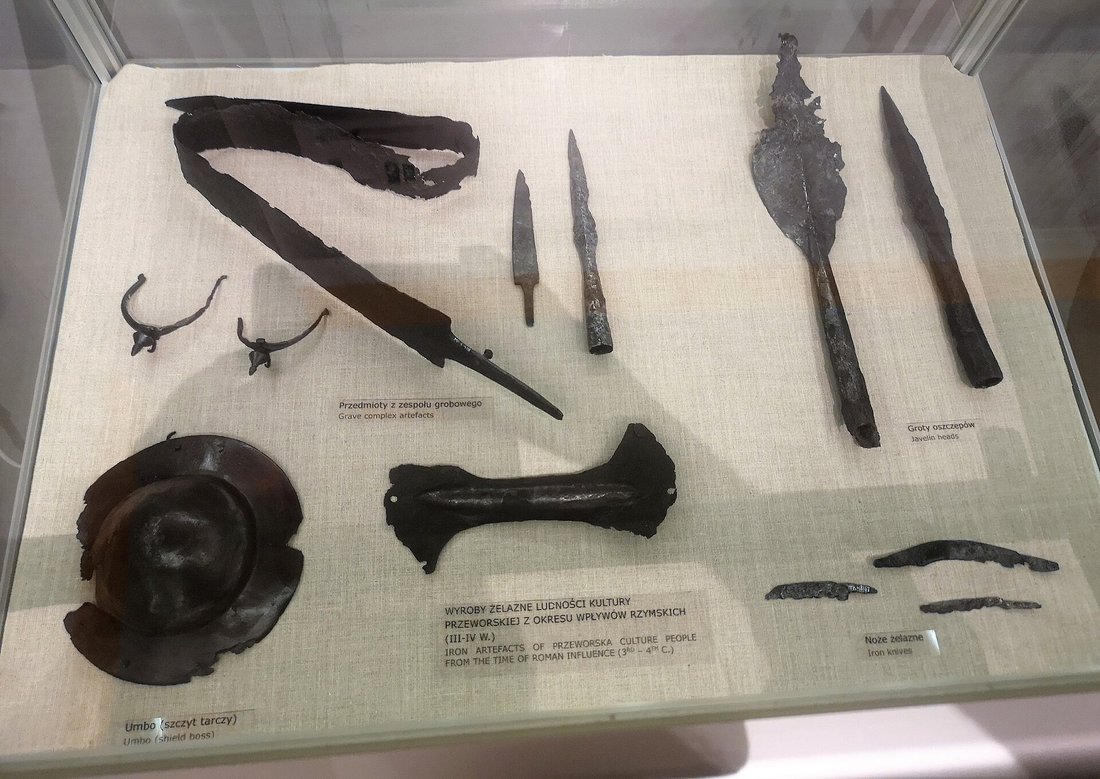
Archaeologically the land between the upper Oder and the Vistula is anything but empty. From the third century BC into the fifth century AD it is occupied by the Przeworsk culture: cremation as the clearly dominant rite, a striking quantity of weapons in male graves, iron dress accessories in large numbers, heavy iron smelting, dense contacts with the Roman Empire. Major cemeteries run to well over a thousand burials. It is a well-defined, prosperous, weapon-minded world.
Kazimierz Godłowski, who knew this culture as well as anyone, held it to be more than a sum of traits: the expression of a community of many small tribes sharing customs and stable ties. He proposed identifying the Lugii, wholly or in part, with the Przeworsk complex north of the Sudetes and the Carpathians – and in the same breath warned against reading the culture as simply Vandalic, or equating Vandals and Lugii outright.
Here lies the heart of the matter. An archaeological culture is a modern ordering category: a set of recurring forms in a region. An ethnic name is an ancient ascription, usually from outside. Both describe the same country, but not the same phenomenon. Brooches carry no ethnicity, and urns give no names.
For the Helvecones the sober consequence is this: not a single object, inscription or settlement names them. No cemetery can be assigned to them, no rampart, no vessel. One may say they very probably lived within the Przeworsk culture. One cannot say which part of it they were. Anyone looking at a map with “Helvecones” printed over a neatly outlined territory is looking at a hypothesis in cartographic form.
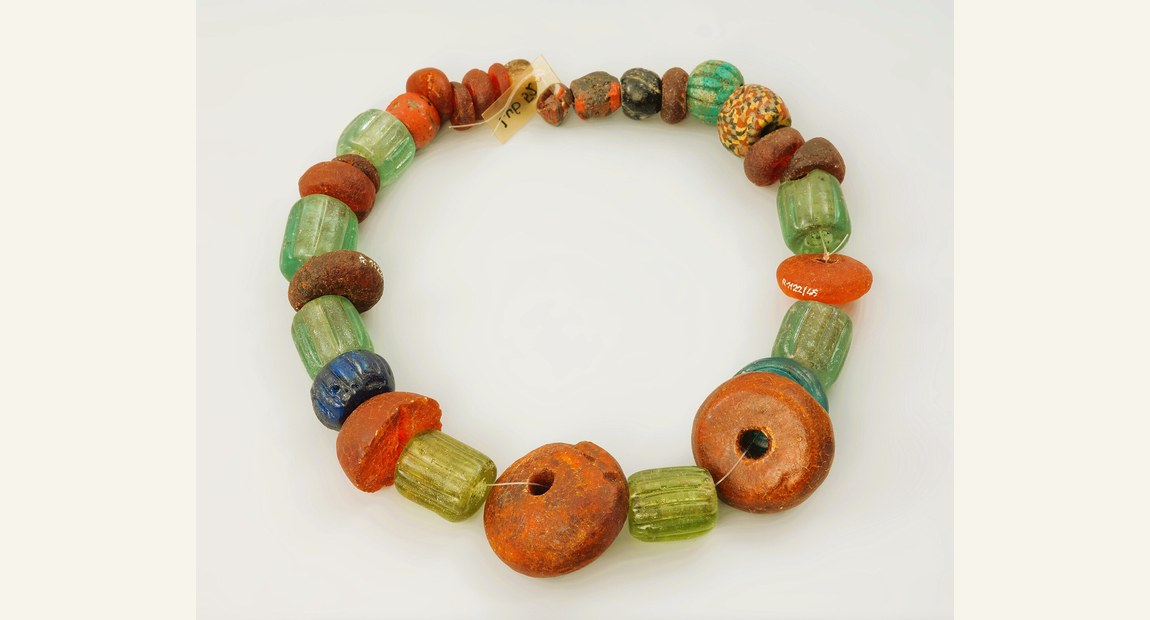
What made this region interesting to Rome was amber. Pliny the Elder reports that under Nero a Roman knight travelled to the Germanic coast expressly to procure amber for the games, and brought back so much that even the safety nets of the arena were studded with it. He gives the distance from Carnuntum on the Danube to those coasts as some six hundred miles. The main route ran from the Baltic along the Vistula, through the Moravian Gate, across the Danube at Carnuntum and on to Aquileia on the Adriatic.
Anyone looking at that map from Alsdorf or Aachen finds the connection elsewhere. Amber reached the west along its own axis, following the Rhine and the Rhône southwards. Same commodity, two separate corridors. The Helvecones sat on the eastern one, not the Rhenish one. It is a fine illustration of how far this world was networked, and at the same time a warning not to fold the two routes into one.
In the third century the Lugii vanish from Greek and Roman texts. Zosimus reports that the emperor Probus crushed them under a king named Semno – a notice Castritius distrusts, since the royal name may simply have been built from the ethnic name of the Semnones. At the same period, in the same region, the Vandals move into the foreground.
Reinhard Wenskus read this as a change of name: the native self-designation Vandili, already known to Pliny, came to the fore once these groups met Rome directly during the Marcomannic Wars, gradually displacing the externally applied Lugian name. Castritius considers it possible that both designations ran in parallel for a while. What became of the Helvecones, no source says. They may have been absorbed into one of these bodies, taken part in the migrations, or simply slipped out of the Roman field of view. We do not know.
Three claims circulate that will not hold. First, that “Helveconae” or “Helvecones” are ancient forms of the name. They are not – what is attested is only the accusative Helveconas alongside the variant Helvaeonas; both nominatives are modern back-formations. Second, that Ptolemy lists the Helvecones among the Lugii. He does not – his Lugian subgroups are the Omanoi, Dounoi and Bouroi, and the equation with his Ailouaiones is a seventeenth-century conjecture that additionally presupposes a different homeland. Third, that the Helvecones are identical with Pliny’s Hilleviones on the island of Scatinavia. That too is pure name resemblance, depends on a difficult passage in Pliny, and has been pulled in both directions for centuries. It carries no weight.
What remains is a word in the accusative, a set of neighbours, and a large archaeological record that says nothing about it. That sounds like little, but it is exactly what one can honestly take away. The Helvecones show that the Germanic world east of the Oder was politically organised – in leagues with names, rank and shared sanctuaries, as the Nahanarvali demonstrate with their grove and the Harii with their reputation. North of them sat the Gutones, and in the wider frame Tacitus counted the whole of it within Suebia, in the orbit of the Suebi.
And they show where our knowledge stops. A people can have been strong enough to make a short Roman list and still remain, for us, nothing but a name. Anyone able to sit with that instead of filling the gap with embroidery has learned more from the Helvecones than from any prettily coloured map.
The Lugii · The Harii · The Nahanarvali · The Vandals · The Gutones · The Bastarnae · The Marcomanni.
All History & Finds articles →
The Helvii lived between the Rhone and the Cevennes, in what is now the Ardeche. They were small, unspectacular and …
Read more →