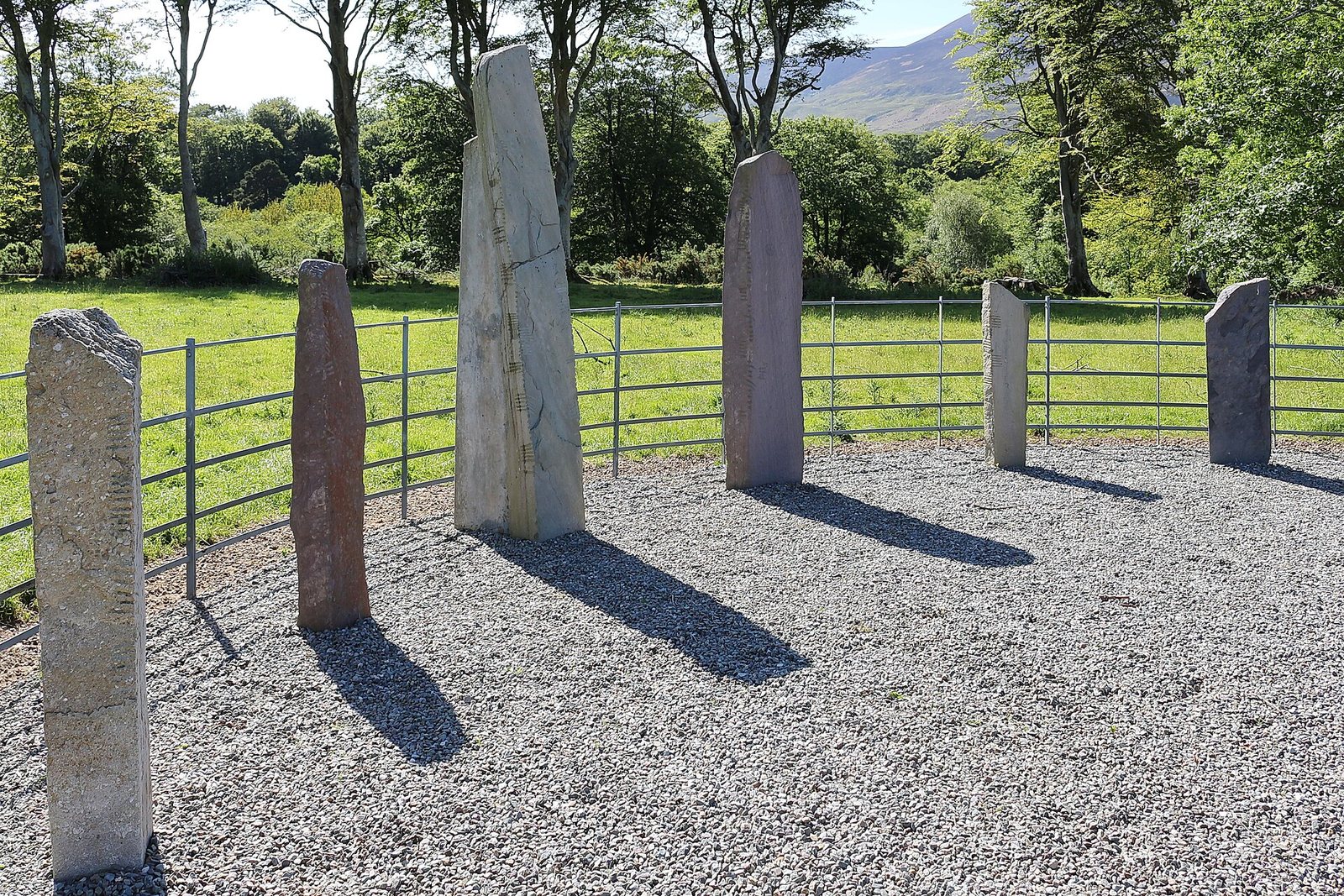
Ogham (pronounced roughly "ohm") is the oldest known script of the Celts, above all in early medieval Ireland and parts of Britain (roughly 4th–7th c. AD). It consists of groups of notches and strokes arranged along a central line – usually the edge of a stone.
The alphabet comprises 20 basic signs (later expanded), grouped into four groups (aicme) of five letters each. A sign is a certain number of strokes to the right, left or across the edge. It is read from bottom to top. Each letter bears a name, traditionally after trees – hence the (however overrated) byname "tree alphabet".
Most Ogham inscriptions are short and stand on boundary and memorial stones. They almost always name names: "(stone) of X, son of Y". Ogham marked property, grave and remembrance – a script for the essentials, in stone for eternity.
"Wits must he have who wanders wide, but all is easy at home."Hávamál 5, after Henry A. Bellows 1923 (public domain)
The comparison to the Germanic runes is obvious: both are early, consist of straight lines (ideal for carving and cutting), bear letter names and often stand on memorial stones. Whether they influenced each other is unclear – both probably arose independently from contact with the Latin script. Two peoples, the same idea: to fix language in stone.
Ogham is the oldest known script of Ireland – a unique system of notches and strokes carved along an edge. Most often it is found on the edges of upright standing stones, more rarely on wood.
Each letter of Ogham consists of one to five notches carved above, below or across a central line. This clear, unusual structure makes Ogham unmistakable – a script like a tally stick.
Most surviving Ogham inscriptions date from the 4th to 6th century and almost always name names – often grave or boundary stones in the sense of "X, son of Y". They are a precious testimony of the early Irish language.
Like the Germanic runes, Ogham was a carving script for short, mostly name-bearing inscriptions. Both arose at the edge of the Roman world. A direct kinship, however, is not proven – they are rather parallel developments.
Ogham is the Celtic art of carving language into stone – sober, elegant and related to the Germanic runic script. More on the runes in our rune overview.
Runes & their meaning · Celtic Religion · The Druids · The Celtic Warriors · Celtic Princely Graves.
All Runes & Writing articles →
Not every runic text honours a dead man. Some tell of a flight. The Oklunda inscription in Östergötland is a rare legal …
Read more →A granite block nearly four metres tall, densely covered on all five faces with around 760 characters: the Rök Stone …
Read more →It is one of the most powerful scenes in all Norse poetry: Odin, the highest god, hangs nine nights self-sacrificed in …
Read more →Before the runes became oracle stones in a pouch, they were simply the first alphabet of the North – for names, trade …
Read more →