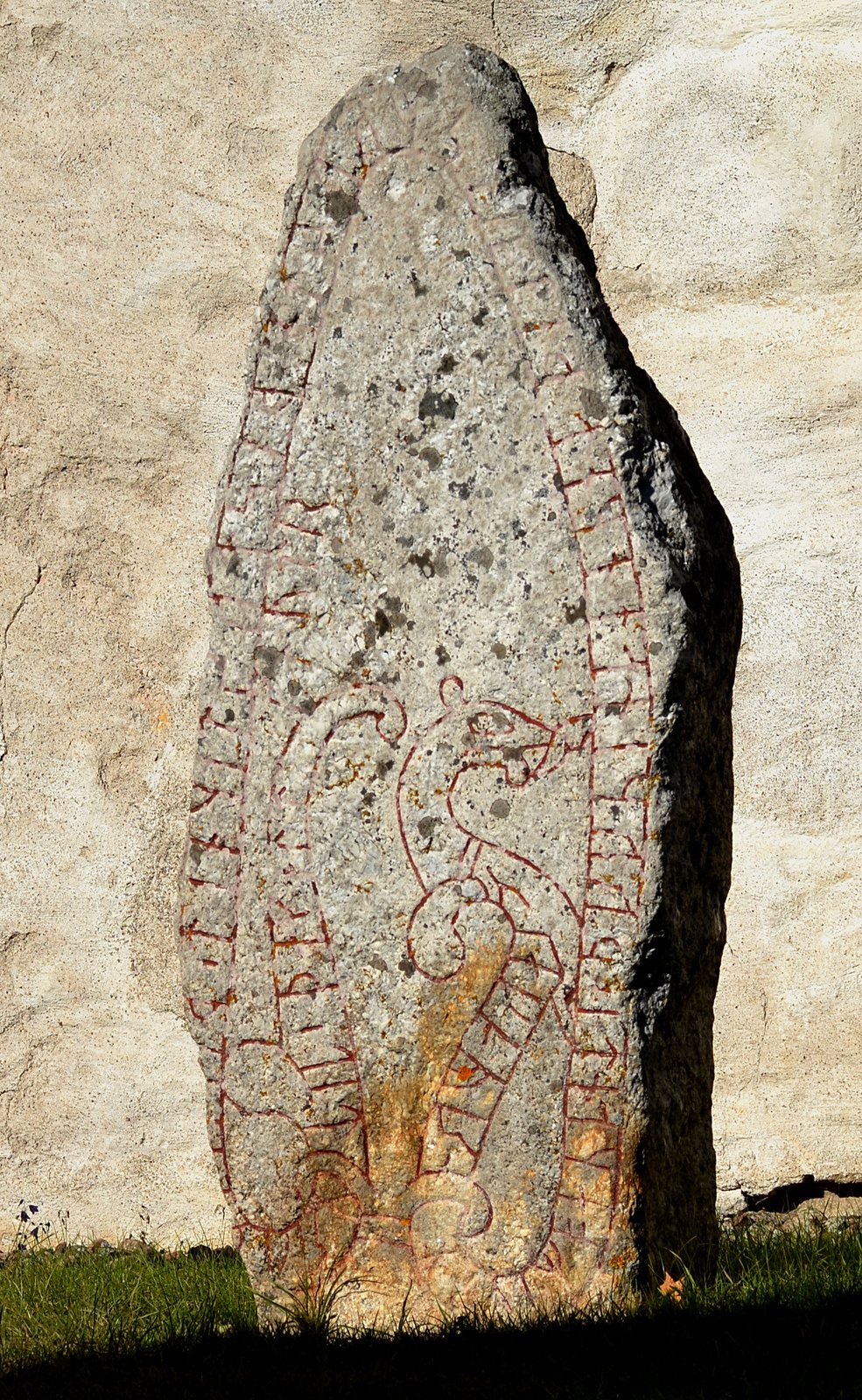
Most runestones tell of death. One in Uppland tells of a career. Ulf of Borresta, it says, took payment in England three times – and then it lists the payers one by one, all the way up to King Cnut. Ulf is not alone. Some thirty stones in Scandinavia commemorate men who went to England. Together with the Anglo-Saxon Chronicle they give us a rare view: the same years seen once from the side of those who paid and once from the side of those who took.
Runestone U 344 originally stood at Yttergärde in Uppland and now stands by the church of Orkesta. It belongs to a group of stones raised by Ulf and his family. The decisive part reads:
En Ulfʀ hafiʀ a Ænglandi þry giald takit. Þet vas fyrsta þet's Tosti ga[l]t. Þa [galt] Þorkætill. Þa galt Knutr.
"And Ulf has taken three payments in England. The first was the one Tosti paid. Then Thorketil paid. Then Cnut paid."Runestone U 344, Yttergärde, now Orkesta; normalised reading after the Samnordisk runtextdatabas, English rendering our own
The Old Norse word is gjald, payment, levy: money England paid so that an army would leave or stay in its service – and of which Ulf brought his share home.
Two of the three names can be placed. Thorketil is very probably Thorkell the Tall, who was in England with a large army from 1009 to 1012. Cnut is Cnut the Great, king of England from 1016. Who Tosti was remains open. A Swedish leader known from later sagas has been suggested; it is not certain.
About thirty runestones mentioning England are known. The great majority, around twenty-seven, stand in present-day Sweden, seventeen of them in the provinces around Lake Mälaren alone; a few more are in Denmark and Norway.
That Sweden has so many does not mean Swedes went to England more often than Danes. It reflects a custom: eleventh-century Uppland raised runestones in numbers seen nowhere else. The England stones are one slice of that wave.
On the other side stand the figures of the Anglo-Saxon Chronicle. After the defeat at Maldon in 991 England paid ten thousand pounds of silver. In 994 it was sixteen thousand, in 1002 twenty-four thousand, in 1007 thirty-six thousand – thirty thousand in one manuscript – and in 1012 forty-eight thousand. In 1018, after his accession, Cnut raised seventy-two thousand pounds, plus ten and a half thousand from London alone, to pay off his army.
The chroniclers call it gafol, tribute. From 1012 a regular tax was added, the heregeld, which paid mercenary fleets in the king's service. The word "Danegeld", by which the whole business is known today, appears only after the Norman Conquest, as the name of a land tax.
How much of it actually reached Scandinavia no one knows. But the hoards speak clearly: Scandinavian treasure finds contain tens of thousands of Anglo-Saxon silver pennies, most of them from the reigns of Æthelred and Cnut.
Ulf is the accountant among the England voyagers, but not the only one to speak of payment.
U 241 at Lingsberg says of Ulfríkr that he took payment in England twice. U 194 at Väsby says of Alli that he took Cnut's payment in England. And Sö 166 from Grinda in Södermanland joins two directions:
"Guðvér was in the west, shared out payment in England, manfully attacked towns in Saxony."Runestone Sö 166, Grinda; English rendering our own
Sharing out payment means dividing spoils among companions, not plundering on one's own account. The stone shows a man who knew both: the paid voyage to England and the raid on the North Sea coast of the Empire.
Not every England voyager was an attacker. On U 668 at Kålsta two brothers raised a stone for their father Geiri, who "sat in the þingalið in the west". The þingalið was the core troop of England's Danish kings between 1016 and 1066, a paid elite drawn largely from Scandinavia.
Geiri, then, was no robber but a professional soldier in the service of a king in London – the same world as the Varangian Guard in Byzantium, only at the other end of Europe.
Proven is that men from Uppland and Södermanland went to England in the late tenth and early eleventh centuries, took part in tribute payments and served in Cnut's army, and that their families were proud of it. The scale of the payments is proven too – from the English side.
Not proven is what any one man received, which battles he fought in, how he came home. The stones are memorials, not reports.
And they are one-sided. What the same years felt like from the other side was put down in 1014 by Archbishop Wulfstan in his sermon to the English, the Sermo Lupi ad Anglos: a country that saw itself punished by God because it no longer knew how to defend itself. Anyone who wants to understand the England voyagers should read both.
The England voyagers are the late heirs of the Great Heathen Army and the contemporaries of the Ingvar voyagers, who set out east from the same villages. For courage. For memory. For legends that live on.
Cnut the Great · Sweyn Forkbeard · The Great Heathen Army · The Ingvar Expedition · The Danelaw · Lið, Hird & Leiðangr · Miklagard and the Varangians · Danes, Swedes, Norwegians.

