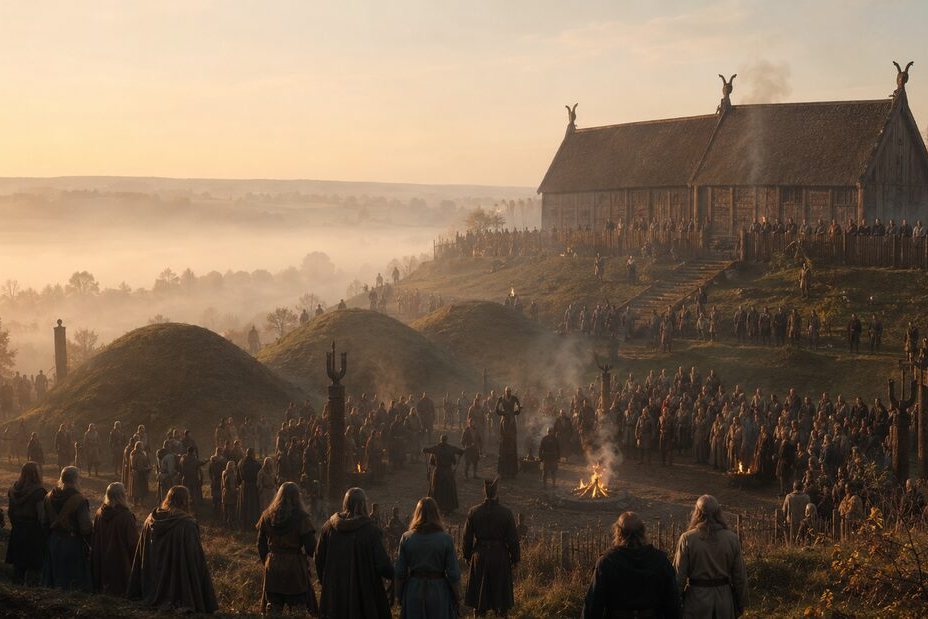
 A league of free tribes that tolerated no prince but decided in the people's assembly – and whose pagan sanctuary of Rethra held all of northern Germany in suspense.
East of the Abodrites, between Elbe and Oder, lived a Slavic federation unlike all its neighbours: the Liutizi (Lutici), called Wilzi by the earlier Franks. Their peculiarity: they had no king. Instead of a prince, the people's assembly ruled – a pagan league of tribes, held together less by rule than by a common cult.
The core of the Liutizi consisted of four tribes: the Redarii, Circipani, Kessini and Tollensani. Important decisions were made jointly; whoever did not comply was forced by fines or violence. The chronicler Thietmar of Merseburg marvelled that this people managed without a head: "They have no lord." For the feudal world of Saxons and Franks that was scarcely conceivable.
As early as 789 Charlemagne marched against the Wilzi, crossed the Elbe and forced their leader Dragovit to submit. It was one of the farthest eastern expeditions of the Frankish empire. But the submission stayed superficial: again and again the league broke free and remained for centuries an independent, pagan power on the empire's northeastern frontier.
The heart of the league was not a princely seat but a temple. In Rethra (also Riedegost), which lay in marshy, forest-ringed land, the Redarii worshipped the warlike god Zuarasici (Svarožić), often equated with Radegast. Thietmar of Merseburg describes a wooden temple with several gates, in which the god-images stood with names and helmets, along with the army's battle standards, brought out only for war. Before every campaign the oracle was consulted: lots were cast and a sacred horse was led over crossed spears. Rethra was the spiritual centre that held the four tribes together.
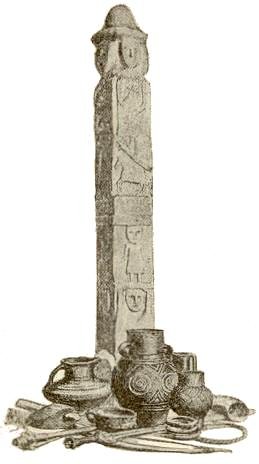
In 983 came the great blow: in a huge Slavic revolt the Liutizi threw off German rule and the church. The young bishoprics of Havelberg and Brandenburg were destroyed, priests driven out or killed, Christianity east of the Elbe set back for some two centuries. The revolt was not only political but religious: a deliberate return to the old faith, carried by the cult of Rethra.
There followed one of the strangest alliances of the Middle Ages. In the great war between Emperor Henry II and the Christian Polish duke Bolesław the Brave, the pagan Liutizi fought alongside the Christian emperor – with their god-images in the army. For Henry it was a political scandal the church held against him; for the Liutizi it was the price of their independence. The alliance shows how far power politics could override the boundaries of faith.
What enemies could not do, internal strife achieved. Around 1057 the league broke apart in a civil war between its own tribes; Rethra lost importance, and the cult partly migrated to Arkona on Rügen. Weakened, the Liutizi lands fell in the 12th century to the Abodrites, Saxons and the Wendish Crusade. Their heirs merged into the March of Brandenburg and Pomerania.
Why did a whole people manage without a king? The Liutizi were a markedly egalitarian warrior society: free farmers and warriors decided together, plunder and land were shared, and too powerful a leader was seen as a danger. The league was held together not by a dynasty but by the common cult and the fear of the god of Rethra. This form of rule was fragile – it worked as long as outside pressure and religious unity bound the tribes, and collapsed once both weakened.
The cult of Rethra was wholly geared to war. Thietmar reports that the league's battle standards were kept in the temple and brought out only for war – whoever damaged them was harshly punished. Before every campaign the sacred horse was consulted: the priest led it over crossed spears; the order of its hooves decided war or peace. In addition, lots were cast on inscribed sticks. So the sanctuary was war-council and oracle in one – a religious centre that made political decisions.
The Redarii around Rethra counted as the leading tribe; the Tollensani sat on the Tollense, the Circipani between Peene and Recknitz, the Kessini on the Warnow. The Tollense region in particular is famous today for a quite different find – the Bronze Age battlefield in the Tollense valley – yet in the Slavic Middle Ages too this water-rich land was a heartland. After the league's collapse the Liutizi lands passed to Pomerania and the March of Brandenburg; German eastward settlement reshaped villages and names, but the Slavic substrate survived in countless place names. It is telling that the very heartland of Prussia and Brandenburg – Berlin among them, a name of Slavic origin – grew on Liutizi ground. The pagan league that once defied emperors became, over the centuries, the invisible foundation of a new German east. For our workshop this matters: whoever engraves a Slavic or Norse motif touches a shared Baltic past in which Vikings, Slavs and Saxons traded, fought and lived side by side. The Liutizi are a reminder that the north was never one people alone.
After its internal collapse the Liutizi lost their fighting strength. In the 12th century Saxon, Danish and Ascanian princes pushed into their land, and with the Wendish Crusade of 1147 the final conquest began. Albert the Bear founded the March of Brandenburg in 1157 on formerly Slavic soil; German settlers, monasteries and towns reshaped the land. Yet the Slavic substrate never wholly vanished: in thousands of place names, in the language of the Sorbs in Lusatia and in archaeological finds, the world of the Liutizi lives on to this day.
So the league of the Wilzi is a striking example that "Germany" in the east stands on a Slavic foundation – a history long suppressed and only brought back to light by modern archaeology.
"They have no king; everything is decided by the assembly in unanimous counsel."after Thietmar of Merseburg, Chronicle (public domain, own translation)
The Abodrites · The Rani (Rügen) · Germanic Sacrifice & Sanctuaries.