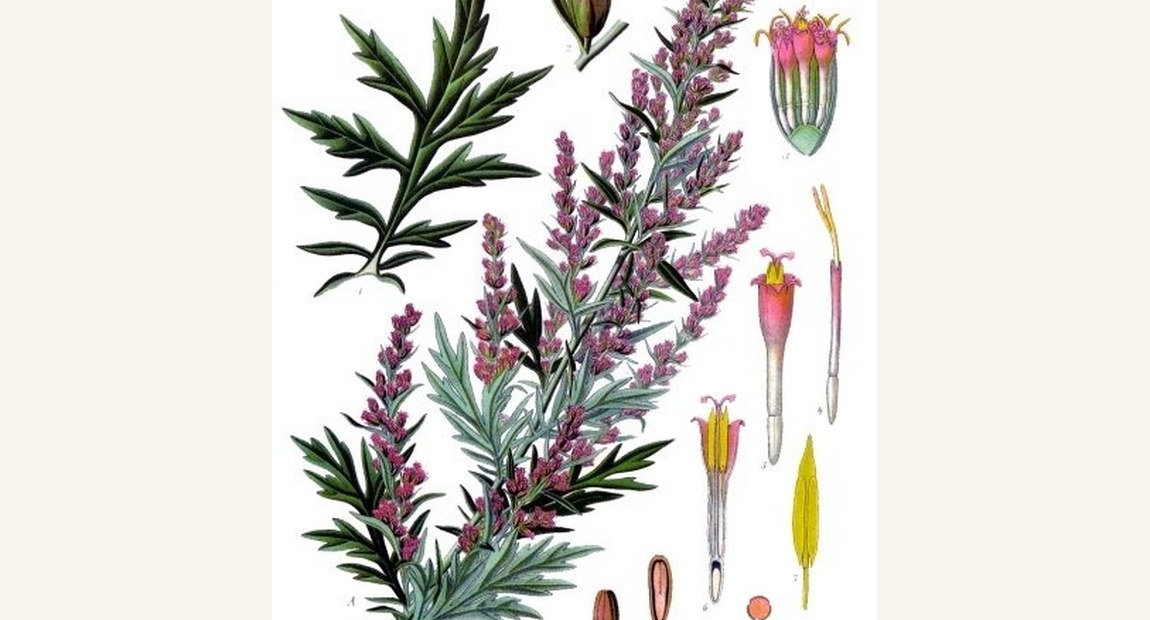
The Vikings healed with herbs, leeks and onions, with bandages and hard-won experience – and almost always with words spoken or carved alongside. What they did not leave us is a Viking herbal. We piece their medicine together from fragments: Old English leechbooks such as the Lacnunga with its Nine Herbs Charm, plant remains from graves like Oseberg and Fyrkat, saga scenes from the battlefield and Eddic verses about healing runes. Here we separate what is attested from what is interpretation – and point out where plants are simply dangerous.
Picture a farm in western Norway in the tenth century. The son has driven an axe into his shin while splitting logs; grandmother has been coughing for weeks. No pharmacy, no package leaflet, no doctor in the modern sense. What there was: people who knew how to wash and bind a wound, which plants grew where – and which words to say over the patient.
The Viking Age (roughly 793 to 1066) left almost no texts of its own, and certainly no recipe collections. The sagas and the Eddas were written down in Iceland in the twelfth and thirteenth centuries. The oldest detailed medical books from the Germanic-speaking world come from England, written in Old English – the language of the Anglo-Saxons, related to Old Norse but not the same.
So anyone talking honestly about Viking herbal medicine has to keep four kinds of evidence apart: archaeological finds, contemporary texts from neighbouring lands, later Norse tradition, and modern interpretation. For broken bones, teeth and surgery, see our wider overview of Viking medicine.
The Nine Herbs Charm – often called Nigon Wyrta Galdor, "the song of nine herbs" – survives in a British Library manuscript, Harley MS 585. This collection of remedies, charms and prayers is known by the modern title Lacnunga ("remedies") and was written around the year 1000, in the late tenth or early eleventh century. Individual texts in it may be considerably older, though nobody can say exactly how old.
The charm is not fireside poetry but part of a set of working instructions. It addresses the plants directly, praises their power against "poison" and "the flying thing" – probably diseases imagined as arriving through the air – and ends on a practical note: grind the herbs to powder, mix them with soap and apple juice, and wash the patient with a slurry of water, ash and fennel before and after the salve goes on.
Its opening still sounds like an invocation:
"Gemyne ðu, mucgwyrt, hwæt þu ameldodest, hwæt þu renadest æt Regenmelde." – Remember, mugwort, what you made known, what you arranged at Regenmeld.Nine Herbs Charm, Lacnunga (BL Harley 585), Old English text; our own translation
Nobody knows for sure what "Regenmeld" was. The number nine runs through the whole text, and three appears again and again. The charm names nine plants, fights nine poisons and nine "flyings", and tells of nine twigs.
Many books and websites give you a neat list: mugwort, plantain, lamb's cress, betony, chamomile, nettle, crab apple, chervil and fennel. That is a widespread modern identification – no more than that. Some of the Old English plant names are clear; others are genuine puzzles.
Anyone who claims "the Vikings" used exactly these nine plants in exactly this order is selling a certainty the source does not offer. Medieval plant names wander.
Halfway through the charm comes the moment that makes it so precious for the history of religion. A serpent – Old English wyrm – comes creeping and wounds a man. Then a god steps in:
"Wyrm com snican, toslat he man; ða genam Woden VIIII wuldortanas, sloh ða þa næddran, þæt heo on VIIII tofleah." – A worm came crawling, it tore a man; then Woden took nine glory-twigs, struck the adder so that it flew apart into nine.Nine Herbs Charm, Lacnunga (BL Harley 585), Old English text; our own translation
Woden is the Old English form of the god the Scandinavians called Óðinn (see Wodan, Donar and Ziu). Outside royal genealogies he appears very rarely in Old English poetry – the line is a small treasure.
What are the wuldortanas, the glory-twigs? One popular reading, mentioned among others by the historian Henry Mayr-Harting, sees them as wooden slips each carved with the initial rune of a plant. It is not attested – the text only says "twigs of glory". An inspiring hypothesis, nothing more.
Another line has kept scholars busy. Of chervil and fennel the charm says that the "wise Lord, holy in heaven" created these herbs "while he hung". Read in Christian terms, that is Christ on the cross. Some have thought of Odin, who according to the Edda hung nine nights on the windswept tree. "Holy in heaven" points rather towards the Christian reading.
The translator R. K. Gordon called the charm "clearly an old heathen thing" that had been subjected to Christian censorship. That captures something real, but it is itself an interpretation: the text also contains a line about Christ who "stood over disease". Heathen and Christian elements cannot be neatly pulled apart here. You will find a very similar blend in Germany, in the Merseburg Charms, where Wodan heals a lamed foal: "ben zi bena, bluot zi bluoda" – bone to bone, blood to blood.
The second great Old English medical book is Bald's Leechbook, preserved in a British Library manuscript (Royal MS 12 D XVII) from the mid-tenth century. It mixes recipes derived from Latin medical writing with home-grown knowledge.
One recipe became world-famous in 2015: an eye salve against a wen, probably a stye on the eyelid. In paraphrase: take cropleac (an allium, probably onion or leek) and garlic in equal amounts and pound them well; take wine and ox gall in equal amounts and mix them with the alliums; put it in a brass vessel, let it stand for nine nights, strain it through a cloth, clarify it well, put it in a horn and apply it to the eye at night with a feather. And there is that nine again.
A team led by microbiologist Freya Harrison and Anglo-Saxonist Christina Lee at the University of Nottingham recreated the mixture. Their study, published in mBio in 2015, found that the salve killed biofilms of Staphylococcus aureus in the lab and markedly reduced the drug-resistant strain MRSA in a mouse model of chronic wounds. A follow-up study (Furner-Pardoe and colleagues, Scientific Reports, 2020) showed that the effect appeared only when all the ingredients were combined – garlic alone did not clear the biofilms.
Now for the big "but". These were laboratory and animal experiments, not human trials. The identity of cropleac is uncertain and the proportions had to be interpreted. The research shows that medieval recipes can be more than superstition. It does not show that you should put garlic mash in your eye. Please don't – eyes are delicate, and non-sterile mixtures can cause serious infections.
From England to Norway, and from parchment to soil. In the autumn of 834 – dated precisely by the tree rings in its timbers – two women were buried in a magnificent ship by the Oslofjord. Because the mound of the Oseberg ship sealed so tightly, wood, textiles and plants survived that would normally have rotted away.
The botanical material was studied as early as the 1920s by the botanist Jens Holmboe. According to that work, the plants in the grave included wild apples in a wooden bucket, hazelnuts, cereals, seeds of woad (Isatis tinctoria), a dye plant for blue, as well as garden cress and hemp (Cannabis sativa). Provisions for the afterlife, garden and craft side by side.
A small leather pouch containing cannabis has drawn particular attention; reports link it with the older of the two women. Skeletal studies by Per Holck suggest she lived to around 80 and suffered from severe arthritis, and later examinations have raised the possibility that cancer was the cause of death. From this grew an obvious but unproven idea: hemp as a painkiller for a sick old woman.
Appealing, but open. In Scandinavia hemp was above all a fibre plant for ropes and cloth, and hemp seed is also food. Whether anyone used it to ease pain, or whether the pouch simply held seed, cannot be read from the find. There is much more on the two women in our full Oseberg article, and on woad in our piece on Viking-age dyeing.
Some 150 years later, in the Denmark of Harald Bluetooth, the ring fortress of Fyrkat rose near Hobro in northern Jutland. In its cemetery lies a woman whom the National Museum of Denmark interprets as a possible seeress, a völva. She was buried in the body of a horse-drawn wagon, as the richest women of her time were, dressed in fine clothing with gold thread and wearing silver toe rings otherwise unknown in Scandinavia.
For our subject, the key object is a pouch of henbane seeds (Hyoscyamus niger). With it lay an iron staff with bronze fittings, perhaps a seeress's staff, and a small box holding owl pellets and little animal bones. The museum notes that burnt henbane seeds can produce an intoxicating smoke. Anyone who thinks of seiðr rituals, of trance and visions, will see the connection at once.
This is where we have to raise our voice: henbane is highly poisonous. It contains tropane alkaloids such as hyoscyamine and scopolamine, which even in small amounts can cause racing heart, confusion, hallucinations, respiratory paralysis and death. The gap between "effect" and "poisoning" is tiny and varies from plant to plant. What an experienced seeress did with it more than a thousand years ago we do not know – and it is not a recipe to copy. More on the plant and the legends around henbane and beer in our article on henbane.
Perhaps the most striking healing scene in Old Norse literature follows the Battle of Stiklestad, where King Óláfr Haraldsson – later Saint Olaf – fell in 1030. It appears in Snorri Sturluson's saga of Óláfr the Saint in Heimskringla and, in its own version, in Fóstbræðra saga. Both were written down some 200 years later.
The skald Þormóðr Kolbrúnarskáld, one of the king's men, has an arrow lodged in his side. He drags himself into a barn where wounded men are being cared for. A woman is washing wounds with warm water and binding them. In a stone kettle she has stirred together leeks and other herbs, boiled them, and she gives the wounded some to eat. The point is strikingly practical: if she can then smell leek at the wound, she knows the abdomen has been pierced – a holsár, a "hollow wound", which in those days was almost always fatal.
Þormóðr refuses the porridge – roughly, with the dry remark that he does not have "porridge sickness". The woman tries to pull out the arrowhead with tongs and fails. So he takes the tongs himself and wrenches the iron out. Fibres hang from the barbs, red, white, yellow and green. He looks at them and says, in effect, that the king has fed them well – there is still fat around the roots of his heart. Then he falls back dead.
We cannot know whether it happened quite like that. But the saga shows medical thinking of its day: a logical test for abdominal wounds, washing, binding, removing foreign bodies. And it is a woman doing this work. Needless to say, it is no guide to self-diagnosis: abdominal injuries are still an emergency for the ambulance service.
The sagas know the word læknir – physician, healer. It is related to Old English læce, the "leech" in "leechbook". Healing was knowledge passed down within families and on farms, and it was often in women's hands; in the sagas it is frequently women who wash and bind wounds after a fight. For women's roles more broadly, see our article on women in the Viking Age.
Snorri tells a famous episode in the saga of Magnús the Good. After the battle on Lyrskog Heath in 1043 there were too few healers for all the wounded. The king is said to have picked the twelve men with the softest hands to bind wounds – and according to the saga they all went on to become excellent healers.
The law codes have their say too. Medieval Scandinavian provincial laws set out compensation for injuries that included the cost of treatment – salve, bandage and the healer's fee; the Norwegian Frostathing Law, for instance, provides for a monthly payment to the physician. These laws are later than the Viking Age (more in our piece on Viking-age law).
And then there are the plants that really mattered in the North. Angelica (Angelica archangelica, Old Norse hvönn) was gathered and eaten in Norway and Iceland; a law book from the late thirteenth century even mentions angelica gardens (see angelica). Leeks and onions – both laukr in Old Norse – were among the most important crops of the time (see what the Vikings ate).
In the North, medicine and magic sat close together. In the Edda the valkyrie Sigrdrífa instructs the hero Sigurd in different kinds of runes. One stanza of Sigrdrífumál is devoted to "branch runes", Old Norse limrúnar:
"Limrúnar skaltu kunna, ef þú vilt læknir vera ok kunna sár at sjá; á berki skal þær rísta ok á baðmi viðar, þeim er lúta austr limar." – Branch runes you must know if you would be a healer and know how to look at wounds; on bark you shall carve them, and on the trunk of a tree whose limbs bend to the east.Sigrdrífumál, Poetic Edda (Codex Regius, c. 1270), Old Norse text; our own translation
Some editors emend limrúnar to lífrúnar, "life runes" – the sense stays similar. In the same sequence Sigrdrífa advises throwing a leek into the drink so that no poison can work in it, and names "help runes" for childbirth. This is poetry written down in Christian Iceland – never a healer's handbook. You can read the full text with us: Sigrdrífumál to read. The Hávamál, too, have a stanza of "remedies": earth against drunkenness, fire against sickness, oak against constipation, runes against harm – probably a later interpolation, as Bellows thought.
The finest warning against botched rune magic comes from Egils saga. Egill Skallagrímsson arrives at a farm in Värmland where a girl called Helga has long been lying ill. A farmer's son had carved runes on a piece of whalebone to heal her – but carved them wrong. Egill finds the bone in her bed, scrapes off the runes, burns the shavings and carves new ones. The girl recovers. And Egill makes a verse whose core is this: no man should carve runes who cannot read them well. A rule we take seriously in our workshop – for spelling reasons.
The first version of this article said that a rune was named after the leek. We need to correct that. The word laukaz ("leek") is a famous formula word on gold bracteates and other early runic inscriptions, often alongside alu. Some scholars reconstruct the name of the l-rune as *laukaz, others as *laguz ("water"); the later rune poems call it lögr or lagu, that is, water. What is certain: the leek had a place in the formulaic language and, as Sigrdrífumál shows, in ideas of protection against poison. Whether the rune itself was called "leek" is uncertain.
Why the leek of all plants? It grows fast, smells sharp and keeps well. In Eddic poetry Sigurd is even compared to a leek grown tall out of the grass – an image of strength and thriving.
Plantain, chamomile, fennel, garlic, onion – you know many of these plants. That makes it tempting to think you could heal "like the Vikings". So let us be clear: this article is history, not health advice. We give no medical recommendations, no doses and no recipes to copy.
Some plants from this world are seriously dangerous. Henbane can kill. Mugwort can trigger allergies and is problematic in pregnancy. Foragers can confuse members of the carrot family – chervil and fennel have poisonous relatives such as hemlock, which looks similar in the field. Never pick anything you cannot identify with certainty, and talk to a doctor or pharmacist if you are unwell. In case of poisoning, call your local poison control centre or emergency number (112 in Europe) at once.
So what does hold? The attitude. People back then observed closely, washed wounds, had tests and experience, and knew the line between remedy and poison. And they believed that words and signs played their part. A line from the Nine Herbs Charm above the door is a reminder of how old the wish is to hold healing and hope together. But the garden is for chamomile and fennel, not henbane. For cleanliness and body care in the period, see our piece on Viking hygiene.
What herbs did the Vikings use for healing? No recipes survive from Scandinavia itself. Finds and texts point to leeks, onions, angelica and other garden and wild plants; from England, the Nine Herbs Charm preserves mugwort, plantain, chamomile, chervil and fennel.
Is the Nine Herbs Charm a Viking text? No. It is Old English and found in the Lacnunga (British Library, Harley 585, c. 1000). It reflects a shared Germanic world of ideas, not a Scandinavian text.
Does Bald's eye salve really kill MRSA? In 2015 a recreated mixture was active against MRSA in the lab and in a mouse model. There are no human trials, and the salve is emphatically not something to make at home.
Did the Vikings use cannabis? Hemp was found in the Oseberg grave, and hemp was grown in Norway, mainly as a fibre plant. Its use as a painkiller or intoxicant is not attested.
What does henbane have to do with Viking seeresses? The grave of a possible völva at Fyrkat contained a pouch of henbane seeds. Ritual use is possible but unproven – and the plant is highly poisonous.
What are limrúnar? In the Eddic poem Sigrdrífumál they are runes a healer should know and carve on tree bark. It is a medieval poetic idea, not a documented healing method.
For courage. For remembrance. For legends that live on.
Rune magic – alu, laukaʀ and the formula words · The old year's cycle up close · The Mästermyr tool chest · Viking clothing & fashion · Mead – the drink of gods.
All Everyday Life & Craft articles →
The shining swords, the fine brooches, the carved ships – behind all of it stood a craftsman with his tools. What those …
Read more →From honey, water and time comes the oldest intoxicating drink of the North. But mead was more than a drink – it was …
Read more →Again and again, peat-cutters in Ireland, Scotland and Scandinavia find the same riddle: a lump of waxy, ancient …
Read more →There are tools that become legend. Among the Vikings it was a sword – or rather: a whole group of swords, all bearing …
Read more →