Few plants mattered as much to the people of the far North, and are as thoroughly underrated today, as angelica. To us, Angelica archangelica is at best an ingredient in herbal liqueurs – but to the farmers and seafarers of the Viking Age, the hvönn was food, seasoning and hard currency, valuable enough to be protected against thieves by law.
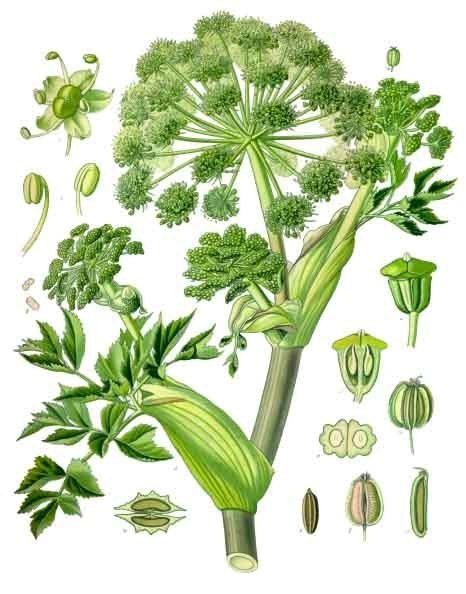
Garden angelica, botanically Angelica archangelica, belongs to the umbellifers – that great plant family which also includes carrot, celery, fennel and caraway. Anyone who has seen it once by the roadside does not forget it: a mighty perennial, often more than two metres tall, with hollow, sturdy stems, large pinnate leaves and rounded, greenish-white flower umbels. It is biennial to short-lived perennial, usually flowering only in its second year before setting seed and dying back.
Its realm is the North. Angelica archangelica is superbly suited to life in Arctic and subarctic regions: it grows wild in Scandinavia, in Iceland, in Greenland, in northern Russia and in the mountains of central Europe – along riverbanks, in damp meadows, on slopes and coasts. In exactly the places where the climate is too harsh for many other vegetables, this robust plant thrives. For the people who settled these lands – the Norwegians, the Icelanders and the inhabitants of the Greenland settlements – that was a stroke of luck. Where grain often ripened only with difficulty, the hvönn stood reliably in the meadows.
In Old Norse the plant was simply called hvönn (plural hvannir). The word survives to this day in Icelandic (hvönn), Faroese (hvonn) and in Norwegian dialects (kvann, kvanne). It is an old, down-to-earth Germanic word – not a learned import, but the name people gave their everyday plant. That alone shows how naturally angelica belonged to life in the North.
People did distinguish between the parts: the stem, the tender leaf stalks and the strong, aromatic root. Each part had its use, and each was used. This is the first important thing to know about the hvönn: first and foremost it was not a magic charm or a medicinal herb, but simply something to eat.
Angelica was a genuine foodstuff in the North. The young, juicy stems and leaf stalks were eaten raw, peeled like a kind of fresh vegetable, or cooked. They taste strongly aromatic, slightly bitter, with a peculiar freshness – a flavour still known today mainly from candied angelica stalks, the green confection that old bakeries used to set on cakes.
In an age without supermarkets and without citrus fruit, this fresh, tart green was a treasure. The long northern winter consisted of what had been dried, salted and smoked. When the first sturdy hvannir shot up from the ground in spring, they brought crisp, fresh food to the table – at exactly the season when the body needed it most. Small wonder that people valued the plant and knew where it grew.
From a modern point of view one important reason for angelica's value is obvious: its fresh green contains vitamin C. In a diet that lived for months on preserved stores, every source of fresh vitamins was precious – and a lack of vitamin C leads to scurvy, that debilitating illness of bleeding gums, weakness and poorly healing wounds that would later plague seafaring in particular.
Let us be honest here: the people of the Viking Age of course did not know the term "vitamin C" and did not think in those categories. From experience they knew that fresh green in spring did them good and strengthened them – the biochemical explanation is supplied only by modern nutritional science. That freshly eaten hvönn really was a sensible source of vitamin C is therefore a later, factual assessment, not knowledge we may put into the mouths of the northern people. Their behaviour was practical: they ate what tasted good, filled the belly and plainly helped.
Besides its role as a vegetable, angelica was a seasoning plant. Its penetrating, resinous aroma is concentrated above all in the root and the seeds. In a kitchen whose spice shelf was modest, and in which overseas spices like pepper remained rare, expensive trade goods, aromatic native plants were precious. The hvönn belonged to this group of home-grown flavourings with which food, and later drinks, could be given character.
It is telling that angelica lives on to this day in Nordic specialities: it gives certain aquavits, herbal spirits and liqueurs their characteristic note, and in Iceland and the Faroes the hvönn is still gathered and used. In its basic idea this tradition reaches far back – the use of a wild-growing, aromatic plant that the North provides for free.
A plant this useful was not left to the chance of wild stands alone. From the sources and from the vocabulary we know that angelica was deliberately cultivated. There were purpose-made angelica gardens – in Old Norse hvanngarðr, literally the "hvönn garden" or the fenced hvönn plot. The word itself is evidence: people enclosed this plant, fenced it in, tended it, and regarded the yield as property.
That is anything but self-evident. Laying out a garden means labour, planning and a claim to the result. That people in the North maintained their own enclosed beds for the hvönn shows unmistakably what rank this plant held: it was worth it, it was plannable, it was wealth. An angelica garden was a small store of provisions on the stalk.
The strongest proof of angelica's value lies not in a hymn of praise but dryly in the law. The oldest surviving Norwegian law codes – the law of the Gulathing in the west and that of the Frostathing in Trøndelag – expressly treat the theft of hvönn from another man's enclosed hvanngarðr as a punishable seizure of another's property. Whoever helped himself from someone else's angelica garden was guilty, just as with other theft.
If a man takes hvönn in another man's angelica garden, he shall pay for it as for other theft; for what a man fences in and tends is his own.Rendered in the sense of the Old Norwegian provincial law (Gulathing/Frostathing); translation: Glanz & Gravur.
One must grasp what this means. A legal system names a particular cultivated plant and makes its theft an offence. You do not do that with roadside weeds that anyone may pick. You do it only with something that has a tangible, generally acknowledged value – as you protect a person's cattle, grain or timber. The hvönn stood in line with the economic goods of the farm.
Where a plant is wealth, it is also traded. Angelica, dried and processed, kept well and could be transported. In the North Atlantic settlements – Iceland, Greenland, the Faroes – where imported vegetables and spices were expensive and local growing conditions limited, the abundantly growing, usable hvönn had a firm place in the stores and in barter. It was one of those native products with which the North was not dependent on distant trade goods.
We should not paint the picture too large: angelica was not a long-distance trade good like walrus ivory, furs or amber that one carried south. Its value was regional and everyday – but precisely there lay its importance. It was a reliable part of self-sufficiency, plannable to grow, easy to preserve and to barter locally. That is the unspectacular but real prosperity of a northern farm.
Only later, in the Christian Middle Ages, did angelica move more strongly into the realm of medicine. In the monastery gardens and in the learned medicine of the Middle Ages and early modern period, Angelica counted as a significant medicinal plant; herbals praised it in the highest terms. To this period also belongs the Latin epithet archangelica – the "archangel's herb" – and the notion that an archangel had recommended the plant as protection against plagues.
This layer matters for keeping the Viking Age and the later Middle Ages apart. The practical kitchen and economic plant of the northern people is one thing; the "archangel's herb" of the Christian herbals, laden with religious symbolism and grand promises of healing, is another. Both are angelica – but they are two different chapters of its history.
A word of clarity is in order here, for hardly any plant attracts so many modern wonder-claims. Countless statements circulate today that angelica helps "against everything" – from digestion and colds to a vague "balancing of energy". We expressly do not make such claims. We are an engraving workshop, not healers, and historical honesty demands that food history not be confused with medical advertising.
What can be said responsibly is limited, and interesting precisely for that reason: the hvönn was a valued vegetable and seasoning plant in the North, worth cultivating and protecting by law, and its fresh green was a sensible source of fresh food in a winter-heavy diet. That is an honest, well-attested story – it needs no embellishment with promises of healing.
The story of the hvönn is a fine antidote to the cliché of the Viking who only raided and drank mead. It shows people who knew their meagre land precisely, who recognised a wild-growing plant, cultivated it, fenced it in and valued it so highly that its theft found its way into the law book. That is the quiet, clever side of the North: careful self-sufficiency, cultivated plant knowledge, an eye for what one's own soil provides.
Anyone walking through northern landscapes today who sees the tall, sturdy umbels of Angelica archangelica standing by a stream is looking at one of the oldest useful plants of the North – a green piece of everyday history that, long before any archangel legend, was simply a valuable, protected vegetable.

Herbs & healing of the Vikings · Viking medicine · Viking Trade · Viking food & drink.
All Everyday Life & Craft articles →
When we think of Vikings, we often see grey-brown figures in undyed wool. That is a mistake. Whoever could afford it …
Read more →The Viking of film and television wears grey, brown and grime. The real Norseman wore red, blue and yellow – and was …
Read more →They ran the farm, could inherit and divorce – and yet the truth about the Viking woman is more nuanced than modern …
Read more →A stone that burns like coal, charges electrically when rubbed like amber, and polishes to a deep black shine: jet is …
Read more →